

 Freedom Index
Listen to the article
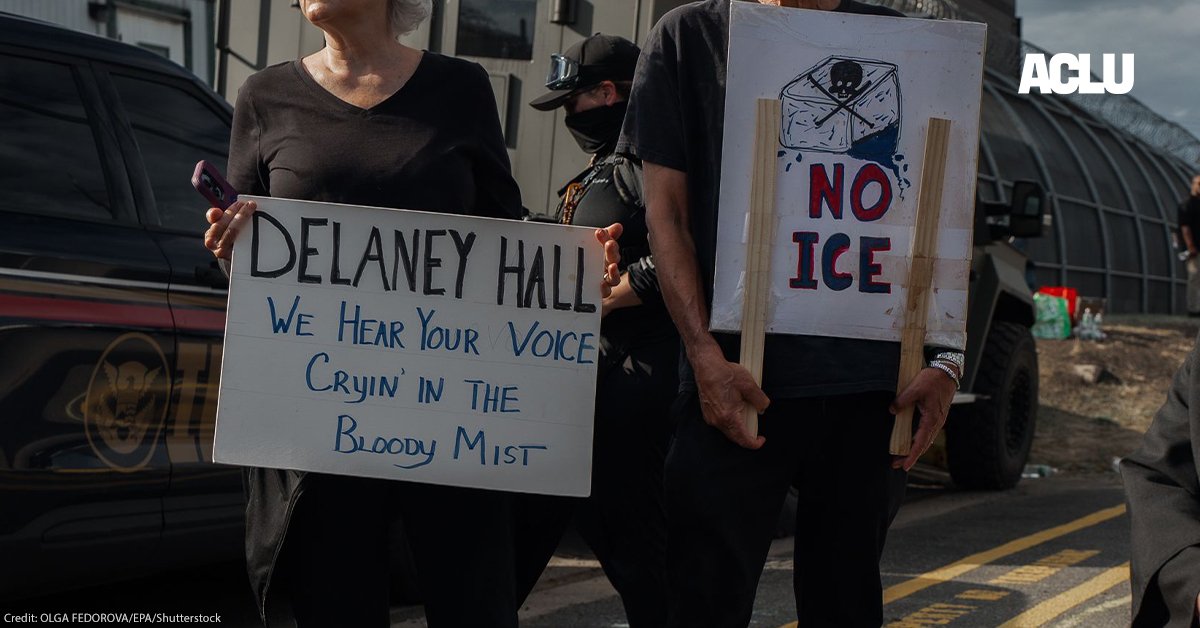
Conditions at Delaney Hall are so reprehensible and degrading that detained individuals have resorted to starving themselves to bring attention to their inhumane treatment. An open letter signed by nearly 300 people, brought light to the medical neglect, spoiled or inadequate food, and other “torturous” conditions at the facility. The hunger and labor strike at Delaney Hall has garnered support and solidarity from loved ones of detained people, community members, and elected officials who have shown up to largely peaceful protests outside of the facility.
Immigration and Customs Enforcement (ICE) agents met detained people and peaceful protestors outside the facility with violence and retaliation. ICE pepper sprayed people inside and outside the facility, used force against both detained individuals and their loved ones protesting and assaulted reporters. It retaliated against detained individuals by putting them in solitary confinement or transferring them to new detention facilities.
ICE has attempted to conceal what’s going on inside — initially denying health inspectors access, while families were blocked from seeing their loved ones through visitation. All the information coming out of the facility has been a result of a few calls from detained individuals to their attorneys of family members and what members of Congress have witnessed during oversight visits that were limited to specific sections of the facility.
Amidst this information blackout, detained individuals have said: “We feel vulnerable and, in a way, kidnapped — detained without justification — not to mention that we are being tortured physically and psychologically due to the poor food resources provided in these detention centers.”
They’ve demanded the following: the release of medically vulnerable, elderly, pregnant, and young people from detention, for immigration judges to meaningfully review their cases, for federal courts to review their habeas petitions, and for the Department of Homeland Security (DHS) to end the practice of pressuring detained people to sign voluntary departure agreements or deportation documents. Their broadest demand is freedom and the closure of the facility.
The hunger and labor strike at Delaney Hall is not an isolated incident. There are now at least five other recent or active hunger-labor strikes in immigration detention facilities across the country. A detention center in Tacoma, WA has had nine strikes in 2026. In Alvarado, TX detained individuals are also on strike. Detained people in Phillipsburg, PA and Baldwin, MI began their strike around mid-April. In Adelanto, CA, they began their strike on May 19.
These strikes across six states hold up a mirror to a detention system that is falling apart at the seams, a crisis entirely of this administration’s own making.
The Government Accountability Office (GAO) released a report on the largest detention facility in country, Camp East Montana located on the Fort Bliss military base in El Paso, Texas. The report found “significant, pervasive issues” with the Trump administration’s treatment of detained people. The ACLU and other legal groups are now representing people who are currently or formerly detained who experienced severe medical neglect and violent abuse, among other violations. The GAO report also raised concerns ranging from failure to perform health assessments of detained people within 14 days of detention to a lost loaded firearm at the facility.
At the facilities with ongoing hunger strikes, detained individuals describe strikingly similar conditions: rotten and spoiled food, denial of basic medical care, unsafe drinking water, indefinite detention without due process, and retaliation — pepper spray, solitary confinement, punitive transfers — for daring to speak up. Their demands are equally consistent. They’ve called for access to competent medical care, meaningful case review, an end to coercion to sign deportation documents, and, above all, release.
Five of the six facilities are operated by private prison corporations — four by GEO Group alone, a company that collected over $1 billion in federal payments last year and whose former executive now serves as acting director of ICE. These strikes, and the record pace of deaths in custody — 50 people dead since January 2025, — are not anomalies. They are the entirely predictable consequence of an administration that has explicitly set out to detain up to 100,000 people, that has poured billions into expanding a system already rife with abuse, and that has treated accountability and oversight as obstacles to be overcome rather than guardrails to keep people safe. A system that grows this fast, with so much money and little to no accountability, doesn’t just risk failure — it guarantees it.
Since demonstrations began outside Delaney Hall, ICE agents have hit protestors with batons and even shoved someone in the path of an oncoming vehicle. Sixty-one people were arrested on the first night of demonstrations alone.
They’ve also flooded protesters with pepper spray, including Senator Andy Kim who was attempting an oversight visit. Congressional oversight visits have been invaluable. Rep. LaMonica McIver has continued to show up despite facing federal charges stemming from a prior oversight visit to Delaney Hall. After his own visit, House Minority Leader Hakeem Jeffries said what he witnessed shocked the conscience. “This is not America,” he said. These are not secondhand accounts. They come from elected officials who went in, observed, and came back out to tell the country what they saw. That testimony has been indispensable when a key part of the administration’s strategy depends on keeping the public from seeing anything at all.
Beyond oversight visits, members of Congress must center the demands of the people inside — meaningful case review, an end to coerced deportations, release of vulnerable individuals, and basic humane conditions.
The ACLU will continue to closely monitor the needs of detained people across the country, actions of the administration and developments inside and outside Delaney Hall. The people on hunger strike inside Delaney Hall, in Michigan, California, Texas, Pennsylvania, and Washington have told us clearly and at great personal risk what they need: meaningful review of their cases, an end to being coerced into signing deportation papers, access to real medical care, and release of the elderly, the pregnant, the sick, and the vulnerable. Those are not radical demands. They are the asks of human beings who want to be treated as such. During this inflection point and indictment on a cruel system that our taxpayer dollars are actively funding, the hunger strikers have done their part. They have put their bodies on the line to make sure we cannot look away. Now is the time for the rest of us to meet that courage with action.
Read the full article here
Fact Checker
Verify the accuracy of this article using AI-powered analysis and real-time sources.