

 Freedom Index
Listen to the article
Washington D.C., April 2, 2026—Iran is now in the grip of the longest internet blackout in its history, a near-total shutdown that has stretched more than 30 days and reduced connectivity to almost zero.
Imposed amid war and unrest, the sweeping, government-imposed blackout has effectively sealed off the country, cutting journalists’ access to sources and audiences, and blocking their ability to verify even the most basic facts. After the Iran war broke out on February 28, internet connectivity dropped to about one percent of normal levels. The Iranian government has invoked “security reasons” to justify the blackout, even as human rights organizations warn that internet shutdowns jeopardize civilian physical and psychological safety, and obfuscate the documentation of rights violations.
“This war is unfolding in almost total darkness,” Hossein Yazdi, a Tehran-based reporter for Iran Times, told CPJ. “This is not like other wars where reporters can provide moment-by-moment coverage. The government allows no activity at all.”
As one of the most extensive and tightly enforced shutdowns ever recorded in the country, it points to an increasingly popular government tactic across the Middle East and North Africa: using internet blackouts to control information during moments of crisis.
From Iran to Sudan, journalists across the Middle East and North Africa have been forced to navigate internet blackouts imposed by authorities. Such shutdowns have been increasingly deployed as a tool of control to silence independent reporting and shape narratives during crises. For journalists, this means working in isolation, relying on risky workarounds such as satellite connections, encrypted messaging, or smuggled footage to continue reporting under digital siege.
Iran
Iran’s current internet blackout is not its first. During mass protests in January, a near-total disruption of connectivity lasted three weeks and hindered coverage of the alleged killings of demonstrators. Authorities also imposed restrictions during the 12-day war with Israel in June 2025.
To stay connected, journalists have described relying on improvised and often costly workarounds. Yazdi said he has attempted to connect through disabled DNS servers briefly brought online by hacker groups, purchased expensive satellite connections, and is constantly forced to switch between providers as they are blocked.
With digital access constrained, traditional forms of communication have regained importance.
“Phone calls, text messages, and face-to-face conversations between friends, colleagues, and family members have become key ways of sharing information,” said Raha Sdiq, a journalist based in Iran who publishes under a pseudonym for safety reasons.
As access shrinks, journalists say the challenge is not only publishing news, but determining what is true.
“There is no real way to verify news,” Sdiq said. “We cannot report the reality, and sometimes we cannot even understand it.”
Another Iranian journalist, who requested anonymity due to safety concerns, described an increasingly fragmented information landscape.
“We mostly follow news through domestic media under heavy censorship because they are the easiest to access,” the journalist said, adding that when the internet briefly returns, “Telegram is still the most popular [source], and people rush to follow news through its channels.”
The journalist said the blackout has widened an information gap, leaving people “more confused and less informed.”
Gaza
In Gaza, Israel has repeatedly targeted telecommunications infrastructure since the war began in October 2023, contributing to chronic communications outages that have cut journalists off from the outside world and from one another. In June 2025, a near-total blackout followed damage to a main fiber-optic route, disrupting communications across the territory.
“Thousands of stories went unreported due to the internet blackout,” Al-Kofiya TV journalist Majdi Islim, who is based in Gaza, told CPJ. Al-Kofiya is a Palestinian outlet based in Egypt.
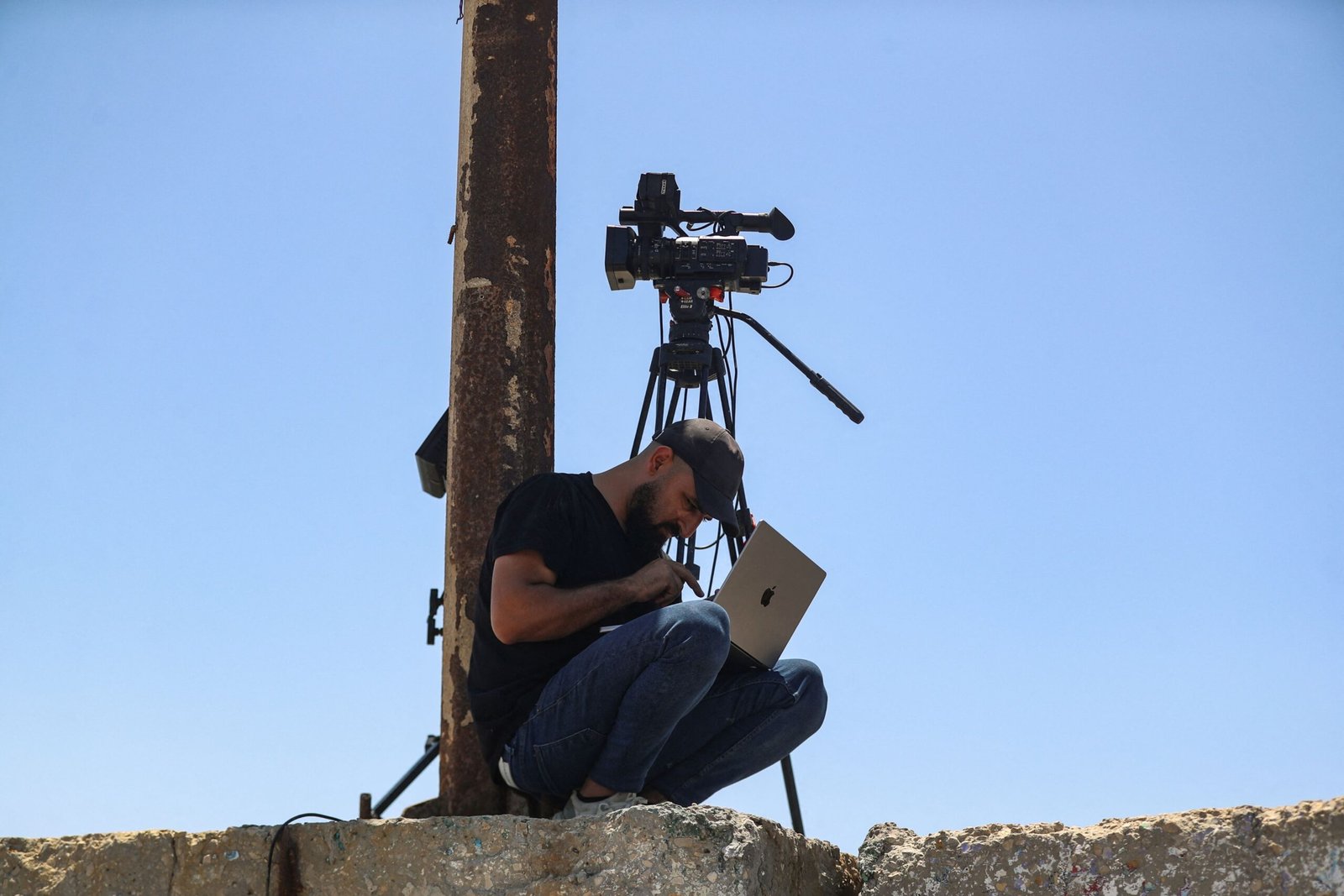
Journalists in Gaza have put their personal safety at risk to file reports. Alaa Al-Helou, who works for the London-based outlet Al-Araby Al-Jadeed, said he has traveled long distances through besieged areas to access for-pay “street internet” in order to contact colleagues and publish stories.
“The task was extremely difficult and exhausting, but it was the only option to continue reporting,” Al-Helou, who is based in Gaza, said.
Islim described climbing to the fifth floor of a building in Rafah, in southern Gaza, to try to connect to Egyptian networks while warplanes flew overhead.
“We tried to seize opportunities and sometimes risked our lives to transmit information, messages, photos, or videos,” he said.
Sudan
Similarly, since the outbreak of conflict in 2023, the Sudanese have suffered from weaponized blackouts inflicted by both the Sudanese Armed Forces and the Rapid Support Forces (RSF), as both parties have fought to control the flow of information. During an acute communication blackout in October 2025 following the RSF’s takeover of the western city of Al-Fasher, journalists struggled to verify reports that their colleagues had been abducted by the paramilitary group.
Sudanese freelance journalist Mohammad Zakaria told CPJ that when internet access through Starlink devices or by way of international organizations’ headquarters failed, journalists used low-tech, low internet bandwidth methods to disseminate information locally.
“We relied on trusted networks of acquaintances in neighborhoods and villages to transmit information verbally or through WhatsApp groups that were created,” Zakaria said. In instances of immediate danger, mosque loudspeakers were used to warn residents.
Journalists have described traveling miles and crossing dangerous checkpoints to contact sources in person or simply to upload videos.
Reflecting on the risks of reporting during an active conflict with limited modes of communication, Zakaria said: “We have no choice. Sadly, some colleagues have paid with their lives because of the lack of accurate information about safe areas.”
Read the full article here
Fact Checker
Verify the accuracy of this article using AI-powered analysis and real-time sources.