

 Freedom Index

Listen to the article
Yuma, a Digital Currency Group-backed investment company, has launched a fund that gives institutional investors diversified exposure to the Bittensor ecosystem, as asset managers expand investment products tied to decentralized AI.
According to a Thursday announcement, the Yuma Total Market Fund provides exposure to Bittensor’s native TAO token and a basket of AI-focused subnets through a single investment vehicle. The strategy is intended to simplify access to the broader Bittensor ecosystem without requiring investors to select individual subnet tokens.
The fund launched with seed capital from an undisclosed anchor investor.
Bittensor is a decentralized network that supports the development of AI infrastructure and applications through specialized subnets spanning areas such as compute, marketplaces and identity. According to Yuma, the network’s 128 subnets represent more than $900 million in combined value. However, data from network tracker Taostats shows a combined subnet value closer to $300 million.
TAO, the native token of the Bittensor ecosystem, has a market capitalization of nearly $2.4 billion. Source: CoinMarketCap
Institutional interest in the Bittensor ecosystem has grown alongside the network’s expanding subnet economy. In April, Grayscale increased TAO’s weighting in its Grayscale Decentralized AI Fund to 43% during the fund’s quarterly rebalance. TAO’s allocation has since fallen to about 20%, with Near Protocol’s NEAR now comprising the fund’s largest holding at roughly 44%.
Asset managers are also seeking to broaden investor access to TAO. Bitwise filed for a TAO Strategy ETF with the US Securities and Exchange Commission (SEC) in April, while Grayscale submitted an amended registration statement to convert its existing Bittensor Trust into a spot TAO exchange-traded fund that would list on NYSE Arca if approved.
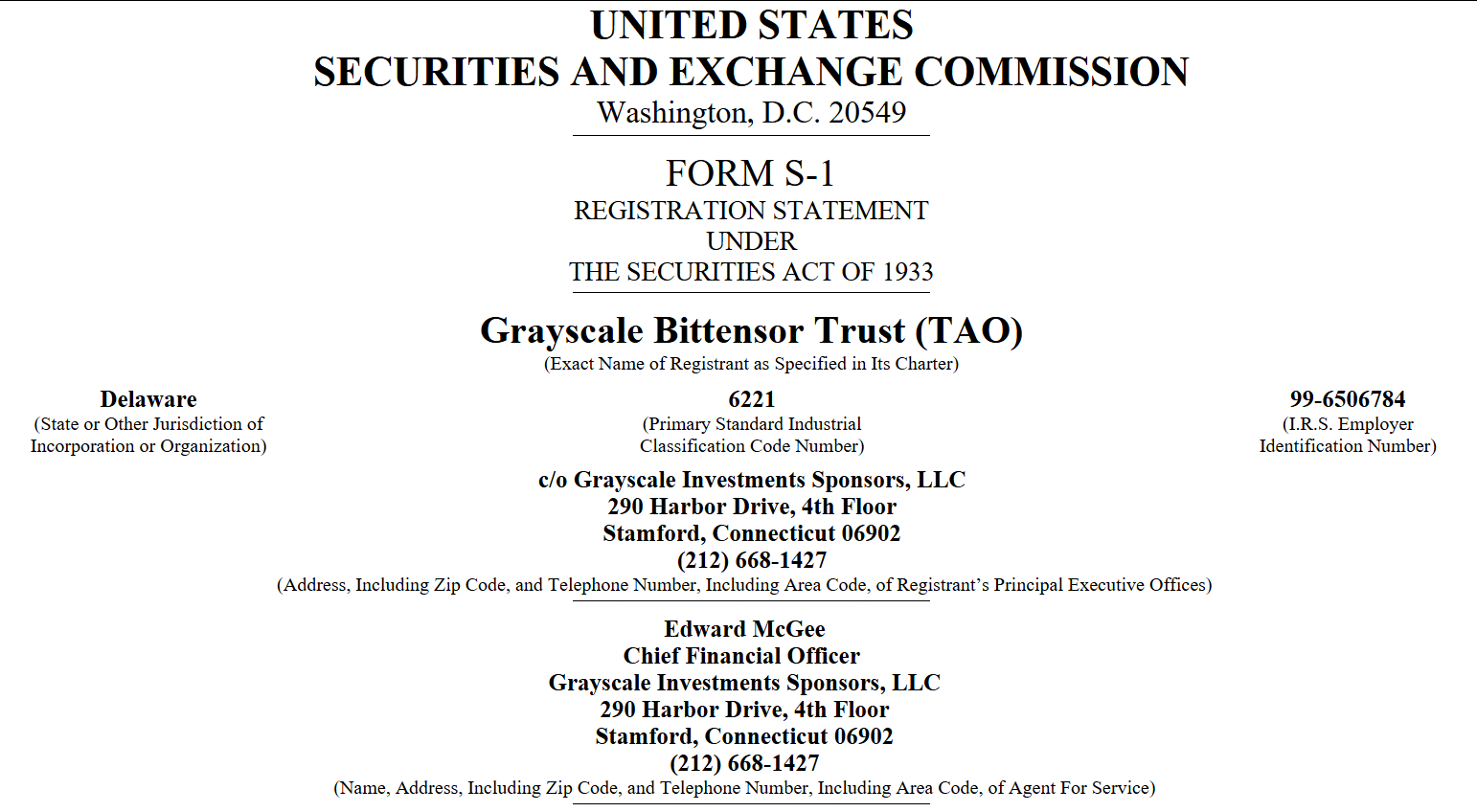
Grayscale Bittensor Trust (TAO) application with the SEC. Source: SEC
Related: Amazon warning triggered US crackdown on Anthropic AI models: Reports
Anthropic restrictions renew focus on decentralized AI
The case for decentralized AI, which distributes AI infrastructure and computing across blockchain-based networks rather than relying on a single provider, gained renewed attention after the US Commerce Department suspended public access to Anthropic’s Fable 5 and Mythos 5 models over national security and export control concerns.
At the time, Grayscale head of research Zach Pandl said the restrictions underscored the risks of relying on centralized AI providers. The government order limiting access to Anthropic’s Fable 5 and Mythos 5 “highlights the risks of centralized control of AI,” Pandl said. “We expect demand for decentralized AI, like Bittensor and its TAO token, to rise as investors seek alternatives.”
The restrictions appear to be easing. The Commerce Department restored access to Mythos 5 on Friday, and Axios reported Saturday that the Trump administration is expected to allow Anthropic to resume public access to Fable 5 as soon as next week.
Magazine: How AI just dramatically sped up the quantum risk for Bitcoin
Read the full article here
Fact Checker
Verify the accuracy of this article using AI-powered analysis and real-time sources.