

 Freedom Index
Listen to the article
New York, June 29, 2026—The Committee to Protect Journalists calls for Ugandan authorities to swiftly and unreservedly remove security forces from the premises of the privately owned Nation Media Group-Uganda (NMG-U), permit the company to operate freely, and ensure Managing Director Susan Nsibirwa can work without concern that she may be arrested or attacked.
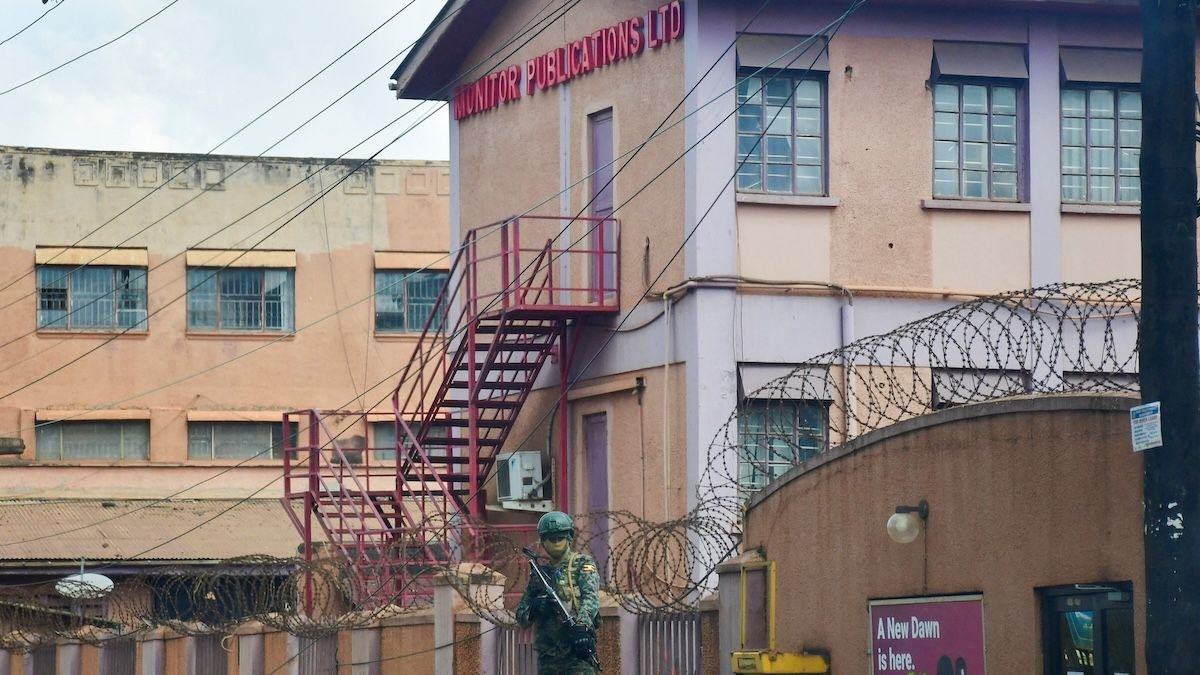
In the early hours of June 28, Ugandan security forces arrived at the NMG-U headquarters in the Namuwongo district of Kampala and its broadcast centers at the Kampala Serena International Conference Centre, blocking access and shutting down the company’s ability to print newspapers or conduct standard radio and TV broadcasts.
“Nothing much has changed,” Nsibirwa told CPJ at around 6 p.m. local time on June 29. “Our websites are active, our social media handles are active, and pretty much that’s how we’re doing our work, until the situation should change. So we’re just digital now.”
“Laying siege to the Nation Media Group in Uganda, the largest independent media house in east and central Africa, at the whim of military chief Gen. Muhoozi Kainerugaba offers yet another indication of the country’s deepening authoritarianism,” said Angela Quintal, CPJ’s Africa director.
“No military officer should be able to intimidate or silence an independent media house because he dislikes its reporting or rejects the universal right to press freedom. President Yoweri Museveni must hold his son accountable for this egregious abuse of power and ensure that the NMG and its journalists can continue to operate freely in Uganda without fear of arbitrary censorship,” said Quintal.
In a June 29 update published online, Daily Monitor, which is an NMG company, noted that in Uganda the media group also owns NTV Uganda, The East African, Spark TV, 93.3 KFM, 90.4 Dembe FM, Ennyanda newspaper, and the Nation Courier.
Nsibirwa said that the security forces detained a technical team and a driver as they took control of the TV premises and held them from around 1 a.m. local time on June 28 until around 3 p.m. that day. They were put in a car but did not seem to have been tortured or beaten, she added.
The forced closures followed posts on social media platform X on June 27 by Kainerugaba, son of Uganda’s president, announcing the shutdown of the NTV and Daily Monitor offices. Additional posts, some of which seem to have been taken down, appeared to call for Nsibirwa to be harmed and arrested. “I DO NOT believe in a free press!” read another, since-removed post, a copy of which CPJ reviewed.
“All we have are the tweets,” Nsibirwa told CPJ, describing how little had been communicated about the closures’ cause. Nsibirwa said she had gone “underground” following the threats and emphasized the arbitrariness of the government’s actions and the difficulty in finding channels to resolve the situation.
“It was achieved through one tweet. But the question is, who do you talk to?” Nsibirwa lamented. “On a normal day, you talk to UCC [the Uganda Communications Commission], you talk to the media council, you talk to the minister of ICT [Information and Communications Technology]. That’s who we fall under…but now under these circumstances, who do we talk to?”
In an X post on June 28, the UCC “noted the circumstances” that led to NMG outlets going off the air and said, “Consultations have begun with the relevant government stakeholders to obtain verified information.”
“The temperature within which we are operating, it’s always been high, but I guess right now we would say it is very high. And I think it’s being felt. I think the public sentiment, really, to this is just that things are bad,” Nsibirwa told CPJ.
Also on June 28, Andrew Mwenda, a leader of the Patriotic League of Uganda political party supporting Kainerugaba, posted on X that he and Kainerugaba had agreed to “reopen both Daily Monitor and NTV soon. However, we shall first have discussions with the management of both sister companies. I will inform them when we can have this meeting.”
In an apparent reference to Mwenda’s statement, Kainerugaba posted minutes later that “we are having discussions with our allies in the UK and Europe about re-opening both NTV and Daily Monitor. We shall take the results of these discussions to Mzee for final approval.” Mzee means elder in Swahili, which in the post appears to refer to President Museveni.
Reached by phone, Mwenda’s personal assistant told CPJ that they could not offer an update on negotiations over the shutdowns and would pass along the request for comment. As a journalist, Mwenda received CPJ’s International Press Freedom Award in 2008.
NMG is based in Kenya and operates across east and central Africa. Tanzanian businessman Rostam Aziz became the majority shareholder in early 2026.
“We have the full support of both management and board in Nairobi,” Nsibirwa said. “Right now, priorities are safety of the teams and then dialogue to work this out.”
CPJ has documented an intensifying crackdown on press freedom in Uganda, including a foreign agents law signed by Museveni in May.
CPJ’s calls to acting Uganda military spokesperson Chris Magezi and police spokesperson Rusoke Kituuma did not connect. Emails to Uganda’s Ministry of Defense and Veteran Affairs, and the national police did not receive immediate responses.
CPJ emailed questions to the UCC but received no immediate response.
Read the full article here
Fact Checker
Verify the accuracy of this article using AI-powered analysis and real-time sources.