

 Freedom Index
Listen to the article
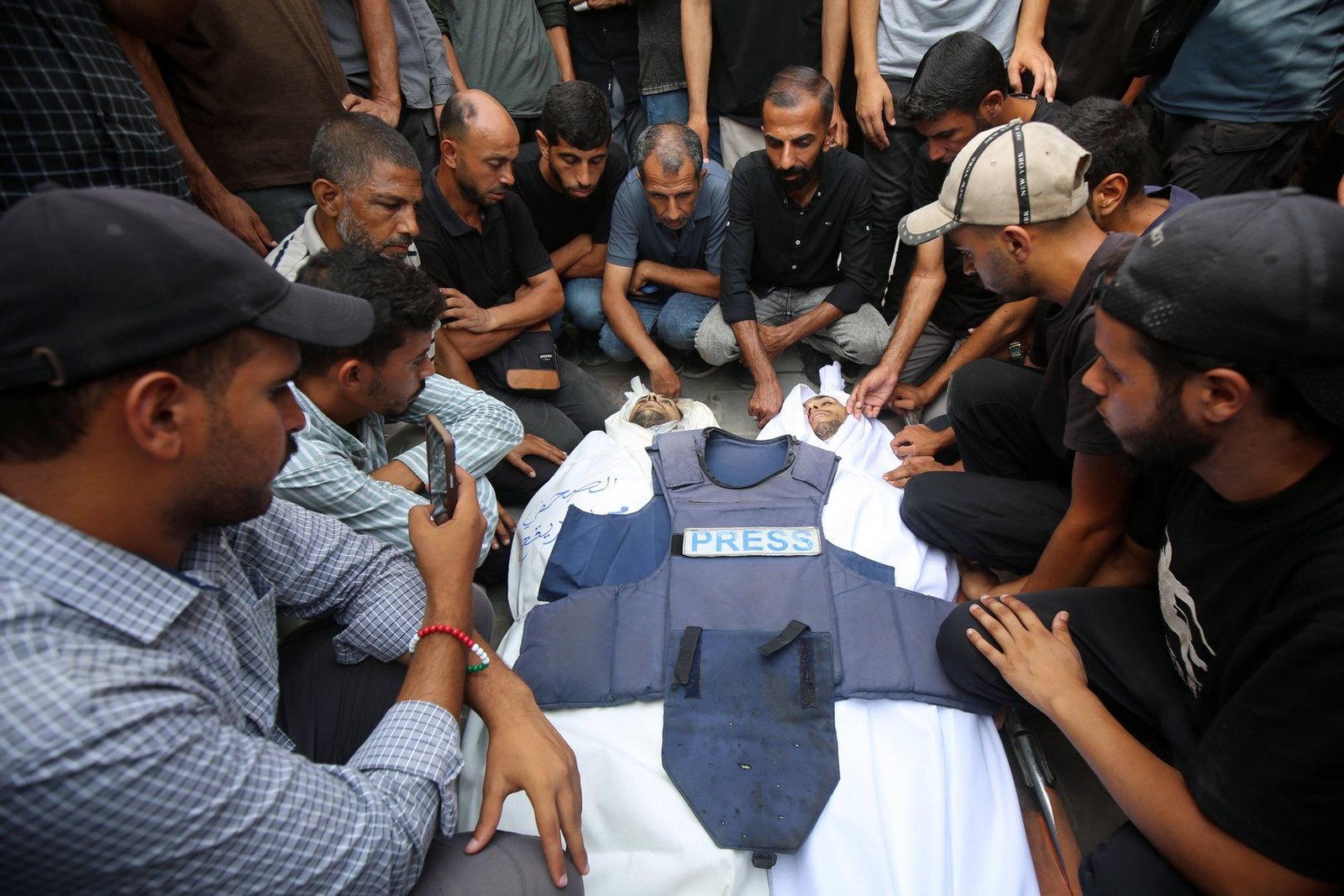
Israel’s official position is that the Israel Defense Force (IDF) never targets journalists for being journalists. The facts, however, tell a different story. Even if no kill order was issued from Prime Minister Benjamin Netanyahu down to the minister of defence, from the minister of defence to the IDF’s chief of staff, and from there all the way to the last sniper in Gaza; even if Israeli soldiers in the Gaza Strip were never explicitly ordered to eliminate every journalist they came across, the bottom line remains unambiguous. According to data from the Committee to Protect Journalists, more than 200 journalists have been killed in the Strip by IDF fire since 7 October 2023, and have continued to be targets even during the current ceasefire. In two years of hostilities, dozens more have been wounded.
The very nature of their work means that journalists reporting wars will enter dangerous areas. They may may be carrying equipment that could be misidentified as weapons; they may have direct contact with senior commanders in the enemy force at bases and command centres that constitute legitimate military targets. All that said: the unprecedented scale of killing suggests that in the case of the IDF and the current war in Gaza, there is an additional factor at play. At the least, a very itchy trigger finger.
A pivotal issue in the current conflict is Israel’s claims that many of the journalists killed in Gaza were terrorists. In some cases, the IDF has produced evidence to justify the deliberate targeting of journalists suspected of participating in terrorist activities; this, however, has not persuaded international human rights organisations reviewing the information that the IDF’s actions were lawful. But in Israel the evidence, such as it is, has been accepted as gospel truth. In any case, large segments of Israeli society see Gazan journalists as part of the enemy, in part due to their role reporting to the world what Israelis perceive as anti-Israeli bias.
Some of the journalists killed by the IDF worked for outlets such as Gaza’s Al-Aqsa channel, a media outlet affiliated with Hamas – the same terrorist organisation that carried out horrific massacres in Israeli communities bordering the Gaza Strip. Some worked for outlets that identify with Hamas and similar organisations, such as Qatar’s Al Jazeera. The others would have had ties of some form with Hamas, by virtue of its presence as the organisation that has ruled the Strip, absolutely and often brutally, for many years. While international laws of war are intended protect journalists – even if they are propaganda mouthpieces for a murderous enemy – the facts listed above suffice to mark virtually all journalists in Gaza, in the eyes of many Israelis, as legitimate targets.
But Gazan journalists are also regarded as the enemy by a growing portion of Israeli society, simply for being Gazan. The growing dehumanisation of Palestinians in the public discourse channels directly into Israeli indifference, Israeli media indifference specifically, concerning the wholesale elimination of journalists in Gaza. This perception – that Palestinians are not human beings with equal rights to Israelis – received a boost from the (entirely real) trauma of the 7 October massacres and the subsequent two-year hostage crisis. But the foundations for this perception had been laid years earlier.
The prolonged Israeli-Palestinian conflict – certainly since the occupation of the West Bank and Gaza, the expansion of the settlements, and the rise of Palestinian terrorism – has created a dilemma for Israeli society and media. For many years, Israeli society has turned a blind eye to the wrongs of the occupation, doing so with the active assistance of the media. Israelis do not want to know what is happening beyond the border; the media (with exceptions such as the left-leaning daily Haaretz) does not want to report it. The result is a well-oiled machine of propaganda on one side, and wilful ignorance on the other. When it comes to the IDF’s actions in the occupied territories, Israelis have lived for years inside an ever-tightening bubble of justification and ignorance.
On 7 October 2023, the bubble burst. Israelis could no longer ignore what was happening beyond their border, because the violence had penetrated deep into the sovereign state of Israel. But the same mechanisms that had long shielded Israelis from acknowledging what was happening around them swiftly responded, unleashing a relentless flood of patriotism and victim narratives. At the same time, the bubble constricted further, preventing information about the war crimes being committed by the IDF penetrating the public consciousness. In this regard, the mass killing of journalists in Gaza is just one more war crime that has gone unacknowledged in Israel.
As with every act of violence Israel has carried out against Palestinians in Gaza, the treatment of journalists did not stop at the Strip’s borders. The first victims were foreign journalists. Foreign media correspondents are commonly perceived in Israel as hostile, as useful idiots in the service of Hamas propaganda, and sometimes as outright antisemites. The foreign press corps has been barred from entering Gaza since the start of the war on security grounds – a pretext that has long since lost any credibility. They are still free to report from the West Bank, but at the risk of confrontation with IDF forces and settlers who sometimes view them as part of the enemy’s combat apparatus.
Recently, there have been increasing documented cases in which settlers and soldiers stationed in the territories operate in full coordination, including in targeting journalists. When a CNN crew was violently detained, the story made international headlines and led to an unusual condemnation by the Chief of Staff. But such conduct, and far worse, goes without any response when the journalists come from lower-profile outlets.
That the government has promulgated legislation empowering the communications minister to disrupt broadcasts by foreign channels that are deemed to “harm state security” only underscores the target painted on their backs.
At the same time, Palestinian citizens of Israel who dare to stand in the street and report in Arabic on events inside Israel have come under attack. Once Palestinians in general, and journalists in particular, had been designated legitimate targets by the authorities, it was the turn of Jewish Israeli civilians – vigilantes – to attack Arab journalists, repeatedly driving them from broadcast positions and preventing them from doing their jobs. Whether reporting for Al Jazeera or for the Arabic-language channel of the Israeli Broadcasting Corporation, Arab journalists were exposed to attacks. Arabic-speaking journalists on friendly terms with their Jewish colleagues have taken to sticking close to them when on assignment, in order to benefit from some degree of protection.
Next came the turn of the Israeli Jewish journalists who refused to submit to the prime minister’s absolute authority. First were journalists at Haaretz, subjected to smear campaigns and boycotts by the government and its propaganda apparatus. Then it was the turn of critical correspondents at major outlets, who found themselves needing security escorts for fear of attack by thugs tacitly sanctioned by the state. The most glaring case was that of Guy Peleg, the legal correspondent of Channel 12 News, after he reported the abuse of Palestinian detainees by reserve soldiers at the IDF’s Sde Teiman detention facility.
The Israeli public, incited by Netanyahu’s propaganda machine, regarded the suspected soldiers as the victims of the story and cast the journalist in the role of collaborator with the real enemy – the ‘Deep State.’ The public raged and demanded justice, not from those suspected of assaulting the detainee, but from those who leaked the footage to Paleg. After the detainee was transferred to Gaza as part of one of the deals with Hamas, military prosecutors were forced to drop the charges against the soldiers. The military advocate general, by contrast, is still facing charges over the leak, while Paleg is regarded by many circles in Israel as someone who published a false blood libel.
As someone who has been writing critically about the government and its media arms for twenty years, I am well aware of the privilege that my Jewish identity affords me. At the same time, I am keenly aware of the rapid erosion of that privilege in recent years. The presumption that Palestinian citizens of Israel are a fifth column is increasingly spilling over toward left-wing Israeli Jews who dare oppose government policy.
Netanyahu, like every authoritarian leader, is not satisfied with the propaganda channels that sing his praises. He wants all the media to join the chorus. Channel 12 News is considered Israel’s most influential television news outlet, giving airtime to both critical commentators and pro-Netanyahu mouthpieces. But it is no longer considered a legitimate media outlet in the eyes of the government. Netanyahu’s sycophants call it “Al Jazeera 12”, making it clear that they see no meaningful difference between it and a channel that serves the enemy.
In January 2023, the Netanyahu government announced a “judicial reform” that in practice, amounted to a constitutional coup. After a long struggle ending with the executive branch establishing its dominion over the legislature, the government now sought to subjugate the judiciary as well – to strip the Supreme Court of the ability to strike down laws, and to seize control of the judicial appointments mechanism with the goal of packing the courts with yes-men.
The major broadcast outlets quickly understood that they were next in line. Their newsrooms suddenly discovered some residual professional backbone, and for several months reported on the government’s moves incisively and critically. But that approach evaporated on October 7 of that same year and has not returned. This is in part because of the prolonged war, which changes shape every few months while its end remains nowhere in sight.
For the violent and increasingly lethal treatment of Palestinian and Jewish journalists to end, mainstream Israeli media must first return to those months in 2023 when it fulfilled its role of holding Netanyahu’s government to account, sounding the alarm about the erosion of what remains of democracy in this country. Only then might it become possible to envision a reality in which the lives of journalists are not forfeit, even if they were born Palestinian or, God forbid, left-wing.
Read the full article here
Fact Checker
Verify the accuracy of this article using AI-powered analysis and real-time sources.