Close Menu
FSNN | Free Speech News NetworkFSNN | Free Speech News Network
  • Home
  • News
    • Politics
    • Legal & Courts
    • Tech & Big Tech
    • Campus & Education
    • Media & Culture
    • Global Free Speech
  • Opinions
    • Debates
  • Video/Live
  • Community
  • Freedom Index
  • About
    • Mission
    • Contact
    • Support
Trending

A Polymarket-linked bet on the weather in France forecasts a major data issue

11 minutes ago

Spain Leads EURC Stablecoin Adoption Across Europe: Brighty

12 minutes ago

Gemini Gains Key CFTC Approval to Expand Prediction Market, Perps Offerings

14 minutes ago
Facebook X (Twitter) Instagram
Facebook X (Twitter) Discord Telegram
FSNN | Free Speech News NetworkFSNN | Free Speech News Network
Market Data Newsletter
Thursday, April 30
  • Home
  • News
    • Politics
    • Legal & Courts
    • Tech & Big Tech
    • Campus & Education
    • Media & Culture
    • Global Free Speech
  • Opinions
    • Debates
  • Video/Live
  • Community
  • Freedom Index
  • About
    • Mission
    • Contact
    • Support
FSNN | Free Speech News NetworkFSNN | Free Speech News Network
Home»News»Global Free Speech»Journalists gather to issue a public statement addressing increasing pressure on the press in Turkey, highlighting arrests, detentions, and legal actions targeting reporters. Photo: ZUMA Press, Inc./Alamy Live News Turkey is slipping fast down the Reporters without Borders (RSF) ‘s World Press Freedom Index. The country is now ranked 159th out of 180. As I write these lines from exile there are 31 Turkish journalists behind bars. But while some journalists languish in prison, many more, like me, have been forced to leave the country. Their destinations range from Greece and Switzerland to other European countries, as well as neighbouring regions such as Armenia and the Kurdistan Region of Iraq. Three journalists shared their experience with Index for World Press Freedom Day. Baransel Ağca, 36, has worked as a journalist for a decade, including as an editor for İleri Haber, 16 Punto and Dokuz8Haber. He faces 15 separate cases against him and has already received a prison sentence of nearly three years in one concluded trial. Explaining the background to his exile, Ağca said: “In 2020, I began publishing investigative reports on suspicious deaths and financial activities linked to the government on my X account. Within a year, I was detained multiple times and received threats. As my safety and freedom were at risk, I came to Germany at the end of 2021.” Now living in Berlin under refugee status, Ağca survives on state support. “I haven’t practised journalism for three years,” explained Ağca: “I’m trying to build a life here, and I have no opportunity to continue journalism. I don’t think I even want to anymore. I have a work permit, but working is actually a disadvantage for refugees like me. Since I can’t work as a journalist, any income I earn as an unskilled worker would lead to losing my housing support.” Reflecting on exile, Ağca told Index: “Above all, being away from my loved ones is the hardest part. I miss my country. Two months ago, I lost my mother and couldn’t even attend her funeral. I struggle to hold on, to build a life and to integrate – because I don’t want to live here. But I can’t return to my country either.”  If his cases are resolved in his favour, he hopes to return to Turkey. Systematic repression in Turkey has disproportionately targeted Kurdish journalists. One of them, Beritan Canözer, 31, encountered this reality at the very beginning of her career in 2013. She has worked exclusively for Kurdish women’s news agencies, including JINHA, Gazete Şujin and JINNEWS. She was arrested in Diyarbakır in 2015 and again in 2023, spending a total of seven months in prison. Her reporting has been criminalised, resulting in 13 separate cases on charges such as “terrorist propaganda” and “membership of a terrorist organisation”. She currently faces up to 10 years in prison in four ongoing appeals, while two other cases have already resulted in confirmed sentences totalling five years. After arrest warrants were issued following these rulings, Canözer left Turkey via irregular routes to Greece in November 2024 before applying for asylum in Belgium. Asked whether she could continue her profession in exile, Canözer told Index: “I try to create opportunities to stay connected to journalism, but I still don’t have a work permit. This makes life very difficult, both financially and psychologically.” She described starting over in exile as deeply challenging: “The hardest part is being away from field reporting. At the same time, my asylum process is exhausting. The procedures move very slowly, and as time passes, conditions become more difficult. Even going to the hospital when I’m sick can turn into chaos.” She attended her first asylum interview in September and has been waiting for a response for seven months. “How long will this uncertainty last?” I ask. “No one knows,” she says. “It varies. Some people have been waiting for three years.” From Belgium I turned again to Germany to speak with Arif Aslan about the hardship of exile. Aslan, 35, has worked as a journalist for 15 years, including roles at Dicle News Agency, Van TV and, between 2018 and 2025, VOA Kurdish Service. He was arrested in 2017 while covering a story, spending around eight months in prison. In a separate case related to social media posts in 2016, he received a prison sentence of one year and three months on charges of “terrorist propaganda”. After the sentence was upheld, he was arrested again in February 2025 and spent 35 days in prison before being conditionally released. Shortly after his release, a new investigation was launched against him on similar grounds. Describing what happened next, Aslan said: “When I came to Germany for a job interview, a new investigation was opened in May 2025 and police raided my home. Due to a confidentiality order, I still don’t know exactly what I’m being accused of.” Aslan has been living in exile since April 2025 and is currently staying in a refugee camp in eastern Germany. “Conditions in the camp are very poor – crowded and lacking hygiene,” he said. “These conditions make it impossible to continue my profession. I feel as though I’m being punished a second time. Six of us share a container, and it resembles a prison.” Forced to leave his wife and three children behind in Van, Aslan describes the emotional toll: “One of the greatest difficulties is being separated from my family. They are still in Turkey. I will be able to apply for family reunification once I obtain residency, but there’s no clarity on how long that will take. This is especially traumatic for the children.” From censorship to imprisonment, these pressures are clearly reshaping the lives of journalists – often far beyond Turkey’s borders. This raises a final question: Who will heal the wounds of journalists forced into exile? READ MORE
Global Free Speech

Journalists gather to issue a public statement addressing increasing pressure on the press in Turkey, highlighting arrests, detentions, and legal actions targeting reporters. Photo: ZUMA Press, Inc./Alamy Live News Turkey is slipping fast down the Reporters without Borders (RSF) ‘s World Press Freedom Index. The country is now ranked 159th out of 180. As I write these lines from exile there are 31 Turkish journalists behind bars. But while some journalists languish in prison, many more, like me, have been forced to leave the country. Their destinations range from Greece and Switzerland to other European countries, as well as neighbouring regions such as Armenia and the Kurdistan Region of Iraq. Three journalists shared their experience with Index for World Press Freedom Day. Baransel Ağca, 36, has worked as a journalist for a decade, including as an editor for İleri Haber, 16 Punto and Dokuz8Haber. He faces 15 separate cases against him and has already received a prison sentence of nearly three years in one concluded trial. Explaining the background to his exile, Ağca said: “In 2020, I began publishing investigative reports on suspicious deaths and financial activities linked to the government on my X account. Within a year, I was detained multiple times and received threats. As my safety and freedom were at risk, I came to Germany at the end of 2021.” Now living in Berlin under refugee status, Ağca survives on state support. “I haven’t practised journalism for three years,” explained Ağca: “I’m trying to build a life here, and I have no opportunity to continue journalism. I don’t think I even want to anymore. I have a work permit, but working is actually a disadvantage for refugees like me. Since I can’t work as a journalist, any income I earn as an unskilled worker would lead to losing my housing support.” Reflecting on exile, Ağca told Index: “Above all, being away from my loved ones is the hardest part. I miss my country. Two months ago, I lost my mother and couldn’t even attend her funeral. I struggle to hold on, to build a life and to integrate – because I don’t want to live here. But I can’t return to my country either.”  If his cases are resolved in his favour, he hopes to return to Turkey. Systematic repression in Turkey has disproportionately targeted Kurdish journalists. One of them, Beritan Canözer, 31, encountered this reality at the very beginning of her career in 2013. She has worked exclusively for Kurdish women’s news agencies, including JINHA, Gazete Şujin and JINNEWS. She was arrested in Diyarbakır in 2015 and again in 2023, spending a total of seven months in prison. Her reporting has been criminalised, resulting in 13 separate cases on charges such as “terrorist propaganda” and “membership of a terrorist organisation”. She currently faces up to 10 years in prison in four ongoing appeals, while two other cases have already resulted in confirmed sentences totalling five years. After arrest warrants were issued following these rulings, Canözer left Turkey via irregular routes to Greece in November 2024 before applying for asylum in Belgium. Asked whether she could continue her profession in exile, Canözer told Index: “I try to create opportunities to stay connected to journalism, but I still don’t have a work permit. This makes life very difficult, both financially and psychologically.” She described starting over in exile as deeply challenging: “The hardest part is being away from field reporting. At the same time, my asylum process is exhausting. The procedures move very slowly, and as time passes, conditions become more difficult. Even going to the hospital when I’m sick can turn into chaos.” She attended her first asylum interview in September and has been waiting for a response for seven months. “How long will this uncertainty last?” I ask. “No one knows,” she says. “It varies. Some people have been waiting for three years.” From Belgium I turned again to Germany to speak with Arif Aslan about the hardship of exile. Aslan, 35, has worked as a journalist for 15 years, including roles at Dicle News Agency, Van TV and, between 2018 and 2025, VOA Kurdish Service. He was arrested in 2017 while covering a story, spending around eight months in prison. In a separate case related to social media posts in 2016, he received a prison sentence of one year and three months on charges of “terrorist propaganda”. After the sentence was upheld, he was arrested again in February 2025 and spent 35 days in prison before being conditionally released. Shortly after his release, a new investigation was launched against him on similar grounds. Describing what happened next, Aslan said: “When I came to Germany for a job interview, a new investigation was opened in May 2025 and police raided my home. Due to a confidentiality order, I still don’t know exactly what I’m being accused of.” Aslan has been living in exile since April 2025 and is currently staying in a refugee camp in eastern Germany. “Conditions in the camp are very poor – crowded and lacking hygiene,” he said. “These conditions make it impossible to continue my profession. I feel as though I’m being punished a second time. Six of us share a container, and it resembles a prison.” Forced to leave his wife and three children behind in Van, Aslan describes the emotional toll: “One of the greatest difficulties is being separated from my family. They are still in Turkey. I will be able to apply for family reunification once I obtain residency, but there’s no clarity on how long that will take. This is especially traumatic for the children.” From censorship to imprisonment, these pressures are clearly reshaping the lives of journalists – often far beyond Turkey’s borders. This raises a final question: Who will heal the wounds of journalists forced into exile? READ MORE

News RoomBy News Room2 hours agoNo Comments5 Mins Read548 Views
Share Facebook Twitter Pinterest Copy Link LinkedIn Tumblr Email VKontakte Telegram
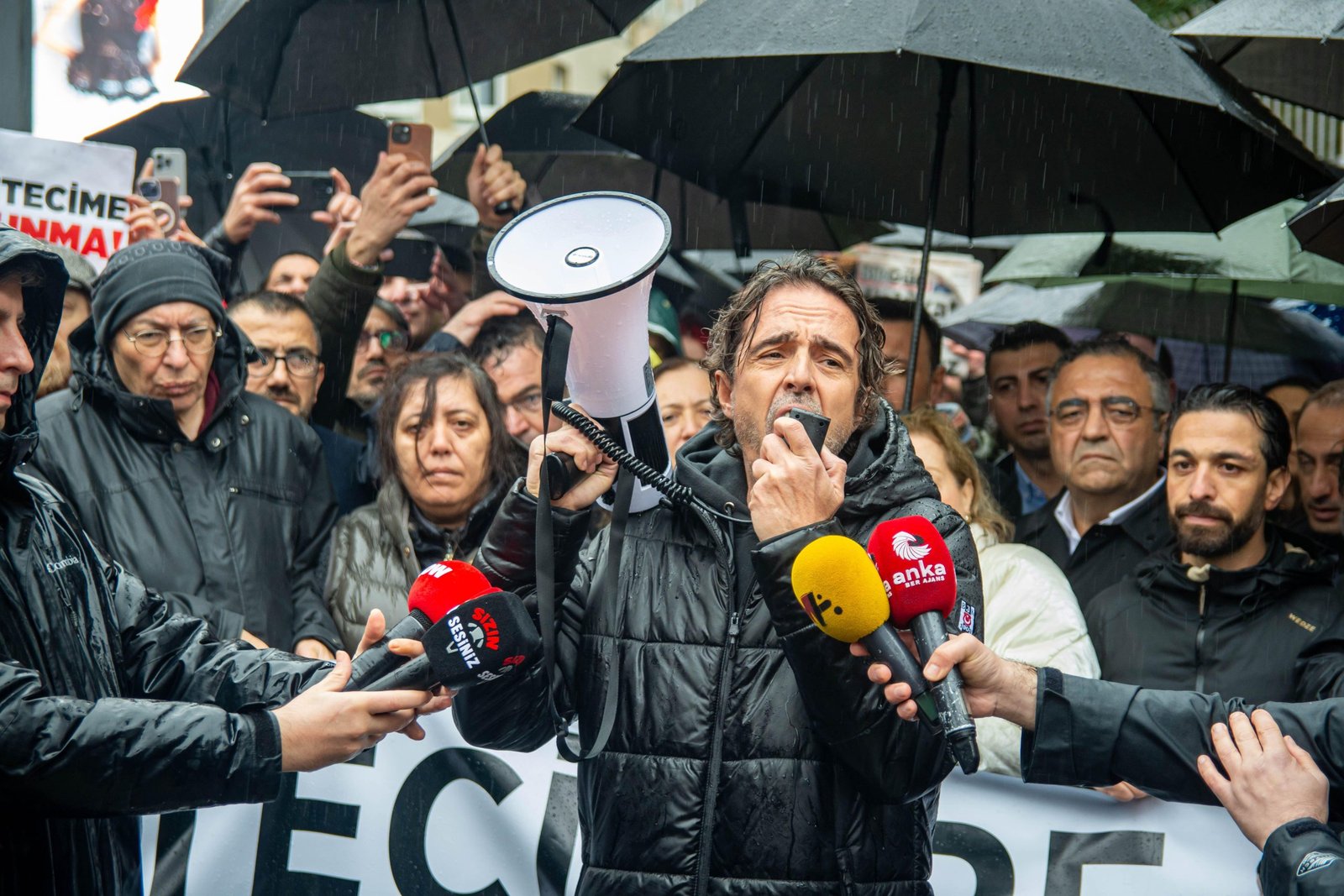
Journalists gather to issue a public statement addressing increasing pressure on the press in Turkey, highlighting arrests, detentions, and legal actions targeting reporters. Photo: ZUMA Press, Inc./Alamy Live News


				Turkey is slipping fast down the Reporters without Borders (RSF) ‘s World Press Freedom Index. The country is now ranked 159th out of 180. As I write these lines from exile there are 31 Turkish journalists behind bars.
But while some journalists languish in prison, many more, like me, have been forced to leave the country. Their destinations range from Greece and Switzerland to other European countries, as well as neighbouring regions such as Armenia and the Kurdistan Region of Iraq.
Three journalists shared their experience with Index for World Press Freedom Day.
Baransel Ağca, 36, has worked as a journalist for a decade, including as an editor for İleri Haber, 16 Punto and Dokuz8Haber. He faces 15 separate cases against him and has already received a prison sentence of nearly three years in one concluded trial.
Explaining the background to his exile, Ağca said: “In 2020, I began publishing investigative reports on suspicious deaths and financial activities linked to the government on my X account. Within a year, I was detained multiple times and received threats. As my safety and freedom were at risk, I came to Germany at the end of 2021.”
Now living in Berlin under refugee status, Ağca survives on state support. “I haven’t practised journalism for three years,” explained Ağca: “I’m trying to build a life here, and I have no opportunity to continue journalism. I don’t think I even want to anymore. I have a work permit, but working is actually a disadvantage for refugees like me. Since I can’t work as a journalist, any income I earn as an unskilled worker would lead to losing my housing support.”
Reflecting on exile, Ağca told Index: “Above all, being away from my loved ones is the hardest part. I miss my country. Two months ago, I lost my mother and couldn’t even attend her funeral. I struggle to hold on, to build a life and to integrate – because I don’t want to live here. But I can’t return to my country either.”  If his cases are resolved in his favour, he hopes to return to Turkey.
Systematic repression in Turkey has disproportionately targeted Kurdish journalists. One of them, Beritan Canözer, 31, encountered this reality at the very beginning of her career in 2013. She has worked exclusively for Kurdish women’s news agencies, including JINHA, Gazete Şujin and JINNEWS.
She was arrested in Diyarbakır in 2015 and again in 2023, spending a total of seven months in prison. Her reporting has been criminalised, resulting in 13 separate cases on charges such as “terrorist propaganda” and “membership of a terrorist organisation”. She currently faces up to 10 years in prison in four ongoing appeals, while two other cases have already resulted in confirmed sentences totalling five years.
After arrest warrants were issued following these rulings, Canözer left Turkey via irregular routes to Greece in November 2024 before applying for asylum in Belgium.
Asked whether she could continue her profession in exile, Canözer told Index: “I try to create opportunities to stay connected to journalism, but I still don’t have a work permit. This makes life very difficult, both financially and psychologically.”
She described starting over in exile as deeply challenging: “The hardest part is being away from field reporting. At the same time, my asylum process is exhausting. The procedures move very slowly, and as time passes, conditions become more difficult. Even going to the hospital when I’m sick can turn into chaos.”
She attended her first asylum interview in September and has been waiting for a response for seven months. “How long will this uncertainty last?” I ask. “No one knows,” she says. “It varies. Some people have been waiting for three years.”
From Belgium I turned again to Germany to speak with Arif Aslan about the hardship of exile. Aslan, 35, has worked as a journalist for 15 years, including roles at Dicle News Agency, Van TV and, between 2018 and 2025, VOA Kurdish Service.
He was arrested in 2017 while covering a story, spending around eight months in prison. In a separate case related to social media posts in 2016, he received a prison sentence of one year and three months on charges of “terrorist propaganda”. After the sentence was upheld, he was arrested again in February 2025 and spent 35 days in prison before being conditionally released. Shortly after his release, a new investigation was launched against him on similar grounds.
Describing what happened next, Aslan said: “When I came to Germany for a job interview, a new investigation was opened in May 2025 and police raided my home. Due to a confidentiality order, I still don’t know exactly what I’m being accused of.”
Aslan has been living in exile since April 2025 and is currently staying in a refugee camp in eastern Germany. “Conditions in the camp are very poor – crowded and lacking hygiene,” he said. “These conditions make it impossible to continue my profession. I feel as though I’m being punished a second time. Six of us share a container, and it resembles a prison.”
Forced to leave his wife and three children behind in Van, Aslan describes the emotional toll: “One of the greatest difficulties is being separated from my family. They are still in Turkey. I will be able to apply for family reunification once I obtain residency, but there’s no clarity on how long that will take. This is especially traumatic for the children.”
From censorship to imprisonment, these pressures are clearly reshaping the lives of journalists – often far beyond Turkey’s borders.
This raises a final question: Who will heal the wounds of journalists forced into exile?


				READ MORE
Share
Facebook Twitter Pinterest Email Copy Link

Listen to the article

0:00
0:00

Key Takeaways

Playback Speed

Select a Voice

Turkey is slipping fast down the Reporters without Borders (RSF) ‘s World Press Freedom Index. The country is now ranked 159th out of 180. As I write these lines from exile there are 31 Turkish journalists behind bars.

But while some journalists languish in prison, many more, like me, have been forced to leave the country. Their destinations range from Greece and Switzerland to other European countries, as well as neighbouring regions such as Armenia and the Kurdistan Region of Iraq.

Three journalists shared their experience with Index for World Press Freedom Day.

Baransel Ağca, 36, has worked as a journalist for a decade, including as an editor for İleri Haber, 16 Punto and Dokuz8Haber. He faces 15 separate cases against him and has already received a prison sentence of nearly three years in one concluded trial.

Explaining the background to his exile, Ağca said: “In 2020, I began publishing investigative reports on suspicious deaths and financial activities linked to the government on my X account. Within a year, I was detained multiple times and received threats. As my safety and freedom were at risk, I came to Germany at the end of 2021.”

Now living in Berlin under refugee status, Ağca survives on state support. “I haven’t practised journalism for three years,” explained Ağca: “I’m trying to build a life here, and I have no opportunity to continue journalism. I don’t think I even want to anymore. I have a work permit, but working is actually a disadvantage for refugees like me. Since I can’t work as a journalist, any income I earn as an unskilled worker would lead to losing my housing support.”

Reflecting on exile, Ağca told Index: “Above all, being away from my loved ones is the hardest part. I miss my country. Two months ago, I lost my mother and couldn’t even attend her funeral. I struggle to hold on, to build a life and to integrate – because I don’t want to live here. But I can’t return to my country either.”  If his cases are resolved in his favour, he hopes to return to Turkey.

Systematic repression in Turkey has disproportionately targeted Kurdish journalists. One of them, Beritan Canözer, 31, encountered this reality at the very beginning of her career in 2013. She has worked exclusively for Kurdish women’s news agencies, including JINHA, Gazete Şujin and JINNEWS.

She was arrested in Diyarbakır in 2015 and again in 2023, spending a total of seven months in prison. Her reporting has been criminalised, resulting in 13 separate cases on charges such as “terrorist propaganda” and “membership of a terrorist organisation”. She currently faces up to 10 years in prison in four ongoing appeals, while two other cases have already resulted in confirmed sentences totalling five years.

After arrest warrants were issued following these rulings, Canözer left Turkey via irregular routes to Greece in November 2024 before applying for asylum in Belgium.

Asked whether she could continue her profession in exile, Canözer told Index: “I try to create opportunities to stay connected to journalism, but I still don’t have a work permit. This makes life very difficult, both financially and psychologically.”

She described starting over in exile as deeply challenging: “The hardest part is being away from field reporting. At the same time, my asylum process is exhausting. The procedures move very slowly, and as time passes, conditions become more difficult. Even going to the hospital when I’m sick can turn into chaos.”

She attended her first asylum interview in September and has been waiting for a response for seven months. “How long will this uncertainty last?” I ask. “No one knows,” she says. “It varies. Some people have been waiting for three years.”

From Belgium I turned again to Germany to speak with Arif Aslan about the hardship of exile. Aslan, 35, has worked as a journalist for 15 years, including roles at Dicle News Agency, Van TV and, between 2018 and 2025, VOA Kurdish Service.

He was arrested in 2017 while covering a story, spending around eight months in prison. In a separate case related to social media posts in 2016, he received a prison sentence of one year and three months on charges of “terrorist propaganda”. After the sentence was upheld, he was arrested again in February 2025 and spent 35 days in prison before being conditionally released. Shortly after his release, a new investigation was launched against him on similar grounds.

Describing what happened next, Aslan said: “When I came to Germany for a job interview, a new investigation was opened in May 2025 and police raided my home. Due to a confidentiality order, I still don’t know exactly what I’m being accused of.”

Aslan has been living in exile since April 2025 and is currently staying in a refugee camp in eastern Germany. “Conditions in the camp are very poor – crowded and lacking hygiene,” he said. “These conditions make it impossible to continue my profession. I feel as though I’m being punished a second time. Six of us share a container, and it resembles a prison.”

Forced to leave his wife and three children behind in Van, Aslan describes the emotional toll: “One of the greatest difficulties is being separated from my family. They are still in Turkey. I will be able to apply for family reunification once I obtain residency, but there’s no clarity on how long that will take. This is especially traumatic for the children.”

From censorship to imprisonment, these pressures are clearly reshaping the lives of journalists – often far beyond Turkey’s borders.

This raises a final question: Who will heal the wounds of journalists forced into exile?

Read the full article here

Fact Checker

Verify the accuracy of this article using AI-powered analysis and real-time sources.

Get Your Fact Check Report

Enter your email to receive detailed fact-checking analysis

5 free reports remaining

Continue with Full Access

You've used your 5 free reports. Sign up for unlimited access!

Already have an account? Sign in here

Share. Facebook Twitter Pinterest LinkedIn Tumblr Email Telegram Copy Link
News Room
  • Website
  • Facebook
  • X (Twitter)
  • Instagram
  • LinkedIn

The FSNN News Room is the voice of our in-house journalists, editors, and researchers. We deliver timely, unbiased reporting at the crossroads of finance, cryptocurrency, and global politics, providing clear, fact-driven analysis free from agendas.

Related Articles

Global Free Speech

Mourners carry the body of Al Jazeera correspondent Anas al-Sharif, who was killed alongside other journalists in an overnight Israeli strike on their tent in Gaza City, during his funeral in Gaza City on 11 August 2025. Photo: IMAGO/Omar Ashtawy apaimages/Alamy Israel’s official position is that the Israel Defense Force (IDF) never targets journalists for being journalists. The facts, however, tell a different story. Even if no kill order was issued from Prime Minister Benjamin Netanyahu down to the minister of defence, from the minister of defence to the IDF’s chief of staff, and from there all the way to the last sniper in Gaza; even if Israeli soldiers in the Gaza Strip were never explicitly ordered to eliminate every journalist they came across, the bottom line remains unambiguous. According to data from the Committee to Protect Journalists, more than 200 journalists have been killed in the Strip by IDF fire since 7 October 2023, and have continued to be targets even during the current ceasefire. In two years of hostilities, dozens more have been wounded. The very nature of their work means that journalists reporting wars will enter dangerous areas. They may may be carrying equipment that could be misidentified as weapons; they may have direct contact with senior commanders in the enemy force at bases and command centres that constitute legitimate military targets. All that said: the unprecedented scale of killing suggests that in the case of the IDF and the current war in Gaza, there is an additional factor at play. At the least, a very itchy trigger finger. A pivotal issue in the current conflict is Israel’s claims that many of the journalists killed in Gaza were terrorists. In some cases, the IDF has produced evidence to justify the deliberate targeting of journalists suspected of participating in terrorist activities; this, however, has not persuaded international human rights organisations reviewing the information that the IDF’s actions were lawful. But in Israel the evidence, such as it is, has been accepted as gospel truth. In any case, large segments of Israeli society see Gazan journalists as part of the enemy, in part due to their role reporting to the world what Israelis perceive as anti-Israeli bias. Some of the journalists killed by the IDF worked for outlets such as Gaza’s Al-Aqsa channel, a media outlet affiliated with Hamas – the same terrorist organisation that carried out horrific massacres in Israeli communities bordering the Gaza Strip. Some worked for outlets that identify with Hamas and similar organisations, such as Qatar’s Al Jazeera. The others would have had ties of some form with Hamas, by virtue of its presence as the organisation that has ruled the Strip, absolutely and often brutally, for many years. While international laws of war are intended protect journalists – even if they are propaganda mouthpieces for a murderous enemy – the facts listed above suffice to mark virtually all journalists in Gaza, in the eyes of many Israelis, as legitimate targets. But Gazan journalists are also regarded as the enemy by a growing portion of Israeli society, simply for being Gazan. The growing dehumanisation of Palestinians in the public discourse channels directly into Israeli indifference, Israeli media indifference specifically, concerning the wholesale elimination of journalists in Gaza. This perception – that Palestinians are not human beings with equal rights to Israelis – received a boost from the (entirely real) trauma of the 7 October massacres and the subsequent two-year hostage crisis. But the foundations for this perception had been laid years earlier. The prolonged Israeli-Palestinian conflict – certainly since the occupation of the West Bank and Gaza, the expansion of the settlements, and the rise of Palestinian terrorism – has created a dilemma for Israeli society and media. For many years, Israeli society has turned a blind eye to the wrongs of the occupation, doing so with the active assistance of the media. Israelis do not want to know what is happening beyond the border; the media (with exceptions such as the left-leaning daily Haaretz) does not want to report it. The result is a well-oiled machine of propaganda on one side, and wilful ignorance on the other. When it comes to the IDF’s actions in the occupied territories, Israelis have lived for years inside an ever-tightening bubble of justification and ignorance. On 7 October 2023, the bubble burst. Israelis could no longer ignore what was happening beyond their border, because the violence had penetrated deep into the sovereign state of Israel. But the same mechanisms that had long shielded Israelis from acknowledging what was happening around them swiftly responded, unleashing a relentless flood of patriotism and victim narratives. At the same time, the bubble constricted further, preventing information about the war crimes being committed by the IDF penetrating the public consciousness. In this regard, the mass killing of journalists in Gaza is just one more war crime that has gone unacknowledged in Israel. As with every act of violence Israel has carried out against Palestinians in Gaza, the treatment of journalists did not stop at the Strip’s borders. The first victims were foreign journalists. Foreign media correspondents are commonly perceived in Israel as hostile, as useful idiots in the service of Hamas propaganda, and sometimes as outright antisemites. The foreign press corps has been barred from entering Gaza since the start of the war on security grounds – a pretext that has long since lost any credibility. They are still free to report from the West Bank, but at the risk of confrontation with IDF forces and settlers who sometimes view them as part of the enemy’s combat apparatus. Recently, there have been increasing documented cases in which settlers and soldiers stationed in the territories operate in full coordination, including in targeting journalists. When a CNN crew was violently detained, the story made international headlines and led to an unusual condemnation by the Chief of Staff. But such conduct, and far worse, goes without any response when the journalists come from lower-profile outlets. That the government has promulgated legislation empowering the communications minister to disrupt broadcasts by foreign channels that are deemed to “harm state security” only underscores the target painted on their backs. At the same time, Palestinian citizens of Israel who dare to stand in the street and report in Arabic on events inside Israel have come under attack. Once Palestinians in general, and journalists in particular, had been designated legitimate targets by the authorities, it was the turn of Jewish Israeli civilians – vigilantes – to attack Arab journalists, repeatedly driving them from broadcast positions and preventing them from doing their jobs. Whether reporting for Al Jazeera or for the Arabic-language channel of the Israeli Broadcasting Corporation, Arab journalists were exposed to attacks. Arabic-speaking journalists on friendly terms with their Jewish colleagues have taken to sticking close to them when on assignment, in order to benefit from some degree of protection. Next came the turn of the Israeli Jewish journalists who refused to submit to the prime minister’s absolute authority. First were journalists at Haaretz, subjected to smear campaigns and boycotts by the government and its propaganda apparatus. Then it was the turn of critical correspondents at major outlets, who found themselves needing security escorts for fear of attack by thugs tacitly sanctioned by the state. The most glaring case was that of Guy Peleg, the legal correspondent of Channel 12 News, after he reported the abuse of Palestinian detainees by reserve soldiers at the IDF’s Sde Teiman detention facility. The Israeli public, incited by Netanyahu’s propaganda machine, regarded the suspected soldiers as the victims of the story and cast the journalist in the role of collaborator with the real enemy – the ‘Deep State.’ The public raged and demanded justice, not from those suspected of assaulting the detainee, but from those who leaked the footage to Paleg. After the detainee was transferred to Gaza as part of one of the deals with Hamas, military prosecutors were forced to drop the charges against the soldiers. The military advocate general, by contrast, is still facing charges over the leak, while Paleg is regarded by many circles in Israel as someone who published a false blood libel. As someone who has been writing critically about the government and its media arms for twenty years, I am well aware of the privilege that my Jewish identity affords me. At the same time, I am keenly aware of the rapid erosion of that privilege in recent years. The presumption that Palestinian citizens of Israel are a fifth column is increasingly spilling over toward left-wing Israeli Jews who dare oppose government policy. Netanyahu, like every authoritarian leader, is not satisfied with the propaganda channels that sing his praises. He wants all the media to join the chorus. Channel 12 News is considered Israel’s most influential television news outlet, giving airtime to both critical commentators and pro-Netanyahu mouthpieces. But it is no longer considered a legitimate media outlet in the eyes of the government. Netanyahu’s sycophants call it “Al Jazeera 12”, making it clear that they see no meaningful difference between it and a channel that serves the enemy. In January 2023, the Netanyahu government announced a “judicial reform” that in practice, amounted to a constitutional coup. After a long struggle ending with the executive branch establishing its dominion over the legislature, the government now sought to subjugate the judiciary as well – to strip the Supreme Court of the ability to strike down laws, and to seize control of the judicial appointments mechanism with the goal of packing the courts with yes-men. The major broadcast outlets quickly understood that they were next in line. Their newsrooms suddenly discovered some residual professional backbone, and for several months reported on the government’s moves incisively and critically. But that approach evaporated on October 7 of that same year and has not returned. This is in part because of the prolonged war, which changes shape every few months while its end remains nowhere in sight. For the violent and increasingly lethal treatment of Palestinian and Jewish journalists to end, mainstream Israeli media must first return to those months in 2023 when it fulfilled its role of holding Netanyahu’s government to account, sounding the alarm about the erosion of what remains of democracy in this country. Only then might it become possible to envision a reality in which the lives of journalists are not forfeit, even if they were born Palestinian or, God forbid, left-wing. READ MORE

1 hour ago
Global Free Speech

RightsCon 2025 took place in Taipei in Taiwan. Photo: RightsCon When your job is to campaign against censorship, sometimes censorship comes for you. And that’s exactly what has just happened to me, and indeed many others in my field. I was supposed to go to Zambia today. I had meticulously planned my trip. I’d filled out forms and booked airport transfers. My suitcase was half packed. I’d even started my course of anti-malarial pills. I would have been one of thousands heading to the capital city Lusaka for the RightsCon event which was meant to take place next week. Organised by Access Now, RightsCon is one of the largest and most important annual conferences on the intersection of human rights and technology in the world. It’s a special event, attracting a mix of leading digital rights specialists, researchers, policymakers, journalists and technologists. Except it was cancelled at the eleventh hour. Not because of any logistical mess-up, but because the Zambian government clearly didn’t want us there. I’m going to call their intervention out for what it is – censorship. Each year, Access Now carefully choose where they host RightsCon. In 2025 it was in Taipei in Taiwan. While staging the conference there was not without its complications (some were unable to attend following the withdrawal of USAID), the event was still buzzing; rich, rewarding conversations and connections flowed. This year Access Now wanted the conference to be more accessible to people from the Global South. Zambia was chosen for this reason and likely too because in Africa it’s known as one of the more stable countries. That calculation appeared to pay off. Last week the Zambian government issued a statement welcoming the event. Then came the U-turn. First on Tuesday when Zambia’s Minister of Technology and Science, Felix Mutati, said the conference needed to be postponed to ensure it “fully [aligns] with national procedures, diplomatic protocols, and the broader objective of fostering a balanced and consensus-driven platform for dialogue.” He added: “In particular, certain invited speakers and participants remain subject to pending administrative and security clearances, which have not yet been concluded.” Yesterday, the Zambian government doubled down. “The postponement was necessitated by the need for comprehensive disclosure of critical information related to key thematic issues proposed for discussion during the Summit,” said Thabo Kawana, the Permanent Secretary for the Ministry of Information and Media. “Such disclosure is essential to ensure full alignment with Zambia’s national values, policy priorities, and broader public interest considerations.” The statement is extraordinary. What does alignment with “Zambia’s national values” mean? It’s the nebulous language autocrats often use to justify punishing their critics. Could the “thematic issues” relate to discussions about LGBTQ+ rights in a country which criminalises same sex relationships and routinely detains and beats up gay people?  As for “policy priorities”, could it concern Zambia’s general elections, due to take place in August? The government has been criticised over recent constitutional changes that many believe extend its power. Other policies are leading to a shrinking civic space. Several people have been imprisoned for criticising President Hakainde Hichilema. Or could it concern Zambia’s relationship with China? Last Friday they signed an agreement to work more closely together. The relationship was already tight – Zambia is the first African country to allow mining companies to pay in yuan, China’s currency. Beijing would not be a fan of RightsCon and Beijing has a record of interference. Consider too the “broader public interest considerations”. Let’s get real. RightsCon is an event for nerds and wonks, the opposite of a rowdy crowd. Besides, wouldn’t the thousands of travellers to Lusaka be good for the hospitality industry, part of any sensible “broader public interest consideration”? The reasons given smell bad because they are. RightsCon have now formally cancelled the event. They’ve said that they “do not recommend registered participants travel to Lusaka for RightsCon.” I’m reading this as a warning – it’s not safe. I was looking forward to visiting Zambia and getting under the belly of the country or at least trying to. UNESCO, capitalising on the crowd that would be gathered there, also planned their annual World Press Freedom Day Global conference to happen just before RightsCon in Lusaka. I was part of events at both, alongside a separate workshop on encryption. I was excited to connect with people from last year’s RightsCon and to meet new ones. Solidarity is essential and especially right now, with the connections made at conferences like these invaluable. I was buoyed by the prospect of all the knowledge-sharing and to hear stories that resonate more when said to someone’s face rather than in pixelated form. There’s a reason these events have gone back to being predominantly in-person. I feel sorry for the Access Now team who would have spent months working on the programme. I feel bad for the attendees from Zambia and nearby countries who RightsCon was hoping to support. I feel guilty for the hotels and restaurants which went from being fully booked to available. Mostly of all I feel very sad about all the conversations that should have happened and now won’t. Hopefully RightsCon will be back with a bang next year. But nothing can or will fill the hole this year’s cancellation has left. READ MORE

3 hours ago
Global Free Speech

Journalist Ahmed Shihab-Eldin has had his Kuwaiti citizenship revoked. Photo: Mohamed Nanabhay/CC BY 2.0 One early April morning, the newsroom of a Kuwaiti television channel skipped all mention of the sirens that had wailed through the night and disrupted everyone’s sleep. American and Israeli missiles had been raining on Iran for weeks, and Kuwait was one of multiple neighbours Tehran had been lashing out against. But the crew, like many others in the tiny state, had learned that the night’s developments were not free to speak about. Najwa*, a Kuwaiti journalist with more than two decades of experience and part of that broadcaster’s team, says she has never seen censorship this bad. “The ceiling of freedom is completely shattered,” she tells Index on Censorship by phone, asking to be referred to by a pseudonym for fear of persecution. She is not alone. Since US-Israel hostilities on Iran began on 28 February, a sweeping crackdown on war-related speech has consumed the Arabian Gulf. Journalists have been silenced, residents detained, and the basic act of filming the sky – plumes of smoke, the aftermath of a strike – has become a prosecutable offence across multiple Gulf states. The legal architecture enabling these crackdowns predates the war. The conflict has provided governments a pretext to activate it at scale. The most visible case is that of Ahmed Shihab-Eldin, a prominent dual US-Kuwaiti journalist who was detained in Kuwait on 2 March after posting a geolocated video of a jet crash linked to the conflict. After global calls for his release, Shihab-Eldin has since been acquitted, but stripped of his citizenship, a tactic aggressively deployed by Kuwaiti government in recent year, impacting over 60,000 people, according to estimates. The outcome has been the complete silencing of critics, including those who were previously vocal who fear facing this fate. The practice, justified by the government in Shihab-Eldin’s case as the result his illegal dual nationality, affect not only Shihab-Eldin, but his siblings. But Shihab-Eldin’s case is part of a much larger story of media clampdown that has received little international attention. “There is no official figure, but it is informally circulated that approximately 1,200 people have been detained by state security –  either for filming strike locations or for expressing sympathy with Iran,” says Najwa. For Kuwait, the current climate carries a particular weight. The small Gulf state was long regarded as the region’s most democratic: it had the Arabian Gulf’s most combative freely-elected parliament, a constitution that meaningfully constrained the ruling family and a media spectrum that reflected and responded to that political pluralism. For decades, journalists pushed boundaries their counterparts elsewhere in the Gulf could not approach. That reputation began unravelling in 2024, when the then-new Emir suspended parliament indefinitely alongside key articles of the constitution, removing the most significant institutional check on executive power, and with it much of the legal and political cover that had allowed a relatively open press to function. It is against that backdrop that the war arrived. Najwa describes a media environment now operating under unspoken martial law. Official information about the war is channeled exclusively through a daily military briefing, prepared by military and security apparatuses and delivered on screen by a uniformed spokesperson. The briefings offer the numbers of drones and missiles intercepted. They make no mention of strike locations, infrastructure damage, or Iranian strikes on Israel. Kuwait’s media, Najwa says, has been instructed to adopt the American narrative framework wholesale. Any deviation carries grave consequences. For a country where roughly 30% of its 1.4 million people are Shiite and therefore carry close ties to Iran as the world’s preeminent Shia state, this war is a particular conundrum. On 6 April, a local press cited official Kuwaiti statements warning against content that “incites sectarian discourse” and urging the avoidance of “provocative content online.” “State security has expanded its net to include the charge of sympathising with Iran,” Najwa says. A “like” on a post, or a comment, can be interpreted as sympathy with the enemy and referred to state security for interrogation. She gives the specific example of Zainab Dashti, a broadcaster and former freelance presenter at state television, who posted opinions on X that authorities deemed pro-Iranian. According to Najwa, Dashti was detained by state security in early March and has not been released. Two other Ministry of Information broadcasters were informally suspended from work because of their association with her. Old tweets from 2012 and 2014, praising Hezbollah at a time when the organisation was not yet criminalised in Kuwait, were surfaced and used against them. Index on Censorship could not independently confirm these allegations. But Najwa is unequivocal: “Even insinuation can be reframed as sympathy with Iran.” The situation is so acute that Najwa deleted her WhatsApp conversation with this reporter the moment it ended. “Even this conversation with you,” she said before hanging up, “after we finish, I will delete it. Because at any moment, if someone searches my phone – at a checkpoint, anywhere –  and sees this conversation, I could be referred to state security. And when people are referred to state security, there is no fixed charge, no fixed timeline. There are people who have been there since the beginning of March and have not yet appeared before a court.” The pattern is regional. In Saudi Arabia – Iran’s arch-rival and competitor for regional hegemony – an expatriate journalist who has reported from the kingdom for over six years describes conditions as unprecedented. “We are not told which targets were struck, and sources refuse to share details,” they told Index, asking not to be named. “We learned from unofficial sources that workers at petroleum facilities are not allowed to bring in their phones, so as not to capture the scale and scope of damage. People are terrified of taking pictures. Street banners warn against filming anything, disseminating news, or distributing so-called rumours. There are no clear and direct instructions hindering journalists, but the overall environment is crippling.” The legal framework enabling these crackdowns, says Inès Osman, Executive Director of MENA Rights Group, predates the war but has been radically redeployed. “What has changed is the scope of who is considered a target and what is considered political. Ordinary citizens posting a video of smoke on the horizon did not necessarily see themselves as engaging in an act that could get them prosecuted. Authorities are now treating war-related content as falling within ‘endangering national security’ or ‘harming the reputation of the state’, which carry heavy sentences.” Osman points to a deeper motivation. “Gulf states have spent millions marketing themselves as stable, modern, investable. Any narrative that runs against that is ultimately threatening their very foundation,” she says, referring to booming economies in Saudi and the UAE, competing over foreign investments, and other smaller ones vying to catch up. The war, she argues, has made explicit a bargain many residents, particularly expatriates, had allowed themselves to forget. “We deliver security and prosperity, but you need to keep silent.” The numbers are stark. In the UAE, Abu Dhabi police have reportedly arrested hundreds for sharing footage of strikes and interceptions, with at least 35 individuals receiving orders related to “misleading” videos and reports suggesting up to 70 British nationals may face charges. In Qatar, more than 300 people have reportedly been detained for sharing war imagery. In Saudi Arabia, 19 journalists have been detained alongside blanket photography bans, backed by an official campaign warning that sharing such footage “serves the enemy”. A March 10 report by Reporters Without Borders documented intensifying restrictions across the region. The United Nations has raised alarm over civic repression. Even as a fragile ceasefire takes hold, Osman is not optimistic. “History has shown that emergency measures almost always become permanent. The post-9/11 counter-terrorism framework was kept and significantly expanded, well after the original justification faded. Even if the bans are formally lifted, they will leave behind a climate of fear and self-censorship.” In Kuwait, Najwa puts it more plainly. The war, she says, may pause. The silence it has enforced may not. READ MORE

4 hours ago
Global Free Speech

Philippine journalist RJ Nichole Ledesma killed in army operation

6 hours ago
Global Free Speech

Tadjadit and others face the death sentence for their part in encouraging social media users to express discontent with the government through using the #ManichRadhi (I am not satisfied) hashtag This article first appeared in the Spring 2026 issue of Index on Censorship, The monster unleashed: How Hungary’s illliberal vision is seducing the Western world published on 2 April 2026.  Algerian poet Mohamed Tadjadit, winner of the Index 2025 Freedom of Expression Award in Arts, was recently jailed following trumped-up charges. He is also facing separate charges that mean he could face the death penalty. [His trial is due to take place on 30 April 2026 and the UN has called for the charges to be quashed.] Tadjadit writes raw poetry rooted in social reality and his poems have quickly become a popular expression of the anger, hope and dignity of a people striving for freedom against an authoritarian government. He writes about the challenges facing Algerian youth: unemployment, marginalisation, lack of opportunities, bureaucracy, the state of the economy and social exclusion. He was jailed by the authorities for his part in the Hirak movement – a series of peaceful protests which started in 2019 after then president Abdelaziz Bouteflika announced his intention to stand for a fifth term. After the protests erupted, Bouteflika resigned but his place was taken by former prime minister and ally Abdelmadjid Tebboune. Under Tebboune, there has been escalating repression and the systematic criminalisation of all dissenting voices. Algeria faces one of the darkest periods in terms of freedoms and human rights since its independence. Zaki Hannache, a member of the Anti-Repression Network, became involved with Tadjadit the year he was first arrested. “I had been documenting arbitrary arrests linked to popular mobilisations since July 2019, which led me to follow his case closely from the start,” Hannache said. “I was present when Mohamed was apprehended following a peaceful sit-in in solidarity with prisoners of conscience in front of the Sidi M’hamed court.” Hannache, who now acts as Tadjadit’s representative and manages his Facebook page, has been legally pursued and imprisoned for his work documenting human rights violations, particularly regarding prisoners of conscience. Tadjadit was arrested immediately after the sit-in and has since become known as “the poet of the Hirak”. Hannache told Index: “Mohamed’s poetry resonated widely because it is accessible, sincere and deeply rooted in social reality. Mohamed writes in Algerian darija, a simple, popular and easily understandable language. He addresses current events, the everyday experiences of citizens, their frustrations and aspirations. His poems speak truths without filter, delivered through a courageous activist voice, while also incorporating historical references that strengthen their impact. “Mohamed belongs to a generation that grew up just after the ‘black decade’, a dark period marked by violence and terrorism. He also lived under Abdelaziz Bouteflika’s 20-year governance, characterised by widespread corruption and chaotic administration. The sense of lacking real freedom despite the sacrifices of independence martyrs, the experience of oppression (hogra) and the political use of fear during the ‘black decade’ to suppress legitimate popular demands all profoundly shaped his poetic imagination.” Over the past six years, Tadjadit has been in and out of court facing arbitrary legal proceedings. In early November, he was sentenced to five years in prison following trumped-up charges of “glorifying terrorism” and “using communication technologies to support terrorist organisations”. The sentence was reduced to one year on appeal. In a separate case that month, he and 12 other activists were charged with “conspiring to incite citizens against the authority of the state and to undermine national unity” – a crime which carries the death sentence. That case has now been postponed to the next court session between March and June 2026. Hannache said Tadjadit was deeply attached to Algeria’s history, particularly to the memory of the country’s national liberation war. “He has always been close to people who lived through colonisation and the independence struggle, listening to their stories and sacrifices after 132 years of [French] colonial domination,” he said. “This strong connection to collective memory and national identity largely explains his attraction to poetry, which he sees as a means of transmission, resistance and fidelity to the spirit of independence.” Here we publish three of Tadjadit’s poems, translated into English for the first time. Tadjadit recited the first poem in the early weeks of the Hirak movement. “At that time, there was an open space in the streets of the capital dedicated to political debate and public exchange. Citizens, activists and artists gathered to speak freely, discuss the future of the country and express dissent,” said Hannache. “Videos of the recitation circulated extensively and [had] thousands of views.” Untitled 1 By Mohamed Tadjadit He who once presented himself as a leader has become someone who hides. Abroad, he surrounded himself with walls, forgetting that the people are the true elite and that the fate of every decision belongs to them. He who rode the wave did not do so out of love; we know well the marks of the traitor. This country is not a game, it is the land of free men. In our downfall, you were the cause; there is no longer any dialogue with you. My homeland is a land of men, a land of desert and mountains, a land of Revolution, a land of wealth, a land of struggle. The garment of my country is tailored from the fabric of freedom. Its roots are Amazigh, and its Arab identity is illuminated by Islam. I will speak a little about its condition, about this country shaped by time, where free men were sold, where the ignorant became rulers, where everyone now sees it as their private property. They imprisoned the people, they deepened the injustice against them, and freed only those who obeyed. O my homeland, one can no longer even think clearly about you; these are the children of your enemy, and they are hungry. Even our rights have become illusions. O my mother, your children are lost. They locked us into a corridor of madness; I speak to you with my soul, O my homeland. By God, there is not a trace of manhood among them. What kind of election is this, when the people are not satisfied? When the sun rose, it burned through their sieve, and their past was exposed to the light. In any case, the fourth-mandate-and-a-half will not pass as something ordinary. My homeland is full of men: sons of the sea, sons of the desert, sons of the mountains. The people made the Revolution; they plundered it – today, struggle is necessary. Is it not true that Algeria is strong through its people? Or has the national spirit itself begun to fade? In summary, we have broken the chains of slavery. The second poem is part of a campaign which encouraged social media users to express discontent with the government through using the #ManichRadhi (I am not satisfied) hashtag. Tadjadit’s involvement is being used as evidence by prosecutors in the case for which he faces the death sentence. Untitled 2 By Mohamed Tadjadit Welcome to the new Algeria. We have taken your concerns fully into account. We will tell you about our achievements in a poem. We have carried out great projects for you. The country’s renaissance is not far away. We have made our decision: we will rebuild the Blida roundabout for you, and you will experience innovation with us. We only want what is useful for you. You haven’t heard it on the news, and you haven’t read it in the newspaper. Soon the sea will dry up, and we will fill it with Saïda [a well-known brand of mineral water in Algeria]. And we will amaze you with our ideas. And anyone who criticises us will face severe punishment. Really “fighters”, really “revolutionaries”? They have no shame and carry a stubborn pen. They want us to build hospitals. They lack faith and conviction. Everyone knows we will die one day. We have already outlined the main lines. We will regulate prices. The potato crisis? We have solved it. And we have created for you the University of Hot Peppers. We will export orange peels and use them for investment. You went out into the streets for the Hirak, but it is we who took control. You wanted an independent judiciary, and we have not forgotten that demand. But after we first create the space taxis, it is neither our concern nor in our hands. We hold the seat of power, and we are loyal to it. Tadjadit continues to write from his cell in El Harrach prison, including the final poem printed here. Hannache said: “Several have been released and widely circulated on social media, becoming symbols of resistance and dignity in the face of repression.” Untitled 3 By Mohamed Tadjadit The Hirak of the people draws, each colour receives its words. It draws minds on its land that work, where every person has value and dignity. And the country advances through knowledge, these are not empty words. It draws birds that do not suffer and that achieve their dreams. Children read and learn, holding a raised flag in their hands, with a smiling star and crescent, living in peace. It draws a strong and organised army, where light overcomes darkness. It draws the law that governs, and justice that guides the decisions. The executioner does not control; under its wing, everyone serves, fighting ignorance and injustice. It draws them as twin brothers, resisting for humanity. It establishes order and draws a generation that does not compromise, with a vision for the future, moving forward in the world’s politics, impossible to be destructive. It draws with art and the generosity of the pen, always peaceful in its drawing. It draws the street that speaks, and freedom that resonates in its sounds. It draws a spirit that does not surrender, and which, with every step forward, grows stronger. They tried to stop it from continuing to draw, wanted to break its pencils, to prevent it from dreaming, and criminalise its thinking. All poems translated by Zaki Hannache READ MORE

6 hours ago
Global Free Speech

Myanmar junta revokes licenses of 3 media outlets in martial law clampdown

7 hours ago
Add A Comment
Leave A Reply Cancel Reply

Editors Picks

Spain Leads EURC Stablecoin Adoption Across Europe: Brighty

12 minutes ago

Gemini Gains Key CFTC Approval to Expand Prediction Market, Perps Offerings

14 minutes ago

Justice John Marshall Harlan and Birth Tourism

46 minutes ago

Mourners carry the body of Al Jazeera correspondent Anas al-Sharif, who was killed alongside other journalists in an overnight Israeli strike on their tent in Gaza City, during his funeral in Gaza City on 11 August 2025. Photo: IMAGO/Omar Ashtawy apaimages/Alamy Israel’s official position is that the Israel Defense Force (IDF) never targets journalists for being journalists. The facts, however, tell a different story. Even if no kill order was issued from Prime Minister Benjamin Netanyahu down to the minister of defence, from the minister of defence to the IDF’s chief of staff, and from there all the way to the last sniper in Gaza; even if Israeli soldiers in the Gaza Strip were never explicitly ordered to eliminate every journalist they came across, the bottom line remains unambiguous. According to data from the Committee to Protect Journalists, more than 200 journalists have been killed in the Strip by IDF fire since 7 October 2023, and have continued to be targets even during the current ceasefire. In two years of hostilities, dozens more have been wounded. The very nature of their work means that journalists reporting wars will enter dangerous areas. They may may be carrying equipment that could be misidentified as weapons; they may have direct contact with senior commanders in the enemy force at bases and command centres that constitute legitimate military targets. All that said: the unprecedented scale of killing suggests that in the case of the IDF and the current war in Gaza, there is an additional factor at play. At the least, a very itchy trigger finger. A pivotal issue in the current conflict is Israel’s claims that many of the journalists killed in Gaza were terrorists. In some cases, the IDF has produced evidence to justify the deliberate targeting of journalists suspected of participating in terrorist activities; this, however, has not persuaded international human rights organisations reviewing the information that the IDF’s actions were lawful. But in Israel the evidence, such as it is, has been accepted as gospel truth. In any case, large segments of Israeli society see Gazan journalists as part of the enemy, in part due to their role reporting to the world what Israelis perceive as anti-Israeli bias. Some of the journalists killed by the IDF worked for outlets such as Gaza’s Al-Aqsa channel, a media outlet affiliated with Hamas – the same terrorist organisation that carried out horrific massacres in Israeli communities bordering the Gaza Strip. Some worked for outlets that identify with Hamas and similar organisations, such as Qatar’s Al Jazeera. The others would have had ties of some form with Hamas, by virtue of its presence as the organisation that has ruled the Strip, absolutely and often brutally, for many years. While international laws of war are intended protect journalists – even if they are propaganda mouthpieces for a murderous enemy – the facts listed above suffice to mark virtually all journalists in Gaza, in the eyes of many Israelis, as legitimate targets. But Gazan journalists are also regarded as the enemy by a growing portion of Israeli society, simply for being Gazan. The growing dehumanisation of Palestinians in the public discourse channels directly into Israeli indifference, Israeli media indifference specifically, concerning the wholesale elimination of journalists in Gaza. This perception – that Palestinians are not human beings with equal rights to Israelis – received a boost from the (entirely real) trauma of the 7 October massacres and the subsequent two-year hostage crisis. But the foundations for this perception had been laid years earlier. The prolonged Israeli-Palestinian conflict – certainly since the occupation of the West Bank and Gaza, the expansion of the settlements, and the rise of Palestinian terrorism – has created a dilemma for Israeli society and media. For many years, Israeli society has turned a blind eye to the wrongs of the occupation, doing so with the active assistance of the media. Israelis do not want to know what is happening beyond the border; the media (with exceptions such as the left-leaning daily Haaretz) does not want to report it. The result is a well-oiled machine of propaganda on one side, and wilful ignorance on the other. When it comes to the IDF’s actions in the occupied territories, Israelis have lived for years inside an ever-tightening bubble of justification and ignorance. On 7 October 2023, the bubble burst. Israelis could no longer ignore what was happening beyond their border, because the violence had penetrated deep into the sovereign state of Israel. But the same mechanisms that had long shielded Israelis from acknowledging what was happening around them swiftly responded, unleashing a relentless flood of patriotism and victim narratives. At the same time, the bubble constricted further, preventing information about the war crimes being committed by the IDF penetrating the public consciousness. In this regard, the mass killing of journalists in Gaza is just one more war crime that has gone unacknowledged in Israel. As with every act of violence Israel has carried out against Palestinians in Gaza, the treatment of journalists did not stop at the Strip’s borders. The first victims were foreign journalists. Foreign media correspondents are commonly perceived in Israel as hostile, as useful idiots in the service of Hamas propaganda, and sometimes as outright antisemites. The foreign press corps has been barred from entering Gaza since the start of the war on security grounds – a pretext that has long since lost any credibility. They are still free to report from the West Bank, but at the risk of confrontation with IDF forces and settlers who sometimes view them as part of the enemy’s combat apparatus. Recently, there have been increasing documented cases in which settlers and soldiers stationed in the territories operate in full coordination, including in targeting journalists. When a CNN crew was violently detained, the story made international headlines and led to an unusual condemnation by the Chief of Staff. But such conduct, and far worse, goes without any response when the journalists come from lower-profile outlets. That the government has promulgated legislation empowering the communications minister to disrupt broadcasts by foreign channels that are deemed to “harm state security” only underscores the target painted on their backs. At the same time, Palestinian citizens of Israel who dare to stand in the street and report in Arabic on events inside Israel have come under attack. Once Palestinians in general, and journalists in particular, had been designated legitimate targets by the authorities, it was the turn of Jewish Israeli civilians – vigilantes – to attack Arab journalists, repeatedly driving them from broadcast positions and preventing them from doing their jobs. Whether reporting for Al Jazeera or for the Arabic-language channel of the Israeli Broadcasting Corporation, Arab journalists were exposed to attacks. Arabic-speaking journalists on friendly terms with their Jewish colleagues have taken to sticking close to them when on assignment, in order to benefit from some degree of protection. Next came the turn of the Israeli Jewish journalists who refused to submit to the prime minister’s absolute authority. First were journalists at Haaretz, subjected to smear campaigns and boycotts by the government and its propaganda apparatus. Then it was the turn of critical correspondents at major outlets, who found themselves needing security escorts for fear of attack by thugs tacitly sanctioned by the state. The most glaring case was that of Guy Peleg, the legal correspondent of Channel 12 News, after he reported the abuse of Palestinian detainees by reserve soldiers at the IDF’s Sde Teiman detention facility. The Israeli public, incited by Netanyahu’s propaganda machine, regarded the suspected soldiers as the victims of the story and cast the journalist in the role of collaborator with the real enemy – the ‘Deep State.’ The public raged and demanded justice, not from those suspected of assaulting the detainee, but from those who leaked the footage to Paleg. After the detainee was transferred to Gaza as part of one of the deals with Hamas, military prosecutors were forced to drop the charges against the soldiers. The military advocate general, by contrast, is still facing charges over the leak, while Paleg is regarded by many circles in Israel as someone who published a false blood libel. As someone who has been writing critically about the government and its media arms for twenty years, I am well aware of the privilege that my Jewish identity affords me. At the same time, I am keenly aware of the rapid erosion of that privilege in recent years. The presumption that Palestinian citizens of Israel are a fifth column is increasingly spilling over toward left-wing Israeli Jews who dare oppose government policy. Netanyahu, like every authoritarian leader, is not satisfied with the propaganda channels that sing his praises. He wants all the media to join the chorus. Channel 12 News is considered Israel’s most influential television news outlet, giving airtime to both critical commentators and pro-Netanyahu mouthpieces. But it is no longer considered a legitimate media outlet in the eyes of the government. Netanyahu’s sycophants call it “Al Jazeera 12”, making it clear that they see no meaningful difference between it and a channel that serves the enemy. In January 2023, the Netanyahu government announced a “judicial reform” that in practice, amounted to a constitutional coup. After a long struggle ending with the executive branch establishing its dominion over the legislature, the government now sought to subjugate the judiciary as well – to strip the Supreme Court of the ability to strike down laws, and to seize control of the judicial appointments mechanism with the goal of packing the courts with yes-men. The major broadcast outlets quickly understood that they were next in line. Their newsrooms suddenly discovered some residual professional backbone, and for several months reported on the government’s moves incisively and critically. But that approach evaporated on October 7 of that same year and has not returned. This is in part because of the prolonged war, which changes shape every few months while its end remains nowhere in sight. For the violent and increasingly lethal treatment of Palestinian and Jewish journalists to end, mainstream Israeli media must first return to those months in 2023 when it fulfilled its role of holding Netanyahu’s government to account, sounding the alarm about the erosion of what remains of democracy in this country. Only then might it become possible to envision a reality in which the lives of journalists are not forfeit, even if they were born Palestinian or, God forbid, left-wing. READ MORE

1 hour ago
Latest Posts

Coinbase (COIN) launches tokenized stablecoin credit fund on Solana, Ethereum, Base

1 hour ago

South Korea Seeks 20-Year Sentence for Delio CEO Over $169M Crypto Fraud

1 hour ago

Morning Minute: Bitcoin Falls After Powell’s Likely Final FOMC

1 hour ago

Subscribe to News

Get the latest news and updates directly to your inbox.

At FSNN – Free Speech News Network, we deliver unfiltered reporting and in-depth analysis on the stories that matter most. From breaking headlines to global perspectives, our mission is to keep you informed, empowered, and connected.

FSNN.net is owned and operated by GlobalBoost Media
, an independent media organization dedicated to advancing transparency, free expression, and factual journalism across the digital landscape.

Facebook X (Twitter) Discord Telegram
Latest News

A Polymarket-linked bet on the weather in France forecasts a major data issue

11 minutes ago

Spain Leads EURC Stablecoin Adoption Across Europe: Brighty

12 minutes ago

Gemini Gains Key CFTC Approval to Expand Prediction Market, Perps Offerings

14 minutes ago

Subscribe to Updates

Get the latest news and updates directly to your inbox.

© 2026 GlobalBoost Media. All Rights Reserved.
  • Privacy Policy
  • Terms of Service
  • Our Authors
  • Contact

Type above and press Enter to search. Press Esc to cancel.

🍪

Cookies

We and our selected partners wish to use cookies to collect information about you for functional purposes and statistical marketing. You may not give us your consent for certain purposes by selecting an option and you can withdraw your consent at any time via the cookie icon.

Cookie Preferences

Manage Cookies

Cookies are small text that can be used by websites to make the user experience more efficient. The law states that we may store cookies on your device if they are strictly necessary for the operation of this site. For all other types of cookies, we need your permission. This site uses various types of cookies. Some cookies are placed by third party services that appear on our pages.

Your permission applies to the following domains:

  • https://fsnn.net
Necessary
Necessary cookies help make a website usable by enabling basic functions like page navigation and access to secure areas of the website. The website cannot function properly without these cookies.
Statistic
Statistic cookies help website owners to understand how visitors interact with websites by collecting and reporting information anonymously.
Preferences
Preference cookies enable a website to remember information that changes the way the website behaves or looks, like your preferred language or the region that you are in.
Marketing
Marketing cookies are used to track visitors across websites. The intention is to display ads that are relevant and engaging for the individual user and thereby more valuable for publishers and third party advertisers.