Close Menu
FSNN | Free Speech News NetworkFSNN | Free Speech News Network
  • Home
  • News
    • Politics
    • Legal & Courts
    • Tech & Big Tech
    • Campus & Education
    • Media & Culture
    • Global Free Speech
  • Opinions
    • Debates
  • Video/Live
  • Community
  • Freedom Index
  • About
    • Mission
    • Contact
    • Support
Trending

Live updates: Bitcoin ETFs resume buying as ether funds stretch streak to 11 days

6 minutes ago

Brickbat: Ask Questions Later

45 minutes ago

London Stock Exchange to work with Payward to bring biggest UK stocks onchain

1 hour ago
Facebook X (Twitter) Instagram
Facebook X (Twitter) Discord Telegram
FSNN | Free Speech News NetworkFSNN | Free Speech News Network
Market Data Newsletter
Tuesday, September 1
  • Home
  • News
    • Politics
    • Legal & Courts
    • Tech & Big Tech
    • Campus & Education
    • Media & Culture
    • Global Free Speech
  • Opinions
    • Debates
  • Video/Live
  • Community
  • Freedom Index
  • About
    • Mission
    • Contact
    • Support
FSNN | Free Speech News NetworkFSNN | Free Speech News Network
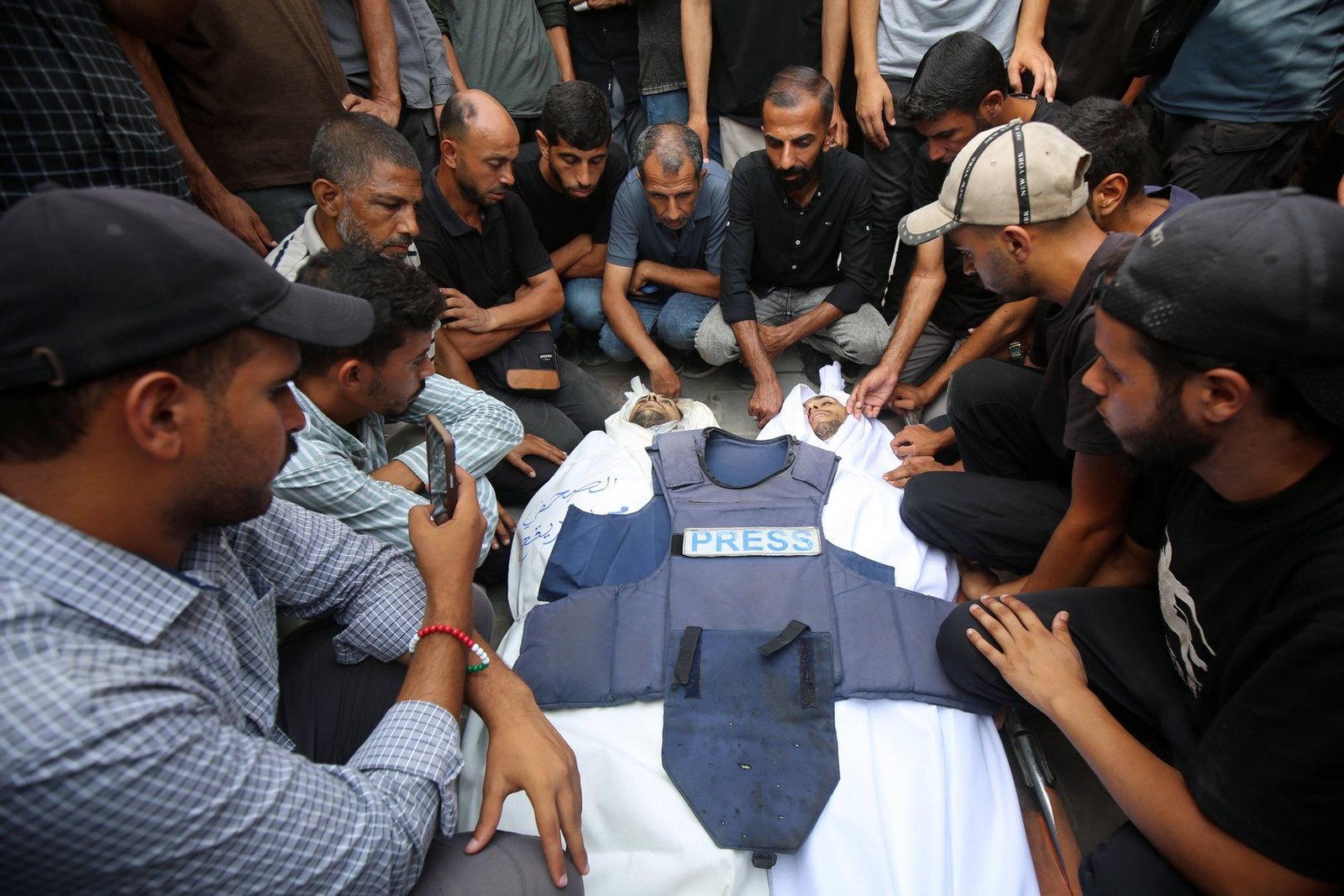
Home»News»Global Free Speech»Mourners carry the body of Al Jazeera correspondent Anas al-Sharif, who was killed alongside other journalists in an overnight Israeli strike on their tent in Gaza City, during his funeral in Gaza City on 11 August 2025. Photo: IMAGO/Omar Ashtawy apaimages/Alamy Israel’s official position is that the Israel Defense Force (IDF) never targets journalists for being journalists. The facts, however, tell a different story. Even if no kill order was issued from Prime Minister Benjamin Netanyahu down to the minister of defence, from the minister of defence to the IDF’s chief of staff, and from there all the way to the last sniper in Gaza; even if Israeli soldiers in the Gaza Strip were never explicitly ordered to eliminate every journalist they came across, the bottom line remains unambiguous. According to data from the Committee to Protect Journalists, more than 200 journalists have been killed in the Strip by IDF fire since 7 October 2023, and have continued to be targets even during the current ceasefire. In two years of hostilities, dozens more have been wounded. The very nature of their work means that journalists reporting wars will enter dangerous areas. They may may be carrying equipment that could be misidentified as weapons; they may have direct contact with senior commanders in the enemy force at bases and command centres that constitute legitimate military targets. All that said: the unprecedented scale of killing suggests that in the case of the IDF and the current war in Gaza, there is an additional factor at play. At the least, a very itchy trigger finger. A pivotal issue in the current conflict is Israel’s claims that many of the journalists killed in Gaza were terrorists. In some cases, the IDF has produced evidence to justify the deliberate targeting of journalists suspected of participating in terrorist activities; this, however, has not persuaded international human rights organisations reviewing the information that the IDF’s actions were lawful. But in Israel the evidence, such as it is, has been accepted as gospel truth. In any case, large segments of Israeli society see Gazan journalists as part of the enemy, in part due to their role reporting to the world what Israelis perceive as anti-Israeli bias. Some of the journalists killed by the IDF worked for outlets such as Gaza’s Al-Aqsa channel, a media outlet affiliated with Hamas – the same terrorist organisation that carried out horrific massacres in Israeli communities bordering the Gaza Strip. Some worked for outlets that identify with Hamas and similar organisations, such as Qatar’s Al Jazeera. The others would have had ties of some form with Hamas, by virtue of its presence as the organisation that has ruled the Strip, absolutely and often brutally, for many years. While international laws of war are intended protect journalists – even if they are propaganda mouthpieces for a murderous enemy – the facts listed above suffice to mark virtually all journalists in Gaza, in the eyes of many Israelis, as legitimate targets. But Gazan journalists are also regarded as the enemy by a growing portion of Israeli society, simply for being Gazan. The growing dehumanisation of Palestinians in the public discourse channels directly into Israeli indifference, Israeli media indifference specifically, concerning the wholesale elimination of journalists in Gaza. This perception – that Palestinians are not human beings with equal rights to Israelis – received a boost from the (entirely real) trauma of the 7 October massacres and the subsequent two-year hostage crisis. But the foundations for this perception had been laid years earlier. The prolonged Israeli-Palestinian conflict – certainly since the occupation of the West Bank and Gaza, the expansion of the settlements, and the rise of Palestinian terrorism – has created a dilemma for Israeli society and media. For many years, Israeli society has turned a blind eye to the wrongs of the occupation, doing so with the active assistance of the media. Israelis do not want to know what is happening beyond the border; the media (with exceptions such as the left-leaning daily Haaretz) does not want to report it. The result is a well-oiled machine of propaganda on one side, and wilful ignorance on the other. When it comes to the IDF’s actions in the occupied territories, Israelis have lived for years inside an ever-tightening bubble of justification and ignorance. On 7 October 2023, the bubble burst. Israelis could no longer ignore what was happening beyond their border, because the violence had penetrated deep into the sovereign state of Israel. But the same mechanisms that had long shielded Israelis from acknowledging what was happening around them swiftly responded, unleashing a relentless flood of patriotism and victim narratives. At the same time, the bubble constricted further, preventing information about the war crimes being committed by the IDF penetrating the public consciousness. In this regard, the mass killing of journalists in Gaza is just one more war crime that has gone unacknowledged in Israel. As with every act of violence Israel has carried out against Palestinians in Gaza, the treatment of journalists did not stop at the Strip’s borders. The first victims were foreign journalists. Foreign media correspondents are commonly perceived in Israel as hostile, as useful idiots in the service of Hamas propaganda, and sometimes as outright antisemites. The foreign press corps has been barred from entering Gaza since the start of the war on security grounds – a pretext that has long since lost any credibility. They are still free to report from the West Bank, but at the risk of confrontation with IDF forces and settlers who sometimes view them as part of the enemy’s combat apparatus. Recently, there have been increasing documented cases in which settlers and soldiers stationed in the territories operate in full coordination, including in targeting journalists. When a CNN crew was violently detained, the story made international headlines and led to an unusual condemnation by the Chief of Staff. But such conduct, and far worse, goes without any response when the journalists come from lower-profile outlets. That the government has promulgated legislation empowering the communications minister to disrupt broadcasts by foreign channels that are deemed to “harm state security” only underscores the target painted on their backs. At the same time, Palestinian citizens of Israel who dare to stand in the street and report in Arabic on events inside Israel have come under attack. Once Palestinians in general, and journalists in particular, had been designated legitimate targets by the authorities, it was the turn of Jewish Israeli civilians – vigilantes – to attack Arab journalists, repeatedly driving them from broadcast positions and preventing them from doing their jobs. Whether reporting for Al Jazeera or for the Arabic-language channel of the Israeli Broadcasting Corporation, Arab journalists were exposed to attacks. Arabic-speaking journalists on friendly terms with their Jewish colleagues have taken to sticking close to them when on assignment, in order to benefit from some degree of protection. Next came the turn of the Israeli Jewish journalists who refused to submit to the prime minister’s absolute authority. First were journalists at Haaretz, subjected to smear campaigns and boycotts by the government and its propaganda apparatus. Then it was the turn of critical correspondents at major outlets, who found themselves needing security escorts for fear of attack by thugs tacitly sanctioned by the state. The most glaring case was that of Guy Peleg, the legal correspondent of Channel 12 News, after he reported the abuse of Palestinian detainees by reserve soldiers at the IDF’s Sde Teiman detention facility. The Israeli public, incited by Netanyahu’s propaganda machine, regarded the suspected soldiers as the victims of the story and cast the journalist in the role of collaborator with the real enemy – the ‘Deep State.’ The public raged and demanded justice, not from those suspected of assaulting the detainee, but from those who leaked the footage to Paleg. After the detainee was transferred to Gaza as part of one of the deals with Hamas, military prosecutors were forced to drop the charges against the soldiers. The military advocate general, by contrast, is still facing charges over the leak, while Paleg is regarded by many circles in Israel as someone who published a false blood libel. As someone who has been writing critically about the government and its media arms for twenty years, I am well aware of the privilege that my Jewish identity affords me. At the same time, I am keenly aware of the rapid erosion of that privilege in recent years. The presumption that Palestinian citizens of Israel are a fifth column is increasingly spilling over toward left-wing Israeli Jews who dare oppose government policy. Netanyahu, like every authoritarian leader, is not satisfied with the propaganda channels that sing his praises. He wants all the media to join the chorus. Channel 12 News is considered Israel’s most influential television news outlet, giving airtime to both critical commentators and pro-Netanyahu mouthpieces. But it is no longer considered a legitimate media outlet in the eyes of the government. Netanyahu’s sycophants call it “Al Jazeera 12”, making it clear that they see no meaningful difference between it and a channel that serves the enemy. In January 2023, the Netanyahu government announced a “judicial reform” that in practice, amounted to a constitutional coup. After a long struggle ending with the executive branch establishing its dominion over the legislature, the government now sought to subjugate the judiciary as well – to strip the Supreme Court of the ability to strike down laws, and to seize control of the judicial appointments mechanism with the goal of packing the courts with yes-men. The major broadcast outlets quickly understood that they were next in line. Their newsrooms suddenly discovered some residual professional backbone, and for several months reported on the government’s moves incisively and critically. But that approach evaporated on October 7 of that same year and has not returned. This is in part because of the prolonged war, which changes shape every few months while its end remains nowhere in sight. For the violent and increasingly lethal treatment of Palestinian and Jewish journalists to end, mainstream Israeli media must first return to those months in 2023 when it fulfilled its role of holding Netanyahu’s government to account, sounding the alarm about the erosion of what remains of democracy in this country. Only then might it become possible to envision a reality in which the lives of journalists are not forfeit, even if they were born Palestinian or, God forbid, left-wing. READ MORE
Global Free Speech

Mourners carry the body of Al Jazeera correspondent Anas al-Sharif, who was killed alongside other journalists in an overnight Israeli strike on their tent in Gaza City, during his funeral in Gaza City on 11 August 2025. Photo: IMAGO/Omar Ashtawy apaimages/Alamy Israel’s official position is that the Israel Defense Force (IDF) never targets journalists for being journalists. The facts, however, tell a different story. Even if no kill order was issued from Prime Minister Benjamin Netanyahu down to the minister of defence, from the minister of defence to the IDF’s chief of staff, and from there all the way to the last sniper in Gaza; even if Israeli soldiers in the Gaza Strip were never explicitly ordered to eliminate every journalist they came across, the bottom line remains unambiguous. According to data from the Committee to Protect Journalists, more than 200 journalists have been killed in the Strip by IDF fire since 7 October 2023, and have continued to be targets even during the current ceasefire. In two years of hostilities, dozens more have been wounded. The very nature of their work means that journalists reporting wars will enter dangerous areas. They may may be carrying equipment that could be misidentified as weapons; they may have direct contact with senior commanders in the enemy force at bases and command centres that constitute legitimate military targets. All that said: the unprecedented scale of killing suggests that in the case of the IDF and the current war in Gaza, there is an additional factor at play. At the least, a very itchy trigger finger. A pivotal issue in the current conflict is Israel’s claims that many of the journalists killed in Gaza were terrorists. In some cases, the IDF has produced evidence to justify the deliberate targeting of journalists suspected of participating in terrorist activities; this, however, has not persuaded international human rights organisations reviewing the information that the IDF’s actions were lawful. But in Israel the evidence, such as it is, has been accepted as gospel truth. In any case, large segments of Israeli society see Gazan journalists as part of the enemy, in part due to their role reporting to the world what Israelis perceive as anti-Israeli bias. Some of the journalists killed by the IDF worked for outlets such as Gaza’s Al-Aqsa channel, a media outlet affiliated with Hamas – the same terrorist organisation that carried out horrific massacres in Israeli communities bordering the Gaza Strip. Some worked for outlets that identify with Hamas and similar organisations, such as Qatar’s Al Jazeera. The others would have had ties of some form with Hamas, by virtue of its presence as the organisation that has ruled the Strip, absolutely and often brutally, for many years. While international laws of war are intended protect journalists – even if they are propaganda mouthpieces for a murderous enemy – the facts listed above suffice to mark virtually all journalists in Gaza, in the eyes of many Israelis, as legitimate targets. But Gazan journalists are also regarded as the enemy by a growing portion of Israeli society, simply for being Gazan. The growing dehumanisation of Palestinians in the public discourse channels directly into Israeli indifference, Israeli media indifference specifically, concerning the wholesale elimination of journalists in Gaza. This perception – that Palestinians are not human beings with equal rights to Israelis – received a boost from the (entirely real) trauma of the 7 October massacres and the subsequent two-year hostage crisis. But the foundations for this perception had been laid years earlier. The prolonged Israeli-Palestinian conflict – certainly since the occupation of the West Bank and Gaza, the expansion of the settlements, and the rise of Palestinian terrorism – has created a dilemma for Israeli society and media. For many years, Israeli society has turned a blind eye to the wrongs of the occupation, doing so with the active assistance of the media. Israelis do not want to know what is happening beyond the border; the media (with exceptions such as the left-leaning daily Haaretz) does not want to report it. The result is a well-oiled machine of propaganda on one side, and wilful ignorance on the other. When it comes to the IDF’s actions in the occupied territories, Israelis have lived for years inside an ever-tightening bubble of justification and ignorance. On 7 October 2023, the bubble burst. Israelis could no longer ignore what was happening beyond their border, because the violence had penetrated deep into the sovereign state of Israel. But the same mechanisms that had long shielded Israelis from acknowledging what was happening around them swiftly responded, unleashing a relentless flood of patriotism and victim narratives. At the same time, the bubble constricted further, preventing information about the war crimes being committed by the IDF penetrating the public consciousness. In this regard, the mass killing of journalists in Gaza is just one more war crime that has gone unacknowledged in Israel. As with every act of violence Israel has carried out against Palestinians in Gaza, the treatment of journalists did not stop at the Strip’s borders. The first victims were foreign journalists. Foreign media correspondents are commonly perceived in Israel as hostile, as useful idiots in the service of Hamas propaganda, and sometimes as outright antisemites. The foreign press corps has been barred from entering Gaza since the start of the war on security grounds – a pretext that has long since lost any credibility. They are still free to report from the West Bank, but at the risk of confrontation with IDF forces and settlers who sometimes view them as part of the enemy’s combat apparatus. Recently, there have been increasing documented cases in which settlers and soldiers stationed in the territories operate in full coordination, including in targeting journalists. When a CNN crew was violently detained, the story made international headlines and led to an unusual condemnation by the Chief of Staff. But such conduct, and far worse, goes without any response when the journalists come from lower-profile outlets. That the government has promulgated legislation empowering the communications minister to disrupt broadcasts by foreign channels that are deemed to “harm state security” only underscores the target painted on their backs. At the same time, Palestinian citizens of Israel who dare to stand in the street and report in Arabic on events inside Israel have come under attack. Once Palestinians in general, and journalists in particular, had been designated legitimate targets by the authorities, it was the turn of Jewish Israeli civilians – vigilantes – to attack Arab journalists, repeatedly driving them from broadcast positions and preventing them from doing their jobs. Whether reporting for Al Jazeera or for the Arabic-language channel of the Israeli Broadcasting Corporation, Arab journalists were exposed to attacks. Arabic-speaking journalists on friendly terms with their Jewish colleagues have taken to sticking close to them when on assignment, in order to benefit from some degree of protection. Next came the turn of the Israeli Jewish journalists who refused to submit to the prime minister’s absolute authority. First were journalists at Haaretz, subjected to smear campaigns and boycotts by the government and its propaganda apparatus. Then it was the turn of critical correspondents at major outlets, who found themselves needing security escorts for fear of attack by thugs tacitly sanctioned by the state. The most glaring case was that of Guy Peleg, the legal correspondent of Channel 12 News, after he reported the abuse of Palestinian detainees by reserve soldiers at the IDF’s Sde Teiman detention facility. The Israeli public, incited by Netanyahu’s propaganda machine, regarded the suspected soldiers as the victims of the story and cast the journalist in the role of collaborator with the real enemy – the ‘Deep State.’ The public raged and demanded justice, not from those suspected of assaulting the detainee, but from those who leaked the footage to Paleg. After the detainee was transferred to Gaza as part of one of the deals with Hamas, military prosecutors were forced to drop the charges against the soldiers. The military advocate general, by contrast, is still facing charges over the leak, while Paleg is regarded by many circles in Israel as someone who published a false blood libel. As someone who has been writing critically about the government and its media arms for twenty years, I am well aware of the privilege that my Jewish identity affords me. At the same time, I am keenly aware of the rapid erosion of that privilege in recent years. The presumption that Palestinian citizens of Israel are a fifth column is increasingly spilling over toward left-wing Israeli Jews who dare oppose government policy. Netanyahu, like every authoritarian leader, is not satisfied with the propaganda channels that sing his praises. He wants all the media to join the chorus. Channel 12 News is considered Israel’s most influential television news outlet, giving airtime to both critical commentators and pro-Netanyahu mouthpieces. But it is no longer considered a legitimate media outlet in the eyes of the government. Netanyahu’s sycophants call it “Al Jazeera 12”, making it clear that they see no meaningful difference between it and a channel that serves the enemy. In January 2023, the Netanyahu government announced a “judicial reform” that in practice, amounted to a constitutional coup. After a long struggle ending with the executive branch establishing its dominion over the legislature, the government now sought to subjugate the judiciary as well – to strip the Supreme Court of the ability to strike down laws, and to seize control of the judicial appointments mechanism with the goal of packing the courts with yes-men. The major broadcast outlets quickly understood that they were next in line. Their newsrooms suddenly discovered some residual professional backbone, and for several months reported on the government’s moves incisively and critically. But that approach evaporated on October 7 of that same year and has not returned. This is in part because of the prolonged war, which changes shape every few months while its end remains nowhere in sight. For the violent and increasingly lethal treatment of Palestinian and Jewish journalists to end, mainstream Israeli media must first return to those months in 2023 when it fulfilled its role of holding Netanyahu’s government to account, sounding the alarm about the erosion of what remains of democracy in this country. Only then might it become possible to envision a reality in which the lives of journalists are not forfeit, even if they were born Palestinian or, God forbid, left-wing. READ MORE

News RoomBy News Room4 months agoNo Comments9 Mins Read3 Views
Share Facebook Twitter Pinterest Copy Link LinkedIn Tumblr Email VKontakte Telegram
Mourners carry the body of Al Jazeera correspondent Anas al-Sharif, who was killed alongside other journalists in an overnight Israeli strike on their tent in Gaza City, during his funeral in Gaza City on 11 August 2025. Photo: IMAGO/Omar Ashtawy apaimages/Alamy


				Israel’s official position is that the Israel Defense Force (IDF) never targets journalists for being journalists. The facts, however, tell a different story. Even if no kill order was issued from Prime Minister Benjamin Netanyahu down to the minister of defence, from the minister of defence to the IDF’s chief of staff, and from there all the way to the last sniper in Gaza; even if Israeli soldiers in the Gaza Strip were never explicitly ordered to eliminate every journalist they came across, the bottom line remains unambiguous. According to data from the Committee to Protect Journalists, more than 200 journalists have been killed in the Strip by IDF fire since 7 October 2023, and have continued to be targets even during the current ceasefire. In two years of hostilities, dozens more have been wounded.
The very nature of their work means that journalists reporting wars will enter dangerous areas. They may may be carrying equipment that could be misidentified as weapons; they may have direct contact with senior commanders in the enemy force at bases and command centres that constitute legitimate military targets. All that said: the unprecedented scale of killing suggests that in the case of the IDF and the current war in Gaza, there is an additional factor at play. At the least, a very itchy trigger finger.
A pivotal issue in the current conflict is Israel’s claims that many of the journalists killed in Gaza were terrorists. In some cases, the IDF has produced evidence to justify the deliberate targeting of journalists suspected of participating in terrorist activities; this, however, has not persuaded international human rights organisations reviewing the information that the IDF’s actions were lawful. But in Israel the evidence, such as it is, has been accepted as gospel truth. In any case, large segments of Israeli society see Gazan journalists as part of the enemy, in part due to their role reporting to the world what Israelis perceive as anti-Israeli bias.
Some of the journalists killed by the IDF worked for outlets such as Gaza’s Al-Aqsa channel, a media outlet affiliated with Hamas – the same terrorist organisation that carried out horrific massacres in Israeli communities bordering the Gaza Strip. Some worked for outlets that identify with Hamas and similar organisations, such as Qatar’s Al Jazeera. The others would have had ties of some form with Hamas, by virtue of its presence as the organisation that has ruled the Strip, absolutely and often brutally, for many years. While international laws of war are intended protect journalists – even if they are propaganda mouthpieces for a murderous enemy – the facts listed above suffice to mark virtually all journalists in Gaza, in the eyes of many Israelis, as legitimate targets.
But Gazan journalists are also regarded as the enemy by a growing portion of Israeli society, simply for being Gazan. The growing dehumanisation of Palestinians in the public discourse channels directly into Israeli indifference, Israeli media indifference specifically, concerning the wholesale elimination of journalists in Gaza. This perception – that Palestinians are not human beings with equal rights to Israelis – received a boost from the (entirely real) trauma of the 7 October massacres and the subsequent two-year hostage crisis. But the foundations for this perception had been laid years earlier.
The prolonged Israeli-Palestinian conflict – certainly since the occupation of the West Bank and Gaza, the expansion of the settlements, and the rise of Palestinian terrorism – has created a dilemma for Israeli society and media. For many years, Israeli society has turned a blind eye to the wrongs of the occupation, doing so with the active assistance of the media. Israelis do not want to know what is happening beyond the border; the media (with exceptions such as the left-leaning daily Haaretz) does not want to report it. The result is a well-oiled machine of propaganda on one side, and wilful ignorance on the other. When it comes to the IDF’s actions in the occupied territories, Israelis have lived for years inside an ever-tightening bubble of justification and ignorance.
On 7 October 2023, the bubble burst. Israelis could no longer ignore what was happening beyond their border, because the violence had penetrated deep into the sovereign state of Israel. But the same mechanisms that had long shielded Israelis from acknowledging what was happening around them swiftly responded, unleashing a relentless flood of patriotism and victim narratives. At the same time, the bubble constricted further, preventing information about the war crimes being committed by the IDF penetrating the public consciousness. In this regard, the mass killing of journalists in Gaza is just one more war crime that has gone unacknowledged in Israel.
As with every act of violence Israel has carried out against Palestinians in Gaza, the treatment of journalists did not stop at the Strip’s borders. The first victims were foreign journalists. Foreign media correspondents are commonly perceived in Israel as hostile, as useful idiots in the service of Hamas propaganda, and sometimes as outright antisemites. The foreign press corps has been barred from entering Gaza since the start of the war on security grounds – a pretext that has long since lost any credibility. They are still free to report from the West Bank, but at the risk of confrontation with IDF forces and settlers who sometimes view them as part of the enemy’s combat apparatus.
Recently, there have been increasing documented cases in which settlers and soldiers stationed in the territories operate in full coordination, including in targeting journalists. When a CNN crew was violently detained, the story made international headlines and led to an unusual condemnation by the Chief of Staff. But such conduct, and far worse, goes without any response when the journalists come from lower-profile outlets.
That the government has promulgated legislation empowering the communications minister to disrupt broadcasts by foreign channels that are deemed to “harm state security” only underscores the target painted on their backs.
At the same time, Palestinian citizens of Israel who dare to stand in the street and report in Arabic on events inside Israel have come under attack. Once Palestinians in general, and journalists in particular, had been designated legitimate targets by the authorities, it was the turn of Jewish Israeli civilians – vigilantes – to attack Arab journalists, repeatedly driving them from broadcast positions and preventing them from doing their jobs. Whether reporting for Al Jazeera or for the Arabic-language channel of the Israeli Broadcasting Corporation, Arab journalists were exposed to attacks. Arabic-speaking journalists on friendly terms with their Jewish colleagues have taken to sticking close to them when on assignment, in order to benefit from some degree of protection.
Next came the turn of the Israeli Jewish journalists who refused to submit to the prime minister’s absolute authority. First were journalists at Haaretz, subjected to smear campaigns and boycotts by the government and its propaganda apparatus. Then it was the turn of critical correspondents at major outlets, who found themselves needing security escorts for fear of attack by thugs tacitly sanctioned by the state. The most glaring case was that of Guy Peleg, the legal correspondent of Channel 12 News, after he reported the abuse of Palestinian detainees by reserve soldiers at the IDF’s Sde Teiman detention facility.
The Israeli public, incited by Netanyahu’s propaganda machine, regarded the suspected soldiers as the victims of the story and cast the journalist in the role of collaborator with the real enemy – the ‘Deep State.’ The public raged and demanded justice, not from those suspected of assaulting the detainee, but from those who leaked the footage to Paleg. After the detainee was transferred to Gaza as part of one of the deals with Hamas, military prosecutors were forced to drop the charges against the soldiers. The military advocate general, by contrast, is still facing charges over the leak, while Paleg is regarded by many circles in Israel as someone who published a false blood libel.
As someone who has been writing critically about the government and its media arms for twenty years, I am well aware of the privilege that my Jewish identity affords me. At the same time, I am keenly aware of the rapid erosion of that privilege in recent years. The presumption that Palestinian citizens of Israel are a fifth column is increasingly spilling over toward left-wing Israeli Jews who dare oppose government policy.
Netanyahu, like every authoritarian leader, is not satisfied with the propaganda channels that sing his praises. He wants all the media to join the chorus. Channel 12 News is considered Israel’s most influential television news outlet, giving airtime to both critical commentators and pro-Netanyahu mouthpieces. But it is no longer considered a legitimate media outlet in the eyes of the government. Netanyahu’s sycophants call it “Al Jazeera 12”, making it clear that they see no meaningful difference between it and a channel that serves the enemy.
In January 2023, the Netanyahu government announced a “judicial reform” that in practice, amounted to a constitutional coup. After a long struggle ending with the executive branch establishing its dominion over the legislature, the government now sought to subjugate the judiciary as well – to strip the Supreme Court of the ability to strike down laws, and to seize control of the judicial appointments mechanism with the goal of packing the courts with yes-men.
The major broadcast outlets quickly understood that they were next in line. Their newsrooms suddenly discovered some residual professional backbone, and for several months reported on the government’s moves incisively and critically. But that approach evaporated on October 7 of that same year and has not returned. This is in part because of the prolonged war, which changes shape every few months while its end remains nowhere in sight.
For the violent and increasingly lethal treatment of Palestinian and Jewish journalists to end, mainstream Israeli media must first return to those months in 2023 when it fulfilled its role of holding Netanyahu’s government to account, sounding the alarm about the erosion of what remains of democracy in this country. Only then might it become possible to envision a reality in which the lives of journalists are not forfeit, even if they were born Palestinian or, God forbid, left-wing.


				READ MORE
Share
Facebook Twitter Pinterest Email Copy Link

Listen to the article

0:00
0:00

Key Takeaways

Playback Speed

Select a Voice

Israel’s official position is that the Israel Defense Force (IDF) never targets journalists for being journalists. The facts, however, tell a different story. Even if no kill order was issued from Prime Minister Benjamin Netanyahu down to the minister of defence, from the minister of defence to the IDF’s chief of staff, and from there all the way to the last sniper in Gaza; even if Israeli soldiers in the Gaza Strip were never explicitly ordered to eliminate every journalist they came across, the bottom line remains unambiguous. According to data from the Committee to Protect Journalists, more than 200 journalists have been killed in the Strip by IDF fire since 7 October 2023, and have continued to be targets even during the current ceasefire. In two years of hostilities, dozens more have been wounded.

The very nature of their work means that journalists reporting wars will enter dangerous areas. They may may be carrying equipment that could be misidentified as weapons; they may have direct contact with senior commanders in the enemy force at bases and command centres that constitute legitimate military targets. All that said: the unprecedented scale of killing suggests that in the case of the IDF and the current war in Gaza, there is an additional factor at play. At the least, a very itchy trigger finger.

A pivotal issue in the current conflict is Israel’s claims that many of the journalists killed in Gaza were terrorists. In some cases, the IDF has produced evidence to justify the deliberate targeting of journalists suspected of participating in terrorist activities; this, however, has not persuaded international human rights organisations reviewing the information that the IDF’s actions were lawful. But in Israel the evidence, such as it is, has been accepted as gospel truth. In any case, large segments of Israeli society see Gazan journalists as part of the enemy, in part due to their role reporting to the world what Israelis perceive as anti-Israeli bias.

Some of the journalists killed by the IDF worked for outlets such as Gaza’s Al-Aqsa channel, a media outlet affiliated with Hamas – the same terrorist organisation that carried out horrific massacres in Israeli communities bordering the Gaza Strip. Some worked for outlets that identify with Hamas and similar organisations, such as Qatar’s Al Jazeera. The others would have had ties of some form with Hamas, by virtue of its presence as the organisation that has ruled the Strip, absolutely and often brutally, for many years. While international laws of war are intended protect journalists – even if they are propaganda mouthpieces for a murderous enemy – the facts listed above suffice to mark virtually all journalists in Gaza, in the eyes of many Israelis, as legitimate targets.

But Gazan journalists are also regarded as the enemy by a growing portion of Israeli society, simply for being Gazan. The growing dehumanisation of Palestinians in the public discourse channels directly into Israeli indifference, Israeli media indifference specifically, concerning the wholesale elimination of journalists in Gaza. This perception – that Palestinians are not human beings with equal rights to Israelis – received a boost from the (entirely real) trauma of the 7 October massacres and the subsequent two-year hostage crisis. But the foundations for this perception had been laid years earlier.

The prolonged Israeli-Palestinian conflict – certainly since the occupation of the West Bank and Gaza, the expansion of the settlements, and the rise of Palestinian terrorism – has created a dilemma for Israeli society and media. For many years, Israeli society has turned a blind eye to the wrongs of the occupation, doing so with the active assistance of the media. Israelis do not want to know what is happening beyond the border; the media (with exceptions such as the left-leaning daily Haaretz) does not want to report it. The result is a well-oiled machine of propaganda on one side, and wilful ignorance on the other. When it comes to the IDF’s actions in the occupied territories, Israelis have lived for years inside an ever-tightening bubble of justification and ignorance.

On 7 October 2023, the bubble burst. Israelis could no longer ignore what was happening beyond their border, because the violence had penetrated deep into the sovereign state of Israel. But the same mechanisms that had long shielded Israelis from acknowledging what was happening around them swiftly responded, unleashing a relentless flood of patriotism and victim narratives. At the same time, the bubble constricted further, preventing information about the war crimes being committed by the IDF penetrating the public consciousness. In this regard, the mass killing of journalists in Gaza is just one more war crime that has gone unacknowledged in Israel.

As with every act of violence Israel has carried out against Palestinians in Gaza, the treatment of journalists did not stop at the Strip’s borders. The first victims were foreign journalists. Foreign media correspondents are commonly perceived in Israel as hostile, as useful idiots in the service of Hamas propaganda, and sometimes as outright antisemites. The foreign press corps has been barred from entering Gaza since the start of the war on security grounds – a pretext that has long since lost any credibility. They are still free to report from the West Bank, but at the risk of confrontation with IDF forces and settlers who sometimes view them as part of the enemy’s combat apparatus.

Recently, there have been increasing documented cases in which settlers and soldiers stationed in the territories operate in full coordination, including in targeting journalists. When a CNN crew was violently detained, the story made international headlines and led to an unusual condemnation by the Chief of Staff. But such conduct, and far worse, goes without any response when the journalists come from lower-profile outlets.

That the government has promulgated legislation empowering the communications minister to disrupt broadcasts by foreign channels that are deemed to “harm state security” only underscores the target painted on their backs.

At the same time, Palestinian citizens of Israel who dare to stand in the street and report in Arabic on events inside Israel have come under attack. Once Palestinians in general, and journalists in particular, had been designated legitimate targets by the authorities, it was the turn of Jewish Israeli civilians – vigilantes – to attack Arab journalists, repeatedly driving them from broadcast positions and preventing them from doing their jobs. Whether reporting for Al Jazeera or for the Arabic-language channel of the Israeli Broadcasting Corporation, Arab journalists were exposed to attacks. Arabic-speaking journalists on friendly terms with their Jewish colleagues have taken to sticking close to them when on assignment, in order to benefit from some degree of protection.

Next came the turn of the Israeli Jewish journalists who refused to submit to the prime minister’s absolute authority. First were journalists at Haaretz, subjected to smear campaigns and boycotts by the government and its propaganda apparatus. Then it was the turn of critical correspondents at major outlets, who found themselves needing security escorts for fear of attack by thugs tacitly sanctioned by the state. The most glaring case was that of Guy Peleg, the legal correspondent of Channel 12 News, after he reported the abuse of Palestinian detainees by reserve soldiers at the IDF’s Sde Teiman detention facility.

The Israeli public, incited by Netanyahu’s propaganda machine, regarded the suspected soldiers as the victims of the story and cast the journalist in the role of collaborator with the real enemy – the ‘Deep State.’ The public raged and demanded justice, not from those suspected of assaulting the detainee, but from those who leaked the footage to Paleg. After the detainee was transferred to Gaza as part of one of the deals with Hamas, military prosecutors were forced to drop the charges against the soldiers. The military advocate general, by contrast, is still facing charges over the leak, while Paleg is regarded by many circles in Israel as someone who published a false blood libel.

As someone who has been writing critically about the government and its media arms for twenty years, I am well aware of the privilege that my Jewish identity affords me. At the same time, I am keenly aware of the rapid erosion of that privilege in recent years. The presumption that Palestinian citizens of Israel are a fifth column is increasingly spilling over toward left-wing Israeli Jews who dare oppose government policy.

Netanyahu, like every authoritarian leader, is not satisfied with the propaganda channels that sing his praises. He wants all the media to join the chorus. Channel 12 News is considered Israel’s most influential television news outlet, giving airtime to both critical commentators and pro-Netanyahu mouthpieces. But it is no longer considered a legitimate media outlet in the eyes of the government. Netanyahu’s sycophants call it “Al Jazeera 12”, making it clear that they see no meaningful difference between it and a channel that serves the enemy.

In January 2023, the Netanyahu government announced a “judicial reform” that in practice, amounted to a constitutional coup. After a long struggle ending with the executive branch establishing its dominion over the legislature, the government now sought to subjugate the judiciary as well – to strip the Supreme Court of the ability to strike down laws, and to seize control of the judicial appointments mechanism with the goal of packing the courts with yes-men.

The major broadcast outlets quickly understood that they were next in line. Their newsrooms suddenly discovered some residual professional backbone, and for several months reported on the government’s moves incisively and critically. But that approach evaporated on October 7 of that same year and has not returned. This is in part because of the prolonged war, which changes shape every few months while its end remains nowhere in sight.

For the violent and increasingly lethal treatment of Palestinian and Jewish journalists to end, mainstream Israeli media must first return to those months in 2023 when it fulfilled its role of holding Netanyahu’s government to account, sounding the alarm about the erosion of what remains of democracy in this country. Only then might it become possible to envision a reality in which the lives of journalists are not forfeit, even if they were born Palestinian or, God forbid, left-wing.

Read the full article here

Fact Checker

Verify the accuracy of this article using AI-powered analysis and real-time sources.

Get Your Fact Check Report

Enter your email to receive detailed fact-checking analysis

5 free reports remaining

Continue with Full Access

You've used your 5 free reports. Sign up for unlimited access!

Already have an account? Sign in here

Share. Facebook Twitter Pinterest LinkedIn Tumblr Email Telegram Copy Link
News Room
  • Website
  • Facebook
  • X (Twitter)
  • Instagram
  • LinkedIn

The FSNN News Room is the voice of our in-house journalists, editors, and researchers. We deliver timely, unbiased reporting at the crossroads of finance, cryptocurrency, and global politics, providing clear, fact-driven analysis free from agendas.

Related Articles

Global Free Speech

CPJ calls on Tunisia to release imprisoned journalists amid deadly heatwave

14 hours ago
Global Free Speech

CPJ, partners demand answers on disappeared Yemeni journalist Waheed al-Sufi

2 days ago
Global Free Speech

Cuban journalist given 2 months to leave country for practicing journalism

3 days ago
Global Free Speech

London’s Africa Centre faces closure Earlier this month, I was saddened to learn that The Africa Centre in London may once again be shutting its doors. It won’t be the first time the centre has had to close – but it may be the last time, although the chief executive is still hopeful he can raise the millions of pounds needed to save it. There’s no point dwelling on the reasons, speculative or factual, behind its current crisis. I did though, looking through a list of its recent events, feel a pang of guilt. I could have done more to support The Africa Centre – turning up, talking to people about it, taking cognisance of the real value it has added over the years to London’s political and social life. When the Africa Centre was founded in 1961, its primary objective was to “educate about, connect to and [advocate] for Africa and its diaspora through arts, innovation, culture, thought leadership and education”. In 1964 it found a home in London’s Covent Garden – the Catholic church purchased an old tomato warehouse on King Street and gifted it “to the people of Africa in perpetuity”. When my parents emigrated to the United Kingdom in the mid-1960s, The Africa Centre was one of the very few places where people like them could find space to negotiate the cultural and social differences between them and the unfamiliar wider world. This process of cultural pollination process worked both ways, mind. Intellectuals, activists and dissidents from across the continent spoke at King Street about the political challenges faced by post-colonial African countries, educating curious audiences who wanted to learn more about a part of the world that for many was at best a construct of the imagination, if even that. For two days last June, the London Archives presented to the public a cross-section of documents, photographs and ephemera from its Africa Centre Collection. The archives were a revealing and at times startling record of political and social openness and curiosity. On one table, a poster from 1968 announced a talk about The Future of the Portuguese Territories – long before Angola and Mozambique became proxy battlegrounds for the Cold War between the Soviets and the West. From 1970, an invitation to a talk by Mrs Lydia Osiyemi, “sociology student and mother”, about The African mother and child in Britain. Judging from the poster (left), I fancy that Mrs Osiyemi’s talk was proposing African solutions to a dilemma that remains very real today – to London’s new arrivals and veterans alike. And then, from the early 1990s, in the centre’s guest book (below right), a tribute from a vanguard of democracy. “I pay tribute to those who founded this institution, and those who run it,” the scrawly script read. “This is …  a major cultural shop-window for Africa of which every African should be proud.” The author: “M.K.O. Abiola of Africa.” The Nigeria I grew up in the 1980s and 1990s, after my parents moved back there for a while, was defined by the ever-present cloud of military dictatorship. I can say that now, in hindsight; it’s strange how one normalises the abnormal when we have nothing to compare it against. When Abiola, a business magnate and politician, ran for president in Nigeria in 1993 for a short while it seemed that the country would escape its history of ethnic strife. But then the military snatched victory from him and imprisoned him, extending their malign grip on the country for another half decade. The BAFTA-winning My Father’s Son is set against the backdrop of that very period. A generation before this, the Africa at the Pictures film festival curated by the centre had offered London similar context to political and social concerns across the continent. Abiola’s entry reminded me that it was in the London, on King Street, that I first began to think more clearly about the right to free expression and what happens when this is curtailed. When Chinua Achebe’s Anthills of the Savannah, an acerbic observation on life under military dictatorship in a fictional west African country, was shortlisted for the Booker in 1987 it couldn’t be bought in Nigeria. I got hold of my copy in London – in the Africa Centre’s cramped and musty bookshop, stuffed with books on and from the continent. It wasn’t all high-minded intellectualism on King Street. The Africa Centre was home to one of the few restaurants in London featuring cuisine from here and there across the continent – Mauritian lamb curry, Algerian couscous, fried plantain and boiled yam. Cost? Dishes were, according to a caption, “between 20p and £3”. Happy days. (An early menu is shown below left). In 2012, the Africa Centre left Covent Garden. Maintaining the Grade II-listed building proved too expensive, some said. Perhaps more to the point, it was no longer a good fit for the commercialised ambience that had sprung up around Covent Garden. The historic building on King Street was sold, and with the support of the Mayor of London and the Arts Council, the Centre relocated itself across the river in 2022, to new premises in Southwark. The last time I was there, in the summer of 2023, was to see a fascinating multi-floor exhibition about Nigeria’s Fuji music. Once again, I was surprised and delighted to learn in the Africa Centre something new about my childhood home, so very far away from it. London of the 1980s and 1990s was nothing like the crucible of cultures that it is today. While migrant communities were not quite silenced, they certainly did not have the right to a voice in the public sphere such as they do today. We complain, correctly, about febrile attempts to exclude inconvenient minority voices from the general discourse today. But we don’t, unfortunately, acknowledge enough the real contribution that physical community spaces, big and small, have made over the years to give London the cultural texture and viscera that makes the challenging and contradictory but still very charming city that it is. I’m going to miss the Africa Centre when it’s gone, and places like it, that helped shaped a city where the right to free expression is still, on the whole, seen to be a good thing. READ MORE

4 days ago
Global Free Speech

Photo: Sergio Kian/UnSplash There are many things to adore about China. The high-speed rail networks are great. Zooming from Shanghai international airport into the city at 431 km per hour is an extraordinary experience. The food is varied and delicious. While the country has a problem with sexual and domestic abuse within relationships, the streets are very safe. I miss being able to walk home at any hour down a dark lane without clutching keys in my hands. I could go on and many in fact do. A current trend – Chinamaxxing – sees young people from the West in thrall to China and taking to social media to say as such. One choice phrase is: “You met me at a very Chinese time in my life.” Chinamaxxers often overlook or downplay the negative parts of the country. The retort will typically be: “our countries aren’t perfect”. And they’re right. Europe, the UK and the USA do have problems, ones we often point out at Index. Still, some perspective is needed. We’re not talking about sporadic violations; we’re talking about systematic abuse at scale. I was bemused by an article in The New World this week interviewing a Chinamaxxer who had to change his VPN three times just to do the interview and muffle his voice when speaking about Tibet and Tiananmen Square. In the UK, a VPN is still very much a choice, not a requirement, and speaking quietly is usually done out of respect to neighbours and noise pollution, rather than from a fear you’re being spied on and could receive a knock at the door. I wonder too what the Chinamaxxers make of the fact that Gao Zhen, a prominent Chinese-American artist known for provocative sculptures of Mao Zedong, was sentenced Tuesday to three years in prison for slandering China’s “heroes and martyrs”? I wonder what they’d make of Guo Degang, lauded for his comedy on the national stage, now being investigated for allegedly improvising parts of a patriotic song? How would they respond to a new report from the International Campaign for Tibet, which showed how Beijing is tightening its grip on the region further, the recently passed and euphemistically labelled Promoting Ethnic Unity and Progress Law helping here? In Hong Kong, activist Chow Hang-tung was convicted simply for organising Tiananmen vigils. A letter from her published by us spoke of the subtle torture of handcuffs designed to constrict and contort the body. Thoughts on this? And what about the woman who was arrested outside the same courtroom for wearing a t-shirt with Japanese characters, which were apparently deemed seditious? These are just some examples from the last week. This isn’t a case of whataboutery. I’m not asking Chinamaxxers to comment on the rights record of Venezuela or Belarus. I’m not even asking them to remark on all these individual cases. But for those who call themselves spiritually Chinese, to bypass the bad and the ugly in favour of just the good is either wilful ignorance, self-censorship or both. READ MORE

4 days ago
Global Free Speech

Ugandan journalist Remmy Asiteza detained on `fake news’ charges

5 days ago
Add A Comment

Comments are closed.

Editors Picks

Brickbat: Ask Questions Later

45 minutes ago

London Stock Exchange to work with Payward to bring biggest UK stocks onchain

1 hour ago

Trump Family-Linked Fund to Invest $300M in Polymarket in $1B Round

1 hour ago

OpenAI’s ‘Trust Us’ TIME cover raises an old warning for AI bulls

2 hours ago
Latest Posts

Trump Jr's firm leads $1 billion Polymarket raise at $21 billion value: Report

3 hours ago

BlackRock Drives $217M Bitcoin ETF Inflow Rebound

3 hours ago

Bitcoin steady above $78,000, HYPE leads as majors slip on hawkish Fed bets

4 hours ago

Subscribe to News

Get the latest news and updates directly to your inbox.

At FSNN – Free Speech News Network, we deliver unfiltered reporting and in-depth analysis on the stories that matter most. From breaking headlines to global perspectives, our mission is to keep you informed, empowered, and connected.

FSNN.net is owned and operated by GlobalBoost Media
, an independent media organization dedicated to advancing transparency, free expression, and factual journalism across the digital landscape.

Facebook X (Twitter) Discord Telegram
Latest News

Live updates: Bitcoin ETFs resume buying as ether funds stretch streak to 11 days

6 minutes ago

Brickbat: Ask Questions Later

45 minutes ago

London Stock Exchange to work with Payward to bring biggest UK stocks onchain

1 hour ago

Subscribe to Updates

Get the latest news and updates directly to your inbox.

© 2026 GlobalBoost Media. All Rights Reserved.
  • Privacy Policy
  • Terms of Service
  • Our Authors
  • Contact

Type above and press Enter to search. Press Esc to cancel.

🍪

Cookies

We and our selected partners wish to use cookies to collect information about you for functional purposes and statistical marketing. You may not give us your consent for certain purposes by selecting an option and you can withdraw your consent at any time via the cookie icon.

Cookie Preferences

Manage Cookies

Cookies are small text that can be used by websites to make the user experience more efficient. The law states that we may store cookies on your device if they are strictly necessary for the operation of this site. For all other types of cookies, we need your permission. This site uses various types of cookies. Some cookies are placed by third party services that appear on our pages.

Your permission applies to the following domains:

  • https://fsnn.net
Necessary
Necessary cookies help make a website usable by enabling basic functions like page navigation and access to secure areas of the website. The website cannot function properly without these cookies.
Statistic
Statistic cookies help website owners to understand how visitors interact with websites by collecting and reporting information anonymously.
Preferences
Preference cookies enable a website to remember information that changes the way the website behaves or looks, like your preferred language or the region that you are in.
Marketing
Marketing cookies are used to track visitors across websites. The intention is to display ads that are relevant and engaging for the individual user and thereby more valuable for publishers and third party advertisers.