

 Freedom Index
![London’s Africa Centre faces closure
Earlier this month, I was saddened to learn that The Africa Centre in London may once again be shutting its doors. It won’t be the first time the centre has had to close – but it may be the last time, although the chief executive is still hopeful he can raise the millions of pounds needed to save it.
There’s no point dwelling on the reasons, speculative or factual, behind its current crisis. I did though, looking through a list of its recent events, feel a pang of guilt. I could have done more to support The Africa Centre – turning up, talking to people about it, taking cognisance of the real value it has added over the years to London’s political and social life.
When the Africa Centre was founded in 1961, its primary objective was to “educate about, connect to and [advocate] for Africa and its diaspora through arts, innovation, culture, thought leadership and education”. In 1964 it found a home in London’s Covent Garden – the Catholic church purchased an old tomato warehouse on King Street and gifted it “to the people of Africa in perpetuity”. When my parents emigrated to the United Kingdom in the mid-1960s, The Africa Centre was one of the very few places where people like them could find space to negotiate the cultural and social differences between them and the unfamiliar wider world. This process of cultural pollination process worked both ways, mind. Intellectuals, activists and dissidents from across the continent spoke at King Street about the political challenges faced by post-colonial African countries, educating curious audiences who wanted to learn more about a part of the world that for many was at best a construct of the imagination, if even that.
For two days last June, the London Archives presented to the public a cross-section of documents, photographs and ephemera from its Africa Centre Collection. The archives were a revealing and at times startling record of political and social openness and curiosity. On one table, a poster from 1968 announced a talk about The Future of the Portuguese Territories – long before Angola and Mozambique became proxy battlegrounds for the Cold War between the Soviets and the West. From 1970, an invitation to a talk by Mrs Lydia Osiyemi, “sociology student and mother”, about The African mother and child in Britain. Judging from the poster (left), I fancy that Mrs Osiyemi’s talk was proposing African solutions to a dilemma that remains very real today – to London’s new arrivals and veterans alike.
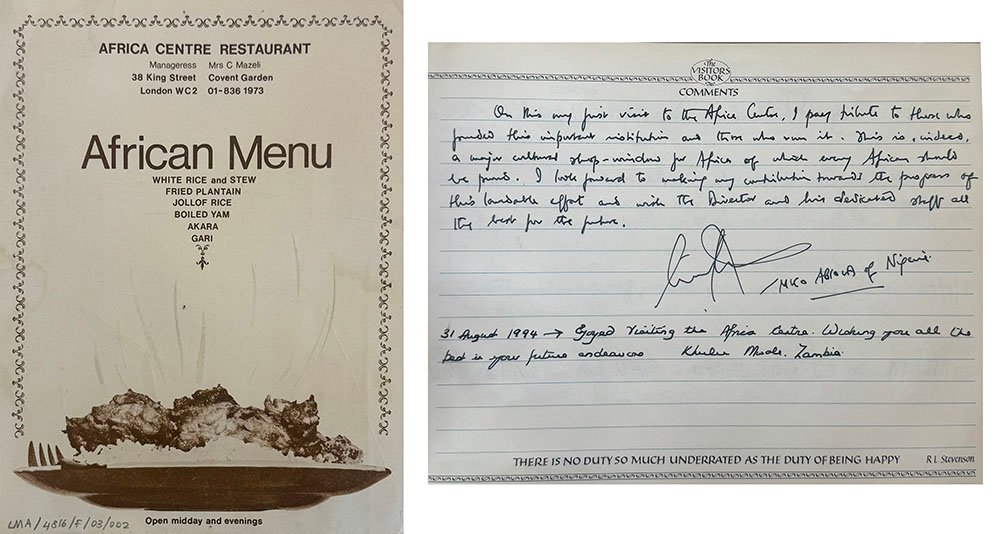
And then, from the early 1990s, in the centre’s guest book (below right), a tribute from a vanguard of democracy. “I pay tribute to those who founded this institution, and those who run it,” the scrawly script read. “This is … a major cultural shop-window for Africa of which every African should be proud.” The author: “M.K.O. Abiola of Africa.”
The Nigeria I grew up in the 1980s and 1990s, after my parents moved back there for a while, was defined by the ever-present cloud of military dictatorship. I can say that now, in hindsight; it’s strange how one normalises the abnormal when we have nothing to compare it against. When Abiola, a business magnate and politician, ran for president in Nigeria in 1993 for a short while it seemed that the country would escape its history of ethnic strife. But then the military snatched victory from him and imprisoned him, extending their malign grip on the country for another half decade. The BAFTA-winning My Father’s Son is set against the backdrop of that very period. A generation before this, the Africa at the Pictures film festival curated by the centre had offered London similar context to political and social concerns across the continent.
Abiola’s entry reminded me that it was in the London, on King Street, that I first began to think more clearly about the right to free expression and what happens when this is curtailed. When Chinua Achebe’s Anthills of the Savannah, an acerbic observation on life under military dictatorship in a fictional west African country, was shortlisted for the Booker in 1987 it couldn’t be bought in Nigeria. I got hold of my copy in London – in the Africa Centre’s cramped and musty bookshop, stuffed with books on and from the continent.
It wasn’t all high-minded intellectualism on King Street. The Africa Centre was home to one of the few restaurants in London featuring cuisine from here and there across the continent – Mauritian lamb curry, Algerian couscous, fried plantain and boiled yam. Cost? Dishes were, according to a caption, “between 20p and £3”. Happy days. (An early menu is shown below left).
In 2012, the Africa Centre left Covent Garden. Maintaining the Grade II-listed building proved too expensive, some said. Perhaps more to the point, it was no longer a good fit for the commercialised ambience that had sprung up around Covent Garden. The historic building on King Street was sold, and with the support of the Mayor of London and the Arts Council, the Centre relocated itself across the river in 2022, to new premises in Southwark.
The last time I was there, in the summer of 2023, was to see a fascinating multi-floor exhibition about Nigeria’s Fuji music. Once again, I was surprised and delighted to learn in the Africa Centre something new about my childhood home, so very far away from it.
London of the 1980s and 1990s was nothing like the crucible of cultures that it is today. While migrant communities were not quite silenced, they certainly did not have the right to a voice in the public sphere such as they do today. We complain, correctly, about febrile attempts to exclude inconvenient minority voices from the general discourse today. But we don’t, unfortunately, acknowledge enough the real contribution that physical community spaces, big and small, have made over the years to give London the cultural texture and viscera that makes the challenging and contradictory but still very charming city that it is. I’m going to miss the Africa Centre when it’s gone, and places like it, that helped shaped a city where the right to free expression is still, on the whole, seen to be a good thing.
READ MORE](https://fsnn.net/wp-content/uploads/2026/08/1280px-Africa_Centre_London.jpg "London’s Africa Centre faces closure
Earlier this month, I was saddened to learn that The Africa Centre in London may once again be shutting its doors. It won’t be the first time the centre has had to close – but it may be the last time, although the chief executive is still hopeful he can raise the millions of pounds needed to save it.
There’s no point dwelling on the reasons, speculative or factual, behind its current crisis. I did though, looking through a list of its recent events, feel a pang of guilt. I could have done more to support The Africa Centre – turning up, talking to people about it, taking cognisance of the real value it has added over the years to London’s political and social life.
When the Africa Centre was founded in 1961, its primary objective was to “educate about, connect to and [advocate] for Africa and its diaspora through arts, innovation, culture, thought leadership and education”. In 1964 it found a home in London’s Covent Garden – the Catholic church purchased an old tomato warehouse on King Street and gifted it “to the people of Africa in perpetuity”. When my parents emigrated to the United Kingdom in the mid-1960s, The Africa Centre was one of the very few places where people like them could find space to negotiate the cultural and social differences between them and the unfamiliar wider world. This process of cultural pollination process worked both ways, mind. Intellectuals, activists and dissidents from across the continent spoke at King Street about the political challenges faced by post-colonial African countries, educating curious audiences who wanted to learn more about a part of the world that for many was at best a construct of the imagination, if even that.
For two days last June, the London Archives presented to the public a cross-section of documents, photographs and ephemera from its Africa Centre Collection. The archives were a revealing and at times startling record of political and social openness and curiosity. On one table, a poster from 1968 announced a talk about The Future of the Portuguese Territories – long before Angola and Mozambique became proxy battlegrounds for the Cold War between the Soviets and the West. From 1970, an invitation to a talk by Mrs Lydia Osiyemi, “sociology student and mother”, about The African mother and child in Britain. Judging from the poster (left), I fancy that Mrs Osiyemi’s talk was proposing African solutions to a dilemma that remains very real today – to London’s new arrivals and veterans alike.
And then, from the early 1990s, in the centre’s guest book (below right), a tribute from a vanguard of democracy. “I pay tribute to those who founded this institution, and those who run it,” the scrawly script read. “This is … a major cultural shop-window for Africa of which every African should be proud.” The author: “M.K.O. Abiola of Africa.”
The Nigeria I grew up in the 1980s and 1990s, after my parents moved back there for a while, was defined by the ever-present cloud of military dictatorship. I can say that now, in hindsight; it’s strange how one normalises the abnormal when we have nothing to compare it against. When Abiola, a business magnate and politician, ran for president in Nigeria in 1993 for a short while it seemed that the country would escape its history of ethnic strife. But then the military snatched victory from him and imprisoned him, extending their malign grip on the country for another half decade. The BAFTA-winning My Father’s Son is set against the backdrop of that very period. A generation before this, the Africa at the Pictures film festival curated by the centre had offered London similar context to political and social concerns across the continent.
Abiola’s entry reminded me that it was in the London, on King Street, that I first began to think more clearly about the right to free expression and what happens when this is curtailed. When Chinua Achebe’s Anthills of the Savannah, an acerbic observation on life under military dictatorship in a fictional west African country, was shortlisted for the Booker in 1987 it couldn’t be bought in Nigeria. I got hold of my copy in London – in the Africa Centre’s cramped and musty bookshop, stuffed with books on and from the continent.
It wasn’t all high-minded intellectualism on King Street. The Africa Centre was home to one of the few restaurants in London featuring cuisine from here and there across the continent – Mauritian lamb curry, Algerian couscous, fried plantain and boiled yam. Cost? Dishes were, according to a caption, “between 20p and £3”. Happy days. (An early menu is shown below left).
In 2012, the Africa Centre left Covent Garden. Maintaining the Grade II-listed building proved too expensive, some said. Perhaps more to the point, it was no longer a good fit for the commercialised ambience that had sprung up around Covent Garden. The historic building on King Street was sold, and with the support of the Mayor of London and the Arts Council, the Centre relocated itself across the river in 2022, to new premises in Southwark.
The last time I was there, in the summer of 2023, was to see a fascinating multi-floor exhibition about Nigeria’s Fuji music. Once again, I was surprised and delighted to learn in the Africa Centre something new about my childhood home, so very far away from it.
London of the 1980s and 1990s was nothing like the crucible of cultures that it is today. While migrant communities were not quite silenced, they certainly did not have the right to a voice in the public sphere such as they do today. We complain, correctly, about febrile attempts to exclude inconvenient minority voices from the general discourse today. But we don’t, unfortunately, acknowledge enough the real contribution that physical community spaces, big and small, have made over the years to give London the cultural texture and viscera that makes the challenging and contradictory but still very charming city that it is. I’m going to miss the Africa Centre when it’s gone, and places like it, that helped shaped a city where the right to free expression is still, on the whole, seen to be a good thing.
READ MORE")
Listen to the article
Earlier this month, I was saddened to learn that The Africa Centre in London may once again be shutting its doors. It won’t be the first time the centre has had to close – but it may be the last time, although the chief executive is still hopeful he can raise the millions of pounds needed to save it.
There’s no point dwelling on the reasons, speculative or factual, behind its current crisis. I did though, looking through a list of its recent events, feel a pang of guilt. I could have done more to support The Africa Centre – turning up, talking to people about it, taking cognisance of the real value it has added over the years to London’s political and social life.
When the Africa Centre was founded in 1961, its primary objective was to “educate about, connect to and [advocate] for Africa and its diaspora through arts, innovation, culture, thought leadership and education”. In 1964 it found a home in London’s Covent Garden – the Catholic church purchased an old tomato warehouse on King Street and gifted it “to the people of Africa in perpetuity”. When my parents emigrated to the United Kingdom in the mid-1960s, The Africa Centre was one of the very few places where people like them could find space to negotiate the cultural and social differences between them and the unfamiliar wider world. This process of cultural pollination process worked both ways, mind. Intellectuals, activists and dissidents from across the continent spoke at King Street about the political challenges faced by post-colonial African countries, educating curious audiences who wanted to learn more about a part of the world that for many was at best a construct of the imagination, if even that.
For two days last June, the London Archives presented to the public a cross-section of documents, photographs and ephemera from its Africa Centre Collection. The archives were a revealing and at times startling record of political and social openness and curiosity. On one table, a poster from 1968 announced a talk about The Future of the Portuguese Territories – long before Angola and Mozambique became proxy battlegrounds for the Cold War between the Soviets and the West. From 1970, an invitation to a talk by Mrs Lydia Osiyemi, “sociology student and mother”, about The African mother and child in Britain. Judging from the poster (left), I fancy that Mrs Osiyemi’s talk was proposing African solutions to a dilemma that remains very real today – to London’s new arrivals and veterans alike.
And then, from the early 1990s, in the centre’s guest book (below right), a tribute from a vanguard of democracy. “I pay tribute to those who founded this institution, and those who run it,” the scrawly script read. “This is … a major cultural shop-window for Africa of which every African should be proud.” The author: “M.K.O. Abiola of Africa.”
The Nigeria I grew up in the 1980s and 1990s, after my parents moved back there for a while, was defined by the ever-present cloud of military dictatorship. I can say that now, in hindsight; it’s strange how one normalises the abnormal when we have nothing to compare it against. When Abiola, a business magnate and politician, ran for president in Nigeria in 1993 for a short while it seemed that the country would escape its history of ethnic strife. But then the military snatched victory from him and imprisoned him, extending their malign grip on the country for another half decade. The BAFTA-winning My Father’s Son is set against the backdrop of that very period. A generation before this, the Africa at the Pictures film festival curated by the centre had offered London similar context to political and social concerns across the continent.
Abiola’s entry reminded me that it was in the London, on King Street, that I first began to think more clearly about the right to free expression and what happens when this is curtailed. When Chinua Achebe’s Anthills of the Savannah, an acerbic observation on life under military dictatorship in a fictional west African country, was shortlisted for the Booker in 1987 it couldn’t be bought in Nigeria. I got hold of my copy in London – in the Africa Centre’s cramped and musty bookshop, stuffed with books on and from the continent.
It wasn’t all high-minded intellectualism on King Street. The Africa Centre was home to one of the few restaurants in London featuring cuisine from here and there across the continent – Mauritian lamb curry, Algerian couscous, fried plantain and boiled yam. Cost? Dishes were, according to a caption, “between 20p and £3”. Happy days. (An early menu is shown below left).
In 2012, the Africa Centre left Covent Garden. Maintaining the Grade II-listed building proved too expensive, some said. Perhaps more to the point, it was no longer a good fit for the commercialised ambience that had sprung up around Covent Garden. The historic building on King Street was sold, and with the support of the Mayor of London and the Arts Council, the Centre relocated itself across the river in 2022, to new premises in Southwark.
The last time I was there, in the summer of 2023, was to see a fascinating multi-floor exhibition about Nigeria’s Fuji music. Once again, I was surprised and delighted to learn in the Africa Centre something new about my childhood home, so very far away from it.
London of the 1980s and 1990s was nothing like the crucible of cultures that it is today. While migrant communities were not quite silenced, they certainly did not have the right to a voice in the public sphere such as they do today. We complain, correctly, about febrile attempts to exclude inconvenient minority voices from the general discourse today. But we don’t, unfortunately, acknowledge enough the real contribution that physical community spaces, big and small, have made over the years to give London the cultural texture and viscera that makes the challenging and contradictory but still very charming city that it is. I’m going to miss the Africa Centre when it’s gone, and places like it, that helped shaped a city where the right to free expression is still, on the whole, seen to be a good thing.
Read the full article here
Fact Checker
Verify the accuracy of this article using AI-powered analysis and real-time sources.