Close Menu
FSNN | Free Speech News NetworkFSNN | Free Speech News Network
  • Home
  • News
    • Politics
    • Legal & Courts
    • Tech & Big Tech
    • Campus & Education
    • Media & Culture
    • Global Free Speech
  • Opinions
    • Debates
  • Video/Live
  • Community
  • Freedom Index
  • About
    • Mission
    • Contact
    • Support
Trending

Official Precedent from a Supreme Court Justice’s Opinion: We Jews Are “a Highly Intellectual Race”

8 minutes ago

The cost of truth: Inside Iran’s mounting media crackdown 

17 minutes ago

Clearing firm RQD* raises $74 million as Wall Street prepares for tokenized markets

25 minutes ago
Facebook X (Twitter) Instagram
Facebook X (Twitter) Discord Telegram
FSNN | Free Speech News NetworkFSNN | Free Speech News Network
Market Data Newsletter
Thursday, August 27
  • Home
  • News
    • Politics
    • Legal & Courts
    • Tech & Big Tech
    • Campus & Education
    • Media & Culture
    • Global Free Speech
  • Opinions
    • Debates
  • Video/Live
  • Community
  • Freedom Index
  • About
    • Mission
    • Contact
    • Support
FSNN | Free Speech News NetworkFSNN | Free Speech News Network
Home»News»Global Free Speech»The cost of truth: Inside Iran’s mounting media crackdown 
Global Free Speech

The cost of truth: Inside Iran’s mounting media crackdown 

News RoomBy News Room17 minutes agoNo Comments8 Mins Read0 Views
Share Facebook Twitter Pinterest Copy Link LinkedIn Tumblr Email VKontakte Telegram
The cost of truth: Inside Iran’s mounting media crackdown 
Share
Facebook Twitter Pinterest Email Copy Link

Listen to the article

0:00
0:00

Key Takeaways

Playback Speed

Select a Voice

Arrest, prosecution, and censorship have long shaped the media landscape in Iran. Currently, nine journalists are known to be imprisoned for doing their job, including Iranian-American journalist Reza Valizadeh, who was detained in September 2024 and is currently serving 10 years in prison. But members of the press interviewed in August by the Committee to Protect Journalists say this year’s war with Israel and the United States has solidified these repressive measures. 

The impact became clear when CPJ reached out to dozens of journalists to map the current reality inside Iran. Only five agreed to be interviewed. Many declined, others stopped responding after initial conversations, and several said they feared speaking — even anonymously — because they believed doing so could expose them to retaliation.

During a near-total internet blackout that lasted 88 days, connectivity plummeted to about 1%, leaving journalists unable to report on the surging violence in their country. But rather than describing an entirely new reality, journalists said the conflict exacerbated existing patterns of judicial harassment, surveillance, and self-censorship.

What some expected to be temporary wartime policies have instead endured after the large-scale fighting of the nearly six-month war eased months ago, trapping local journalists in a prolonged struggle and shaping their daily reporting. 

Mounting legal risks 

One veteran journalist in Tehran paused momentarily when CPJ asked him to describe the current state of affairs. “If I talk to you about what journalists face in Iran, I’ll become an example myself.”

“They will summon me, open another case against me, and ask why I spoke to a foreign organization,” said the journalist, requesting anonymity to speak freely. 

In a country where CPJ has documented at least seven journalists facing arrest, detention or summons since the outbreak of war on February, 28, 2026, their self-censorship and calculated caution have become tools of navigating the conflict.

In July, Iran’s Intelligence Ministry published a list of “hostile” media outlets — including BBC Persian and Voice of America — and journalists, warning that providing them with information or interviews could lead to prosecution under the country’s espionage law. 

In August, the Iranian government made a sweeping new legislative push when lawmakers approved the framework of a bill targeting “foreign influence.” The proposed law bans interviews with hostile media groups and mandates government clearance for some interactions with foreign journalists. 

Earlier this month, Tehran’s Revolutionary Court sentenced veteran Iranian photojournalist Yalda Moaiery to 15 years in prison for giving interviews to media outlets deemed hostile by authorities and providing photographs to U.S.-linked organizations, charges she denies and is appealing.

Restricted movement and information blackout

Since war broke out, ordinary press credentials did not guarantee access to strike sites. 

While, according to reports, Iranian authorities invited the press on coordinated media visits to homes and other civilian sites like schools and hospitals hit by strikes, journalists and photographers often reported facing restrictions on freely entering or documenting damaged areas.

Judicial authorities warned that photographing or distributing images of missiles impact areas could lead to prosecution. Some reporting and photography also required prior coordination with relevant security or police authorities. 

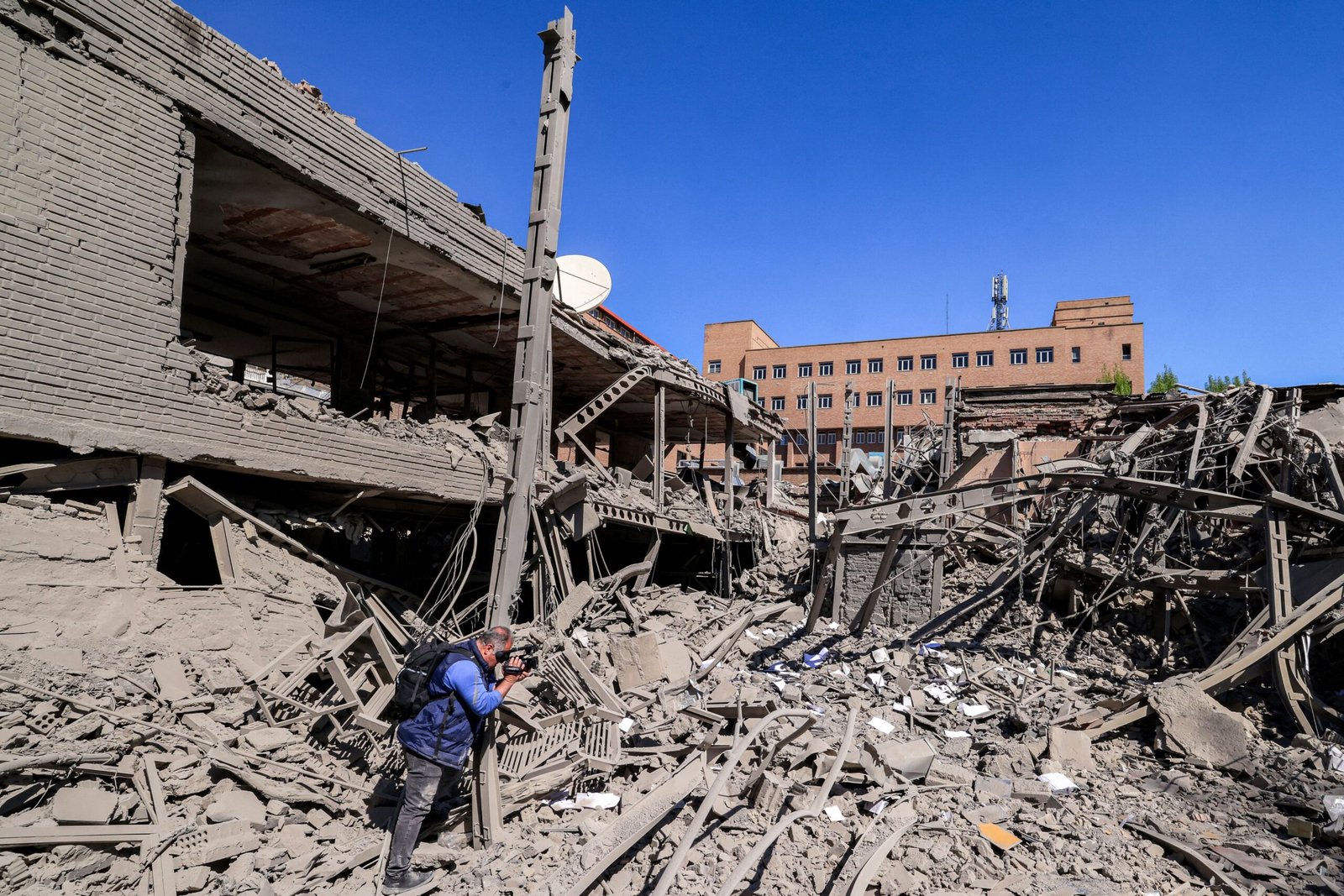
Journalists stand inside a residential building stripped of its facade after being hit by US-Israel airstrikes days before a two-week ceasefire between Iran and the United States took effect, at the Shahid Broujerdi residential complex in southern Tehran on April 14, 2026. (Photo: AFP)

For journalist Hadi Kasaeizadeh, these pressures became personal when Israeli missiles struck near his home in Shahr-e-Ray, south of Tehran.

“My press card and even my official publishing license meant nothing. I wasn’t allowed to photograph or report what I was seeing,” said Kasaeizadeh, editor-in-chief of arts and culture magazine Meydan-e Azadi. 

While some temporary wartime press restrictions are often justifiable, Iran’s heavy handed approach has been known to exceed legitimate national security needs. 

A journalist for two decades, Kasaeizadeh has exposed state corruption through the Telegram channel he ran with colleague Majid Motalebzadeh called, “Journalists Against Corruption.” He told CPJ that authorities have opened numerous judicial cases against him, summoning and interrogating him for his reporting. 

Despite the ease in strikes on Iran in recent months, access to areas affected by the conflict remains heavily restricted.

Access to the internet was also cut off. “When the global internet was cut, we didn’t even have Google,” he said. “The main source of news became Iran International and BBC Persian, even though they weren’t inside Iran. We were inside the country but couldn’t report our own reality.”

During the conflict, the severe blackout cut access to international databases, shipping trackers and crucial official data. The journalists said routine reporting was near impossible.

“If we received information by telephone, we often had no way to verify it with photographs, videos or documents,” said Maryam Shokrani, an economic journalist at Shargh newspaper.

Despite the easing of the internet blackout in late May, Shokrani said slow internet speed, forced VPN usage, blocked video calls and heavy online surveillance are still the order of the day.

Silent sources and self-censorship 

For journalist Reza Asadabadi, who covers the labor market and economy, the most profound shift has been what he describes as a total erosion of trust.

“Many of my sources, including officials and ordinary people, are afraid to speak in the current security climate,” he said. “Even when we promise that their names will not be published, and that they will only be talking about unemployment, the economy, or other non-political issues, they still refuse to speak.”

Several journalists said the contacts who once introduced reporters to knowledgeable sources before the war have become increasingly reluctant to do so. Witnesses, they say, hesitate to share photographs, experts increasingly decline interviews and officials often refuse to speak on the record. 

“We sometimes check a single story with seven or eight different people because official sources won’t speak openly,” said Asadabadi.

Shokrani agrees. For her, today’s biggest challenge is not so much finding the courage to report, but finding sources who are willing to talk. 

“Professional reporting was pushed into the shadows,” she said.
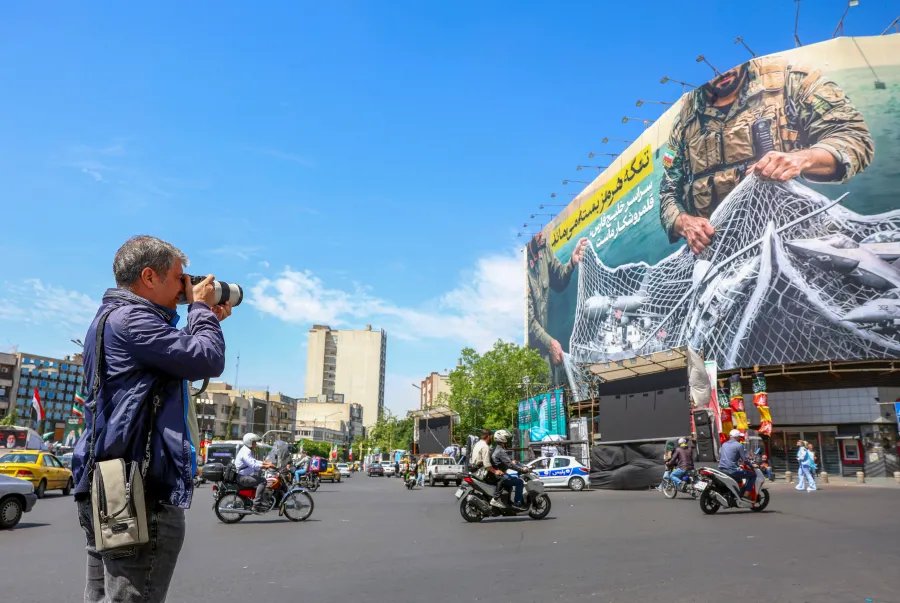
AFP photojournalist Atta Kenare works at the Revolution Square in Tehran on April 28, 2026. (Photo: AFP)

She also pointed to growing newsroom caution, and a rising fear that reporting on certain matters could later be interpreted as an offense to national security.

“The risk of writing became much higher,” she said.

Despite never having been summoned, one political reporter at a leading Tehran daily said the fear of prosecution changed the way he works, including avoiding sensitive topics and cutting contact with sources abroad. 

“I constantly feel that possibility [of being summoned] hanging over me,” said the journalist, who requested anonymity for fear of reprisal.

According to him, behind closed doors, his editors are routinely taking orders from security officials on how to cover sensitive subjects, and journalists are exceptionally cautious about whether to contact a source at all, with Signal and Telegram being their preferred means of communication due to their advanced encryption. 

“I now try to use more secure ways of communicating. Before this, I was much less cautious — the fear itself changes how you work.”

Financial pressures

At the same time, the already-dire financial pressures weakening independent journalism in Iran have been compounded by the war, according to journalists.

“The financial pressure on journalists today is, in many ways, more exhausting than the security pressure,” explained labor and economic journalist Asadabadi.

Many news organizations struggle to pay salaries on time, forcing journalists to work multiple jobs while financially strained media outlets become increasingly dependent on state support or commercial interests.

Many news organizations struggle to pay salaries on time, forcing journalists to work multiple jobs, while financially strained outlets are also cutting staff. In April, Shargh reported that more than 100 journalists and administrative employees had been laid off from one of Iran’s largest private media outlets, and around 50 journalists at prominent economic and financial newspaper Donya-e Eqtesad, as other outlets closed or failed to pay salaries and bonuses.

According to Kasaeizadeh, wartime office raids and confiscated equipment forced him to stop publishing his magazine. He said he was forced to sell his motorcycle and later his car to pay household expenses and his children’s university tuition. “I had no other choice,” he said.

Despite the growing restrictions, none of the journalists interviewed by CPJ said they intended to stop reporting. 

 “We cannot lose journalism,” said Shokrani. “If we lose it, rebuilding it for society may become impossible. We have a responsibility to preserve it, even in its most limited form.”

Kasaeizadeh, who has paid an immense cost for his reporting, said the pressure has never changed his commitment to journalism. 

“They tell me: don’t criticize, don’t fight corruption, mind your own business,” he said. “But this is my job.”

Read the full article here

Fact Checker

Verify the accuracy of this article using AI-powered analysis and real-time sources.

Get Your Fact Check Report

Enter your email to receive detailed fact-checking analysis

5 free reports remaining

Continue with Full Access

You've used your 5 free reports. Sign up for unlimited access!

Already have an account? Sign in here

Share. Facebook Twitter Pinterest LinkedIn Tumblr Email Telegram Copy Link
News Room
  • Website
  • Facebook
  • X (Twitter)
  • Instagram
  • LinkedIn

The FSNN News Room is the voice of our in-house journalists, editors, and researchers. We deliver timely, unbiased reporting at the crossroads of finance, cryptocurrency, and global politics, providing clear, fact-driven analysis free from agendas.

Related Articles

Global Free Speech

CPJ, IAPA warn broadcast fee proposal will force Costa Rican news outlets off air

17 hours ago
Global Free Speech

Pentagon fires Stars and Stripes staffers after editorial independence comments

2 days ago
Global Free Speech

In rebel-controlled eastern DRC, political coverage banned, journalist Claude Kashonga suspended 

2 days ago
Global Free Speech

CPJ renews call for Kyrgyzstan to drop charges against journalist Makhabat Tajibek kyzy as retrial begins

3 days ago
Global Free Speech

2 French journalists, Togolese fixer detained 26 days following arrest while documentary filming in northern Togo

6 days ago
Global Free Speech

  Chow Hang-tung and Lee Cheuk-yan, co-leaders of the now disbanded Hong Kong Alliance in Support of Patriotic Democratic Movements of China (HKA) were found guilty today (21 August 2026) of incitement to subversion, because they organised vigils attended by tens of thousands in Hong Kong’s Victoria Park to mark the 1989 Tiananmen Square massacre. The vigils were banned in 2020 and both have been detained since 2021. Below is a translation of Chow Hang-tung’s message to the world, published yesterday I’m curious about tomorrow’s verdict. Justice resides in the hearts of the people; there’s no need to look up to such top-down judgments. One verdict is nothing. Thank you all for walking alongside me in different ways. I have received all your support and blessings. ************ Because I don’t want everyone to worry too much, and I don’t want the focus to be lost, I’m sharing these feelings that have been weighing on my mind since the trial: Several years ago, I made a documentary with friends, trying to visualise the issue of torture by inviting Hong Kong friends to experience the various forms of torture suffered by protesters in China, so that it wouldn’t just remain a “tragedy” on paper. The “torture” depicted in the film was designed and researched by me. I thought I had some understanding of the subject, but only in the last couple of days have I realised I was a completely incompetent “torture officer” back then. I knew absolutely nothing about inflicting physical pain. It’s true that some things are impossible to comprehend no matter how much you read about them; you have to experience them firsthand. I say this because since the trial began, the Correctional Services Department [Hong Kong’s prison authority] has changed its method of transport. It’s no longer just simple handcuffs; now they use a full set of handcuffs, leg irons, waist chains, and ankle chains, and then lead the prisoners like dogs on a chain. From the written description alone, it seems like it’s just more inconvenient and somewhat humiliating, nothing like torture. But it’s only when you actually put on those shackles that you realise the devil is in the details. Ordinary handcuffs have buckles on both sides that connect with slipknots, allowing for limited movement between the hands. However, this set of specially made handcuffs has an outer layer of hard plastic covering the outer layer, locking the hands tightly together. This alone wouldn’t be so bad, but the “rings” on the handcuffs aren’t the round kind you usually see in adult stores (uh, I’ve been there, but only to buy props for filming!). Instead, there’s an additional hard material inside, shrinking into a flat, crescent shape that fits snugly at the thickest part of the wrist. So, when the wrist is inside, there’s absolutely no possibility of rotation; you can only constantly twist your arm to accommodate the angle designed by the handcuffs. That already restricts movement to two dimensions. Then comes the small buckle on the waist chain, which locks the handcuffs above the abdomen. If you dare to relax and let your hands hang down, the buckle will move up and lock into the thicker part of the wrist. Moreover, the locking angle is an extremely unnatural twisted pretzel, forcing one to constantly hunch their shoulders, hunch their back, bend their wrists, and twist their arms to try and avoid the handcuffs getting stuck in their wrist bones. However, complete avoidance is impossible; after all, constantly hunching one’s shoulders for the entire journey from Tai Lam [the prison where Hang-tung is incarcerated] to West Kowloon [the courthouse where the trial is taking place] would likely lead to muscle cramps. So, one can only “choose” which part of the body shall suffer in turn—when the shoulders are too tired, let the bones ache; when the hands are numb with pain, tighten the shoulders further. Then, throughout the entire journey, although most of the time is spent “still,” one is already exhausted from the unseen “muscle battle.” Not to mention, no matter how you are locked, you have to carry your belongings; for me, that means court documents. With that added weight, it is inevitable that the handcuffs will cut into the flesh. The deep marks carved into the wrists don’t fade even after a whole day in court. It turns out that locking a person’s joints in certain relative positions can create a kind of “interlocking” effect between body parts. But to the untrained eye, it’s invisible—”It’s just putting your hands in front of your stomach, child’s play.” Sigh, just looking at that statement, I feel I have no reason to complain; but I never imagined the combined effect of locking all the joints would be so powerful. Thinking back to when I was researching for the documentary, I only focused on finding the most exaggerated physical movements, the torture methods most easily identifiable by the naked eye. I was indeed viewing the victims’ experiences through the eyes of a layman. When I “tortured” my friend, the handcuffs were loosely fastened. I was completely unaware that locking the joints was the key—it really was just a childish experiment. Sophisticated torture, much like mature totalitarianism, avoids the visible, “violent” acts of violence. Its power lies in exploiting and creating internal conflicts among the people, fostering constant mutual surveillance, control, and reporting. This diffuses the perpetrators, making it impossible to identify or apprehend any single “evildoer.” People appear to have “choices,” but they are ultimately forced to choose between harming one party and abandoning another. Power, however, seems detached, never directly intervening. Visible, publicly observable conflicts vanish, leaving only unseen internal strife. The damage to society can be far more lasting and profound than occasional violence. On a more personal level, I find my resistance to physical torture is quite low. When my body aches, my mind becomes blank, overwhelmed by aches and pains, making it impossible to enjoy the scenery as usual. If I were subjected to some of the Ten Great Tortures of the Qing Dynasty, I might confess quickly. The ability to endure torture truly requires dedicated training. So, on the bright side, these 75 days of transport can be seen as initial training in physical endurance—as long as my hands aren’t ruined? To say that this correctional system is intentionally designed to torture prisoners wouldn’t be accurate; it’s just that the prisoners’ comfort or pain isn’t a consideration in its design. So, frankly, what I have endured is far from real torture; at best, it was just a preliminary glimpse. The designers’ primary consideration was probably “safety first,” ensuring prisoners have no possibility of movement. Ultimately, prisoners are at the bottom of the food chain—voiceless, powerless. Our opinions, even after suffering, are meaningless in the face of “safety.” Not to mention asking what security needs there were – frankly, even without handcuffs, a weak scholar like me couldn’t escape. Using so many tricks is overkill, but where can I reason with that? In cases where national security is invoked, even if a lawsuit is filed, it will have to be dropped and legal fees paid. But it’s precisely because I don’t want to never have anywhere to voice my grievances, and I don’t want people to remain silent and at the mercy of others, that I must persist in fighting for democracy and human rights, and for systemic change. In this sense, this new experience offered by Correctional Services is actually helping to strengthen my resolve to fight. Well then, thank you for this generous gift. I will certainly not let you down and will fight this ongoing battle well. I also hope that everyone can gain something from this long trial, perhaps just a little bit of strength, a little bit of encouragement, and that would be enough to fulfill my wish! This message was first posted on Chow Hang-tung’s Patreon account yesterday. We are publishing this with the permission of Brian Kern who translated her message on his Substack account     READ MORE

6 days ago
Add A Comment
Leave A Reply Cancel Reply

Editors Picks

The cost of truth: Inside Iran’s mounting media crackdown 

17 minutes ago

Clearing firm RQD* raises $74 million as Wall Street prepares for tokenized markets

25 minutes ago

Ripple Prime Launches Delta One for US Equity Derivatives

29 minutes ago

Data Center Savior

1 hour ago
Latest Posts

AI bug reports trigger emergency warning for Bitcoin Lightning node operators

1 hour ago

UK Expands Bank of England Mandate to Cover Stablecoins

1 hour ago

Bitcoin ETFs Draw $2.8B in Eight-Day Streak as BTC Tests $80K

2 hours ago

Subscribe to News

Get the latest news and updates directly to your inbox.

At FSNN – Free Speech News Network, we deliver unfiltered reporting and in-depth analysis on the stories that matter most. From breaking headlines to global perspectives, our mission is to keep you informed, empowered, and connected.

FSNN.net is owned and operated by GlobalBoost Media
, an independent media organization dedicated to advancing transparency, free expression, and factual journalism across the digital landscape.

Facebook X (Twitter) Discord Telegram
Latest News

Official Precedent from a Supreme Court Justice’s Opinion: We Jews Are “a Highly Intellectual Race”

8 minutes ago

The cost of truth: Inside Iran’s mounting media crackdown 

17 minutes ago

Clearing firm RQD* raises $74 million as Wall Street prepares for tokenized markets

25 minutes ago

Subscribe to Updates

Get the latest news and updates directly to your inbox.

© 2026 GlobalBoost Media. All Rights Reserved.
  • Privacy Policy
  • Terms of Service
  • Our Authors
  • Contact

Type above and press Enter to search. Press Esc to cancel.

🍪

Cookies

We and our selected partners wish to use cookies to collect information about you for functional purposes and statistical marketing. You may not give us your consent for certain purposes by selecting an option and you can withdraw your consent at any time via the cookie icon.

Cookie Preferences

Manage Cookies

Cookies are small text that can be used by websites to make the user experience more efficient. The law states that we may store cookies on your device if they are strictly necessary for the operation of this site. For all other types of cookies, we need your permission. This site uses various types of cookies. Some cookies are placed by third party services that appear on our pages.

Your permission applies to the following domains:

  • https://fsnn.net
Necessary
Necessary cookies help make a website usable by enabling basic functions like page navigation and access to secure areas of the website. The website cannot function properly without these cookies.
Statistic
Statistic cookies help website owners to understand how visitors interact with websites by collecting and reporting information anonymously.
Preferences
Preference cookies enable a website to remember information that changes the way the website behaves or looks, like your preferred language or the region that you are in.
Marketing
Marketing cookies are used to track visitors across websites. The intention is to display ads that are relevant and engaging for the individual user and thereby more valuable for publishers and third party advertisers.