Close Menu
FSNN | Free Speech News NetworkFSNN | Free Speech News Network
  • Home
  • News
    • Politics
    • Legal & Courts
    • Tech & Big Tech
    • Campus & Education
    • Media & Culture
    • Global Free Speech
  • Opinions
    • Debates
  • Video/Live
  • Community
  • Freedom Index
  • About
    • Mission
    • Contact
    • Support
Trending

Agentic Memory: Walrus Takes On AI’s Next Big Bottleneck

3 minutes ago

Licensed to speak? How NY’s AI bill gets it wrong.

23 minutes ago

Open Records Laws Reveal ALPRs’ Sprawling Surveillance. Now States Want to Block What the Public Sees.

26 minutes ago
Facebook X (Twitter) Instagram
Facebook X (Twitter) Discord Telegram
FSNN | Free Speech News NetworkFSNN | Free Speech News Network
Market Data Newsletter
Thursday, April 30
  • Home
  • News
    • Politics
    • Legal & Courts
    • Tech & Big Tech
    • Campus & Education
    • Media & Culture
    • Global Free Speech
  • Opinions
    • Debates
  • Video/Live
  • Community
  • Freedom Index
  • About
    • Mission
    • Contact
    • Support
FSNN | Free Speech News NetworkFSNN | Free Speech News Network
Home»News»Media & Culture»CRISPR Genome Editing and the Future of Down Syndrome Treatment
Media & Culture

CRISPR Genome Editing and the Future of Down Syndrome Treatment

News RoomBy News Room2 hours agoNo Comments5 Mins Read618 Views
Share Facebook Twitter Pinterest Copy Link LinkedIn Tumblr Email VKontakte Telegram
CRISPR Genome Editing and the Future of Down Syndrome Treatment
Share
Facebook Twitter Pinterest Email Copy Link

Listen to the article

0:00
0:00

Key Takeaways

Playback Speed

Select a Voice

Deaf children can now hear thanks to a new treatment that repairs a defective gene. Researchers associated with the biotech company Regeneron Pharmaceuticals unveiled the successful gene therapy last week. One patient, who was treated at 18 months old, Travis Smith, can now hear. Overall, 80 percent of participants (aged 10 months to 16), saw significant improvement in hearing, and 42 percent achieved normal hearing, including the ability to hear whispers. The Food and Drug Administration (FDA) has already approved the treatment.

Medical research on ameliorating physical and intellectual maladies continues apace. For example, researchers at Harvard Medical School reported earlier this month that they have made progress in silencing the extra chromosome that causes Down syndrome using the genome editing technique CRISPR.

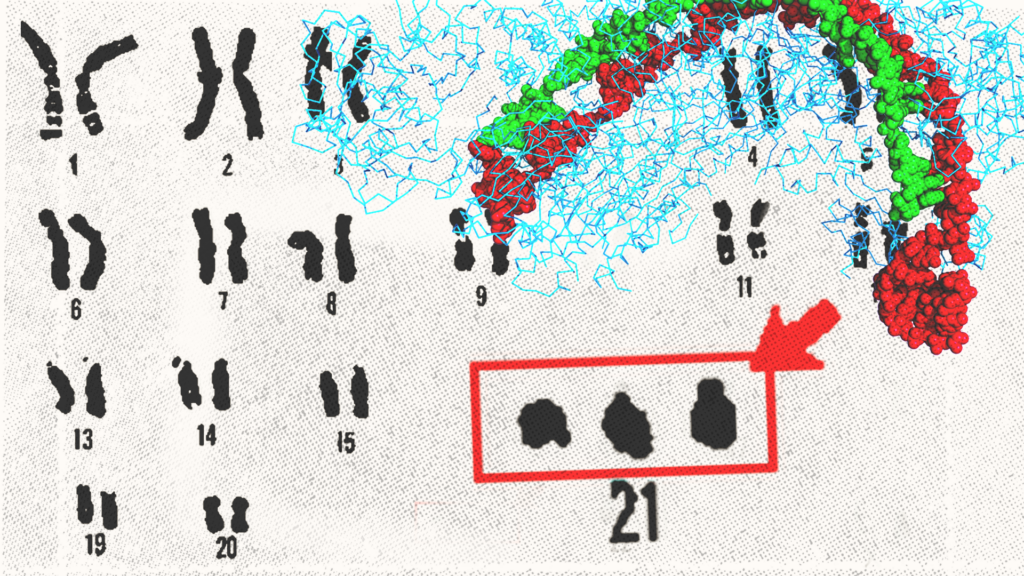
Down syndrome is a genetic condition in which a person has an extra copy of chromosome 21. While its severity varies, people with the condition experience lifelong intellectual disability and developmental delays, along with heart and digestive system problems and a significantly higher risk of Alzheimer’s disease.

CRISPR techniques have recently been successfully applied to treating other genetic conditions, including sickle cell anemia and a rare inborn error of metabolism of the urea cycle, which causes life-threatening accumulation of ammonia in the bloodstream.

Keeping in mind that the new Harvard study is a very preliminary cell-based experiment, the researchers believe their work “paves a road for therapeutic treatment for DS [Down syndrome].” It’s likely to be a long road, but the development of a way to successfully correct this genetic error raises some interesting ethical issues.

Currently, about 67 percent of women in the United States who receive a positive prenatal test for Down syndrome choose to terminate the pregnancy. These decisions might have been changed if the extra chromosome could be safely silenced in fetuses before birth.

But what about offering the CRISPR treatment to children and adults with Down syndrome?

University of Warwick bioethicist Felicity Boardman has suggested that the development of genetic treatments for various conditions, such as deafness, dwarfism, and blindness, would “convey and perpetuate negative views about the particular disabling conditions they are targeted towards, and, by extension, people who currently live with those conditions.” The fact of disability does not diminish the inherent moral worth of any individual. And thanks in large part to their activism, many barriers that once prevented disabled folks from more fully participating in society have been lowered and ameliorated.

As the success of the Regeneron treatment for deafness, however, shows, many people with specific disabilities (and their guardians) already seek out corrective treatments when they become available. For example, some 315,000 deaf Americans have chosen to use cochlear implants to enable them to hear. Genetic treatments for blindness are also being developed. Adult deaf and blind people can give their informed consent to the corrective measures. Of course, in the case of the deaf infants and minor children treated using the Regeneron gene therapy, their parents did.

Already treatments are recommended to mend infirmities that often accompany Down syndrome, such as surgery to repair heart defects. Silencing the extra chromosome in children and adults to treat heart and digestive maladies, or even Alzheimer’s disease risks associated with Down syndrome, does not seem especially problematic ethically.

But who can ethically make decisions that affect intellectual disabilities? After all, the effects of safely delivering effective chromosome silencing to the brains of a child or an adult with Down syndrome would be even more profound than restoring hearing or sight. People with Down syndrome, whose extra chromosome was silenced in their brain cells, might undergo a change in cognition, something like what Charlie Gordon experiences in the sci-fi story Flowers for Algernon, but in this case, the change would be permanent.

There are now reams of studies and reports on how researchers and clinicians should go about obtaining informed consent from people with intellectual disabilities. Most often, the ultimate decision to treat or not rests with the parent or legal guardian of the patient. Various surveys find that some parents of children with Down syndrome would be interested in genetic interventions that improve their child’s cognitive ability. In Flowers for Algernon, Gordon’s estranged sister provided the consent for the experimental treatment that (albeit temporarily) boosts his IQ from 68 to over 185.

Since Down syndrome is implicated in their very identity, successfully treated folks would in some very real sense no longer be the persons that they were. Perhaps one fruitful way to think about the ethical implications of using chromosome silencing is to ask yourself if you would accept a safe treatment that would significantly boost your IQ or improve your memory? (I, for one, would happily accept a cure for my aphantasia.)

In Flowers for Algernon, Gordon writes in his initial entry of his progress report diary, “I hope they use me. Miss Kinnian says maybe they can make me smart. I want to be smart.” Becoming smarter did not ultimately make Gordon happier; he did not have time to adjust to his changed mental and emotional states. Assuming chromosome silencing improves cognition, treated Down syndrome folks, unlike Gordon, would have that time. And research suggests that higher intelligence correlates with greater happiness.

“Should we be using CRISPR for diseases or syndromes that are compatible with life, like Down syndrome?” asked Harvard physician Neal Baer at a symposium last year. “Who is going to make those decisions?” The ethical answer is yes, and we should trust parents— and no one else—to make those decisions.

Read the full article here

Fact Checker

Verify the accuracy of this article using AI-powered analysis and real-time sources.

Get Your Fact Check Report

Enter your email to receive detailed fact-checking analysis

5 free reports remaining

Continue with Full Access

You've used your 5 free reports. Sign up for unlimited access!

Already have an account? Sign in here

#FreePress #IndependentMedia #MediaAccountability #NewsAnalysis #PublicOpinion
Share. Facebook Twitter Pinterest LinkedIn Tumblr Email Telegram Copy Link
News Room
  • Website
  • Facebook
  • X (Twitter)
  • Instagram
  • LinkedIn

The FSNN News Room is the voice of our in-house journalists, editors, and researchers. We deliver timely, unbiased reporting at the crossroads of finance, cryptocurrency, and global politics, providing clear, fact-driven analysis free from agendas.

Related Articles

Cryptocurrency & Free Speech Finance

Agentic Memory: Walrus Takes On AI’s Next Big Bottleneck

3 minutes ago
Media & Culture

Migrant Deaths Hit Record High Under Trump 2.0

32 minutes ago
Media & Culture

Europe Has Too Few Workers and Too Many Retirees. Cutting Immigration Will Make the Math Worse.

34 minutes ago
Cryptocurrency & Free Speech Finance

MegaETH Token Launches as Ethereum Layer-2 Network’s Novel Rewards System Is Tested

1 hour ago
Cryptocurrency & Free Speech Finance

Gemini Gains Key CFTC Approval to Expand Prediction Market, Perps Offerings

2 hours ago
Media & Culture

Justice John Marshall Harlan and Birth Tourism

3 hours ago
Add A Comment
Leave A Reply Cancel Reply

Editors Picks

Licensed to speak? How NY’s AI bill gets it wrong.

23 minutes ago

Open Records Laws Reveal ALPRs’ Sprawling Surveillance. Now States Want to Block What the Public Sees.

26 minutes ago

Migrant Deaths Hit Record High Under Trump 2.0

32 minutes ago

Europe Has Too Few Workers and Too Many Retirees. Cutting Immigration Will Make the Math Worse.

34 minutes ago
Latest Posts

CPJ documentation of Israeli harm against Palestinian journalists, media workers

41 minutes ago

Gemini shares surge on potential prediction market challenge to Kalshi, Polymarket, Hyperliquid

1 hour ago

Bitcoin Price Is Likely to Remain Under $80K for Longer: Here’s Why

1 hour ago

Subscribe to News

Get the latest news and updates directly to your inbox.

At FSNN – Free Speech News Network, we deliver unfiltered reporting and in-depth analysis on the stories that matter most. From breaking headlines to global perspectives, our mission is to keep you informed, empowered, and connected.

FSNN.net is owned and operated by GlobalBoost Media
, an independent media organization dedicated to advancing transparency, free expression, and factual journalism across the digital landscape.

Facebook X (Twitter) Discord Telegram
Latest News

Agentic Memory: Walrus Takes On AI’s Next Big Bottleneck

3 minutes ago

Licensed to speak? How NY’s AI bill gets it wrong.

23 minutes ago

Open Records Laws Reveal ALPRs’ Sprawling Surveillance. Now States Want to Block What the Public Sees.

26 minutes ago

Subscribe to Updates

Get the latest news and updates directly to your inbox.

© 2026 GlobalBoost Media. All Rights Reserved.
  • Privacy Policy
  • Terms of Service
  • Our Authors
  • Contact

Type above and press Enter to search. Press Esc to cancel.

🍪

Cookies

We and our selected partners wish to use cookies to collect information about you for functional purposes and statistical marketing. You may not give us your consent for certain purposes by selecting an option and you can withdraw your consent at any time via the cookie icon.

Cookie Preferences

Manage Cookies

Cookies are small text that can be used by websites to make the user experience more efficient. The law states that we may store cookies on your device if they are strictly necessary for the operation of this site. For all other types of cookies, we need your permission. This site uses various types of cookies. Some cookies are placed by third party services that appear on our pages.

Your permission applies to the following domains:

  • https://fsnn.net
Necessary
Necessary cookies help make a website usable by enabling basic functions like page navigation and access to secure areas of the website. The website cannot function properly without these cookies.
Statistic
Statistic cookies help website owners to understand how visitors interact with websites by collecting and reporting information anonymously.
Preferences
Preference cookies enable a website to remember information that changes the way the website behaves or looks, like your preferred language or the region that you are in.
Marketing
Marketing cookies are used to track visitors across websites. The intention is to display ads that are relevant and engaging for the individual user and thereby more valuable for publishers and third party advertisers.