Close Menu
FSNN | Free Speech News NetworkFSNN | Free Speech News Network
  • Home
  • News
    • Politics
    • Legal & Courts
    • Tech & Big Tech
    • Campus & Education
    • Media & Culture
    • Global Free Speech
  • Opinions
    • Debates
  • Video/Live
  • Community
  • Freedom Index
  • About
    • Mission
    • Contact
    • Support
Trending

Crypto tax bills a work-in-progress as U.S. House lawmakers pose concerns

8 minutes ago

Solana Institute urges CLARITY Act developer protections

10 minutes ago

EU Orders Meta to Open WhatsApp to Rival AI Chatbots—Meta Calls It ‘Regulatory Overreach’

11 minutes ago
Facebook X (Twitter) Instagram
Facebook X (Twitter) Discord Telegram
FSNN | Free Speech News NetworkFSNN | Free Speech News Network
Market Data Newsletter
Tuesday, June 9
  • Home
  • News
    • Politics
    • Legal & Courts
    • Tech & Big Tech
    • Campus & Education
    • Media & Culture
    • Global Free Speech
  • Opinions
    • Debates
  • Video/Live
  • Community
  • Freedom Index
  • About
    • Mission
    • Contact
    • Support
FSNN | Free Speech News NetworkFSNN | Free Speech News Network
Home»News»Media & Culture»The Surprising Divide Over What Counts as True
Media & Culture

The Surprising Divide Over What Counts as True

News RoomBy News Room4 weeks agoNo Comments4 Mins Read1,469 Views
Share Facebook Twitter Pinterest Copy Link LinkedIn Tumblr Email VKontakte Telegram
The Surprising Divide Over What Counts as True
Share
Facebook Twitter Pinterest Email Copy Link

Listen to the article

0:00
0:00

Key Takeaways

Playback Speed

Select a Voice

Maria and Peter are students and meet up for a late dinner. Peter asks Maria whether Tom is at the party that they intend to go to after dinner. Maria answers that Tom is at the party. After all, Tom had told her that he would be at the party. When they arrive at the party, it turns out that Tom had changed his plans, and is not at the party.

This was the scenario posed to research participants in a new study by a team of European researchers. They were then asked: Was Maria’s answer true or false?

It’s pretty clear that Maria’s answer is false, at least from my point of view. In other words, I am fully embracing the correspondence theory of truth. However, the study, published in Cognition, shockingly found that only just over 50 percent of participants would agree with me. Apparently, many other people tend to identify truth with how well a statement fits within a person’s coherent set of beliefs or whether a person’s beliefs are authentic, that is, they are sincere and honest.

To probe how ordinary people think about what is true, the researchers first created conceptual maps of 200 participants asking how similar they think truth is to other related concepts. For example, correspondence related to “reality” and “fact”; coherence to “justification” and “reason”; and authenticity to “honesty” and “transparency.” While many participants endorsed notions relating to all three conceptions of truth, in a “winner-takes-all” summary of the judgements, 55 percent aligned most strongly with correspondence.
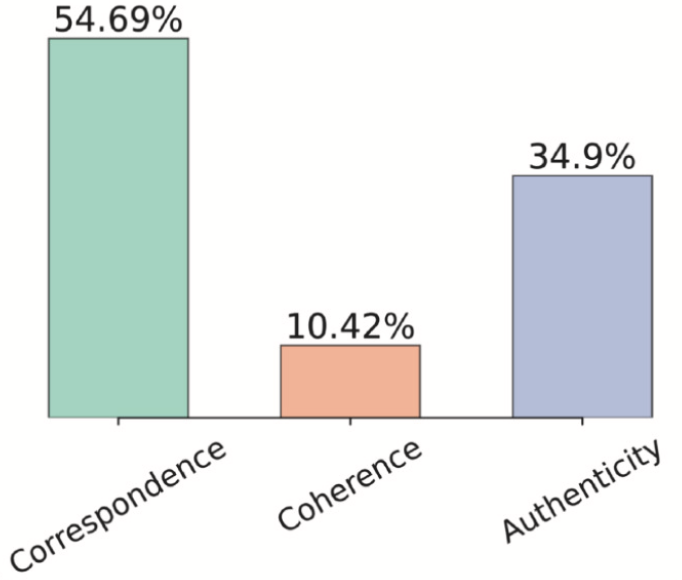
Reuter et al.

In other words, just a bare majority believes that truth is defined by factual reality.

The researchers then wanted to see if these concepts of the truth remained stable in individuals over time. So three months later, they managed to contact 128 of the original participants and ask them to consider what is the truth in the above Maria vignette. In this case, the choice was binary: Was Maria’s statement true or false? As the researchers explained, “A ‘true’ response reflects an authenticity- or coherence-based understanding, as it emphasizes Maria’s sincerity or justification at the time of speaking, while a ‘false’ response reflects a correspondence view, judging truth based on factual alignment with reality.” I have no trouble accepting that Maria could try to justify her sincere and honest belief that Tom was at the party, but the plain truth is that he wasn’t there.

In the later survey, it turns out that an individual’s concept of truth does modestly predict how he or she evaluates the truth of Maria’s statement. The researchers report, “Overall 68 (53.13%) participants responded that Maria’s answer was false (agreeing with correspondence theory) and 60 (46.89%) that her answer was true (agreeing with an authenticity or coherence notion of truth).” Again, a bare majority endorsed factual reality as the standard for determining what is true.

In an article describing their findings over at Psyche, the researchers outline how different conceptions of the truth can cause conflict:

Imagine someone makes a statement about climate change. The discussion unfolds predictably: one side posts links to data (correspondence), the other side cares less about data and replies with accusations of bad faith (authenticity), or they argue that the statement is untrue because it doesn’t fit everything else they already believe to be true (coherence). In such disagreements, giving more of the evidence that convinces you could risk making the conflict worse, not better.

We have all been there, haven’t we? Even for those who endorse the correspondence theory of truth must still grapple with the pervasive problem of confirmation bias.

As I reported a while back, research by the Yale law professor Dan Kahan finds that as scientific literacy goes up, so too does partisan polarization on the issue of climate change. In other words, the more science people know, the more they are able to seek out and find information justifying their beliefs.

Nevertheless, the European researchers suggest hopefully that understanding the differences in the conceptions of what is true may help us more fruitfully navigate political and policy disagreements.

Read the full article here

Fact Checker

Verify the accuracy of this article using AI-powered analysis and real-time sources.

Get Your Fact Check Report

Enter your email to receive detailed fact-checking analysis

5 free reports remaining

Continue with Full Access

You've used your 5 free reports. Sign up for unlimited access!

Already have an account? Sign in here

#Journalism #MediaAccountability #OpenDebate #PoliticalNews #PublicOpinion
Share. Facebook Twitter Pinterest LinkedIn Tumblr Email Telegram Copy Link
News Room
  • Website
  • Facebook
  • X (Twitter)
  • Instagram
  • LinkedIn

The FSNN News Room is the voice of our in-house journalists, editors, and researchers. We deliver timely, unbiased reporting at the crossroads of finance, cryptocurrency, and global politics, providing clear, fact-driven analysis free from agendas.

Related Articles

Cryptocurrency & Free Speech Finance

EU Orders Meta to Open WhatsApp to Rival AI Chatbots—Meta Calls It ‘Regulatory Overreach’

11 minutes ago
Media & Culture

Techdirt Podcast Episode 452: How To Stop Good Companies From Going Bad

52 minutes ago
Media & Culture

Trump’s $100,000 H-1B Visa Fee Is an Unconstitutional Tax, a Federal Judge Rules

54 minutes ago
Legal & Courts

Trump Administration Playbook Takes Tactics from Lavender Scare of the Cold War

58 minutes ago
Legal & Courts

RCFP sues DOJ, ICE for records related to arrests of independent journalists Don Lemon, Georgia Fort, and Shane Bollman

1 hour ago
Cryptocurrency & Free Speech Finance

December Trial Date Set for US Soldier Accused of Insider Trading on Polymarket

1 hour ago
Add A Comment

Comments are closed.

Editors Picks

Solana Institute urges CLARITY Act developer protections

10 minutes ago

EU Orders Meta to Open WhatsApp to Rival AI Chatbots—Meta Calls It ‘Regulatory Overreach’

11 minutes ago

Techdirt Podcast Episode 452: How To Stop Good Companies From Going Bad

52 minutes ago

Trump’s $100,000 H-1B Visa Fee Is an Unconstitutional Tax, a Federal Judge Rules

54 minutes ago
Latest Posts

Trump Administration Playbook Takes Tactics from Lavender Scare of the Cold War

58 minutes ago

RCFP sues DOJ, ICE for records related to arrests of independent journalists Don Lemon, Georgia Fort, and Shane Bollman

1 hour ago

Securitize CEO says tokenized stocks could unlock a $5 trillion crypto market

1 hour ago

Subscribe to News

Get the latest news and updates directly to your inbox.

At FSNN – Free Speech News Network, we deliver unfiltered reporting and in-depth analysis on the stories that matter most. From breaking headlines to global perspectives, our mission is to keep you informed, empowered, and connected.

FSNN.net is owned and operated by GlobalBoost Media
, an independent media organization dedicated to advancing transparency, free expression, and factual journalism across the digital landscape.

Facebook X (Twitter) Discord Telegram
Latest News

Crypto tax bills a work-in-progress as U.S. House lawmakers pose concerns

8 minutes ago

Solana Institute urges CLARITY Act developer protections

10 minutes ago

EU Orders Meta to Open WhatsApp to Rival AI Chatbots—Meta Calls It ‘Regulatory Overreach’

11 minutes ago

Subscribe to Updates

Get the latest news and updates directly to your inbox.

© 2026 GlobalBoost Media. All Rights Reserved.
  • Privacy Policy
  • Terms of Service
  • Our Authors
  • Contact

Type above and press Enter to search. Press Esc to cancel.

🍪

Cookies

We and our selected partners wish to use cookies to collect information about you for functional purposes and statistical marketing. You may not give us your consent for certain purposes by selecting an option and you can withdraw your consent at any time via the cookie icon.

Cookie Preferences

Manage Cookies

Cookies are small text that can be used by websites to make the user experience more efficient. The law states that we may store cookies on your device if they are strictly necessary for the operation of this site. For all other types of cookies, we need your permission. This site uses various types of cookies. Some cookies are placed by third party services that appear on our pages.

Your permission applies to the following domains:

  • https://fsnn.net
Necessary
Necessary cookies help make a website usable by enabling basic functions like page navigation and access to secure areas of the website. The website cannot function properly without these cookies.
Statistic
Statistic cookies help website owners to understand how visitors interact with websites by collecting and reporting information anonymously.
Preferences
Preference cookies enable a website to remember information that changes the way the website behaves or looks, like your preferred language or the region that you are in.
Marketing
Marketing cookies are used to track visitors across websites. The intention is to display ads that are relevant and engaging for the individual user and thereby more valuable for publishers and third party advertisers.