Close Menu
FSNN | Free Speech News NetworkFSNN | Free Speech News Network
  • Home
  • News
    • Politics
    • Legal & Courts
    • Tech & Big Tech
    • Campus & Education
    • Media & Culture
    • Global Free Speech
  • Opinions
    • Debates
  • Video/Live
  • Community
  • Freedom Index
  • About
    • Mission
    • Contact
    • Support
Trending

Tom Lee's BitMine pushes Ethereum into $8 billion staking backlog

16 minutes ago

DOJ Didn’t Sell Any Bitcoin Forfeited From Samourai case

18 minutes ago

EFF Condemns FBI Search of Washington Post Reporter’s Home

54 minutes ago
Facebook X (Twitter) Instagram
Facebook X (Twitter) Discord Telegram
FSNN | Free Speech News NetworkFSNN | Free Speech News Network
Market Data Newsletter
Saturday, January 17
  • Home
  • News
    • Politics
    • Legal & Courts
    • Tech & Big Tech
    • Campus & Education
    • Media & Culture
    • Global Free Speech
  • Opinions
    • Debates
  • Video/Live
  • Community
  • Freedom Index
  • About
    • Mission
    • Contact
    • Support
FSNN | Free Speech News NetworkFSNN | Free Speech News Network
Home»News»Media & Culture»Nepal’s Socialist Government Banned Social Media, So Activists Plotted a Revolution—on Discord.
Media & Culture

Nepal’s Socialist Government Banned Social Media, So Activists Plotted a Revolution—on Discord.

News RoomBy News Room1 month agoNo Comments4 Mins Read111 Views
Share Facebook Twitter Pinterest Copy Link LinkedIn Tumblr Email VKontakte Telegram
Nepal’s Socialist Government Banned Social Media, So Activists Plotted a Revolution—on Discord.
Share
Facebook Twitter Pinterest Email Copy Link

Listen to the article

0:00
0:00

Key Takeaways

Playback Speed

Select a Voice

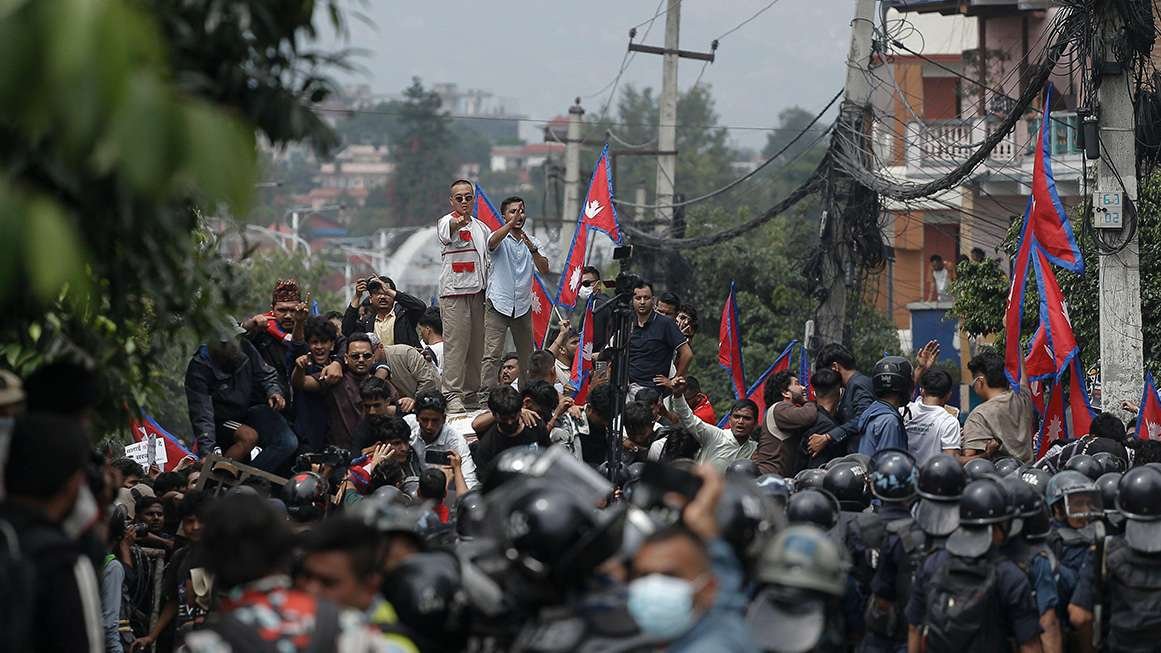
They marched to defend free speech online and ended up reshaping a nation. In September 2025, young protesters opposing Nepal’s social media ban triggered a political upheaval that brought Sushila Karki to power as the country’s first woman prime minister—with much of the organizing happening on the messaging platform Discord.

When the government collapsed, the Nepali military took charge and appointed Karki as transitional leader. Rather than a true “election,” activists held a rushed Discord chat to discuss whom to suggest to the army as leader. Nepalese youth have been organizing quickly to ensure the revolution isn’t hijacked by elements of the old political class who are still in power.

The revolution has been a crash course in “political literacy,” says Samana Lawaki, a member of the Indigenous Gen-Z Collective, one of the organizations founded to represent the revolutionary youth. “A lot of people were saying that they didn’t understand what a referendum is, what an ordinance is, what constitutional values are, and now these young people are trying to learn,” she says. “Our generation is doing a lot, and I’m really proud.”

The nation transitioned from a monarchy to a republic in 2008, but that revolution did not fulfill its promises. Nepal is consistently one of the poorest countries in Asia—hundreds of thousands go abroad to find work every year—and its ruling socialist parties have a reputation for corruption.

In summer 2025, the hashtag #nepokids (a reference to nepotism) spread on social media, criticizing the lavish lifestyle of politicians’ families. When the government tried to ban several foreign social media platforms for ostensibly failing to follow new regulations, many critics thought the regulations were just a pretext to stop the spread of #nepokids content.

Protests against the social media ban broke out in Kathmandu on September 8. The protesters were neither expecting nor prepared to overthrow the government. Then authorities shot protesters with live ammunition. “Nobody expected the level of violence instigated by the state,” says Lawaki, who was at the protests. She recalls a peaceful atmosphere, with young schoolchildren in their uniforms joining the protests, and “could not comprehend” why she suddenly heard gunfire. “Even if there is shooting happening, it must be some kind of rubber bullets,” Lawaki recalls thinking at the time. “But it was not.”

At least 19 people were killed on that first day. Enraged protesters stormed government buildings and politicians’ houses. Zak Aldridge, a former classmate of mine who moved to Kathmandu to pursue the Buddhist path, was traveling through a small border town when the revolution broke out. “I’m up in this hotel thinking, this feels like a bad day to be in the big house,” Aldridge recalls, as he soon learned that the hotel was owned by a member of Parliament and that several politicians were staying there. “I open up the blinds, and there’s 100 guys across the street shouting.”

Aldridge slipped out and greeted the protesters. “You know, they actually apologized to me,” he says. They told him, “We’re sorry, it’s not about you. It’s about us and our corrupt government today, and we’re sorry you got caught in the crossfire,” adding: “If you know anyone else still in the hotel, please tell them to get out because we’re going to burn it tonight.” They didn’t follow through on that threat.

By the second day, former Prime Minister K.P. Sharma Oli resigned and the army took charge. Karki, a former Supreme Court chief justice who had come out early in support of the protests, met with the military after a 100,000-person Discord chat coalesced around her as a leader.

There are questions, of course, about the representativeness of that process. “The streets spoke louder than Discord. Gen Z movement was all of us, not a brand,” social media user Suryasiva Kumar commented on a Reddit thread complaining about various organizers’ self-promotion.

Nevertheless, Karki will lead a transitional government until the next elections, scheduled for March 2026, which will be
the real test of the revolution. “This is a generation of various groups. All of us might not have the same political ideology,” Lawaki says. “This interim government needs to be solid, so that we can have a just and fair election.”

This article originally appeared in print under the headline “Discord Revolution
in the Himalayas.”

Read the full article here

Fact Checker

Verify the accuracy of this article using AI-powered analysis and real-time sources.

Get Your Fact Check Report

Enter your email to receive detailed fact-checking analysis

5 free reports remaining

Continue with Full Access

You've used your 5 free reports. Sign up for unlimited access!

Already have an account? Sign in here

Share. Facebook Twitter Pinterest LinkedIn Tumblr Email Telegram Copy Link
News Room
  • Website
  • Facebook
  • X (Twitter)
  • Instagram
  • LinkedIn

The FSNN News Room is the voice of our in-house journalists, editors, and researchers. We deliver timely, unbiased reporting at the crossroads of finance, cryptocurrency, and global politics, providing clear, fact-driven analysis free from agendas.

Related Articles

Media & Culture

Report Says AI That Hallucinated A Cop Into A Frog Is Making Utah Streets ‘Safer’

56 minutes ago
Media & Culture

Video Shows Feds Shooting ICE Protester With Nonlethal Round at Point-Blank Range, Blinding Him in One Eye

59 minutes ago
Cryptocurrency & Free Speech Finance

Wikipedia Reveals Multiple Deals with AI Giants to Use Its Content

1 hour ago
Media & Culture

ICE vs. Wine Moms, Rogan on Fauci’s Crimes, and the Star Wars Prequels

2 hours ago
Cryptocurrency & Free Speech Finance

Bitcoin Seized From Samourai Wallet Has Not Been Sold, White House Says

2 hours ago
Media & Culture

NoFap Founder Sued Pornhub, UCLA, and Scientists While Intimidating Journalists.

3 hours ago
Add A Comment

Comments are closed.

Editors Picks

DOJ Didn’t Sell Any Bitcoin Forfeited From Samourai case

18 minutes ago

EFF Condemns FBI Search of Washington Post Reporter’s Home

54 minutes ago

Report Says AI That Hallucinated A Cop Into A Frog Is Making Utah Streets ‘Safer’

56 minutes ago

Video Shows Feds Shooting ICE Protester With Nonlethal Round at Point-Blank Range, Blinding Him in One Eye

59 minutes ago
Latest Posts

Hacker steals $282 million crypto from a victim in social-engineering attack

1 hour ago

Bull, base or bear? Three possible paths for crypto in 2026

1 hour ago

Wikipedia Reveals Multiple Deals with AI Giants to Use Its Content

1 hour ago

Subscribe to News

Get the latest news and updates directly to your inbox.

At FSNN – Free Speech News Network, we deliver unfiltered reporting and in-depth analysis on the stories that matter most. From breaking headlines to global perspectives, our mission is to keep you informed, empowered, and connected.

FSNN.net is owned and operated by GlobalBoost Media
, an independent media organization dedicated to advancing transparency, free expression, and factual journalism across the digital landscape.

Facebook X (Twitter) Discord Telegram
Latest News

Tom Lee's BitMine pushes Ethereum into $8 billion staking backlog

16 minutes ago

DOJ Didn’t Sell Any Bitcoin Forfeited From Samourai case

18 minutes ago

EFF Condemns FBI Search of Washington Post Reporter’s Home

54 minutes ago

Subscribe to Updates

Get the latest news and updates directly to your inbox.

© 2026 GlobalBoost Media. All Rights Reserved.
  • Privacy Policy
  • Terms of Service
  • Our Authors
  • Contact

Type above and press Enter to search. Press Esc to cancel.

🍪

Cookies

We and our selected partners wish to use cookies to collect information about you for functional purposes and statistical marketing. You may not give us your consent for certain purposes by selecting an option and you can withdraw your consent at any time via the cookie icon.

Cookie Preferences

Manage Cookies

Cookies are small text that can be used by websites to make the user experience more efficient. The law states that we may store cookies on your device if they are strictly necessary for the operation of this site. For all other types of cookies, we need your permission. This site uses various types of cookies. Some cookies are placed by third party services that appear on our pages.

Your permission applies to the following domains:

  • https://fsnn.net
Necessary
Necessary cookies help make a website usable by enabling basic functions like page navigation and access to secure areas of the website. The website cannot function properly without these cookies.
Statistic
Statistic cookies help website owners to understand how visitors interact with websites by collecting and reporting information anonymously.
Preferences
Preference cookies enable a website to remember information that changes the way the website behaves or looks, like your preferred language or the region that you are in.
Marketing
Marketing cookies are used to track visitors across websites. The intention is to display ads that are relevant and engaging for the individual user and thereby more valuable for publishers and third party advertisers.