

 Freedom Index
Listen to the article
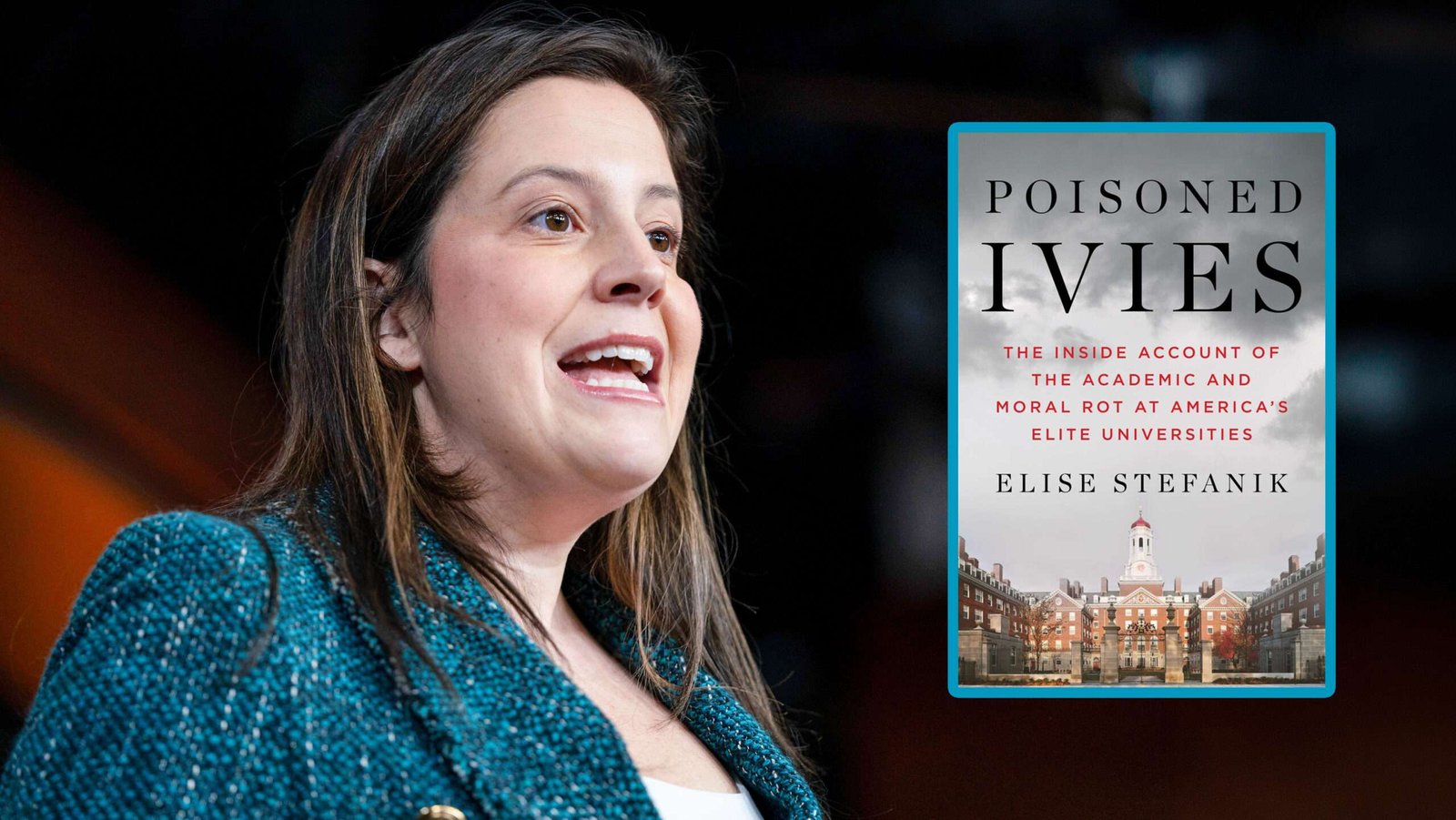
Poisoned Ivies: The Inside Account of the Academic and Moral Rot at America’s Elite Universities, by Elise Stefanik, Threshold Editions, 256 pages, $29.
Elise Stefanik seems to be stepping away from politics, having suspended her gubernatorial campaign and announced that she will not seek re-election to Congress. The New York Republican’s new book, Poisoned Ivies: The Inside Account of the Academic and Moral Rot at America’s Elite Universities, was presumably intended to advance her political career. It may instead serve as a coda to it.
Central to Poisoned Ivies is a congressional hearing held December 5, 2023, when three Ivy league presidents went viral—and not in the good way—for their response to Stefanik’s question: “Does calling for the genocide of Jews violate your university’s code of conduct on bullying or harassment?”
Stefanik excoriates the presidents for the “deadpan” and “nearly verbatim” answers they all gave: “It depends on the context.” Two presidents, Harvard’s Claudine Gay and Penn’s Liz Magill, were out of the job soon after the hearing, and Stefanik laments that MIT President Sally Kornbluth managed to escape the fallout with her title intact. Stefanik suggests that the “hearing heard around the world,” as she repeatedly calls it, is the zenith of her political accomplishments.
As Stefanik emphasizes throughout the book, this was intended as a simple test of good or evil, one that requires only one word: “Yes.” But Stefanik asked these presidents a question about law and policy, then faulted them for not instead answering the unasked moral question about whether they personally condemn pro-genocidal speech. Conservatives have long objected when university bureaucrats blur their personal convictions with their institutional policies to the detriment of neutral speech principles. But here, Stefanik directly demands it.
Despite Stefanik’s claims, the context of speech does actually matter. Without more, a comment perceived as “calling for genocide” is indeed unlikely to meet either the Supreme Court’s standard for peer-on-peer harassment or the limits of First Amendment protection. Later in the book, Stefanik shows her hand and demonstrates why it’s necessary for university leaders to approach such questions with caution: She says the phrase “from the river to the sea” is a “genocidal chant”—presumably one she expects universities to ban.
Readers can draw their own conclusions about the meaning and impact of this and similar phrases. But under the First Amendment, their legal status is not a hard call: This is protected speech. Separating how you feel about speech from your analysis of whether it’s protected is a First Amendment fundamental that we should expect elected officials to understand.
Poisoned Ivies does highlight some genuinely disturbing incidents that took place on campus in the aftermath of the October 7, 2023, attack on Israel. A Cornell student threatened to commit a mass shooting at a kosher dining hall, for example, and there were times when students or workers were trapped inside buildings during occupations. As the Foundation for Individual Rights and Expression, where I work, noted, it does not violate the First Amendment for universities to protect students against actual threats or physical harm.
But Stefanik does a real disservice to that cause by conflating unlawful conduct, which universities have a responsibility to address, with what she perceives as offensive speech about October 7 and the broader Israeli-Palestinian conflict, which she expects the universities she herself derides as censorial to censor. There is a difference between what morality may require of us and what limits the law can place upon us. And that chasm exists for good reason: The beauty and promise of living in a free country is our right to pursue our own version of the good without being forced to live by the values embraced by our politicians. One legislator’s “moral rot” is another American’s core beliefs and values.
Stefanik also keeps pairing antisemitism with the hazy concept of “anti-Americanism.” She never bothers to define the second concept, nor does she address the obvious First Amendment questions raised by an elected official’s endeavours to crack down on such an amorphous, subjective concept. But those distinctions require context and nuance, which Stefanik treats as impediments to the moral clarity demanded by these threats. At one point, the list even balloons to include a murky “anti-West” hate.
In these repeated dismissals of “anti-Americanism,” Stefanik derides student bodies who she suggests reject America, its freedom, and its founding ideals. But what is a greater rejection of the founding ideals of the United States than an overreaching federal government trampling the First Amendment? That overreach is exactly what this book celebrates.
Stefanik calls the Trump administration’s funding freezes to universities like Columbia and Harvard a correct use of “the federal government’s considerable power.” Whether that power is employed lawfully is, once again, a pesky nuance that this book is uninterested in addressing. Nitpicky questions of constitutionality are not welcome distractions in a battle cast in these dire moral terms. Harvard’s reaction to the administration’s strongarming—a lawsuit defending itself—is, she complains, a “vicious[] attack.” She calls President Alan Garber’s assertion of the university’s constitutional rights a result of “radicalized Trump-deranged faculty.”
Stefanik rightly notes the broad challenges posed by academic ties with countries like China and Qatar and the associated risk that foreign governments will instill their censorship preferences onto our universities. There is a serious threat that foreign censorship will diminish our universities in both blunt and subtle ways, and I document how vast the problem is in my book Authoritarians in the Academy. Fears of political retaliation in the form of revoked funding can and have pressured universities to contort themselves to please the governments who are proffering those funds, to the detriment of free expression.
But for a critic so concerned with the threat of censorship levied by foreign governments, Stefanik is curiously eager to see it imposed domestically.
Perhaps most disturbing of all is Stefanik’s celebration of this administration’s crackdown on international students. This includes the newly instituted requirement that their social media accounts be made public so officials can spot “any indications of hostility” to U.S. institutions. (“Rightly so,” she writes.) Poisoned Ivies expresses some valid concerns about some students’ inability to express views unpopular with their peers or administrators, but the book valorizes something far, far worse: an inability to express views unpopular with elected officials, with arrest and deportation as punishment. In the land of the free, international students are forced to swallow their criticisms of the very government threatening to deport them for wrongthink.
Universities are “no longer educating international students, as they once did, into core American principles and values,” Stefanik complains, “because the universities themselves no longer believe in American principles and values.” Unfortunately, some of our elected officials aren’t interested in educating international students in American values such as freedom of speech either.
Poisoned Ivies is a book heavy on rhetoric and light on substance. Stefanik diagnoses universities as partisan, censorial institutions, but her plan for reform is more partisanship and more censorship. Whatever reasonable criticisms Stefanik raises about higher education are drowned out by her advocacy not for institutions that do not censor, but for ones that censor more to her liking.
Stefanik never quite explains what she means by “anti-Americanism.” But readers searching for a definition can find displays of it littered throughout Poisoned Ivies’ pages.
Read the full article here
Fact Checker
Verify the accuracy of this article using AI-powered analysis and real-time sources.