

 Freedom Index

Listen to the article
In today’s newsletter, Marcin Kazmierczak from Redstone takes us through the evolution of tokenization as it moves from “concept to allocation.”
Then, in “Ask an Expert,” Kieran Mitha answers investor questions about tokenized investments.
– Sarah Morton
Where Tokenized Assets Are Today
Tokenization is moving from concept to allocation. What matters now is how these assets fit into portfolios and what they actually enable.
Your clients are already hearing and asking about tokenized assets, and that trend will only accelerate.
In the last 18 months, companies like BlackRock, Franklin Templeton, and Fidelity Investments have launched real products on the blockchain, including Treasury funds and private credit strategies. Investors are taking notice. The numbers are rising, the news is easy to track, and the basic idea is simple: bonds, private credit, and money market funds are now available on-chain, without traditional intermediaries, and settlement becomes orders of magnitude faster.
That summary is mostly accurate, but it does not tell the whole story.
The technology to create tokens has never been the main challenge. The real test comes later, with decisions on compliance, identity, transfer rules, sanctions, and lifecycle management. These are the areas where most projects slow down, and where the market is evolving now.
Last month, RedStone’s research team released the Tokenization & RWA Standards Report 2026, which examines how these systems are actually being built.
The compliance question is an architecture question
For issuers, the most important choice is not which blockchain to use, but where to place the compliance rules.
Compliance can be built right into the token and enforced by smart contracts with every transfer. It can also be managed outside the token using tools such as whitelisting. Another option is to enforce compliance at the network level, where the blockchain itself decides which transactions are allowed.
Each method fixes one issue but creates another.
Identity verification structures for tokenized assets, source: Tokenization Standards Report
Putting compliance rules inside the token gives you exact control, but it makes the system less flexible. For example, updating a sanctions list or rule might require upgrading the contract, turning a simple policy change into a technical task. Managing compliance outside the token makes things more flexible, but it means relying on middlemen and can expose assets if they leave their original environment. Enforcing rules at the network level makes token design easier, but it limits how easily the asset can move to other chains and systems.
For advisors, this is not an abstract design choice. It directly affects how an asset behaves. It determines whether it can move across chains, integrate with blue-chip decentralized finance (DeFi) protocols, like Morpho or Aave, and serve as collateral in a lending strategy. Two tokenized funds with identical underlying assets can behave very differently depending on this single architectural decision.
Institutional capital is already moving on-chain
The transition from theory to practice is most evident in how tokenized assets are used in lending markets.
Deposits of tokenized real-world assets in DeFi lending protocols have surpassed $840 million. A large share of this activity follows a familiar structure: an investor posts a tokenized asset as collateral, borrows against it, and redeploys the borrowed capital, often back into the same asset. The mechanics are new, but the logic is not. It is a programmatic version of the same capital efficiency strategies long used in traditional finance, now executed without a prime broker — faster, cheaper, and with less friction.
How investors allocate these assets is increasingly reflecting broader market trends.
On one major protocol, tokenized Treasury exposure declined sharply, while tokenized gold allocations expanded severalfold over the same period, tracking changes in rate expectations with notable precision. It is the best showcase of how professional capital responds to macro signals through on-chain infrastructure.
For advisors, this reframes the role of tokenized assets. They are not simply wrappers around existing products. In the right structure, they become productive collateral, capable of generating additional yield and participating in broader strategies while remaining in the portfolio.
Credit risk is becoming explicit
As these assets move into lending and structured strategies, credit risk is evolving alongside specific DeFi strategies, such as looping. Emerging DeFi risk ratings frameworks like Credora introduce continuous, on-chain risk assessment, bringing a level of transparency that traditional markets rarely offer.
For advisors, that shifts the question from what the asset represents to how it behaves under stress, and what risks it entails. Simple-to-understand ratings on a familiar A+ to D scale facilitate the creation of a risk-adjusted portfolio, attracting more and more interested parties.
What remains unresolved
Some structural gaps remain. Corporate actions still rely heavily on off-chain processes, and illiquid assets such as private credit and real estate are not yet fully compatible with DeFi standards.
Until those pieces are solved, tokenization will continue to scale unevenly, with the most complex assets lagging behind the simplest ones. The bright side? Creators of tokenization frameworks are well aware of that limitation, and soon enough, we should see solutions addressing that gap.
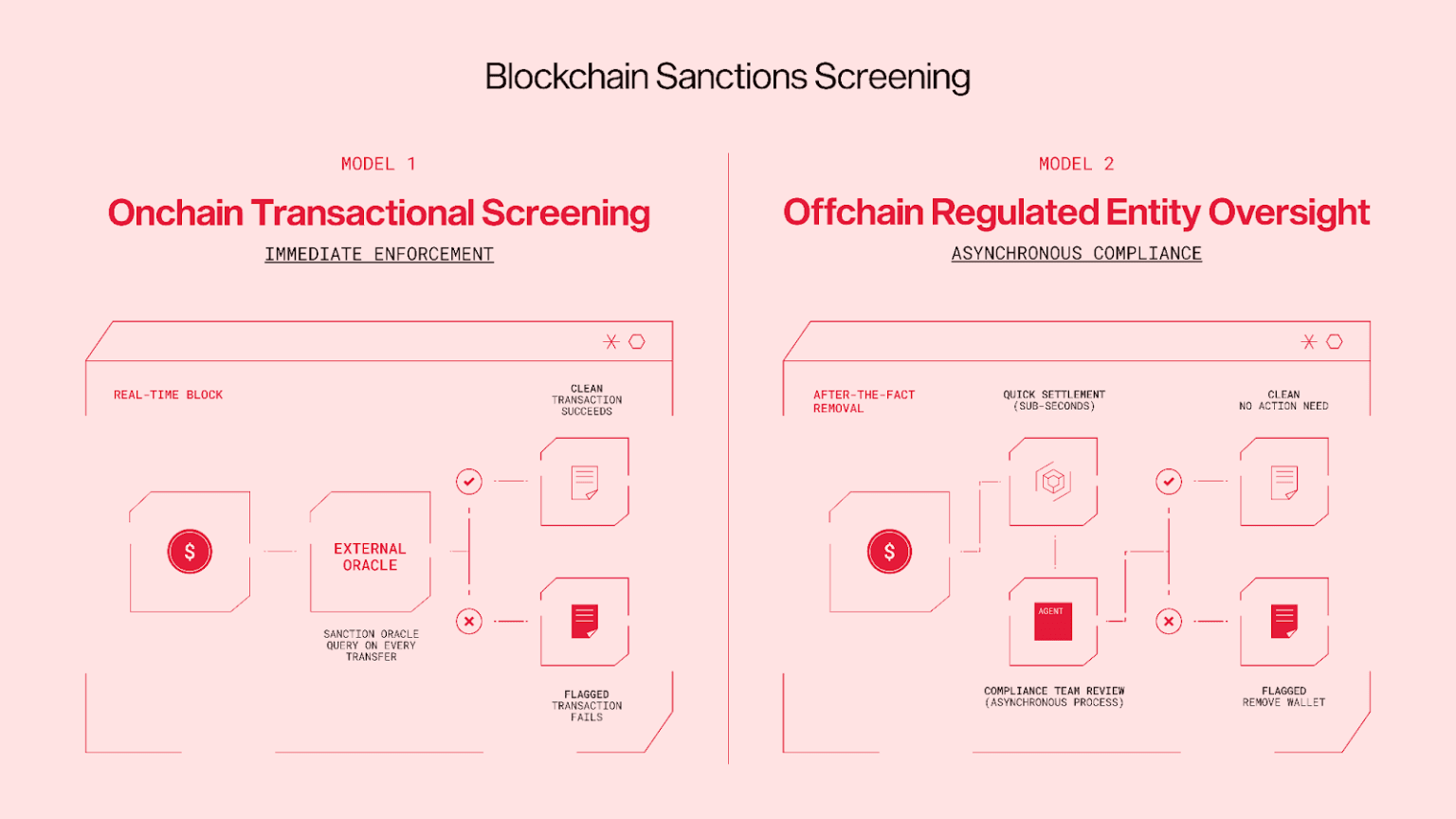
Sanctions screening approaches in tokenized assets, source: Tokenization Standards Report
– Marcin Kazmierczak, co-founder, Redstone
Ask an Expert
Q:As tokenization moves from pilot programs into live financial infrastructure, what needs to happen for it to become a standard layer in global capital markets?
Tokenization becomes standard when it integrates into existing financial systems rather than competing with them. The priority is interoperability between blockchains, custodians, and traditional market infrastructure so assets can move seamlessly across platforms.
Regulatory clarity is equally critical. Institutions need confidence in ownership rights, settlement finality, and compliance frameworks before allocating significant capital. We are already seeing early traction, but scale will come when tokenized assets match or exceed the efficiency, liquidity, and reliability of traditional securities. At that point, tokenization will not be viewed as innovation. It will simply be the infrastructure underpinning modern markets.
Q:What are the most overlooked risks or misconceptions surrounding tokenized assets today?
One of the biggest misconceptions is that tokenization automatically creates liquidity. It does not. It simply makes assets easier to access. Take real estate as an example. You can tokenize a property and divide it into thousands of shares, but if there are no active buyers and sellers, those shares will still be difficult to trade.
Another challenge is how early the market still is. Different platforms are building their own ecosystems, which can lead to fragmented liquidity rather than one unified market.
The technology is moving quickly, but infrastructure, regulation, and investor participation are still catching up. That gap between what is possible and what is practical is where most of the risk exists today.
Q: For retail investors, does tokenization open the door to new types of investments, and could that be a catalyst for bringing younger generations into the market?
Tokenization is emerging as younger generations move into higher earning careers and take a more active role in managing their wealth. Having grown up through rapid technological change myself, this group naturally expects financial systems to evolve in the same way as everything else in their lives.
That mindset is driving a greater willingness to explore asset classes beyond traditional stocks and bonds. Tokenization can open access to areas like private markets and real estate, while offering a more digital and flexible investment experience.
It is not just about new opportunities, it is about alignment. As the financial industry modernizes, it begins to reflect the speed, transparency, and accessibility younger investors are used to. That shift is likely to play a meaningful role in attracting a new generation into investing.
– Kieran Mitha, marketing coordinator
Keep Reading
Read the full article here
Fact Checker
Verify the accuracy of this article using AI-powered analysis and real-time sources.