

 Freedom Index
Listen to the article
A review of Stalin’s Apostles: The Cambridge Five and the Making of the Soviet Empire by Antonia Senior; 462 pages; New York, Public Affairs (May 2026)
I.
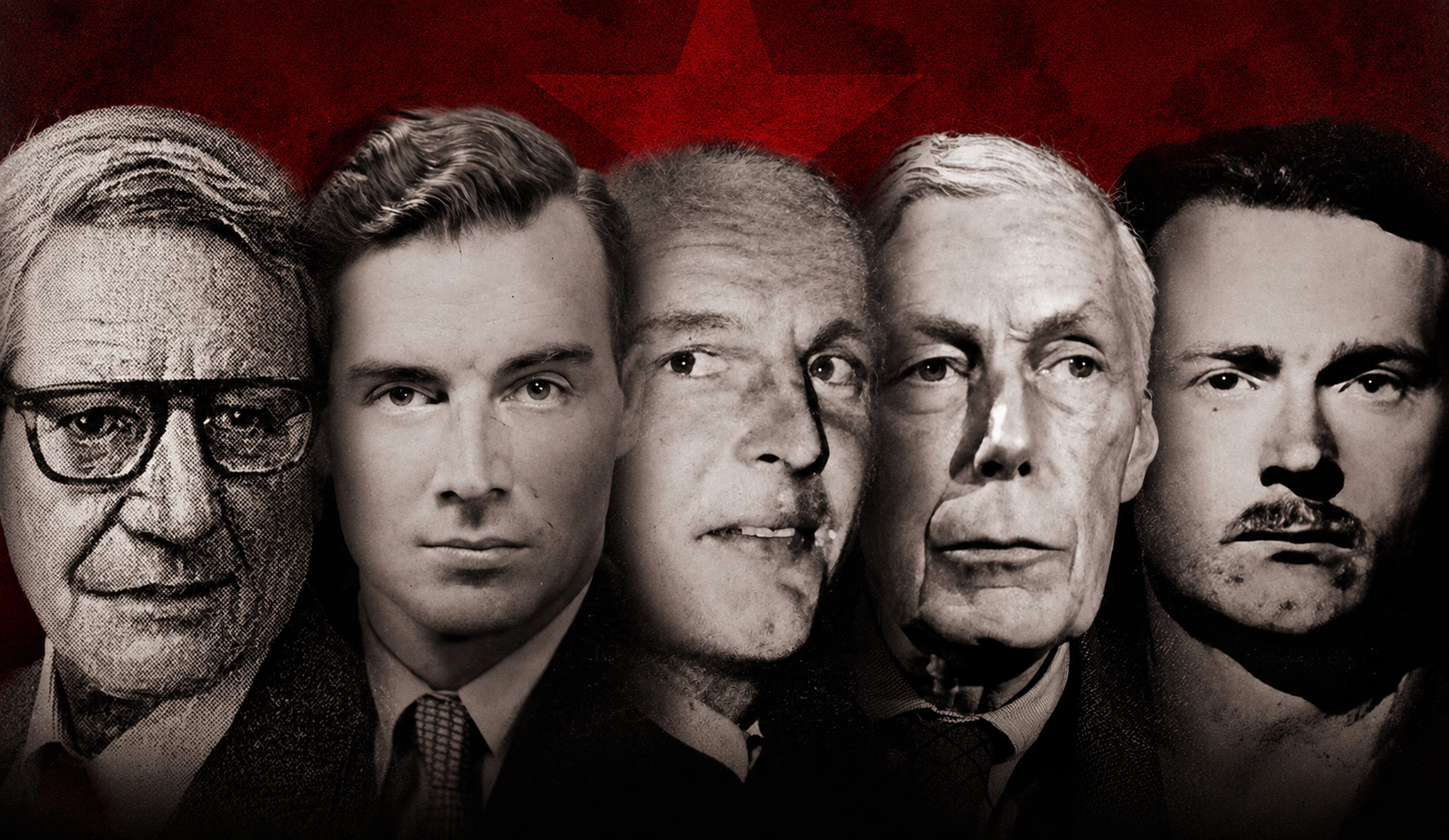
The Cambridge spies—three of whom were members of the Apostles society at Cambridge University—are the best-known and most written-about group of Western agents of Josef Stalin from the 1930s and ’40s. A Spy Among Friends, Ben Macintyre’s bestselling 2014 biography of Kim Philby, the most notorious of the bunch, was made into a well-received television miniseries in 2022. Recruited while they were at Cambridge as young men, Philby’s fellow spies were Anthony Blunt, Donald MacLean, Guy Burgess, and John Cairncross—all of whom easily found employment at the top levels of Britain’s government, including in its intelligence agencies.
The British writer E.M. Forster is often quoted by those who seek to justify the espionage conducted by Western Soviet agents. “If I had to choose,” Forster wrote in 1938, “between betraying my country and betraying my friends, I hope I should have the guts to betray my country.” In her new book about the Cambridge Five, journalist Antonia Senior quotes a similar statement made by the novelist Graham Greene, who wrote this in his introduction to Kim Philby’s memoir: “He betrayed his country—yes, perhaps he did, but who among us has not committed treason to something or someone more important than a country.” Greene later became good friends with John Cairncross, although he likely had no idea that Cairncross was also a Soviet spy.
Those who read Senior’s book will discover just how wrong Forster and Greene were on this count. The Cambridge Five betrayed their country, but they also betrayed their own comrades. Stalin’s needs and commands precluded any other consideration. “Turning their backs on friends was not enough,” Senior writes. “Step two of becoming an agent was to prove yourself by betraying people close to you.” Philby’s Austrian wife was also a communist, but when he was ordered to leave her, he promptly did so. He was also asked to spy on his father, who Moscow erroneously thought worked for British intelligence and acted as an adviser to King Abdulaziz (Ibn Saud) of Saudi Arabia.
Guy Burgess was also ready to betray his close friend Goronwy Rees, who had been a secret communist signed up with Soviet intelligence. But Rees had broken with the Soviets after Stalin and Ribbentrop signed the infamous Nazi-Soviet Pact. He saw that agreement, Senior tells us, “as an act of treachery and betrayal.” Rees foolishly thought that Burgess would also cut ties with the Soviets. Instead, Burgess sent Moscow a message: “This man knows too much and could destroy me and Blunt.” He then demanded, Senior reveals, “that his old, close friend be assassinated.” Surprisingly, “the [Soviet] Centre refused.” What led to their refusal to kill Rees is still unknown. Luckily for Moscow, Rees remained silent—he protected the Five’s treachery and never disclosed the espionage they conducted while they held important positions in the British government. Perhaps Rees held the same view of spying as Forster and Greene.
And although the Five were shocked when Stalin began to purge the leading Bolsheviks during the Great Terror of 1936–8, the show trials and death sentences did not cause them to fall out of love with the Soviet Union or stop spying for Stalin. Continued loyalty, they believed, was “an act of revolutionary resolve.” So they continued, even though they privately worried that they might also be singled out as traitors by Stalin and prosecuted. They did so, even after 1939, when “the men who recruited them, trained them, nurtured them—were dead, imprisoned, missing, or on the run.”
In order to assemble her account, Senior has combed newly available material held in Britain’s National Archives, as well as those held in the US National Archives and Records Administration, and she has incorporated the findings of all previous books on Soviet espionage, as well as many works on the Second World War. Her book also draws upon archival material she obtained from libraries in Lithuania, Albania, and Poland. She has also considered the self-serving memoirs written by the Cambridge Five themselves, and she does a good job of separating fact and fabrication. All of this research has enabled her to write the most comprehensive account yet of the Cambridge spies and their treachery.
Read the full article here
Fact Checker
Verify the accuracy of this article using AI-powered analysis and real-time sources.