

 Freedom Index
Listen to the article
Ahead of this month’s parliamentary election, independent journalists in Kazakhstan have faced “unprecedented” pressure, ranging from criminal prosecutions to professional bans, and this crackdown warrants heightened international scrutiny to ensure the country upholds its obligations on media freedom.
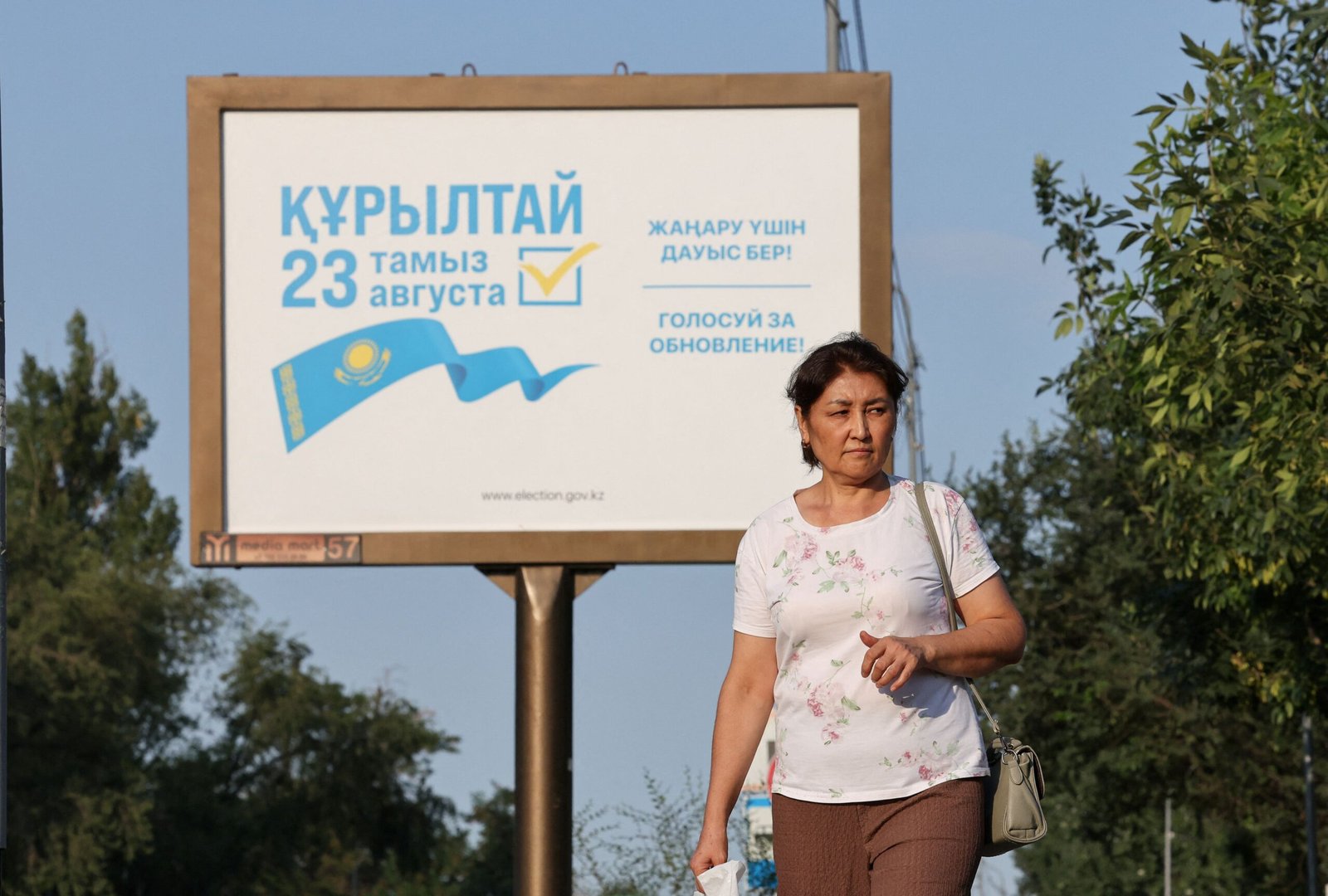
Voters go to the polls on August 23 to elect a unicameral parliament established under a new constitution passed in a March referendum. President Kassym-Jomart Tokayev says the constitution allows a fundamental reshaping of the Central Asian nation but critics say it represents an attempt to extend Tokayev’s power.
Just as the March referendum was accompanied by a series of arrests – which CPJ and partners raised with Kazakh authorities – the upcoming vote has been preceded by fresh intimidation of some of Kazakhstan’s foremost independent journalists.
Since mid-July, five prominent journalists have been jailed or convicted on major criminal charges and cases have been opened against two more. Courts have also imposed draconian restrictions on convicted journalists’ participation in public life and activity online.
The Legal Media Center, a local advocacy group, has warned of an “unprecedented increase in pressure” on journalists.
On August 14, CPJ and eight local and international press freedom and human rights groups expressed deep concern over the escalating pressure, noting that these recent high profile cases formed part of a “broader, longer-term pattern,” which included the use of politically motivated charges, online restrictions on access to information, and other forms of harassment and intimidation against those who criticize the authorities.
Diana Okremova, head of the Legal Media Center, said the crackdown is an effort to “purge the media sphere” and ensure the absence of “negative information online.”
Criminal Prosecutions
The primary tool used by Kazakh authorities to silence the press consists of criminal prosecutions, with journalists frequently charged with “knowingly disseminating false information”.
Here are some prominent recent cases:
- On August 18, a court sentenced Gulnara Bazhkenova, former editor-in-chief of independent outlet Orda and one of Kazakhstan’s best-known journalists, to eight years in prison on multiple charges including deliberate dissemination of false information. The court deferred Bazhkenova’s prison term by two years because she has a child who is a minor but additionally banned her from journalism and a wide range of “public activities,” including blogging, “media-related activities,” and engagement in public events. Kazakh police arrested Bazhkenova in December, weeks after Orda published reports linking the country’s then-foreign minister to large-scale corruption and the 2024 assassination of an opposition blogger. Journalists and rights defenders have suggested her arrest and conviction may be in retaliation for these reports.
- In late July, Aset Matayev, director of leading independent news agency KazTAG, and Amir Kasenov, the outlet’s editor-in-chief, were sentenced to 3.5 years and 15 months, respectively, of “restricted freedom” in a case that centered on allegations the outlet spread false information about Kazakh financial services company Freedom Finance and its majority shareholder, Kazakhstan’s second richest man, Timur Turlov. Matayev, Kasenov and another co-defendant were ordered to pay damages of around US$360,000. The court also banned Kasenov from practising journalism for five years and Matayev for three years. As with Bazhkenova, the pair were further banned from a long list of other activities, including making media appearances, participating in conferences and other public events, and from using social media.
Other charges brought against journalists appear directly linked to political developments.
In mid-July, journalist Azamat Omarov was arrested after he aired an episode of his weekly, YouTube-based political satire show Akhual Segodnya (The Situation Today) criticizing a July 7 ruling by Kazakhstan’s Constitutional Court that Tokayev could seek another seven years in power after the passage of the new constitution was deemed to reset term limits.
Court documents reviewed by CPJ show Omarov was placed in pre-trial detention for two months on accusations of inciting “social and class discord” over an episode of his show that was critical of the government’s economic policy. Following his arrest, Omarov’s YouTube channels became inaccessible. Omarov has denied the charges, saying he considers his work “regular satire and humor.”
Banned from journalism
The multi-year bans on journalism and other public activities handed out to Bazhkenova, Kasenov, and Matayev highlight a growing pattern decried by local rights groups.
“Such measures constitute one of the most severe forms of interference with freedom of expression and the work of the media. Denying a journalist the right to practice their profession means denying society its right to receive independent information,” the Legal Media Center said in August.
On August 3, a court in Almaty sentenced journalist Aleksandra Alyokhova to three years in prison and banned her from journalism for three years after finding her guilty of unlawfully disseminating personal data in an article in 2022. The journalist’s prison term was deferred for five years because she has young children.
Local free speech advocacy group Adil Soz said the case was “legal nonsense,” noting that Alyokhova had simply referred to information leaked from police records and published on social media and that neither the officer who leaked the data nor the individual who originally published it had been held legally responsible.
Alyokhova’s case was connected to an even more absurd case against journalist Oleg Gusev. In December, Gusev was handed a three-year suspended prison sentence and a three-year journalism and public activities ban on charges of unlawfully disseminating the personal data of the same individual simply by linking to Alyokhova’s then unsanctioned 2022 article. Gusev had even cited Alyokhova on a point entirely unconnected to the personal data in question.
Nazira Darimbet, president of Adil Soz, told CPJ that while professional bans have been used in the past, their current “massive and systematic application” is a dangerous trend.
“It’s an instrument for the total exclusion of the citizen from the media sphere,” she said, labelling the punishment a “professional and civic death” that violates Kazakhstan’s constitutional guarantees of freedom of opinion and the right to work, and the country’s international commitments under the International Covenant on Civil and Political Rights.
Social media suppression
The current crackdown has also targeted journalists’ social media accounts, with reports of content suppression and copyright complaints used to force the deleting of videos and other content.
In the weeks before Omarov’s arrest, he repeatedly reported that YouTube and Instagram were removing his videos and blocking his accounts on the basis of apparently spurious copyright complaints.
The targeting of Omarov’s accounts is part of a wave of attacks against more than a dozen leading independent journalists and news outlets in Kazakhstan since the start of this year, and which has again intensified in the run-up to the elections.
CPJ’s research into copyrights complaints that led to Google removing a corruption investigation into Tokayev by the Kazakh service of U.S. Congress-funded broadcaster Radio Free Europe/Radio Liberty from internet search results earlier this year found those alleging breaches made clearly spurious allegations of copyright infringement.
An investigation by Reporters Without Borders has shown that perpetrators used email addresses and posed as representatives of global brands, including L’Oréal and Giorgio Armani, when launching complaints. An investigation published in August by the Organized Crime and Corruption Reporting Project into abusive copyright complaints targeting media in nearby Georgia found evidence of an underground market and agencies charging up to US$5,000 to file false complaints against the press.
The “unprecedented scale” of these attacks is a serious issue for Kazakh journalism, Darimbet said. Authorities’ tight control of traditional print and online media has “pushed independent journalists onto these platforms” and they depend on them for their audiences, she said.
Okremova of the Legal Media Center, whose own Facebook account is currently suspended due to a copyright complaint against a post she wrote announcing a court case her organization had filed against Kazakhstan’s Ministry of Culture, said online platforms needed to take action.
“(Social media) platforms need to take into account the country context, understand that here we have authoritarianism, that the government will do everything possible to strengthen its control,” she said. “They shouldn’t, on the basis of a single complaint, block the accounts of public figures and journalists, because we already have so few sources of independent information as it is.”
Aida Balayeva, Kazakhstan’s minister of culture and information, said in a statement on her Facebook page in August that the ministry does not block social media users, including media outlets and journalists, and such blocks were aimed at discrediting the state.
She said her ministry would “first and foremost support the exercise of freedom of speech” but added that freedom of speech “presupposes responsibility for the disseminated information” and journalists must “take responsibility for the information they disseminate.”
Multipronged attacks
In some cases, several of these repressive tools are unleashed against individual journalists, subjecting them to a whirlwind of intimidation and harassment from different quarters.
Prominent journalist Lukpan Akhmedyarov, who was shot and stabbed in a near-fatal attack in 2012, is a case in point.
Akhmedyarov, the founder of YouTube-based outlet Prosto Zhurnalistika (Just Journalism), was banned from leaving the country on a family holiday on August 3. Then, on August 12, police confirmed a criminal false information investigation had been opened, believed to be related to his extensive coverage of Russian recruitment of Kazakh citizens for its war in Ukraine.
His social media has been targeted too. He told CPJ that over the last year he had around 20 Facebook posts removed and his account was blocked due to baseless copyright complaints. In a further episode of apparent targeting in late July, an unknown individual sprayed paint over Akhmedyarov’s car.
Independent journalist Dinara Yegeubayeva – whose own vehicle was targeted in an arson attack during a previous wave of attacks on journalists in 2023 – told CPJ her Instagram and Facebook accounts were blocked and she had been been forced to restrict access to videos on her main platform, YouTube, in order to prevent further copyright complaints.
On August 4, Yegeubayeva reported that police had opened a criminal case against her over a bizarre traffic incident, caught on camera, in which a cyclist moving against the direction of traffic crashed into her car as it turned into a side road. Yegeubayeva has said she believes the incident was a set-up designed to fabricate a criminal case against her.
Okremova told CPJ the effect of this multi-faceted intimidation, and the goal, is to sow fear and self-censorship among members of the press.
“Journalists see what’s happening (to their colleagues) and will be more wary. They’ll be careful. They’ll toe the government line.”
Read the full article here
Fact Checker
Verify the accuracy of this article using AI-powered analysis and real-time sources.