

 Freedom Index
Listen to the article
Europe’s crackdown on Tether’s USDT is entering a new phase.
When Revolut told European users it would delist USDT after Aug. 31, it became another in a long line of European platforms restricting access to the world’s largest stablecoin as firms adapt to the requirements of the EU’s Markets in Crypto-Assets (MiCA) regulation.
MiCA’s stablecoin rules have been phasing in since 2024, and the EU-wide transition period ended on July 1, putting further pressure on platforms to drop tokens that don’t meet the rules.
Yet according to Artemis Analytics, Tether being squeezed out of a major market has shown little sign of triggering a major shift in USDT activity. Alex Weseley, research and data, tells Magazine:
“The data does not indicate any noticeable change in USDT supply or demand attributable directly to MiCA coming into effect in Europe… MiCA didn’t trigger a major venue or chain migration.”
So why is demand for Tether holding up so well?
Stablecoins become financial infrastructure
One reason USDT demand is proving resilient is that dollar stablecoins are being used for more than trading or saving in other regions of the world.
In Argentina, for example, a country long obsessed with stuffing dollars into mattresses and storing wealth outside the traditional financial system, stablecoin activity has continued to grow even though restrictions on accessing actual US dollars have eased.
USDT supply share by chain at MiCA milestones. Source: Artemis.
Lemon, an Argentine crypto and financial services platform, processed $9.3 billion in total volume in 2025, up 60% from the previous year. Transactional users grew 70% to nearly 1.8 million and stablecoin volume grew 45% year-on-year.
Related: Why Argentina is blocking Polymarket despite its global growth
That suggests stablecoins are doing more than simply filling a gap created by restrictions on access to dollars; they’re becoming part of the way people move and spend money.
Ignacio Gimenez, Lemon’s business and planning manager, tells Magazine:
“The role of USDT and other dollar stablecoins is evolving. What we’re seeing is a shift from stablecoins as a store of value to stablecoins as financial infrastructure.”
He says stablecoin activity is “increasingly driven by payments, cross-border transfers and global financial services rather than only by savings,” adding that Argentine users can pay in Brazil through PIX using pesos, receive dollars or euros from overseas and have them credited as USDC, or move between bank dollars and digital dollar balances.
That makes stablecoin demand harder to measure by simply looking at which tokens are available on regulated exchanges.
MiCA is changing the European gateway
Lemon’s experience highlights a shift in user behavior in one of Latin America’s biggest economies, and there are signs that emerging markets are beginning to follow the trend.
Artemis data shows the number of daily users on Binance Smart Chain rose from about 318,000 in June 2024 to 1.56 million by July 2026, while daily users on Tron increased 44% to around 908,000. These chains are favored by day to day stablecoin users for their low fees. Weseley says:
“That looks like expanding global and emerging market usage rather than a Europe-specific migration, and there’s no clear MiCA-timed break in the chain data.”
That doesn’t mean MiCA is irrelevant: it is certainly changing which stablecoins regulated European platforms can offer, and reshaping the stablecoin market inside the bloc.
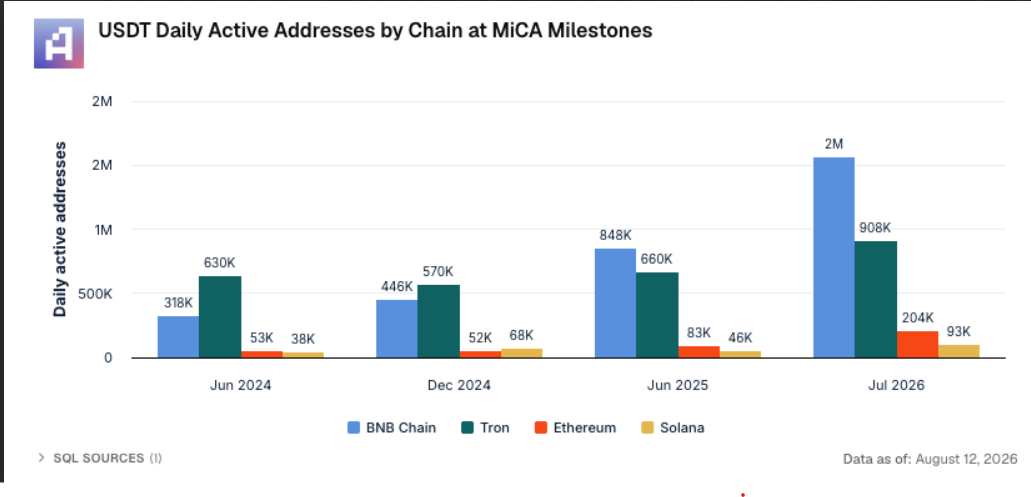
USDT daily active addresses by chain at MiCA milestones. Source: Artemis.
Maksym Sakharov, chief executive and co-founder of WeFi, a crypto financial infrastructure company, says that regulation is primarily changing how users access dollar stablecoins, rather than removing the underlying demand, whether it’s for trading, payments, or cross-border transfers. He tells Magazine:
“Users do not choose a stablecoin only because it is available on one regulated platform. They choose it because counterparties use it, liquidity is deep, and it works across many markets.”
For some platforms, the shift began well before the MiCA deadline. Chief executive of OKX Europe, Erald Ghoos, says OKX has not offered USDT to European users for around two years, so the latest MiCA deadline did not make much material difference.
Europe’s alternatives have a dollar problem
Perhaps the bigger question in Europe is what European users will embrace instead. Dollar-denominated stablecoins have a powerful advantage since the crypto market has always treated the greenback as its primary benchmark.
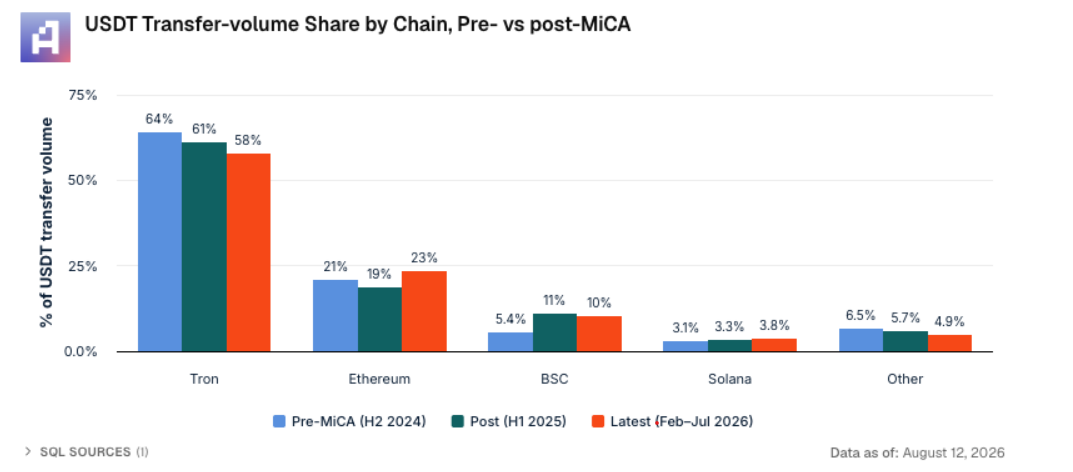
USDT transfer volume share by chain pre vs. post MiCA. Source: Artemis.
While Ghoos doesn’t expect that to change globally any time soon, he says that institutional interest in euro-denominated stablecoins is picking up. He says:
“What we are seeing from institutional players is interest in creating more EUR-denominated stablecoins, which is worth watching as it develops.”
For retail users, euro-denominated stablecoins could also make practical sense by removing additional friction, like currency conversion, from transactions. But while MiCA may determine which products are available through regulated European gateways, it cannot change the dollar’s role in global crypto markets.
Magazine: El Salvador’s Bitcoin experiment turns 5: ‘It was for us, not them’
Cointelegraph publishes long-form journalism, analysis and narrative reporting produced by Cointelegraph’s in-house editorial team with subject-matter expertise. All articles are edited and reviewed by Cointelegraph editors in line with our editorial standards. Some articles contain affiliate links, from which Cointelegraph may earn a commission. These relationships do not influence which products we review or our editorial conclusions. Content published in here does not constitute financial, legal or investment advice. Readers should conduct their own research and consult qualified professionals where appropriate. Cointelegraph maintains full editorial independence.
Read the full article here
Fact Checker
Verify the accuracy of this article using AI-powered analysis and real-time sources.