

 Freedom Index
Listen to the article
from the maybe-don’t-compound-your-evilness-with-stupidity dept
Some readers might look at this headline and think there’s something off about it. And I’ll grant you that. There are several ways music can be played: to, for, not at all. Sometimes though, the only way to describe the playing of music is “at.”
One of Trump’s many vindictive “surges” targeting cities and states run by Democratic party members occurred in Washington DC. Not content to flood the streets with tons of federal officers, the administration decided these forces needed backup from the National Guard. Of course, Trump claimed the crime problem in DC was so bad it could only be dealt with by a surge that blended choice bits from “police state” and “martial law” into an unpalatable whole.
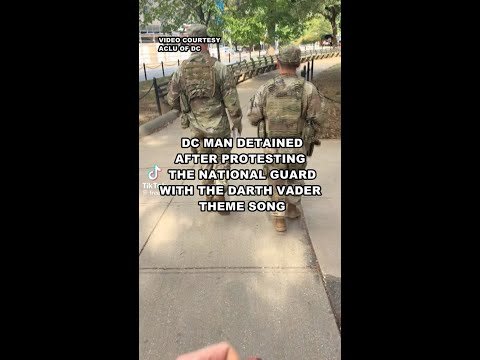
DC residents were less than thrilled. One resident — Sam O’Hara — made his displeasure known by doing the thing in the headline: playing music at National Guard troops.
Here’s how that mild act of protest was described in his lawsuit against the city by his ACLU legal reps:
Given the roughly 200-year-old tradition of civilian law enforcement in the United States, Mr. O’Hara was deeply concerned about the normalization of troops patrolling D.C. neighborhoods. And so, he began protesting the Guard members’ presence by walking several feet behind them when he saw them in the community. Using his phone and sometimes a small speaker, he played The Imperial March as he walked, keeping the music at a volume that was audible but not blaring. Mr. O’Hara recorded the encounters and posted the videos on his TikTok account, where millions of people have viewed them.
And here’s how it looked, from O’Hara’s POV:
I really hate to begin a sentence with “if you’re not familiar with The Imperial March.” And so I haven’t, via the clever use of punctuation. Just in case the presiding judge was unfamiliar, the lawsuit included a brief explainer:
In the Star Wars franchise, The Imperial March is the music that plays when Darth Vader or other dark forces enter a scene or succeed in their dastardly plans.
One of the National Guard troops objected to being Bluetoothed in public. Sgt. Devon Beck threatened to call the cops if O’Hara didn’t stop. Then he did exactly that. The DC Metro PD immediately fell down on the job, arresting O’Hara for crimes he couldn’t have possibly committed. He was not “harassing” the troops, as one of the officers claimed. Nor was he impeding their movement. Nor was he preventing people from entering a nearby store, as Officer Campbell alleged. He was standing to the side of it.
Officer Campbell wasn’t done being stupid quite yet.
In response to Mr. O’Hara’s statements that he was engaged in protest, Officer Campbell said, “That’s not a protest. You better define protest. This isn’t a protest. You are not protesting.”
You are wrong, Officer Campbell. Demonstrably wrong, which is a play on words or something… So enjoy that, readers. I’m taking English and grammar for a rough ride in this post, to borrow a bit of law enforcement vernacular. My apologies in arrears.
Anyway, O’Hara gets the last laugh, some money, and the unfortunate confirmation of the implication he made musically. And, while his original salvo targeted National Guard interlopers, it was the Metro PD officers who accosted/arrested him that truly proved the point.
The District of Columbia has reached a settlement agreement for an undisclosed amount of money with a resident who claims police illegally detained him for following an Ohio National Guard patrol while playing Darth Vader’s theme song from “Star Wars” on his phone — an act of protest against the Trump administration’s federal law-enforcement surge in the nation’s capital.
No one is saying how much the settlement is, but it seems like it’s big enough to mean something.
In an email on Friday, an ACLU spokesperson referred to the settlement’s financial terms as “a significant amount” that O’Hara “is pleased with” but said they aren’t disclosing the dollar figure to protect his privacy.
It also may not be O’Hara’s settlement check from the government. There’s still the matter of the National Guard troop who decided to call the police because he personally didn’t care for O’Hara’s playlist. Beck is still defending himself against the lawsuit, but I have no idea what kind of defense this is:
Attorneys for the Guard member, Sgt. Devon Beck, has asked a judge to dismiss O’Hara’s claims against him.
“He was there because that was his assigned duty,” Beck’s lawyers wrote. “This was not an accidental encounter or a one-time disagreement on a public sidewalk.”
So… Beck isn’t responsible for his direct (or contributory) rights violations because he didn’t ask to be deployed to Washington DC? It probably doesn’t matter. Members of the military are rarely sued by US citizens for rights violations because, well, until very recently they were never asked to patrol US neighborhoods or provide support for law enforcement. There are likely layers of immunity that haven’t even been probed yet, but even if the courts decide the troops were acting as federal officers, it’s almost impossible to successfully sue federal officers. If the government agrees to a settlement, it will because it’s afraid its lawyers might fuck things up so badly adverse precedent might be set.
But for now, some justice has been done. O’Hara gets his money. The Metro PD gets a lesson in why it’s rarely a good idea to provide backup to federal forces and, more hopefully, learns something about how to handle people engaged in protected speech.
Filed Under: 1st amendment, dc metro police, evil empire, free speech, mass deportation, michael perloff, mpd, national guard, trump administration, washington dc
Read the full article here
Fact Checker
Verify the accuracy of this article using AI-powered analysis and real-time sources.