Close Menu
FSNN | Free Speech News NetworkFSNN | Free Speech News Network
  • Home
  • News
    • Politics
    • Legal & Courts
    • Tech & Big Tech
    • Campus & Education
    • Media & Culture
    • Global Free Speech
  • Opinions
    • Debates
  • Video/Live
  • Community
  • Freedom Index
  • About
    • Mission
    • Contact
    • Support
Trending

Republican Hawks Don’t Want an Iran Deal—and Opportunist Democrats Are Helping Them Along

22 minutes ago

New DeFi entrant widens field of crypto political campaign funds as elections loom

53 minutes ago

Hyperliquid Bear Flips Bullish After Losing Over $46M Betting on HYPE Price to Drop

56 minutes ago
Facebook X (Twitter) Instagram
Facebook X (Twitter) Discord Telegram
FSNN | Free Speech News NetworkFSNN | Free Speech News Network
Market Data Newsletter
Wednesday, June 3
  • Home
  • News
    • Politics
    • Legal & Courts
    • Tech & Big Tech
    • Campus & Education
    • Media & Culture
    • Global Free Speech
  • Opinions
    • Debates
  • Video/Live
  • Community
  • Freedom Index
  • About
    • Mission
    • Contact
    • Support
FSNN | Free Speech News NetworkFSNN | Free Speech News Network
Home»Cryptocurrency & Free Speech Finance»Why Ethereum Could Tank Another 25% Before Finding a Bottom: Analysis
Cryptocurrency & Free Speech Finance

Why Ethereum Could Tank Another 25% Before Finding a Bottom: Analysis

News RoomBy News Room2 hours agoNo Comments6 Mins Read1,759 Views
Share Facebook Twitter Pinterest Copy Link LinkedIn Tumblr Email VKontakte Telegram
Why Ethereum Could Tank Another 25% Before Finding a Bottom: Analysis
Share
Facebook Twitter Pinterest Email Copy Link

Listen to the article

0:00
0:00

Key Takeaways

Playback Speed

Select a Voice

In brief

  • Ethereum dropped 8% today alone, crashing through the $2,000 psychological support zone and hitting an intraday low near $1,814.
  • On Myriad, traders are now betting ETH reaches $1,500 before it bounces back to $3,000—a probability that surged nearly 25% in recent weeks.
  • The charts back the bearish bet: RSI is in bear territory, the Squeeze Momentum Indicator just fired a bearish signal, and there’s no meaningful support between $1,700 and the $1,400–$1,500 range.

If you’ve been tracking crypto prices over the last couple days, you already know the broader picture: the market is getting hammered. Bitcoin cratered below $67,000, its worst level since April, and ETFs are bleeding.

But while things aren’t looking great for Bitcoin in the near term, Ethereum—the second largest crypto asset by market capitalization—is getting hit worse.

Ethereum fell below $2,000 on June 2 and hasn’t looked back. There are several possible reasons, beyond the typical macroeconomic winds, why ETH may be especially bearish at the moment: key developers at the Ethereum Foundation have jumped ship, some very vocal, high-profile supporters have sold their bags, and Ethereum ETFs have now logged 15 consecutive trading days of net outflows.

On Myriad, a prediction market built by Decrypt‘s parent company Dastan, current odds on Ethereum’s next move tell you everything you need to know about ETH sentiment at the moment. Traders are now pricing in a 71% chance that Ethereum drops all the way down to $1,500 before making any kind of comeback. Those odds are up 25% since mid-May.

Ethereum price: What the charts say

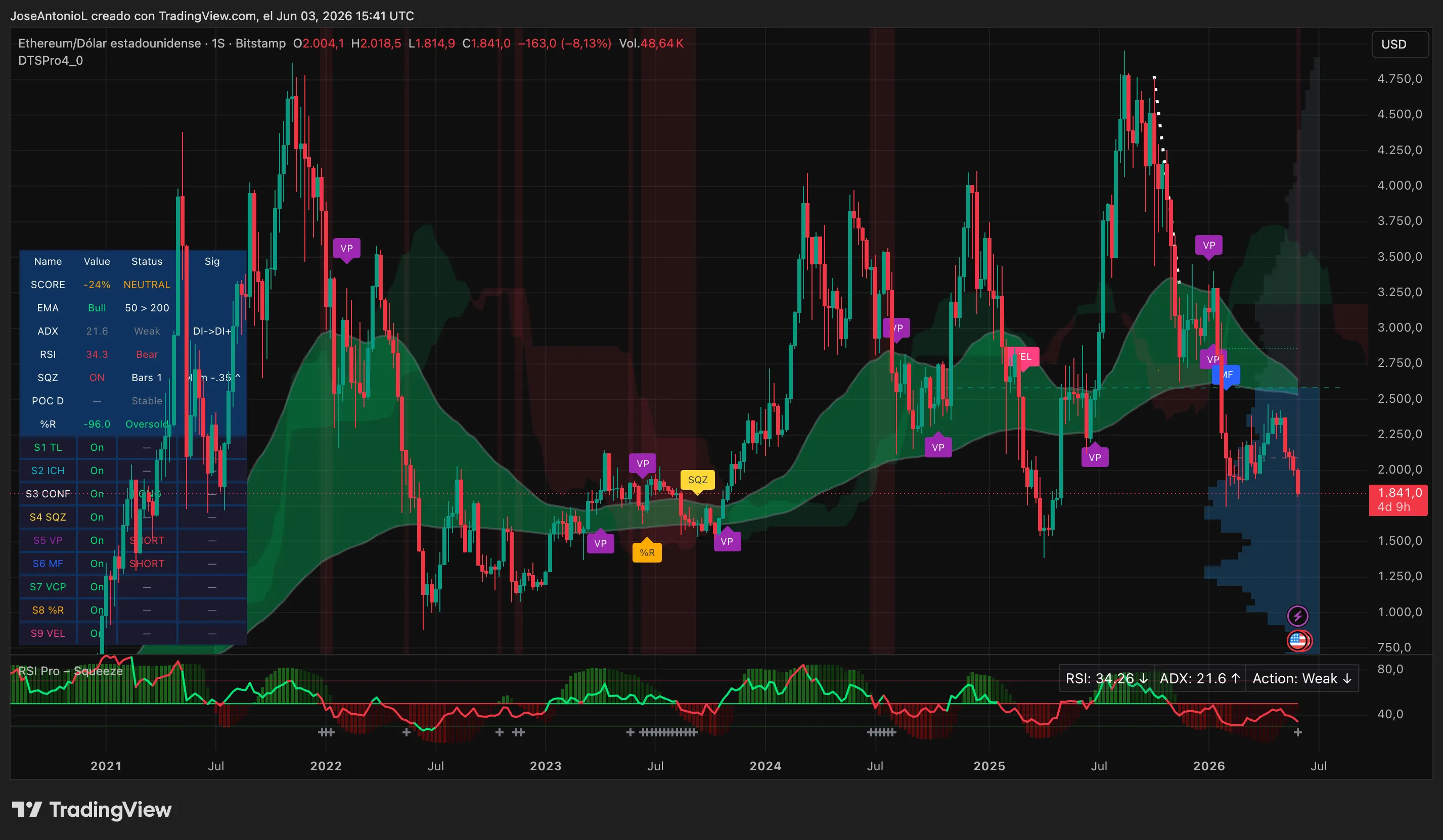
Today’s Ethereum price action is brutal in its clarity. ETH opened at $2,004, tested a high of $2,018—barely clearing the broken $2,000 level before sellers stepped in—then plunged to an intraday low of $1,814.90, showing a clean rejection and continuation event.

Ethereum price data. Image: Tradingview

The pattern of lower highs and lower lows that’s been in place since Ethereum’s all-time high of $4,954 in August 2025 is still very much intact.

The chart shows a critical level around $1,700. If ETH doesn’t find buyers and stage a meaningful bounce at or above that zone today or in the next few sessions, there’s very little standing between the current price and the $1,400 support cluster—a region that acted as major resistance-turned-support in early 2023.

That’s roughly 25% below current levels if it touches the minimums from 2025, which is exactly what the prediction market is pricing in.

The Relative Strength Index, or RSI, sits at 34.26—in bear territory and approaching oversold. RSI measures overbought and oversold conditions on a scale of 0 to 100; readings below 30 typically signal a market that’s been sold too hard too fast. We’re not there yet, and a reading in the mid-30s doesn’t automatically mean a bounce is coming. It just means sellers have had the wheel for a while, but there is room for a bigger dip before oversold levels show their effect.

The Average Directional Index, or ADX, reads 21.6—technically “weak” (the price is not dropping as fast as it was previously) but trending upward. ADX measures the strength of a trend regardless of direction; readings above 25 confirm an actual trend is developing. The fact that it’s creeping toward that threshold while the price of ETH is falling is not encouraging for traders.

The EMAs—Exponential Moving Averages—paint a complicated picture. The chart still shows the 50-day moving average above the 200-day, technically a “golden cross” on the long timeframe. But ETH is trading well below both averages right now, which means those levels are acting as resistance, not support. Price has to fight uphill just to get back to neutral. The 50-day EMA sits around $2,194, and the 200-day is near $2,510. Both are ceilings, not floors, at current prices.

The gap between both EMAs is closing fast, which could potentially end up in a “death cross”—the inverse of a golden cross and a textbook bearish indicator in technical analysis.

The Squeeze Momentum Indicator is on, firing with a momentum reading of -0.35. The Squeeze fires when volatility compresses—like a spring being coiled—and then measures which direction the energy releases. This hopium indicator may be a sign of prices compressing before a bounce, but it does not necessarily mean there will be a change of direction, only that right now there is a fight between bulls and bears that have stagnated prices.

Moon or doom? That is the question

The bull thesis from here is essentially a mean-reversion play. With RSI near 34, a squeeze in play, and ETH down roughly 60% from its all-time high, the argument is that the selling has been overdone and any macro relief—a softer-than-expected jobs report, a Fed pivot signal, or de-escalation in the Middle East—could trigger a sharp short-squeeze bounce. The $1,700 zone also represents a significant psychological level that bulls will attempt to defend.

There’s also the Ethereum roadmap. The network’s Glamsterdam upgrade, confirmed by the Ethereum Foundation for Q3 2026, targets a major gas limit expansion and 10,000 transactions per second on the layer-1 network. If institutional sentiment stabilizes around that catalyst, buying could return before prices get much worse. Some buyers may see the current discount as an opportunity rather than a warning.

The problem with the bounce thesis is that none of the macro triggers are imminent, and the technicals aren’t supporting a reversal yet. The 15-day ETF outflow streak for Ethereum is a sign of how the overall market feels. Institutional money leaving isn’t a sentiment issue that resolves in one session—it reflects a broader rotation out of crypto and into AI equities, where earnings visibility is real and tangible in a way that ETH’s network utility isn’t, at least right now.

The chart structure is also working against buyers. ETH has printed lower highs and lower lows consistently. Every bounce attempt since breaking $2,500 has been capped and reversed. The $2,000 level, which had held as support for weeks, broke with conviction yesterday.

Ethereum price data. Image: Tradingview

Disclaimer

The views and opinions expressed by the author are for informational purposes only and do not constitute financial, investment, or other advice.

Daily Debrief Newsletter

Start every day with the top news stories right now, plus original features, a podcast, videos and more.

Read the full article here

Fact Checker

Verify the accuracy of this article using AI-powered analysis and real-time sources.

Get Your Fact Check Report

Enter your email to receive detailed fact-checking analysis

5 free reports remaining

Continue with Full Access

You've used your 5 free reports. Sign up for unlimited access!

Already have an account? Sign in here

Share. Facebook Twitter Pinterest LinkedIn Tumblr Email Telegram Copy Link
News Room
  • Website
  • Facebook
  • X (Twitter)
  • Instagram
  • LinkedIn

The FSNN News Room is the voice of our in-house journalists, editors, and researchers. We deliver timely, unbiased reporting at the crossroads of finance, cryptocurrency, and global politics, providing clear, fact-driven analysis free from agendas.

Related Articles

Media & Culture

Republican Hawks Don’t Want an Iran Deal—and Opportunist Democrats Are Helping Them Along

22 minutes ago
Cryptocurrency & Free Speech Finance

New DeFi entrant widens field of crypto political campaign funds as elections loom

53 minutes ago
Cryptocurrency & Free Speech Finance

Hyperliquid Bear Flips Bullish After Losing Over $46M Betting on HYPE Price to Drop

56 minutes ago
Cryptocurrency & Free Speech Finance

Perplexity Wants Your Laptop to Do Part of the AI Work—So It Doesn’t Have To

58 minutes ago
Media & Culture

As Rubio Declares Iran War ‘Over,’ Lawmakers Prepare War Powers Vote

1 hour ago
Cryptocurrency & Free Speech Finance

Bitcoin Cash (BCH) falls 10.7%, leading index lower

2 hours ago
Add A Comment
Leave A Reply Cancel Reply

Editors Picks

New DeFi entrant widens field of crypto political campaign funds as elections loom

53 minutes ago

Hyperliquid Bear Flips Bullish After Losing Over $46M Betting on HYPE Price to Drop

56 minutes ago

Perplexity Wants Your Laptop to Do Part of the AI Work—So It Doesn’t Have To

58 minutes ago

As Rubio Declares Iran War ‘Over,’ Lawmakers Prepare War Powers Vote

1 hour ago
Latest Posts

  Every year, as 4 June approaches, an old ritual unfolds in China. Censors spring into action. Social media posts disappear. Searches for “Tiananmen”, “June Fourth”, “1989”, and even more cryptic references are scrubbed from the internet. Activists are placed under surveillance, or sent on forced holidays. Foreign journalists gather in Hong Kong, Taipei, London and Washington to commemorate an event that officially never happened. For more than three decades, the Party has tried to erase the memory of Tiananmen. The effort itself suggests how deeply it remains haunted by it. I know because I was there. Not in Tiananmen Square itself, but in Nanjing, where I was a 25-year-old factory worker. Like millions of Chinese, I watched events unfold with excitement and hope. The student demonstrations soon spread beyond the universities. People from all walks of life joined in. I organised a large protest by workers from my missile factory in support of the students. For the first time in my life, I felt history opening before me. My fellow protesters and I believed that ordinary people could help shape our country’s future. Then, in the darkness before dawn on 4 June, came the sound of gunfire. The movement was crushed. The hopes of a generation were shattered. Like many others, I learned a painful lesson about the limits of political change in China. What has fascinated me ever since is not only the crackdown itself but the Chinese Communist Party’s determination to erase it from public memory. The campaign has been remarkably successful. Many young Chinese know little or nothing about Tiananmen. Some have never heard of it. Others know only fragments. In 2013, shortly before Xi Jinping came to power, when the political atmosphere was still somewhat more relaxed than it is today, I gave a book talk attended by university students. Afterwards, an earnest-looking young man approached me. “Did the government really open fire on the students on 4 June 1989?” he asked. “That was just Western propaganda, wasn’t it?” I have often been struck by the gap between my memories and their knowledge. Personally, I have never regretted what I did in 1989. I was repeatedly interrogated by the police and suspended from work, yet it remains the most meaningful thing I have ever done in my life. It shaped not only my understanding of China but also a lifelong fascination with politics and power. Looking back, I do not see 4 June simply as a tragedy. I also see it as a watershed. The movement arose not only from a desire for democracy and human rights, but also from widespread frustration with everyday life. Corruption was rampant, inflation was rising, and personal freedom was limited. The Party’s response was twofold. Politically, it tightened control. Economically, however, it accelerated reform and gradually gave people more personal freedom. Chinese citizens today can choose where to live, what careers to pursue and, to a much greater extent than before, how to live. The cage remains, but it has grown so large that many no longer feel its bars. In that sense, the protests of 1989 were not an absolute failure. Some of the grievances that fuelled it were addressed. Without that shock, China’s rulers might never have felt compelled to expand the cage. The Party may have defeated the movement, but it has never fully escaped its legacy. It fears Tiananmen not because it threatens its power today. China’s young people are more likely to worry about jobs, housing prices and economic uncertainty than political reform. What Tiananmen represents, however, is a challenge to the Party’s preferred narrative. The official story of modern China is one of stability, prosperity and national rejuvenation under Communist rule. Tiananmen reminds people that there was another possible path, and another vision of China’s future. When I was young, the Chinese government encouraged us to remember past humiliations and injustices. It understood that memory shapes identity. The same principle applies to Tiananmen. An event of such magnitude cannot be permanently erased. It survives in family stories, private conversations, overseas communities, memoirs and fragments of testimony. Now, 37 years later, the Party may have largely succeeded in making Tiananmen invisible. It has not succeeded in making it irrelevant. The impulses that brought people onto the streets in 1989 have not entirely disappeared. The desire for dignity, fairness and a voice in public life still surface quietly: parents challenging school policies on WeChat, residents petitioning local authorities over pollution or land disputes, women speaking out despite the risks. These are not movements in any formal sense, but they reveal something persistent – a wish to be heard. When repression goes too far, people are willing to push back, as seen in the White Paper Movement of late 2022, spontaneous protests which erupted nationwide against suffocating Covid rules. For me, the events of 1989 remain a reminder of a moment when millions of Chinese briefly imagined a different future. The tanks ended that dream, but they did not entirely extinguish the questions that inspired it. That is why, every June, the censors return to work. Not because Tiananmen is remembered too much, but because it is remembered at all. READ MORE

2 hours ago

Bitcoin Cash (BCH) falls 10.7%, leading index lower

2 hours ago

Agentic payments surpass 100M transactions on Coinbase’s Base

2 hours ago

Subscribe to News

Get the latest news and updates directly to your inbox.

At FSNN – Free Speech News Network, we deliver unfiltered reporting and in-depth analysis on the stories that matter most. From breaking headlines to global perspectives, our mission is to keep you informed, empowered, and connected.

FSNN.net is owned and operated by GlobalBoost Media
, an independent media organization dedicated to advancing transparency, free expression, and factual journalism across the digital landscape.

Facebook X (Twitter) Discord Telegram
Latest News

Republican Hawks Don’t Want an Iran Deal—and Opportunist Democrats Are Helping Them Along

22 minutes ago

New DeFi entrant widens field of crypto political campaign funds as elections loom

53 minutes ago

Hyperliquid Bear Flips Bullish After Losing Over $46M Betting on HYPE Price to Drop

56 minutes ago

Subscribe to Updates

Get the latest news and updates directly to your inbox.

© 2026 GlobalBoost Media. All Rights Reserved.
  • Privacy Policy
  • Terms of Service
  • Our Authors
  • Contact

Type above and press Enter to search. Press Esc to cancel.

🍪

Cookies

We and our selected partners wish to use cookies to collect information about you for functional purposes and statistical marketing. You may not give us your consent for certain purposes by selecting an option and you can withdraw your consent at any time via the cookie icon.

Cookie Preferences

Manage Cookies

Cookies are small text that can be used by websites to make the user experience more efficient. The law states that we may store cookies on your device if they are strictly necessary for the operation of this site. For all other types of cookies, we need your permission. This site uses various types of cookies. Some cookies are placed by third party services that appear on our pages.

Your permission applies to the following domains:

  • https://fsnn.net
Necessary
Necessary cookies help make a website usable by enabling basic functions like page navigation and access to secure areas of the website. The website cannot function properly without these cookies.
Statistic
Statistic cookies help website owners to understand how visitors interact with websites by collecting and reporting information anonymously.
Preferences
Preference cookies enable a website to remember information that changes the way the website behaves or looks, like your preferred language or the region that you are in.
Marketing
Marketing cookies are used to track visitors across websites. The intention is to display ads that are relevant and engaging for the individual user and thereby more valuable for publishers and third party advertisers.