

 Freedom Index
Listen to the article
Yes, Judge John Milton Younge (E.D. Pa.) suggested Friday in Hiester v. School District of Philadelphia:
The crux of Plaintiffs’ allegations is that the School District and its officials established a Muslim Prayer Room at one of its high schools, the Academy at Palumbo …. Plaintiffs claim that the room was restricted to Muslim students, and that they were unfairly disciplined by the Defendants for entering the Prayer Room because they are not Muslim….
The Supreme Court requires that the Establishment Clause be interpreted by “reference to historical practices and understandings.” To prevail on an Establishment Clause claim, a plaintiff must show that the challenged government action “resemble[s] a traditional hallmark of religious establishment.” The Third Circuit has identified six of these hallmarks:
“First, the government exerted control over the doctrine and personnel of the established church. Second, the government mandated attendance in the established church and punished people for failing to participate. Third, the government punished dissenting churches and individuals for their religious exercise. Fourth, the government restricted political participation by dissenters. Fifth, the government provided financial support for the established church, often in a way that preferred the established denomination over other churches. And sixth, the government used the established church to carry out certain civil functions, often by giving the established church a monopoly over a specific function.”
To prevail on their Establishment Clause claim, Plaintiffs only need to show that SDP’s Prayer/Quiet Room policy “resembles one” of these hallmarks.
Student Plaintiffs plausibly allege that Defendants … suspended them for entering the Muslim Prayer Room as non-Muslims. They also plausibly allege that they were suspended to pacify Palumbo students’ outrage, thereby reinforcing the student body’s perception that the Prayer Room was available to Muslim students only. In this respect, the defendants’ actions resemble the fourth hallmark of religious establishment: “the government restrict[ing] political participation by dissenters.”
The Plaintiffs also plausibly allege that Defendants … used public resources to create the Prayer Room and prevent non-Muslim students from accessing it. The room was on the grounds of a publicly funded school and was used during school hours. In this respect, Defendants’ actions resemble the fifth hallmark of religious establishment: “the government provid[ing] financial support for the established church, often in a way that prefer[s] the established denomination over other churches.”
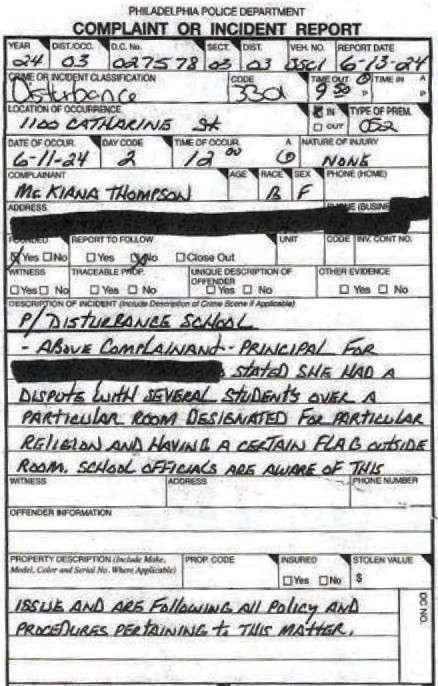
The school defendants argued that the room was actually open “to all students who wished to pray, meditate, or reflect privately,” and Muslim students just happened to use the room more often than other students. But plaintiffs had alleged—plausibly, the court concluded—that they were indeed disciplined for entering the room as non-Muslims, citing “The Police Report filed in response to Defendant Thompson’s complaint wherein she stated that the room is ‘designated for a particular religion and having a certain flag [Palestinian] outside the room'”:
Here are excerpts from the factual backstory, as alleged by plaintiffs:
[1.] Prayer Room Incident[:] The final days of the Palumbo school year are generally quite an informal affair, with teachers regularly allowing students to leave class, coming and going as they please within the building. On the third-to-last day of the school year—June 11, 2024—Plaintiff M. Danowitz decided to visit his old friends at Palumbo. Danowitz, who is Jewish, had attended Palumbo the previous school year and remained friendly with Palumbo students including Plaintiff John Hiester. He and Hiester arrived at Palumbo together on the morning of June 11, entering the building through the main entrance. They passed Palumbo’s Principal, Kiana Thompson … and Dean of Student Conduct Rashida Stamps … on their way in, and went through Palumbo’s standard security screening. Danowitz was admitted into the building without objection. His entrance was recorded by Palumbo security cameras.
Once inside, Hiester and Danowitz joined Plaintiff Meru Parmar and several other friends in the school’s computer lab. The group (“the Boys” [no, not those Boys -EV]) then made their way to the library, where an open door marked “Quiet Room” and decorated with a makeshift Palestinian flag caught their attention. Believing that the room was open to all students, first Danowitz—then later Hiester and Parmar—went inside.
Inside the Quiet Room, the Boys found several female students seated at a table using their laptops, as well as Islamic religious decorations and Arabic signage adorning the walls. One large sign welcomed people to the “Prayer Room” and wished them a “Happy Ramadan.” A laminated placard pinned to the wall contained “guidelines” from The Academy at Palumbo Muslim Student Association for use of the “Quiet Room.”
The Boys sat on the opposite side of the room from the female students, and one of them (a non-party to this suit) recorded an iPhone video as Danowitz said a short Jewish prayer in Hebrew. The prayer elicited laughter from the female students and a short exchange during which the girls questioned why the Boys were in the room. Danowitz responded that he had a First Amendment right to pray and was a proud Zionist; he also sang a short section of Am Yisroel Chai (“The People of Israel Live”) and did a handstand. As he left the room, he removed a laminated placard from the wall, setting it on the floor.
[2.] Immediate Aftermath[:] The Boys faced immediate backlash to their actions in the Prayer Room. Within minutes, Hiester was bombarded by texts and calls from fellow students demanding to know Danowitz’s whereabouts. Unnerved by this reaction, Danowitz left the Palumbo building, followed by Hiester shortly thereafter; Parmar returned to the computer lab. Throughout the day, Hiester received a continuous flood of threatening texts and phone calls from Palumbo classmates; one Muslim student (A.B.) who had previously assaulted Hiester called him 11 times. The same student led a group into the computer lab to confront Parmar, angrily accusing him of “trashing” the Prayer Room. Feeling threatened, Parmar had his mother pick him up from school early.
[3.] Investigation Initiated[:] Within hours of the incident, Palumbo administrators began taking witness statements, and Defendant Stamps notified Defendant Thompson of a “potential ‘Hate Crime'” in the “Quiet Room/Prayer Room.” Thompson subsequently contacted each of the Student Plaintiffs’ parents.
First, she called Hiester’s parents to tell them that their son had left school early without permission. At his parents’ urging, Hiester returned to school, where he was directed by Principal Thompson to fill out an Incident Report. He admitted to entering the “Prayer Room” but denied that any harassment had occurred. Before leaving school for the day, Hiester was confronted and threatened by A.B. and a group of other students in a first-floor bathroom.
Defendant Thompson next called Plaintiff Danowitz’s mother to tell her that her son had been accused of sneaking into Palumbo and harassing Muslim students. The following morning, she called Plaintiff Parmar’s father to inform him that a statement from his son was needed to address “serious accusations” of “harassment of girls “in the Prayer Room.” When Parmar arrived at school that morning, he was directed to Principal Thompson’s office for questioning and to fill out an Incident Report. Parmar maintained that he didn’t “know of any incident” in the Prayer Room.
[4.] Accusations Spread Online …
[5.] Student Plaintiffs Suspended and Parents’ Concerns Rebuffed by Palumbo Administration …
[6.] Plaintiff Families File Statements with the District[:] The Plaintiffs went directly from Palumbo to SDP’s main administrative building to file statements about the Prayer Room incident and its fallout. They also showed SDP Victim Assistance Specialists a video taken during the incident which contradicted many of the accusations lodged against Plaintiff students.
Despite Plaintiff Families filing statements, sharing video evidence, and making repeated appeals to Palumbo and SDP leadership, SDP did not publicly respond to the threats and accusations against Plaintiff students until August 19, 2024, when Defendant Thompson issued a letter to the Palumbo community. The letter stated that the investigation into the incident was ongoing, but emphasized that the kind of harassment the Student Plaintiffs were accused of committing was unacceptable. It also warned Palumbo students that there would be consequences for any students who used social media to “exacerbate claims beyond the allegations that were reported.”
Aside from the letter, the Plaintiff families’ concerns were never addressed. On June 19, 2024, Kathryn Hiester requested a safety transfer for her son due to student threats and Palumbo administrators’ dismissive reaction to her concerns; she never received a response. Parmar’s mother, Catherine, also sent an email on June 16 expressing her concern that went unanswered.
[7.] Teacher Defendants Amplify the Accusations Against Student Plaintiffs …
[8.] SDP’s Formal Investigation[:] The investigation of the Prayer Room incident matter was assigned to an employee of SDP’s Office of School Safety Investigation Unit, Steven Jefferson (“Jefferson”). Summarizing the incident, Jefferson referred to the Plaintiff students and their (non-party) friends as “five Jewish male students,” despite the fact that Hiester and Parmar are not Jewish. Jefferson never interviewed the Student Plaintiffs or Plaintiff families. The investigation credited the secondhand accounts of students who did not directly witness the Prayer Room incident, despite Plaintiff Families showing SDP officials video footage that contradicted their accusations. On August 29, 2024, Defendant Thompson prepared two letters informing Plaintiff families that the SDP investigation had found that their sons committed harassment on June 11, 2024. The letters were sent to the Hiester and Parmar families on September 6, 2024.
The full investigative report that was eventually turned over to Plaintiffs’ counsel contained no specific factual findings or analysis, merely the conclusion that that the harassment allegations were “founded.” A Harassment, Intimidation and Bullying Report (“HIBster Report”) was prepared as part of the investigation by Jade Tuff, a Palumbo teacher who also served as the faculty advisor to the Academy at Palumbo Muslim Student Association (APMSA). Plaintiffs allege that Palumbo administrators had granted authority over the Prayer Room to APMSA, creating a clear conflict of interest for Tuff….
The court allowed plaintiffs’ Due Process Clause claim to proceed as well:
Under the Fourteenth Amendment, no State shall “deprive any person of life, liberty, or property without due process of law …” Property interests are typically created and defined by non-constitutional sources, like state law. Under Pennsylvania law, education is a statutory right, and students must be afforded all appropriate due process before being excluded from school….
Here, Student Plaintiffs were neither provided notice of the charges against them nor given an opportunity to deny them before the suspension took effect. When Defendant Stamps and Thompson questioned Student Plaintiffs about the Prayer Room incident of June 11, 2024, they never asked how M. Danowitz obtained access to Palumbo. Therefore, Student Plaintiffs were never given notice that they were alleged to have accompanied a trespasser on campus, nor were they provided an opportunity to contest that accusation.
At 10 p.m. the night before the Student Plaintiffs’ suspensions took effect, Defendant Thompson notified their parents of the suspension and its grounds. She did not notify the students themselves. Providing written notice of suspension to a student’s parents is required under Pennsylvania law, but it doesn’t replace a disciplinarian’s obligation to notify the excluded student themselves. Despite the suspension taking effect the following morning, Defendant Thompson refused to meet with the Student Plaintiffs and their parents when they arrived at Palumbo seeking an audience. This deprived the Student Plaintiffs of the opportunity to contest the allegations.
In their motion to dismiss, SDP Defendants argue that a pre-deprivation hearing is not required when it is infeasible to do so, and the hearing subsequently occurs as soon as reasonably practicable…. But making all inferences for the Plaintiff, the Court concludes that it was feasible for SDP defendants to provide notice of the suspension and an informal hearing to Student Plaintiffs without endangering persons or property or disrupting the (then-concluded for the year) academic process.
Defendant Thompson suspended Student Plaintiffs on a Wednesday night. She could have consented to meet with Plaintiffs to provide notice and hearing when they came to Palumbo seeking to meet with her the next morning. Or, in a post-Covid world where remote learning is commonplace, Thompson could easily have arranged a video conference with the Student Plaintiffs.
Read the full article here
Fact Checker
Verify the accuracy of this article using AI-powered analysis and real-time sources.