Close Menu
FSNN | Free Speech News NetworkFSNN | Free Speech News Network
  • Home
  • News
    • Politics
    • Legal & Courts
    • Tech & Big Tech
    • Campus & Education
    • Media & Culture
    • Global Free Speech
  • Opinions
    • Debates
  • Video/Live
  • Community
  • Freedom Index
  • About
    • Mission
    • Contact
    • Support
Trending

Don’t Trust The Name On The PAC

31 minutes ago

Today in Supreme Court History: August 24, 1946

36 minutes ago

Jackson Hole Symposium, U.S. PCE prices, IREN earnings: Crypto Week Ahead

53 minutes ago
Facebook X (Twitter) Instagram
Facebook X (Twitter) Discord Telegram
FSNN | Free Speech News NetworkFSNN | Free Speech News Network
Market Data Newsletter
Monday, August 24
  • Home
  • News
    • Politics
    • Legal & Courts
    • Tech & Big Tech
    • Campus & Education
    • Media & Culture
    • Global Free Speech
  • Opinions
    • Debates
  • Video/Live
  • Community
  • Freedom Index
  • About
    • Mission
    • Contact
    • Support
FSNN | Free Speech News NetworkFSNN | Free Speech News Network
Home»News»Media & Culture»This YouTuber Got Kicked Out of the Flock Convention. So He Ran His Own Surveillance.
Media & Culture

This YouTuber Got Kicked Out of the Flock Convention. So He Ran His Own Surveillance.

News RoomBy News Room2 hours agoNo Comments5 Mins Read4 Views
Share Facebook Twitter Pinterest Copy Link LinkedIn Tumblr Email VKontakte Telegram
This YouTuber Got Kicked Out of the Flock Convention. So He Ran His Own Surveillance.
Share
Facebook Twitter Pinterest Email Copy Link

Listen to the article

0:00
0:00

Key Takeaways

Playback Speed

Select a Voice

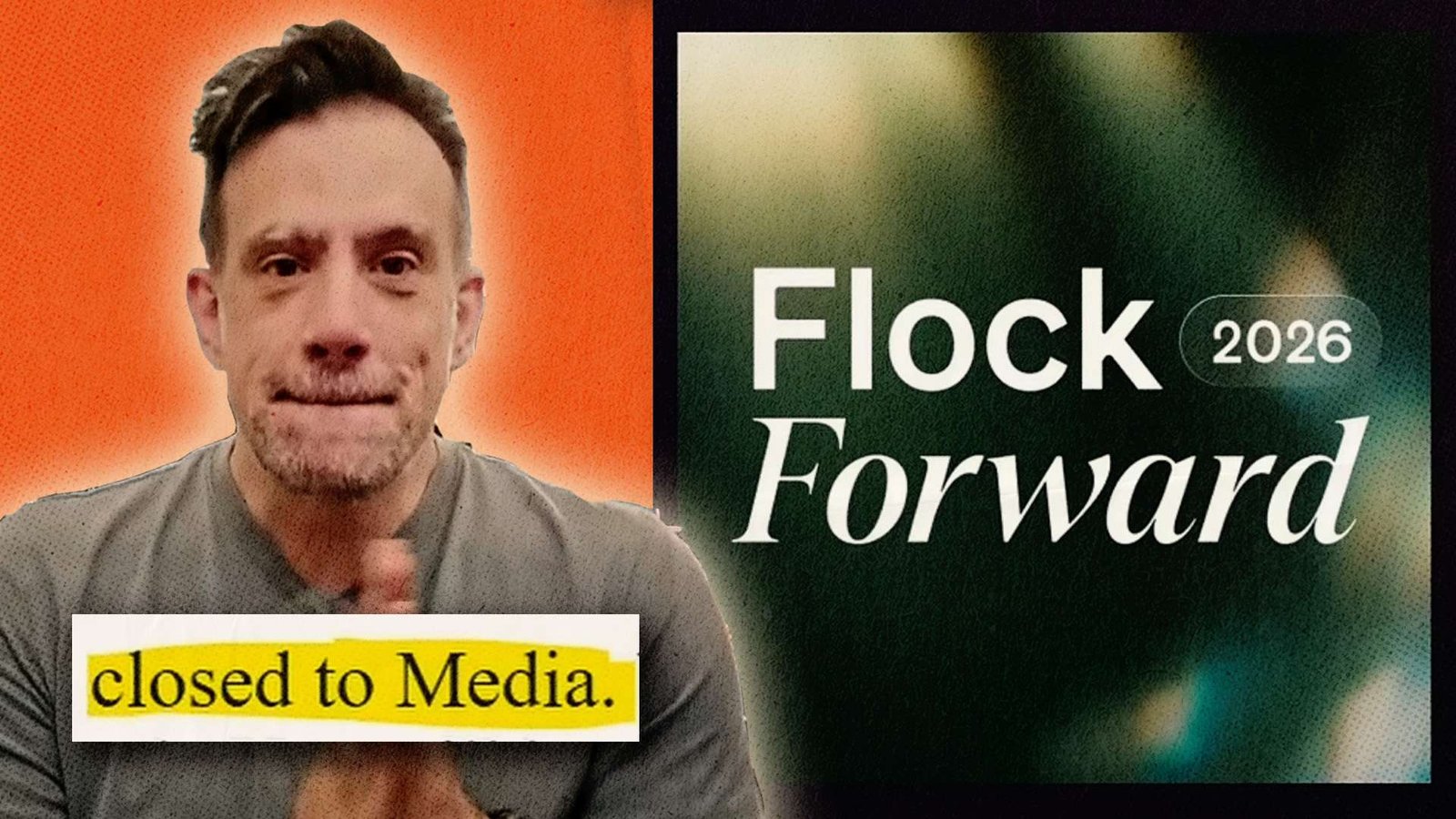
The surveillance contractor Flock Safety argues that police customers don’t need a warrant to track drivers with its automated license plate reading cameras because drivers have “no reasonable expectation of privacy” on public roads. So YouTube host Benn Jordan applied the same logic back on Flock. He sat outside Flock’s recent police convention in Atlanta with radio equipment and a drone, which he used to unmask attendees and even listen to microphones inside the convention hall.

“Flock values their privacy. Oh well,” Jordan wrote in the title of his video on the convention.

His plans didn’t quite start out that way. Jordan, an early and outspoken critic of Flock, wanted to visit the convention to see what the relationship between police and the company was like after a string of cases in Georgia involving police misusing Flock products, he tells Reason. After downloading the conference app, he looked inside the source code and found that it revealed the entire guest list. Jordan alerted Flock to the data breach.

Once the company caught wind that Jordan was coming, it canceled his tickets. But the attempts to keep Jordan out went further than that. An employee from Flock called the hotel to cancel Jordan’s room reservation, which he had booked himself, according to a video Jordan posted of a call with the hotel. (Flock did not respond to Reason‘s request for comment.) Jordan even found out that all of the rest of the rooms and even the parking lots surrounding the hotel had been booked.

Still, he was able to find a public parking spot within view of the hotel, where he parked a van with dozens of WiFi adapters, a parabolic dish antenna, and a dipole array. This equipment picked up the signal from the convention hall’s wireless microphones, allowing Jordan to hear attendees’ conversations. “Everything was on public channels,” he says. Then he used a drone to photograph attendees walking out and used facial recognition to figure out their identities.

Ironically, government regulations helped Jordan with his surveillance, because the Federal Communications Commission limits wireless microphones to broadcast on very specific frequencies.

Although it’s within a private company’s right to choose who can and can’t come to its conference—and Jordan acknowledges that keeping outsiders away from the hotel can be a reasonable security measure—many of the attendees were police officials, presumably attending on the taxpayer dime. More fundamentally, it’s an issue of different rights for different people. While Flock and its police customers are happy to erode the expectation of privacy in everyday life, they carve out ultra-private spaces for themselves.

Indeed, Jordan is careful not to reveal anything he picked up from his radio surveillance, telling Reason that the point was simply to show that it could be done. “Public officials should know that you can’t go to a private thing where journalists aren’t allowed and not expect anybody to fly a drone from public view. You should be a little unsettled about going to something like that,” Jordan adds. He says that he’s ultimately happy that his stunt drew attention to the lack of transparency.

Although automatic license plate readers have been raising privacy concerns for years, the growth of Flock is particularly alarming because the company plugs police departments around the country into a central database that isn’t subject to court orders or the Fourth Amendment to the Constitution. And the lack of oversight isn’t just theoretical. Police officers have been caught using Flock data to stalk romantic interests. One woman spent two weeks in jail, and another was detained at gunpoint because of mistaken identifications from Flock cameras.

The American public is becoming increasingly hostile to these cameras. At least 56 cities and towns have ended their Flock contracts in 2026 over privacy concerns. Ring, a doorbell camera company owned by Amazon, also canceled its planned partnership with Flock over public backlash. More alarmingly, citizens have started vandalizing the cameras.

Jordan, whose YouTube channel covers eclectic science topics from animal hearing to modern train synthesizers, accidentally found himself at the forefront of the movement against Flock. He saw mysterious new cameras in his neighborhood early last year, followed his instincts to reverse engineer everything, and found security vulnerabilities allowing anyone to access Flock footage without a password.

In response to Jordan’s video, Flock CEO Garrett Langley sent officials around the country a letter in December 2025 claiming that “Flock has never been hacked” and is “under coordinated attack…from the same activist groups who want to defund the police, weaken public safety, and normalize lawlessness.” The city of Staunton, Virginia, published the letter in its announcement that it was ending its relationship with Flock.

Although he hasn’t gotten any response for his surveillance of the Flock conference, Jordan tells Reason that he’s had police show up outside his house “and just blast their siren” in the past. He claims he also spotted a private investigator (who is unlicensed and a convicted felon) hanging around his house, but couldn’t figure out who hired them.

Despite the unwanted attention, Jordan has continued speaking to city councils and police departments around the country. While he says that he would prefer no license plate tracking to begin with, he has been pitching a solution to cities that are going to do it anyway: locally owned cameras feeding into locally owned databases that police need a warrant from a judge to access.

“I want there to be an end to this investigation…I generally never make a video about the same thing twice,” Jordan tells Reason. “But unfortunately, I have cameras everywhere all around my neighborhood, so I can’t not think about it.”


Read the full article here

Fact Checker

Verify the accuracy of this article using AI-powered analysis and real-time sources.

Get Your Fact Check Report

Enter your email to receive detailed fact-checking analysis

5 free reports remaining

Continue with Full Access

You've used your 5 free reports. Sign up for unlimited access!

Already have an account? Sign in here

#IndependentMedia #MediaEthics #NarrativeControl #OpenDebate #PoliticalCoverage
Share. Facebook Twitter Pinterest LinkedIn Tumblr Email Telegram Copy Link
News Room
  • Website
  • Facebook
  • X (Twitter)
  • Instagram
  • LinkedIn

The FSNN News Room is the voice of our in-house journalists, editors, and researchers. We deliver timely, unbiased reporting at the crossroads of finance, cryptocurrency, and global politics, providing clear, fact-driven analysis free from agendas.

Related Articles

Media & Culture

Don’t Trust The Name On The PAC

31 minutes ago
Media & Culture

Today in Supreme Court History: August 24, 1946

36 minutes ago
Cryptocurrency & Free Speech Finance

Strive Buys $81.5 Million in Bitcoin After Issuing More Shares

58 minutes ago
Campus & Education

After censoring an anti-ICE cartoon, this school district officially enacted prior review

1 hour ago
Cryptocurrency & Free Speech Finance

AI Model Ox Alpha Is Free, Beats Claude Fable, and Nobody Knows Who Built It

2 hours ago
Media & Culture

Trump Threatens Think Tank With Libel Lawsuit For Telling The Truth About National Guard Deployments

3 hours ago
Add A Comment
Leave A Reply Cancel Reply

Editors Picks

Today in Supreme Court History: August 24, 1946

36 minutes ago

Jackson Hole Symposium, U.S. PCE prices, IREN earnings: Crypto Week Ahead

53 minutes ago

CFTC, US soldier accused of illegal Polymarket bet spar over interpretation of prediction markets

56 minutes ago

Strive Buys $81.5 Million in Bitcoin After Issuing More Shares

58 minutes ago
Latest Posts

After censoring an anti-ICE cartoon, this school district officially enacted prior review

1 hour ago

This YouTuber Got Kicked Out of the Flock Convention. So He Ran His Own Surveillance.

2 hours ago

Bitcoin steadies near $78,000 as gold rallies, altcoins consolidate after best week in 3 years

2 hours ago

Subscribe to News

Get the latest news and updates directly to your inbox.

At FSNN – Free Speech News Network, we deliver unfiltered reporting and in-depth analysis on the stories that matter most. From breaking headlines to global perspectives, our mission is to keep you informed, empowered, and connected.

FSNN.net is owned and operated by GlobalBoost Media
, an independent media organization dedicated to advancing transparency, free expression, and factual journalism across the digital landscape.

Facebook X (Twitter) Discord Telegram
Latest News

Don’t Trust The Name On The PAC

31 minutes ago

Today in Supreme Court History: August 24, 1946

36 minutes ago

Jackson Hole Symposium, U.S. PCE prices, IREN earnings: Crypto Week Ahead

53 minutes ago

Subscribe to Updates

Get the latest news and updates directly to your inbox.

© 2026 GlobalBoost Media. All Rights Reserved.
  • Privacy Policy
  • Terms of Service
  • Our Authors
  • Contact

Type above and press Enter to search. Press Esc to cancel.

🍪

Cookies

We and our selected partners wish to use cookies to collect information about you for functional purposes and statistical marketing. You may not give us your consent for certain purposes by selecting an option and you can withdraw your consent at any time via the cookie icon.

Cookie Preferences

Manage Cookies

Cookies are small text that can be used by websites to make the user experience more efficient. The law states that we may store cookies on your device if they are strictly necessary for the operation of this site. For all other types of cookies, we need your permission. This site uses various types of cookies. Some cookies are placed by third party services that appear on our pages.

Your permission applies to the following domains:

  • https://fsnn.net
Necessary
Necessary cookies help make a website usable by enabling basic functions like page navigation and access to secure areas of the website. The website cannot function properly without these cookies.
Statistic
Statistic cookies help website owners to understand how visitors interact with websites by collecting and reporting information anonymously.
Preferences
Preference cookies enable a website to remember information that changes the way the website behaves or looks, like your preferred language or the region that you are in.
Marketing
Marketing cookies are used to track visitors across websites. The intention is to display ads that are relevant and engaging for the individual user and thereby more valuable for publishers and third party advertisers.