

 Freedom Index

Listen to the article
The hockey stick growth of stablecoin adoption
The stablecoin market reached a pivotal milestone on Dec. 12, 2025, hitting $310 billion in total value. That represents a 70% increase in just one year. This growth is not just another cryptocurrency bubble metric; it signals a fundamental shift in how digital assets are beginning to be used globally.
To understand why the $310-billion stablecoin market matters, it is first necessary to understand what stablecoins are. Unlike Bitcoin (BTC) or Ether (ETH), which fluctuate based on market sentiment, stablecoins are designed to aim for price stability by referencing an underlying asset, typically through reserve backing or algorithmic mechanisms. This is typically the US dollar, though some track the euro or commodities such as gold.
This simple design addresses a critical problem in cryptocurrency: volatility. When sending $100 internationally, most users want to know it will arrive as $100, not $50 or $150, depending on foreign exchange market conditions. Stablecoins make this possible by acting as a bridge between traditional finance and the decentralized economy.
The market is dominated by Tether’s USDT (USDT), with $172 billion, and Circle’s USDC (USDC), with $145 billion. Together, they account for roughly 80% of global stablecoin transaction activity. This concentration reveals something important about crypto adoption: Users tend to prioritize network effects and trust over technological novelty alone.
Did you know? On many major cryptocurrency exchanges, stablecoins now account for roughly 80% of total trading volume, effectively serving as the default cash leg of the digital asset market.
A global payment revolution building quietly
Stablecoins demonstrate their most transformative potential in cross-border payments. Traditional international money transfers rely on multiple intermediaries, including correspondent banks, clearing houses and foreign exchange brokers. Each layer adds fees and delays. A typical international transfer can take three to five business days and cost 2%-3% of the transaction value.
Stablecoin-based transfers can settle in minutes at costs as low as a fraction of a percent. Some remittance providers report cost reductions of up to 95% when shifting from traditional payment rails to stablecoin settlement, while also reducing settlement times from days to minutes.
In high-inflation economies such as Argentina and Venezuela, stablecoins are increasingly used as a store of value when local currencies become unstable. This reflects a form of financial inclusion in which individuals gain access to relatively stable digital assets without relying on traditional bank accounts in regions with limited banking infrastructure.
Did you know? Research from FIS shows that nearly three-quarters of consumers would be willing to try stablecoins if they were offered by their bank, while just 3.6% say they feel comfortable using unregulated providers.
Institutional demand is crucial to stablecoin adoption
Whether it is Stripe’s acquisition of the stablecoin platform Bridge, Circle’s introduction of the Arc layer-1 blockchain or Tether-backed Stable launching its own layer-1 protocol, it is clear that major players are increasingly investing in purpose-built infrastructure aimed at further improving stablecoin efficiency.
According to Fireblocks’ 2025 “Stablecoins in Banking” report, nearly half of surveyed institutions were already using stablecoins in operational settings, with another 41% piloting or planning implementations. Among active users, the most common use cases are cross-border transactions. An Ernst & Young survey found that 62% use stablecoins to pay suppliers, while 53% accept them for business payments.
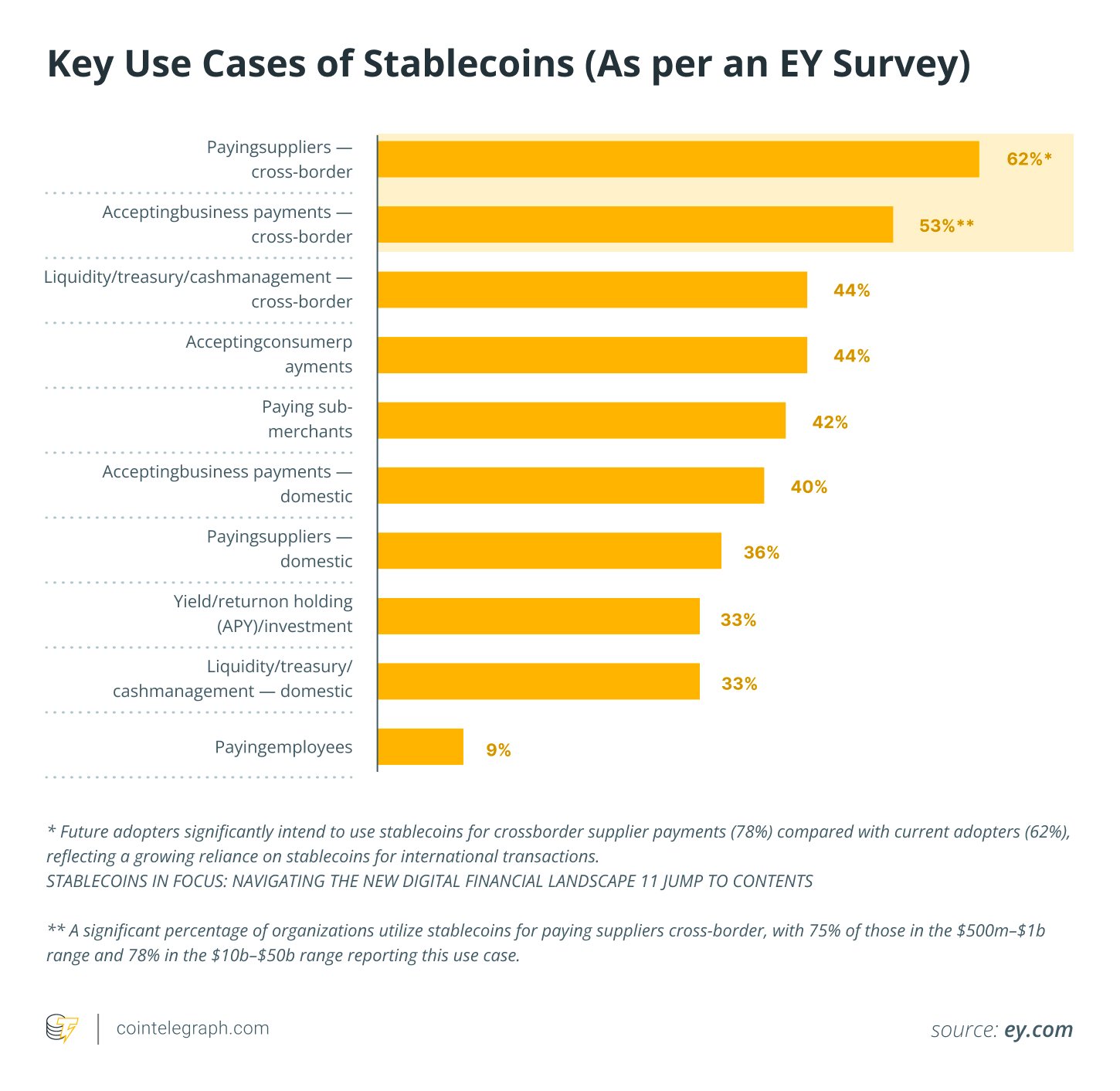
The institutional shift from speculation to operational necessity is reshaping stablecoin adoption. Corporate treasurers increasingly view stablecoins as workflow tools. Capital moving through traditional banking systems can incur opportunity costs and currency risk, while stablecoins allow for near-instant, 24/7 settlement with improved visibility.
Did you know? Industry surveys in 2025 indicate that stablecoins are often the first blockchain product institutions pilot internally, even before Bitcoin or Ethereum exposure, because they most closely align with existing money and treasury workflows.
Stablecoins have evolved to become the foundation of DeFi
Stablecoins play a central role in the decentralized finance (DeFi) stack. Major protocols such as Aave and Curve structure their core lending and trading pools around stablecoins because they offer predictable, low-volatility collateral. Developers are also experimenting with yield-bearing stable assets, such as Ethena’s USDe (USDE), which are designed to generate returns automatically and turn passive currency into productive capital.
Stablecoin transaction volumes reflect this role. In 2025, onchain transfer volumes linked to major stablecoins reached multitrillion-dollar levels on an annualized basis, with growth rates that, in certain periods and measured by raw settlement value, have exceeded those of traditional card networks. Stablecoin settlement volumes have begun to rival those of global payment providers, even though most users do not interact with these rails directly.
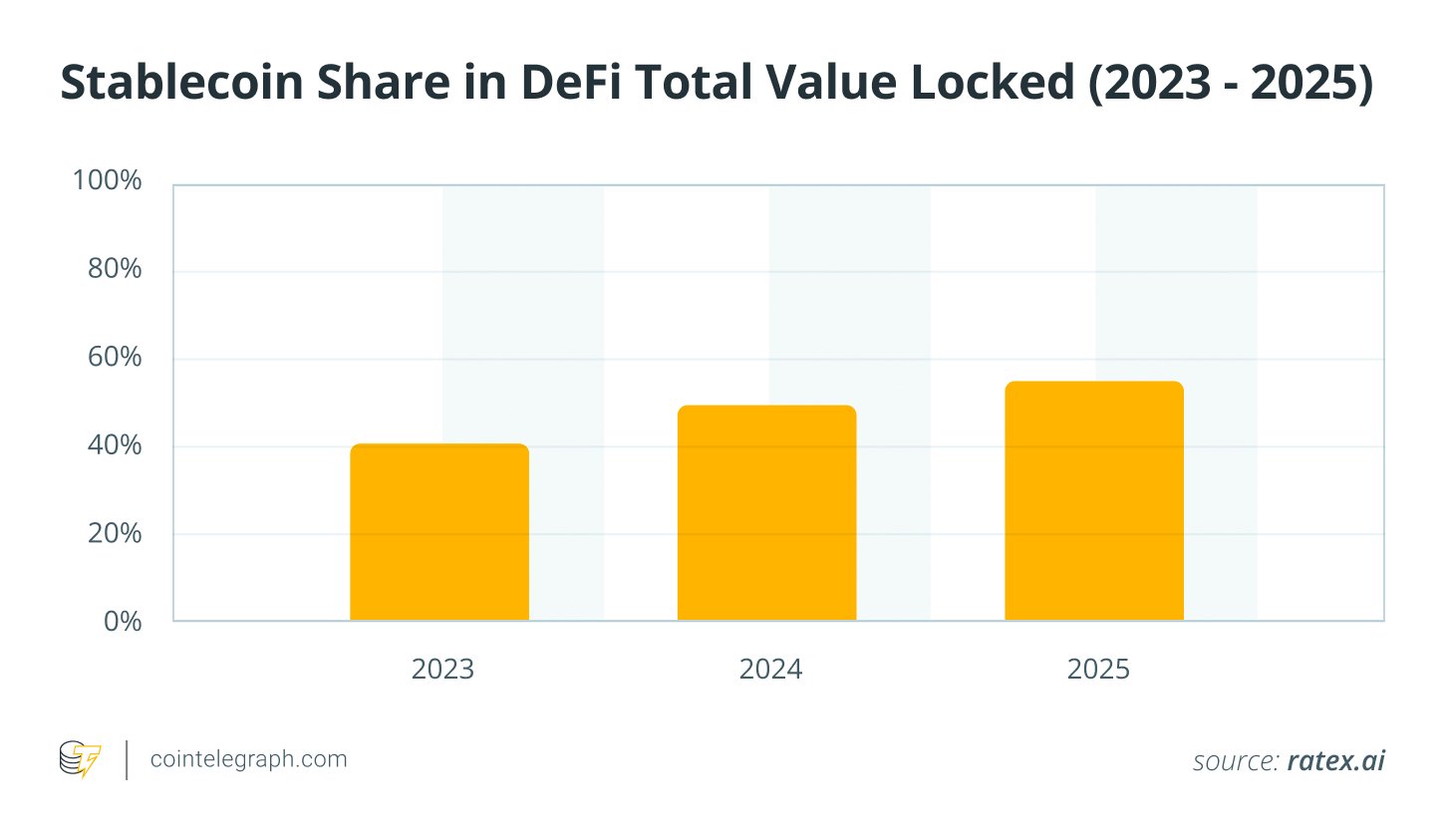
Did you know? In 2025, more than half of DeFi’s total value locked sits in stablecoins, making them the primary collateral and accounting unit for many onchain lending protocols and liquidity pools.
The scale question: From billions to trillions
The headline of $310 billion raises an obvious question: If stablecoins are so useful, why has the market not yet scaled into the trillion-dollar range? The answer lies in how financial infrastructure adoption typically unfolds, gradually at first and then suddenly.
At present, stablecoins primarily function as trading infrastructure within crypto markets and as cross-border payment rails for remittances and institutional flows. For stablecoins to scale meaningfully, several infrastructure layers still need to mature. These include compliant on-ramps and off-ramps that connect banks and wallets, merchant tools that make stablecoin acceptance as intuitive as card payments and user interfaces that abstract away blockchain complexity.
Several industry analyses model scenarios in which stablecoin supply reaches $2 trillion by 2028, assuming broader integration by large financial institutions. These projections are based on stablecoins evolving from a trading-focused tool into a more general-purpose digital cash layer used across e-commerce, business-to-business payments and embedded finance.
Did you know? Under Markets in Crypto-Assets (MiCA) and the Guiding and Empowering Nation’s Innovation for US Stablecoins (GENIUS) Act, leading fiat-backed stablecoins are required to be fully reserved with high-quality assets and subject to regular audits and disclosures. This structure is closer to traditional regulated finance than many early crypto experiments.
Robust infrastructure is key to mainstream adoption
The fast-growing stablecoin market tells a broader story about how transformative technologies actually spread. Stablecoins may not dominate headlines in the way Bitcoin halving cycles do, but they power much of the real-world usage beneath those narratives.
This asset class combines price stability, regulatory structure and technical composability in a way that appeals to both conservative institutions and experimental DeFi protocols. As frameworks such as MiCA and the GENIUS Act take hold and as the market continues to mature, stablecoins are likely to remain central to crypto’s connection with mainstream finance.
For everyday users, the most impactful crypto innovation may not be a new blockchain at all, but the steady expansion of digital dollars that simply work more efficiently than the payment rails they replace.
Read the full article here
Fact Checker
Verify the accuracy of this article using AI-powered analysis and real-time sources.