

 Freedom Index

Listen to the article
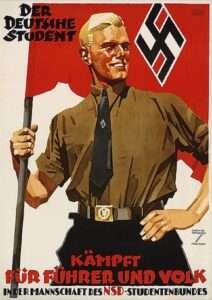
Periodically, debate rages over the question of whether the Nazis were socialists. As a general rule, conservatives (and some libertarians) make this accusation, while left-wingers indignantly deny it. This question has returned to prominence in recent months, and it remains worth addressing. The right answer is that the Nazis were similar to socialists in backing sweeping government control over the economy, yet different from them in rejecting racial and ethnic equality. But the difference is greater in theory than in practice.When socialists come to power, they often engage in persecution of minority groups, even though this is inimical to their ideology. There are systematic reasons for this pattern, which go beyond the idiosyncracies of individual leaders.
All of this has significant implications for current political debates, at a time when “democratic socialism” is a growing movement and much of the right has embraced statist nationalist economics.
It is difficult to deny that the Nazis (and other similar right-wing nationalist movements) embraced sweeping economic statism, including socialist-style central planning. The movement wasn’t called the National Socialist Party for nothing. I summarized some of the evidence in a 2007 post, relying on then-recent academic research (later research has not changed these conclusions):
The idea that Nazism was an extreme form of “capitalism” and Hitler primarily a tool serving the interests of “big business” is a longstanding myth that even now retains a measure of popularity in some quarters. This, despite the fact that the full name of the Nazi Party was the National Socialist German Workers’ Party, and that Nazi political strategy was explicitly based on combining the appeal of socialism with that of nationalism (thus the choice of name). Once in power, the Nazis even went so far as to institute a Four Year Plan for running the German economy, modeled in large part on the Soviet Union’s Five Year Plans….
Two recent books further explain the socialist elements of Nazi economic policy, and will hopefully put the final nails in the coffin of the myth that the Nazis were “capitalists” or free marketeers. In The Wages of Destruction: The Making and Breaking of the Nazi Economy, historian Adam Tooze describes the statist nature of Nazi economic policy in great detail, and concludes that the Nazis imposed greater government control over the economy than any other noncommunist regime in modern history. (pp. 658-60). Tooze notes that, even before the outbreak of World War II, government military spending accounted for some 20% of the GDP, while much of the rest of the economy came under government control as a result of the Four Year Plan and other similar measures.
In Hitler’s Beneficiaries: : Plunder, Racial War, and the Nazi Welfare State, Gotz Aly argues on the basis of extensive evidence, that German support for Nazi rule was maintained by the creation of a massive welfare state funded in large part by plunder captured in Hitler’s foreign conquests, but also partly by means of “soak the rich” taxation within Germany itself.
Some nonetheless persist in viewing the Nazi economic system as “capitalist” because 1) some big businessmen (such as the Krupps) supported the Nazi regime, and 2) most of the means of production remained under private rather than state ownership. It is certainly true that much industrial capital remained formally under private ownership under the Nazis. However, under the Four Year Plan and other similar policies, it was primarily the government that determined what goods would be produced, what prices would be charged, and (in many cases) who would be the consumers. “Capitalist” private firms in Nazi Germany played a role far more similar to that of socialist managers of enterprises in the Soviet Union than that of actual capitalists in a market system. The Krupps and others certainly profited greatly under the Nazis, but so too did high-ranking Communist Party enterprise managers in the Soviet Union. Neither, however, detracted from the state’s ultimate control over economic production…..
These two new books are useful complements to Avraham Barkai’s 1990 work Nazi Economics, which explored the ideological origins of Nazi economic policy and showed how Nazi economic theorists explicitly advocated statism, while rejecting free markets. Like some modern opponents of globalization and free trade, the Nazis viewed economics as a zero-sum game between nations, where increasing wealth for one country could, in the long run, only be achieved by impoverishing or conquering others.
More recently, economist Bryan Caplan has surveyed the data on Nazi economic policy, indicating extensive and rapidly growing government control of the economy.
But government control of the economy was not the only element of Nazi ideology. Another key facet was racial and ethnic hierarchy. The Nazis believed the state should serve the interest of “Aryan” Germans. Other groups were at best second-class citizens, and at worst slated for slavery (as in the case of Slavic peoples), or outright extermination (as in the case of the Jews).
By contrast, socialist ideology is egalitarian. The slogan “Workers of the World Unite” urges proletarians of all ethnic and national backgrounds to come together. Marx famously regarded nationalism as a form of “false consciousness.” Not all socialists reject nationalism so completely. But, as a general rule, they support racial and ethnic equality and condemn discrimination. In part for this reason, historically oppressed racial and ethnic minorities have often played a role in nascent socialist movements.
The anti-Semitic trope that communism was a Jewish conspiracy is false. Most Russian Jews were not communists, and most communists were not Jews. But it is true that Jews (and a number of other ethnic minorities) were disproportionately represented among pre-1917 Russian communists. That was in part because the communists promised ethnic equality and an end to the Russian Empire’s egregious anti-Semitic discrimination. Jews were similarly overrepresented in other movements promoting ethnic equality at that time, including the Constitutional Democratic Party, which sought to make Russia a liberal democracy.
Left-wingers who argue that the Nazis were not socialist like to emphasize this egalitarian dimension of socialist ideology. They have a point. But, sadly, socialist governments often fail to live up to these principles.
The Soviet Union – the world’s first socialist state – is a notable example. Despite promising equality, the Soviet government ultimately engaged in massive persecution of minority groups. Stalin deported and partially exterminated various groups, such as the Crimean Tartars. Ukrainian language and culture was subjected to widespread persecution, and the state-created famine of the 1930s was in part an effort to crush Ukrainians (though millions of Russians and others also died). For many decades, the Soviet Union also promoted extensive state-sponsored anti-Semitism and discrimination against Jews. Despite the fact that Jews had been overrepresented among the “Old Bolsheviks” (early leaders of the communist movement).
Such ethnic persecution and discrimination is far from unique to the Soviet Union. It was and is common in other socialist states. The Chinese communists have engaged in horrific persecution of Uyghurs and Tibetans, among others. Pol Pot’s Cambodia targeted Vietnamese and other minorities for extermination. Ethiopian communists persecuted and murdered members of the Eritrean and Tigrayan minorities. And such examples can easily be multiplied.
The ubiquity of ethnic persecution – often rising to the level of deportation and mass murder – under socialist regimes, suggests a systematic pattern. Why does it happen? A key factor is that socialism requires immense coercion and concentration of power in order to function. If you intend to subject the economy to systematic central planning, ethnic and cultural minorities are a potential danger. Their distinctive practices and traditions might deviate from the plan in various ways. Ethnic groups that seek (or might seek) autonomy or secession are a particular threat to the plan, and therefore especially likely to be subjected to repression. Thus, the Soviet government’s animus against Ukrainians (the largest potentially secessionist minority in the USSR), and China’s against the Tibetans and Uyghurs.
In addition, socialist hatred and fear of capitalists often leads to prejudice against minority groups – such as the Jews in Europe and Chinese in southeast Asia – who are disproportionately represented in business and financial enterprises. This is how we get the distinctive far-left version of anti-Semitism, evident in Karl Marx’s writings, among others.
A Soviet joke holds that a Soviet citizen who speaks only one language (usually an ethnic Russian who knows only Russian) is a good communist. By contrast, one who speaks two languages (usually a member of a non-Russian minority group, who speaks both Russian and that group’s language) is a dangerous “nationalist.” And one who speaks five, is a malevolent “Zionist” (likely, a Jew). The joke well captures socialist regimes’ fear and suspicion of minority groups, despite their ideological commitment to egalitarianism.
In some cases, the idiosyncratic prejudices of individual leaders also play a role. Stalin, for example, had a variety of prejudices against various groups, including Jews. But these idiosyncracies are significant in large part because of systematic tendencies of socialism. Stalin’s personal views had a big impact because the socialist system required an immense concentration of power, and massive coercion. People who questioned Stalin’s prejudices (many of which were genuinely at odds with traditional Marxist ideology) could expect to lose their jobs, end up in prison or a Gulag, or even be executed.
In sum, there are important commonalities between Nazis and socialists. But also an important difference, when it comes to racial and ethnic equality. But, in a tragic irony, the point on which Nazis and socialists are similar – government control of the economy – often ends up undermining the ethnic egalitarianism which is one of the few admirable aspects of socialism.
All of this is of more than just theoretical significance at a time when many right-wingers in the US and Europe are embracing statist nationalist economic policy. Racial and ethnic bigotry and persecution is a ubiquitous feature of nationalist movements, even if most don’t go as far as the Nazis do. The move towards statist nationalism is the main reason for the current resurgence of anti-Semitism and other bigotry on the political right in the US. And nationalist central planning of the economy has other massive flaws, many of them similar to the socialist version.
On the left, “democratic socialism” has had a resurgence in popularity. Left-liberals would do well to remember that this movement’s economic policies have many of the same dangers as those of right-wing nationalists. In addition, socialists’ promotion of economic central planning often ends up undermining their laudable ethnic and racial egalitarianism.
Read the full article here
Fact Checker
Verify the accuracy of this article using AI-powered analysis and real-time sources.