

 Freedom Index
Listen to the article
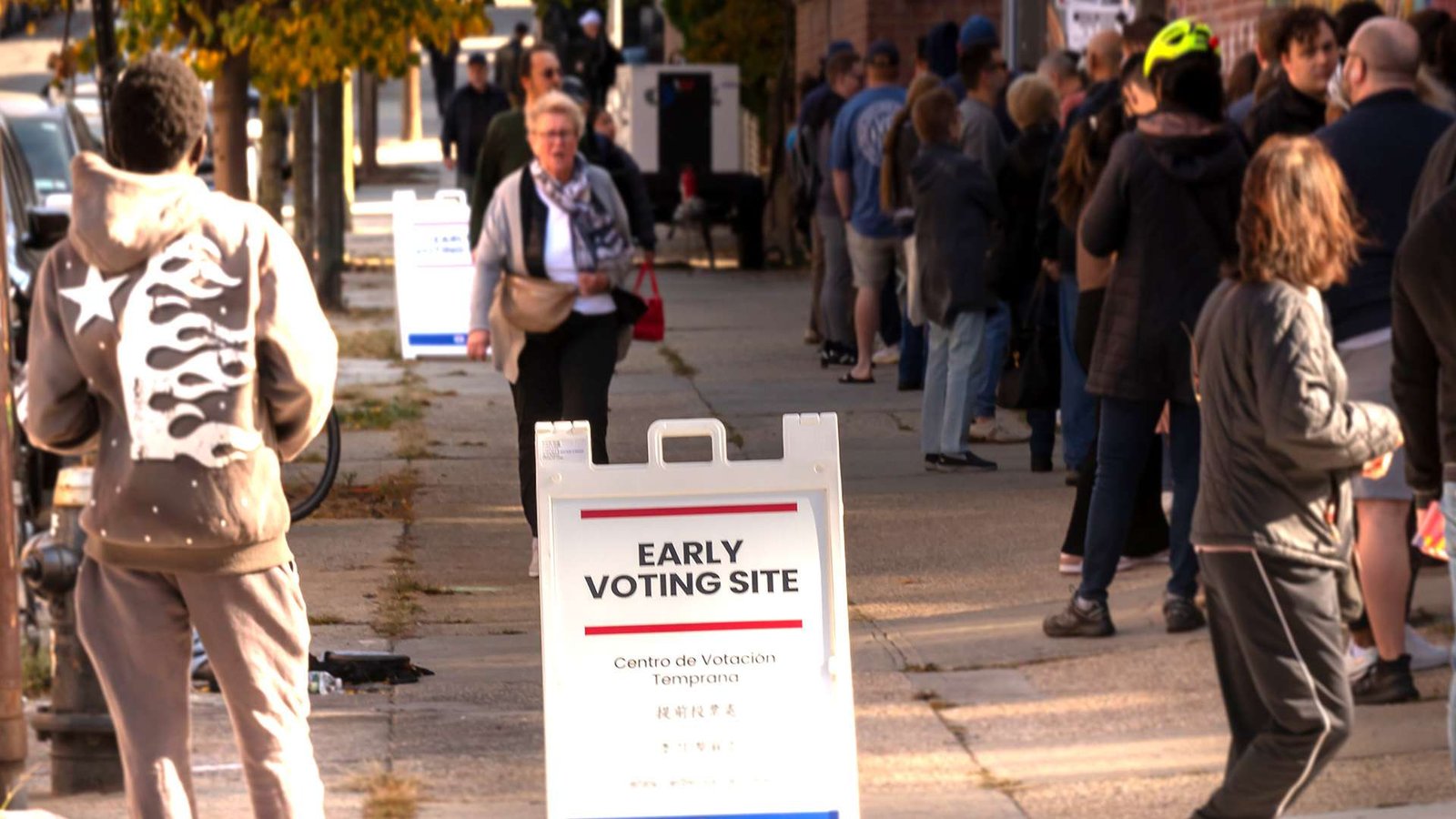
So far, Democrats are turning out way more than Republicans in contested statewide primaries across the country.
During midterms in President Donald Trump’s first term, Democrats turned out with energy and enthusiasm and flipped 42 House seats to win the majority. It’s possible we’re now gearing up for a repeat, if the primaries are any indication.
The Reason Roundup Newsletter by Liz Wolfe Liz and Reason help you make sense of the day’s news every morning.
“This primary season, perhaps the starkest example of Democratic enthusiasm came in Texas, a state Mr. Trump carried by 14 percentage points two years ago. Both parties had hard-fought and expensive Senate primary campaigns there this year,” reports The New York Times. “About 150,000 more people voted in the Democratic primary between James Talarico, the victor, and Representative Jasmine Crockett than in the Republican contest between Senator John Cornyn and the state’s attorney general, Ken Paxton, who would go on to win in a runoff.”
This is a marked change from 2022, “when there were 900,000 more votes in the state’s Republican primaries for state offices than in its Democratic contests,” adds the Times. “Even in 2018, during the last Democratic wave election, 500,000 more people voted in the Republican Senate primary than in the Democratic one.”
It’s looking like this year might be extremely good for Democratic voter turnout, if the Times’ projections are any indication: “Compare 2022 to 2026: Twenty-two states held contested primary elections in both parties for governor or Senate. Democratic turnout increased in three-quarters of those states this year over four years ago, while dropping in two-thirds of those states for Republicans.”
What can Alaska teach us? “Ten years ago, the changing geography of blue-collar jobs reshaped American politics. As the effects of the 2008 financial crisis, automation, and expanding global trade swept across the former industrial heartland, voters—male voters especially—spurned establishment figures for candidates they saw as more attuned to their concerns,” writes Jordan McGillis for City Journal. Now, “both parties have made reviving manufacturing central to their economic agendas. Yet in Michigan, Wisconsin, and Pennsylvania, fewer manufacturing jobs exist today than when Trump rode down the escalator in June 2015.”
So where have the manufacturing jobs gone? Mostly overseas. But, McGillis argues, Alaska is replete with blue-collar work. Maybe not in manufacturing, but jobs that require no college degree and provide stability and solid wages:
My analysis of Census data finds that more than 40 percent of civilian, prime-age, noncollege Alaska men employed in blue-collar occupations earn at least $75,000. More strikingly, 9.4 percent of Alaska’s civilian, prime-age, noncollege men work a blue-collar job and earn at least $100,000, compared with 3.6 percent nationally, ranking Alaska first in the country. Among those in such occupations more than one in four earns six figures.
What explains those returns? Alaska’s abundant natural resources play a major role. Median earned income for oil-and-gas drilling workers is an astonishing $191,500, while mining operators earn $134,000, compared with the national median for blue-collar workers of $48,400. Resource extraction, like manufacturing, belongs to the tradeable sector: production occurs locally, but the output gets sold into global markets.
Those workers represent only a small blue-collar elite, however. Far more Alaskans work in transportation, construction, and equipment maintenance, and many of these occupations also command substantial premiums, particularly when tied to the resource economy.
In other words, Alaska’s success will be hard to replicate elsewhere, “but the state does demonstrate that extraordinary opportunities remain available to workers without four-year degrees,” argues McGillis. The whole piece is worth a read.
Scenes from New York: “Some New York City police officers used Flock Safety, a system of automated license-plate readers that has been criticized as an invasion of privacy, to run searches even though the Police Department did not have a contract to do so,” reports The New York Times. “At least two dozen officers made more than 1,700 searches in Flock’s nationwide database between March 2023 and December 2025, according to an analysis of public data by the Surveillance Technology Oversight Project and LatinoJustice, a national civil rights organization. Those figures were confirmed by a New York Times analysis. The Police Department confirmed that a ‘handful’ of officers used the technology during the period cited in the report. The department never had a contract with Flock, but the officers used the technology in an ad hoc manner, the police said in a statement.”
Basically, representatives from Flock offered the NYPD a free trial, and the officers say they used it for cars they suspected were stolen or involved in hit-and-runs. Flock Safety “has 120,000 cameras across the country that alert law enforcement agencies whenever the cameras spot cars wanted in a crime or of interest to police,” adds the Times. “It allows police officers to search through its system even if the police agencies do not own the company’s cameras.”
QUICK HITS
- “SpaceX’s massive Starship rocket reached orbit for the first time on Monday morning, achieving a milestone for the program even though the company cut the mission short after an earlier engine failure,” reports Bloomberg. “Starship took off at 7:49 a.m. local time out of the Starbase launch facility in South Texas. The rocket was carrying 26 of the company’s upgraded Starlink satellites, which the vehicle successfully placed in orbit to join the existing internet-from-space network.”
- “Until 1975, half of Americans said they entertained guests at their home every month,” writes Derek Thompson. “But then something changed. Americans stopped throwing parties. Even more fundamentally, they stopped visiting each other. Between 1975 and 1998, the share of Americans who gave or attended a monthly dinner party declined by half. The share of Americans saying they never entertained people at home tripled.” I’m a big dinner party appreciator (and host) and can’t recommend them enough:
Dinner parties require work and risk (what if it all goes terribly and you embarrass yourself and dinner’s awful?) but they allow for intimacy: You learn something new about people when you glimpse their home life, and home reveals things that don’t meet the eye when one has… https://t.co/MJpvKL6fP3
— Liz Wolfe (@LizWolfeReason) September 29, 2026
- “Iran insisted on Sunday that only diplomacy can solve its conflict with the United States and Israel, after US President Donald Trump said he rejected an Iranian proposal to reopen the Strait of Hormuz and end fighting,” reports Reuters. “Iran announced a peace proposal last week at the UN General Assembly in New York, saying it had been transmitted to the Americans via Qatari mediators. Trump said on Saturday he rejected the plan, and argued that desperation was driving the Iranians’ push for an agreement on the key waterway.”
- “Grade inflation isn’t a new trend; as NAEP’s survey makes clear, it’s been on a steady march from the 1980s to the present,” writes Kelsey Piper for The Argument. “It has many drivers, including the fact that teachers are counseled for equity reasons not to give a student a zero for an assignment they didn’t complete. But in surveys, teachers report that the most common sources of pressure to change grades are students and parents.”
Read the full article here
Fact Checker
Verify the accuracy of this article using AI-powered analysis and real-time sources.