

 Freedom Index

Listen to the article
from the classroom-exercises dept
Early in the media law and ethics course I teach, as I shift gears from the ethics section to the law and core free speech issues, I try to build a foundation by introducing the many kinds of legal issues they may face as communicators. By this time, we have already discussed social media platforms and the terms and conditions to which they have agreed as users, and what this means for them as future media professionals and citizens.
As a break from weekly writing assignments, I set up a lesson starting in 2023 using the online game launched by Techdirt called “Trust & Safety Tycoon.” This puts students in the position of the head of a trust and safety team — basically, the chief of content moderation — for a social media startup company. As the site grows its users and popularity, and tries to remain viable as a commercial enterprise, the player faces increasingly challenging tasks. What happens when users threaten a boycott over offensive content? How do you handle Congress or foreign government leaders demanding takedowns? When news breaks on your platform and police ask for your help, to what extent do you cooperate?
While I require my students to do case briefs and other writing assignments on a weekly basis, the ease of using generative AI to do these assignments makes them less appealing. Students are far more likely to want to play a video game, especially one as engaging and challenging as Trust & Safety Tycoon. The assignment itself — to play the game through twice at a minimum, submitting selfies with the end-game screen — can be done in less than an hour, though some students report playing it several times to try to max out their score.
By this point in the semester, usually around the fourth week, students have completed readings and in-class discussion on media ethics and First Amendment issues. Playing this game is an opportunity to engage critically with modern content regulation matters across a broad array of media law topics — particularly free speech, prior restraint, privacy and intellectual property.
To ensure that students have played through the game as an assignment, they are asked to take a picture of themselves with the end-game screen. This provides another level of interaction that students enjoyed, with some sharing their results on their own social media accounts and commenting on the game there.
Execution of Assignment in the Classroom: Students were told in class about the assignment, with the instruction that the student had to play the game at least twice: once to learn the game mechanics and develop some comfort with how it operates, and a second time as a more serious effort to complete the game to their satisfaction. When they reach the final screen, they take a selfie with the end-game screen (rather than a screenshot, which could be easily copied or downloaded). They then upload those into the assignment box in the online course management system.
After class, a link was sent via email to the online game at https://trustandsafety.fun. Students had two days (48 hours) to complete the game. They were also instructed to be ready to start the next class with discussion about the decisions they made.
The game itself takes about 20 to 30 minutes to complete. The game was designed by the Copia Gaming initiative and launched on Techdirt in 2023. The player begins as an employee of a social media startup called “Yapper,” which appears to operate as a hybrid of Facebook and Twitter/X. The player then has to make a number of decisions on content moderation rooted in the real experience of those companies, such as handling users who use the site to host pirated copyrighted video from Netflix or managing parody accounts of celebrities. Each year in the game, the player can invest in moderation resources (such as verified users, blocklists, encryption, copyright scanning, etc.) to help maximize the site’s moderation speed, user growth, conversation health, and ad revenue.
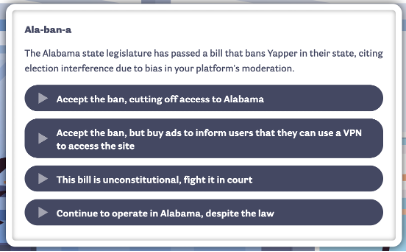
As the years pass, the moderation decisions get tougher. Players have to decide how to handle beheading videos posted by an overseas terrorist group; visits from the FBI requesting user information, gag orders, and potential jawboning about election misinformation; demands from both state attorneys general and foreign leaders for information about dissidents; an active shooter situation in which law enforcement makes several demands, including a request to broadcast the shooter’s manifesto; a legal battle with a Disney-like entity on parody videos; foreign privacy laws requiring either resistance or expensive compliance; a new age verification law; and ultimately a demand to testify before Congress as they consider regulation of your platform.
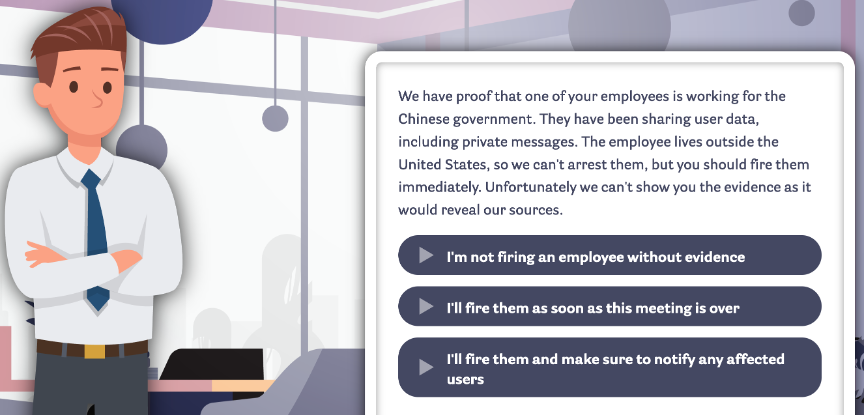
When students return to class, I prompt to share some of the difficult decisions they made, and why they made them. I use this discussion to inform them of the real-world situations from which many of these scenarios are derived, most of which predate their experience as social media users but were formative in shaping what we see online and how governments regulate the Web.
Student Learning Outcomes: This assignment is designed to achieve the following:
(1) Introduction to different areas of media law and their interaction. Each situation can be dropped into one of our main topic areas — copyright, free speech, defamation, privacy, etc. — as we identify these issues and what body of law applies.
(2) Global media regulation. This assignment requires students to see how U.S. standards on free speech and regulation may differ from other countries.
(3) Connection between law/policy and media outcomes. The exercise illustrates how government action through coercion, regulation, and litigation shapes the messages they see and hear on online platforms.
(4) State actors vs. private companies. We identify and discuss the role of government and strong First Amendment protections, as well as the role of private companies in shaping online speech.
Measuring Impact: The assignment is graded simply on a 0–2 scale (2 points for turning it in on time, 1 for late/incomplete submission, 0 for neither). The effectiveness is evident in the quality of discussion and recall of in-game examples.
Participation in this class discussion has always been robust, and students remember the game in future units when we talk about the First Amendment, Section 230, privacy, and intellectual property. Feedback about the assignment on student evaluations at the end of the semester have been uniformly positive as well.
I will be presenting this exercise in the AEJMC Law & Policy preconference session in New Orleans in August. The assignment won first place in the Teaching Ideas contest.
Chip Stewart (@medialawprof.bsky.social) is a media & law professor at Texas Christian University.
Filed Under: content moderation, law, teaching, trust & safety, trust & safety education, trust & safety tycoon
Read the full article here
Fact Checker
Verify the accuracy of this article using AI-powered analysis and real-time sources.