

 Freedom Index
Listen to the article
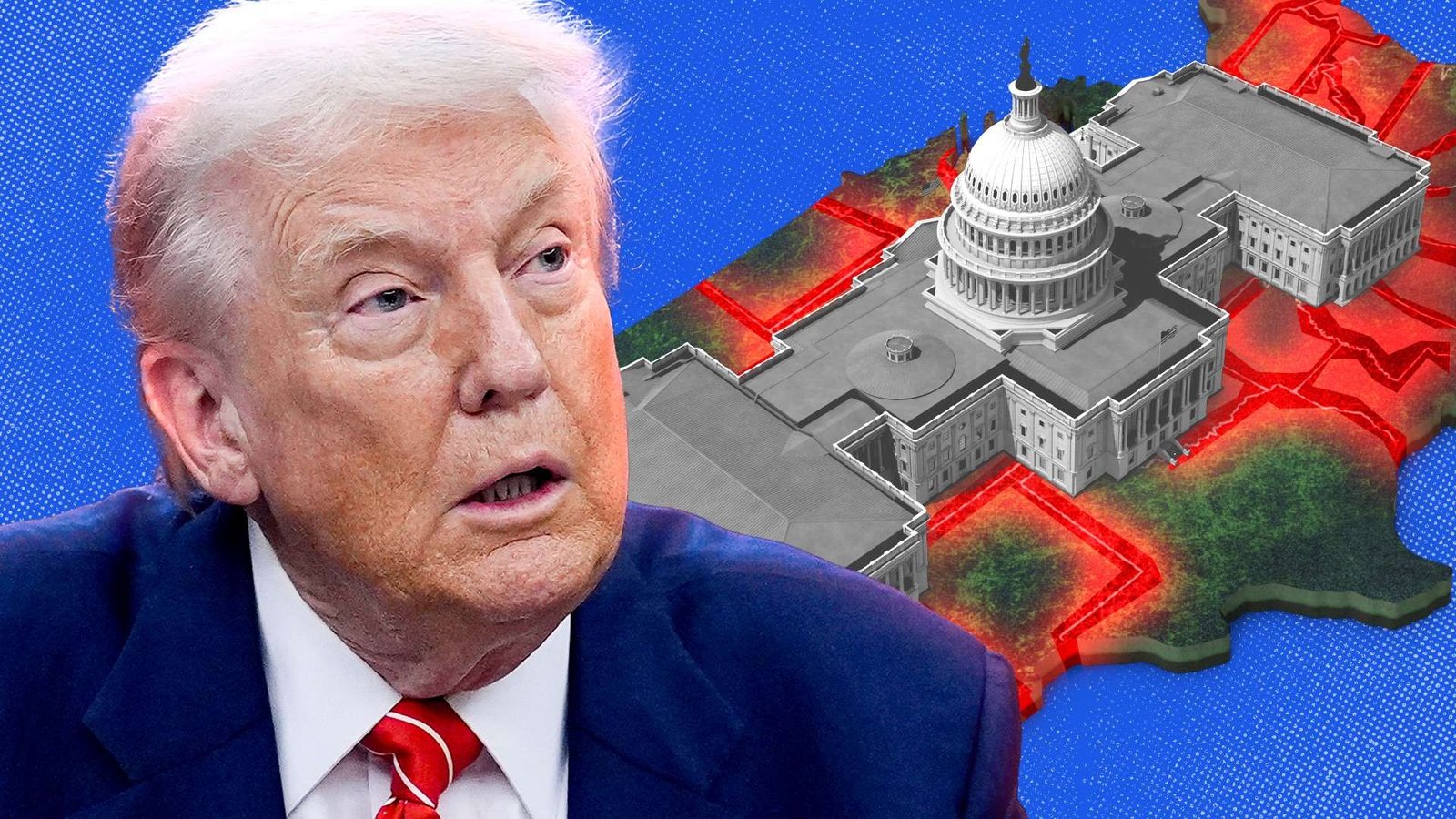
President Donald Trump suggested this week that the federal government should take over certain states’ elections, in clear violation of the Constitution. It’s a bad idea, just like it was a bad idea five years ago when Democrats proposed something similar.
“The Republicans should say, we want to take over—we should take over the voting in at least…15 places,” Trump told conservative podcaster Dan Bongino, who until recently served as FBI deputy director. “The Republicans ought to nationalize the voting.”
Trump tied the idea to his shopworn belief that the 2020 election was stolen from him, even though overwhelming evidence indicates he lost fair and square.
When asked about his comments, White House press secretary Karoline Leavitt said Trump “believes in the United States Constitution” and was simply expressing his support for national voter ID legislation—a thoroughly unconvincing explanation that seems to ignore what he actually said.
Indeed, Trump doubled down hours later. “If you think about it, the state is an agent for the federal government in elections,” he said in the Oval Office. “I don’t know why the federal government doesn’t do them anyway.”
As any high school civics student knows, under America’s federalist system, while the federal government sets certain overarching rules, everything else is left to the states; the idea that states merely act on behalf of the all-powerful feds is averse to the constitutional system the Founders established.
And there are very good reasons for the states to be in charge of their own elections.
“The Constitution entrusts the administration of federal elections to the states and localities, subject to Congress’s passage of laws regulating the manner of election,” explains Walter Olson of the Cato Institute. “Congress has rightly respected the states’ and localities’ lead role, and it should go on doing so.”
“If you were worried about election integrity before, this would make things infinitely worse,” agreed former Libertarian Rep. Justin Amash in a post on X. “Decentralized elections are one of the greatest protections against large-scale fraud and abuse.”
Even some on Trump’s side of the aisle felt the president’s idea went too far. “I’m not in favor of federalizing elections, no. I think that’s a constitutional issue,” Senate Majority Leader John Thune (R–S.D.) said. “I’m a big believer in decentralized and distributed power. And I think it’s harder to hack 50 election systems than it is to hack one. In my view, at least, that’s always a system that has worked pretty well.”
Indeed, if Trump were truly concerned about the potential for fraud at the level that could sway a national election, he should prefer the system we have now, where each state largely makes and administers its own rules, and the central government has little authority to impose its will.
A completely centralized election process would make it that much easier for one particularly motivated malefactor to manipulate, in the way Trump still fancifully insists happened to him in 2020. Yet that’s exactly the type of system he is advocating. Worse still, he’s not alone.
Last week, Rep. Bryan Steil (R–Wisc.) introduced the Make Elections Great Again (MEGA) Act. “Americans should be confident their elections are being run with integrity,” Steil said in a statement. “These reforms will improve voter confidence, bolster election integrity, and make it easy to vote, but hard to cheat.”
Steil’s bill would introduce some understandable rules, like requiring all states to check voters’ citizenship and ID. But it would also go considerably further, like banning ranked choice voting, universal mail-in voting—which is currently used in eight states and Washington, D.C.—and “ballot harvesting,” a term for collecting and returning other people’s completed ballots for them, like the elderly or disabled.
Steil would also require mailed ballots “to be received by the close of polls on election day.” Fourteen states currently allow mailed ballots that arrive a few days late as long as they’re postmarked on time.
Mail-in voting is quite secure, and ranked choice voting has no bearing on election security. Steil’s bill would make voting more difficult while having little appreciable impact on the frequency of voter fraud, which remains blessedly rare in this country.
But what the MEGA Act unquestionably would do is expand the federal government’s role in people’s lives in ways that contradict the vision of the Founders.
“Election administration is one of the few remaining areas of American policy that is still largely determined by the states. And that’s a good thing,” writes Stephen Richer of the Cato Institute. “Federalism in election administration allows states to recognize their unique attributes (e.g., western states support mail voting because of the larger geographic distances), it strengthens election security (there isn’t one hack that can disrupt all 50 states), and it encourages democratic entrepreneurship (states can test different ideas and learn from each other).”
Letting whichever party that currently holds power set voting standards for the entire country is a fool’s errand, guaranteed to backfire as bureaucrats impose one-size-fits-all rules on a country with variegated needs.
It was just as bad an idea five years ago, when Democrats proposed a bill that would do largely the same thing.
Democrats first introduced the For the People Act in 2019 and reintroduced it in 2021, when it passed the House of Representatives but stalled in the Senate.
“Our democracy urgently needs repair,” Daniel I. Weiner and Gareth Fowler of the Brennan Center for Justice wrote in 2021. “The For the People Act would move us measurably closer to realizing the promise of democracy for all.”
Just like the MEGA Act, the For the People Act was a mixed bag, containing some good ideas—like making registration and early voting easier—as well as some unfortunate and potentially unconstitutional aspects. At the time, Olson found at least seven provisions of the bill were likely unconstitutional; among other things, he characterized it as “speech‐hostile, bossy in areas long left to the sound discretion of the states” and noted it “places impossible burdens on local election administrators.”
The American Civil Liberties Union opposed the bill in its original form, writing that although “we strongly support and have long championed” much of what the bill contained, many of its other provisions “unconstitutionally impinge on the free speech rights of American citizens and public interest organizations.”
Trump, like every previous occupant of the Oval Office, thinks he should have more power. But in this case, he’s proposing the polar opposite of what the Constitution calls for.
Read the full article here
Fact Checker
Verify the accuracy of this article using AI-powered analysis and real-time sources.