

 Freedom Index
Listen to the article
The trustees of the John F. Kennedy Center for the Performing Arts flouted the will of Congress when they renamed the institution after President Donald Trump, a federal judge in Washington, D.C., ruled on Friday. Whatever your opinion of Trump or JFK, the decision is a useful reminder that the president, no matter what he might think, is not above the law.
The Kennedy Center’s Board of Trustees, which is chaired by Trump himself and stacked with his cronies, “overstepped its statutory bounds by unilaterally renaming the Kennedy Center after President Trump,” U.S. District Judge Christopher Cooper concluded in Beatty v. Trump. “In 1964, Congress deliberately rechristened the ‘National Cultural Center’ the ‘John F. Kennedy Center for the Performing Arts.’ The text, structure, and evolution of the organic statute makes the institution’s name abundantly clear.”
Trump was predictably outraged by Cooper’s assault on his vanity. “Judge Cooper ruled that the 36 Member Board of Trustees, which unanimously voted to add the name ‘TRUMP’ onto the former Kennedy Center, making it The Trump Kennedy Center, did not have the right to do such an addition, and the name, ‘TRUMP,’ must be removed,” the president huffed on Truth Social. “Judge Cooper should be ashamed of himself!”
Trump’s complaint is striking for two reasons. First, it suggests that Trump, contrary to what you might have surmised from this controversy and decades of similar evidence, is familiar with the concept of shame. Second, Trump makes no attempt to argue that Cooper got the law wrong. As usual, Trump is simply frustrated by the limits that the law imposes on his whims.
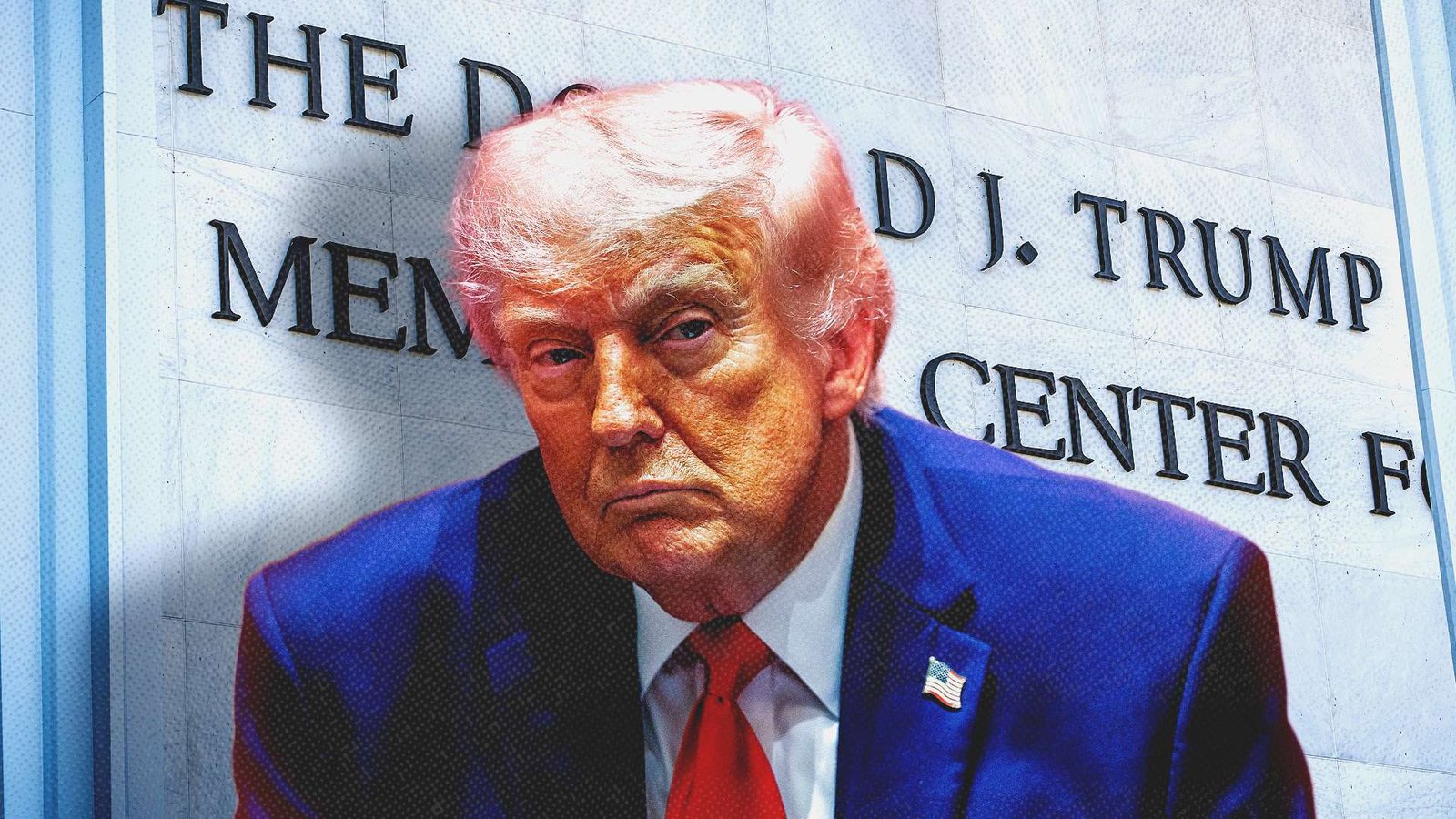
On December 18, the Kennedy Center’s board voted to change the institution’s name. The very next day, 17 letters were added to the building’s portico, giving the place an awkward new name: “THE DONALD J. TRUMP AND THE JOHN F. KENNEDY MEMORIAL CENTER FOR THE PERFORMING ARTS.”
Although she is officially a member of the center’s board, Rep. Joyce Beatty (D–Ohio) had no say in that decision. In addition to Trump and 32 other presidential appointees, the board includes 23 ex officio members who serve by virtue of their positions in federal or local government. But in May 2025, the board decided that ex officio trustees like Beatty would no longer be allowed to vote. Beatty instead expressed her displeasure at the name change by filing a federal lawsuit. Her argument was straightforward: “Because Congress named the center by statute, changing the Kennedy Center’s name requires an act of Congress.”
It is not hard to see why Cooper agreed with Beatty. When Congress amended the National Cultural Center Act in 1964, it established a “bureau” within the Smithsonian Institution that “shall be directed by a board to be known as the Trustees of the John F. Kennedy Center for the Performing Arts.” It instructed the trustees to “construct within the Smithsonian Institution…a building to be designated as the John F. Kennedy Center for the Performing Arts.”
The board’s “duty,” Congress said, “shall be to maintain and administer the John F. Kennedy Center for the Performing Arts and site thereof as the National Center for the Performing Arts, a living memorial to John Fitzgerald Kennedy.” It added that the Kennedy Center would be “the sole national memorial to the late John Fitzgerald Kennedy within the city of Washington and its environs.”
The amendments changed the name of the law to the “John F. Kennedy Center Act” and replaced all references to the “National Cultural Center” with “John F. Kennedy Center for the Performing Arts.” Congress added that “any designation or reference to the National Cultural Center in any other law, map, regulation, document, record, or other paper of the United States shall be held to designate or refer to such Center as the John F. Kennedy Center for the Performing Arts.”
The law “refers to the institution as the ‘John F. Kennedy Center for the Performing Arts’ no fewer than two dozen times,” Cooper noted. “There can be no confusion about the name Congress gave it.” In fact, he said, “it is hard to imagine a more intentional legislative effort to call the Center by its chosen name.”
Trump et al. “do not contest that the Center must be named for President Kennedy,” Cooper wrote. Instead, they “posit that the ‘Trump Kennedy Center’ is merely a
‘secondary name.'” But “that convenient reframing is too cute by half—and belied by the record.”
On December 18, White House press secretary Karoline Leavitt announced that the trustees “have just voted unanimously to rename the Kennedy Center to the Trump-Kennedy Center.” The next day, “President Trump’s name was affixed to the front portico of the main Kennedy Center building—above President Kennedy’s, to boot,” Cooper noted. “The joint name has since been featured on the Center’s official website, email communications, letterhead, and logo. The Center even filed a trademark application with the institution’s new name and logo. These official changes reflect far more than an innocuous nicknaming.”
In short, Cooper said, “the ‘Trump Kennedy Center’ label adds an entirely new name to the Center’s formal title and relegates President Kennedy’s name to second place. If that is not a renaming, what is?”
Cooper identified another way in which Trump’s self-aggrandizement violated federal law. A provision that Congress enacted in 1983 says “no additional memorials or plaques in the nature of memorials shall be designated or installed in the public areas of the John F. Kennedy Center for the Performing Arts.” It makes exceptions for “any plaque acknowledging a gift from a foreign country,” “any plaque on a theater chair or a theater box acknowledging the gift of such chair or box,” and “any inscription on the marble walls in the north or south galleries, the Hall of States, or the Hall of Nations acknowledging a major contribution.” In 2012, Congress imposed another restriction, prohibiting donor acknowledgments on the exterior of the building.
Trump et al. argued that adding his name to the portico did not qualify as a memorial. “That suggestion is risible, both in light of the record evidence and as a matter of common sense,” Cooper said. “The lettering literally reads: ‘The Donald J. Trump and [the] John F. Kennedy Memorial Center for the Performing Arts.'”
When Leavitt announced the new name, she said it was meant to recognize “the unbelievable work President Trump has done over the last year in saving the building”—”not only from the standpoint of its reconstruction, but also financially, and its reputation.” Roma Daravi, the center’s vice president for public relations, likewise said the name change “recognizes that the current Chairman saved the institution from financial ruin and physical destruction.”
The renaming clearly “was meant to honor President Trump’s work on the Center,” Cooper said. “And no wonder—why add an individual’s name to the very title of an institution if not to commemorate him?”
Trump et al. “quibble with the terms of Congress’s clear proscription, arguing, for
instance, that the lettering on the front portico is permissible because a ‘memorial’ can only honor some ‘past impression’ of a person or entity, and Mr. Trump is the sitting president,” Cooper noted. “This is more than a stretch. As a textual matter, Congress has not just banned public ‘memorials’ at the site, but ‘plaques in the nature of memorials.’ In any event, according to the Press Secretary, the ‘Trump Kennedy Center’ name recognized the ‘unbelievable work President Trump’ had already done to ‘salvag[e]’ the building during the first year of his second term. The renaming was thus an effort to ensure that future visitors would be aware of the President’s ‘past’ work.”
The defendants also argued that a “memorial” cannot honor someone who is still alive. Cooper disagreed: “Nothing in the plain text of the statute endorses such a constricted reading. And nothing in the ordinary meaning of ‘memorial’ suggests that the word necessarily denotes posthumous commemoration, even by the Defendants’ own cited dictionary definition.” The exceptions that Congress made, which allowed “plaques in the nature of memorials” acknowledging financial supporters, likewise indicate that the category goes beyond references to dead people.
You might not care what this particular entertainment venue is called. You might even question whether the federal government should be funding such a facility at all. But as with Trump’s grand plans for replacing the demolished East Wing of the White House, the issue here goes beyond the embarrassment of the president’s unquenchable thirst for self-glorification and public adulation.
In ways large and small, Trump has repeatedly acted as if he can do whatever he wants, without regard to the rule of law or the separation of powers. Given that track record, Cooper’s rebuke is a modest but welcome vindication of those principles.
Read the full article here
Fact Checker
Verify the accuracy of this article using AI-powered analysis and real-time sources.