Zhipu AI (now Z.ai) released GLM-5.3 on Thursday through its GLM Coding Plan and ZCode.
The lab calls it the “most capable open-weights model for coding,”.
GLM-5.3 is a 743-billion-parameter model built by scaling post-training on the GLM-5.2 base.
Chinese AI lab Z.ai released GLM-5.3 on Thursday, a sizable coding model it’s pitching as the strongest open-weights coder on the market. The model is live now through the GLM Coding Plan subscription and ZCode, with API access and downloadable weights following after a safety review.
“Scaling post-training is all we did for GLM-5.3,” the company wrote in its launch post. “With GLM-5.2 we built the stack… Over the past month we kept scaling on this stack: more environments, more diverse tasks, and more compute spent training on them.”
Myriad: When will OpenAI release GPT-6? Click to make your prediction.
The team focused more on token efficiency, not raw dominance. GLM-5.3 stands at 743 billion parameters and consumes a lot less tokens per task than its predecessor. Parameters are the amount of dials a model handle while processing information while tokens are the basic unit of information a model can consume or generate.
Z.ai says GLM-5.3 clears 34.5% on its in-house Z.ai Code Bench at Max effort while burning roughly 75,000 output tokens per task, against GLM-5.2’s 23.4% at 96,000. Against closed models, the blog notes it beats Claude Opus 4.8 on token economy but “remains behind Claude Fable 5, which reaches 39.5% at Max effort.”
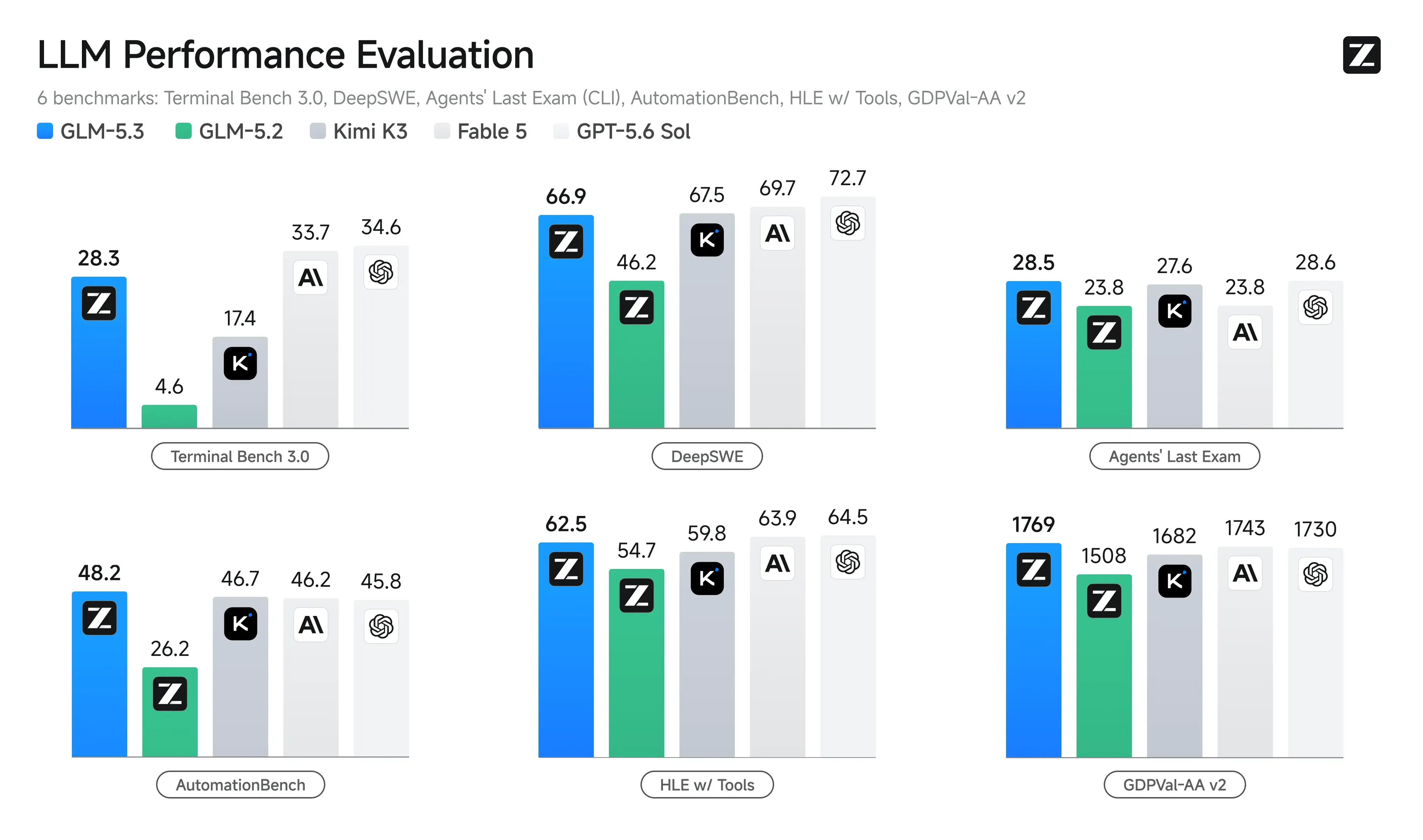
In terms of coding, GLM5.3 is a very good performer, beating fellow Chinese model Kimi K3 on the most relevant benchmarks.
On Terminal Bench 3.0—a test of autonomous shell/tool use in real Linux environments—GLM-5.3 scores 28.3, slightly behind closed models Fable 5 (33.7) and GPT-5.6 Sol (34.6). On DeepSWE v1.1, a benchmark for fixing real GitHub issues end-to-end, open rival Kimi K3 (67.5) and Fable 5 (69.7) both beat GLM-5.3’s 66.9.
The pattern can be more or less summed up like this: GLM-5.3 clears its own predecessor and some open peers, but closed U.S. models still lead the headline coding boards.
The cybersecurity results show another important leap. GLM-5.3 leads CyberGym at 84.5% and more than doubles GLM-5.2 on exploitation benchmarks. Z.ai says the model flagged 2,436 vulnerabilities across 269 open-source projects, 1,097 of them medium-to-high severity.
“GLM-5.3 takes agentic coding to the next level, delivering a dramatic improvement over GLM-5.2 while achieving better results with fewer output tokens,” Z.ai posted on X. “GLM-5.3 is available now through GLM Coding Plan and ZCode. API access and open weights will be released in stages following rigorous safety evaluations.”
GLM-5.3 takes agentic coding to the next level, delivering a dramatic improvement over GLM-5.2 while achieving better results with fewer output tokens. pic.twitter.com/KGc6ZR7GHv
— Z.ai (@Zai_org) August 14, 2026
On price, the gap with U.S. frontier models is the open-weights draw. Z.ai’s GLM Coding Plan runs on a points quota (off-peak calls cost half), with Zhipu’s API priced at roughly a tenth of U.S. frontier per-token rates—GLM-5.2’s official rate was $1.40 in / $4.40 out per million tokens. That stacks against GPT-5.3-Codex at $1.75 / $14 and Claude Opus 4.8 near the top of Anthropic’s tiers.
Z.ai is a Beijing lab included on the U.S. Entity List, which means American firms cannot export controlled tech to it. Despite this, GLM is an extremely popular model and Chinese open-weight models already beat American ones on OpenRouter token usage.
GLM-5.3 weights are set for public release in about two weeks, per the launch post—the open-weights label applies to what’s coming, not what’s downloadable today.
Daily Debrief Newsletter
Start every day with the top news stories right now, plus original features, a podcast, videos and more.
The FSNN News Room is the voice of our in-house journalists, editors, and researchers. We deliver timely, unbiased reporting at the crossroads of finance, cryptocurrency, and global politics, providing clear, fact-driven analysis free from agendas.
We and our selected partners wish to use cookies to collect information about you for functional purposes and statistical marketing. You may not give us your consent for certain purposes by selecting an option and you can withdraw your consent at any time via the cookie icon.
Cookies are small text that can be used by websites to make the user experience more efficient. The law states that we may store cookies on your device if they are strictly necessary for the operation of this site. For all other types of cookies, we need your permission. This site uses various types of cookies. Some cookies are placed by third party services that appear on our pages.
Your permission applies to the following domains:
https://fsnn.net
Necessary
Necessary cookies help make a website usable by enabling basic functions like page navigation and access to secure areas of the website. The website cannot function properly without these cookies.
Statistic
Statistic cookies help website owners to understand how visitors interact with websites by collecting and reporting information anonymously.
Preferences
Preference cookies enable a website to remember information that changes the way the website behaves or looks, like your preferred language or the region that you are in.
Marketing
Marketing cookies are used to track visitors across websites. The intention is to display ads that are relevant and engaging for the individual user and thereby more valuable for publishers and third party advertisers.


 Freedom Index