

 Freedom Index
Listen to the article
Two days before Christmas, the European Commission—essentially the executive branch of the European Union (E.U.)—protested U.S. travel restrictions against five residents of the bloc. According to U.S. Secretary of State Marco Rubio, the five were sanctioned for “organized efforts to coerce American platforms to censor, demonetize, and suppress American viewpoints they oppose.” Whether the penalties were appropriate is worth a conversation, but there’s no doubt the five played a role in growing efforts by government officials in the E.U.—and elsewhere, including the U.S.—to muzzle views they don’t like.
You are reading The Rattler from J.D. Tuccille and Reason. Get more of J.D.’s commentary on government overreach and threats to everyday liberty.
“The European Commission strongly condemns the U.S. decision to impose travel restrictions on five European individuals, including former European Commissioner Thierry Breton,” the European Commission complained in a December 23 statement. “The EU is an open, rules-based single market, with the sovereign right to regulate economic activity in line with our democratic values and international commitments. Our digital rules ensure a safe, fair, and level playing field for all companies, applied fairly and without discrimination.”
Along with Breton, the other sanctioned individuals, according to Under Secretary of State Sarah B. Rogers, are Imran Ahmed, head of the Center for Countering Digital Hate (CCDH); Clare Melford, co-founder of the Global Disinformation Index (GDI); and Anna-Lena von Hodenberg and Josephine Ballon, the co-leaders of HateAid. Those three (nominally—more about that later) nongovernmental organizations pressure tech companies to deplatform people, rank media organizations by their alleged reliability, and use public and legal pressure to narrow the range of “acceptable” speakers and speech.
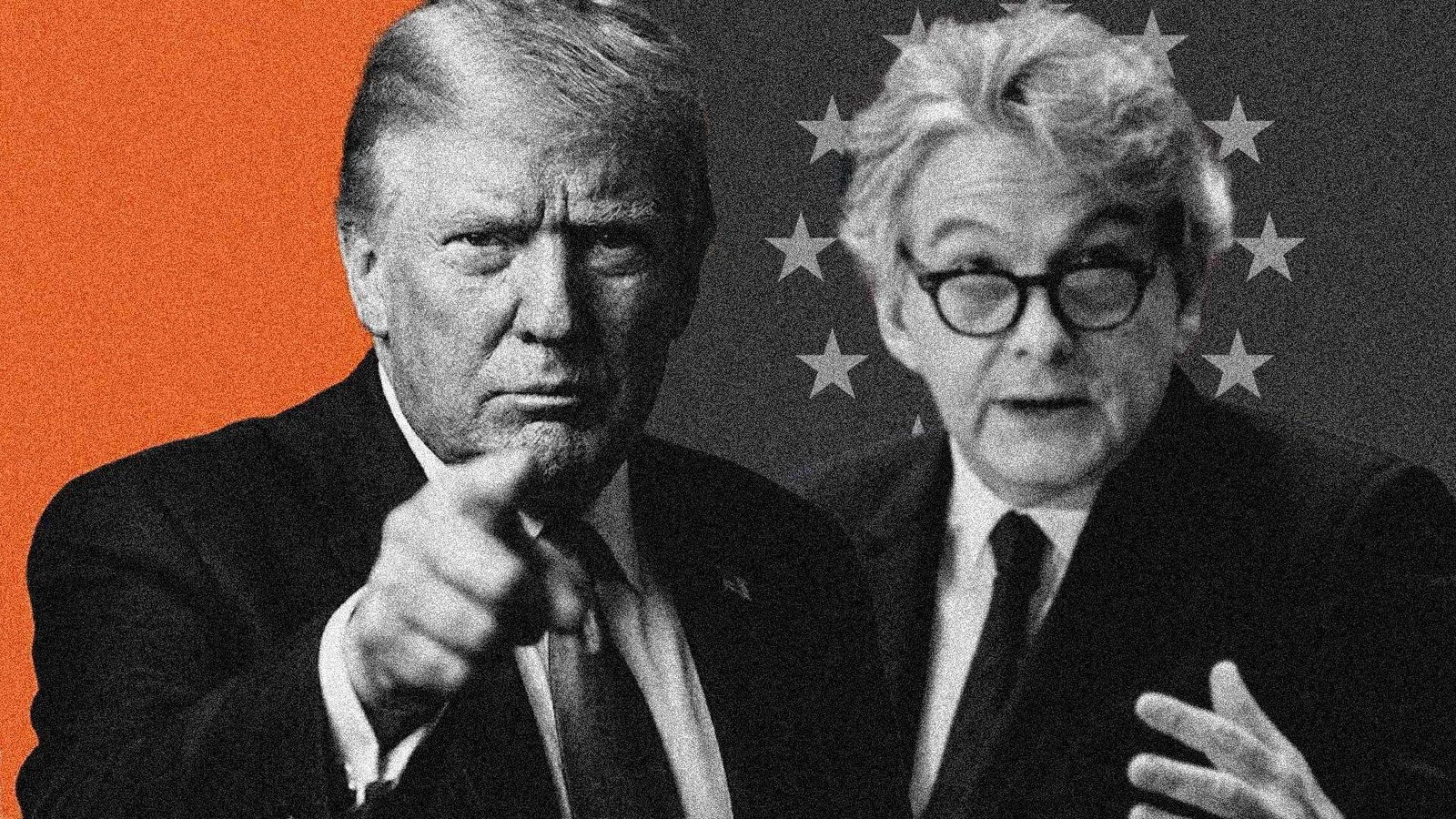
Despite the European Commission’s claim that its “rules ensure a safe, fair, and level playing field,” the mention of Breton is telling. As the E.U.’s internal market commissioner, Breton waged a personal crusade against ideas he disliked. In 2024, Breton warned X head Elon Musk that his planned online conversation with then–U.S. presidential candidate Donald Trump would be accessible to Europeans. “Therefore, we are monitoring the potential risks in the EU associated with the dissemination of content that may incite violence, hate, and racism in conjunction with major political—or societal—events around the world, including debates and interviews in the context of elections,” Breton sniffed.
Breton went on to caution about discussions of events in the United Kingdom, also not part of the E.U.
In response, a coalition of civil libertarian organizations and individuals wrote: “We are particularly concerned by your attempt to use the [Digital Services Act] to stifle freedom of expression beyond the European Union because of what you call ‘spillovers.’ Warning an online platform that streaming an interview with one of the two key candidates in the United States presidential election may be incompatible with an online safety law is more characteristic of an autocratic nation than a democracy.”
For its part, GDI is nominally private, but has received funding from government sources including the Biden-era U.S. State Department. That funding helped it publish a 2022 report listing Reason among the riskiest U.S. news sources for, in part, publishing “no information regarding authorship attribution”—a laughably false claim. GDI also claimed to be advised by some prominent journalists who had no idea about their supposed affiliation.
CCDH, which leans left and has ties to Britain’s Labour Party, emphasizes deplatforming and attempts to push advertisers away from media platforms it dislikes. HateAid, partially funded by Germany’s government, focuses on lawsuits against speech classified as hateful under European laws.
All three organizations are accused by Secretary of State Marco Rubio of “extraterritorial overreach by foreign censors targeting American speech.” There’s strong evidence to support charges that all five sanctioned individuals are part of efforts to extend Europe’s restrictive rules beyond the E.U.’s borders.
European regulatory spillage is common enough that it is termed “the Brussels Effect.” Basically, Europeans produce nothing in such quantity as they produce red tape, but the European market is so big that it’s easier for companies around the world to implement restrictive E.U. rules which will generally be acceptable elsewhere than to accommodate multiple regulatory environments.
But as applied to speech controls, the Brussels Effect shows more vigor than Europeans have brought to any other activity in recent years. The E.U. is openly determined to police speech.
Martin Gurri, a Mercatus Center scholar and author of The Revolt of the Public and the Crisis of Authority in the New Millennium, sees the censorship craze as reflecting the panic of political elites losing control over information and their grip on power. Last year he wrote, “The elites are driven entirely by the impulse to control. They detest democracy, which keeps getting in their way, and much prefer a golden ideal they possessively call ‘Our Democracy’—their own rule in perpetuity.”
Sociologist Frank Furedi largely agrees, though instead of “elites” he points his finger at “techno-centrism” which “has no ideological pretension and is entirely focused on its task of preserving its own dominance over the institutions of society.” He believes “centrism has become increasingly intolerant and willing to implement authoritarian and anti-democratic measures to destroy its political opponents.” Furedi adds, “Apart from the European Union, technocratic governance rarely exists in a pure form.”
Both see European censorship as the reaction of a besieged political class trying to maintain control in the face of upstart parties and movements and angry voters. The populists may not have anything better to offer—their ideas are often even worse—but they threaten the powers that be.
We have our own political class, of course. It not only funded GDI but also tried to muzzle dissidents on social media. E.U. officials just have fewer restraints on their authoritarian efforts.
As mentioned above, though, populists aren’t necessarily better. The Trump administration denied a few censorship-happy Europeans access to the U.S., but it has its own problems with speech. The State Department revoked the visas of foreign students for exercising their right to protest. It also punished law firms associated with its political opponents, threatened to prosecute people who record Immigration and Customs Enforcement (ICE) agents, and insists that broadcast licenses can be conditioned on positive coverage of the president.
It’s encouraging to see the U.S. government stand up to foreign efforts to muzzle Americans. It would be even better if the sanctions represented a much more consistent respect for free speech.
Read the full article here
Fact Checker
Verify the accuracy of this article using AI-powered analysis and real-time sources.