

 Freedom Index
Listen to the article
This week, our podcast is brought to you courtesy of HonestReporting Canada, a Toronto-based organisation that promotes fairness and accuracy in Canadian media coverage of the Middle East and the Jewish community; and which regularly calls out what it regards as anti-Israeli bias among journalists and other public figures.
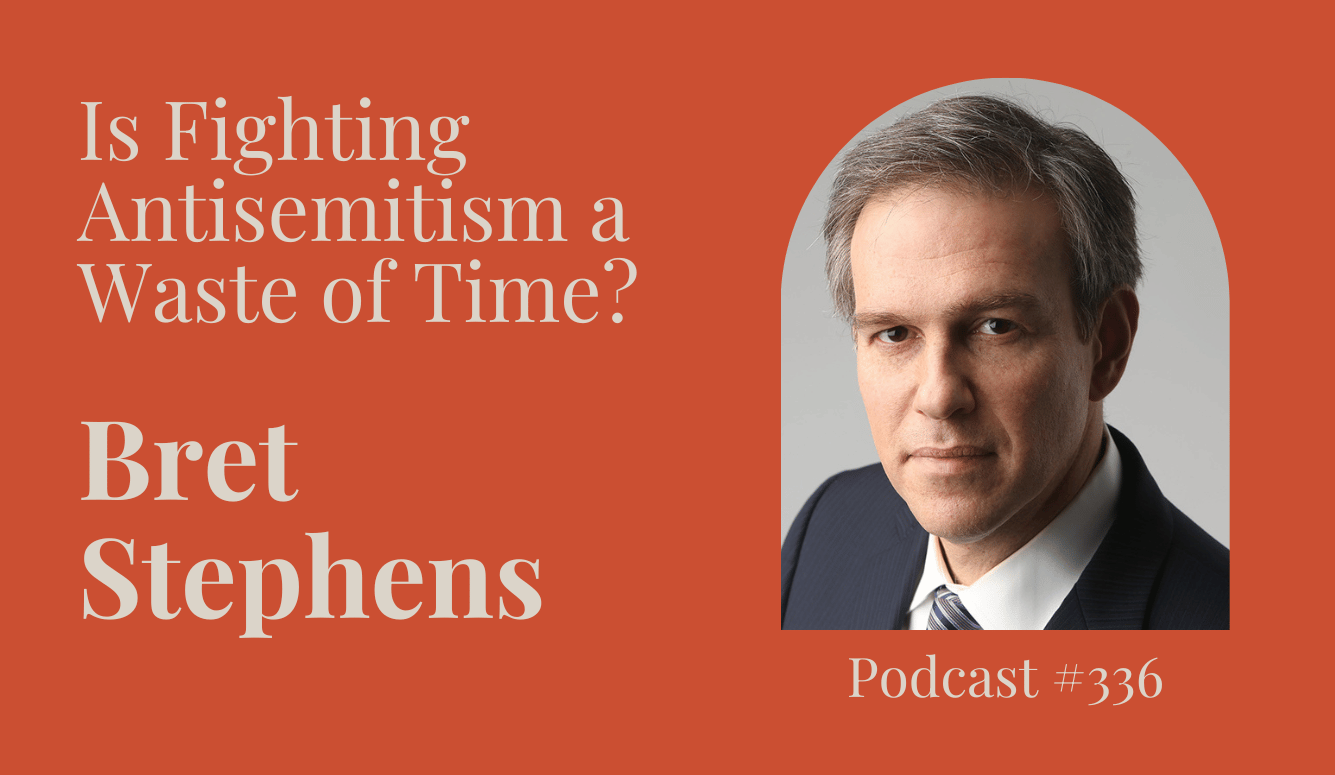
Last month, I was invited to host an HonestReporting webinar on the subject of antisemitism featuring New York Times columnist Bret Stephens, a strong supporter of Israel, And this week’s Quillette podcast is adapted from that presentation, which HonestReporting has kindly allowed us to broadcast.
Bret’s views on antisemitism have been in the news this year, because of remarks he delivered on the subject back in February, when he was the featured speaker for the annual State of World Jewry talk at the 92nd Street Y in Manhattan.
In that speech, Bret urged Jews to stop playing victim, and said that educational initiatives and outreach efforts aren’t really that useful for fighting antisemitism, because most antisemites, as well as strident anti-Zionists, don’t really lack for information, and aren’t really interested in listening to their opponents.
In our conversation, we talked about how modern forms of progressive social justice ideology now overlap with hatred of the Jewish state, And I asked whether the war in Iran had encouraged thinkers, such as John Mearsheimer, who see Israel and its supporters as puppet masters leading the West—the United States, in particular—toward ruin.
Please enjoy my interview with New York Times columnist and editor-in-chief of the journal Sapir, Bret Stephens.
Transcript
Jon Kay: I went back and read a great piece you wrote in late 2023, titled “Anti-Semitism: A Guide for the Perplexed,” published in the New York Times. A lot of the ideas in it were similar to those you developed in what has become quite a famous speech at the 92nd Street Y in Manhattan. What changed between the two is that your Times piece was largely analytical, while your speech was prescriptive. You said, in effect, that our approach to fighting antisemitism has to change — it shouldn’t just be about outreach, seeking approval, or trying to educate people. We have to strengthen our community from within. Did anything change in the last couple of years that brought you to that conclusion?
Bret Stephens: I don’t think things changed so much as gestated. What became depressingly clear in the nearly three years since October 7th is how little the world has been moved by the plight of Jews experiencing a level of antisemitism we haven’t seen since the 1930s. The Jewish community itself has never been more engaged—more willing to give philanthropically, more aroused when it comes to institutions, particularly universities, with which they are closely involved. And yet all of that effort seemed to move the needle very little, if at all. That helped me think through the efficacy of what so much of the Jewish community, with the best of intentions, was attempting to do and yet not succeeding in doing. The definition of insanity, famously attributed to Einstein, is doing the same thing over and over again and expecting a different result. So what I was trying to do in that speech was chart a radically different course—to change what we can change, rather than butt our heads against the things we cannot.
Kay: You have a wonderful line in that speech: They do not hate us because of our faults and failures. They hate us because of our virtues and successes. Could you unpack that?
Stephens: There is a psychological basis to antisemitism that I think is distinct from other forms of bigotry. As I say in the speech, antisemitism is resentment marinating in envy. Resentment, because we are a counter-cultural nation whose core ideas sometimes run headlong against the societies in which we live. And envy, because those counter-cultural ideas have a record of success — a record of turning Jews who arrive penniless and dispossessed on the shores of one country into successes in the next generation. Those are virtues the world ought to admire. But much of the world simply doesn’t.
It’s foolish to imagine that the hatred directed our way is somehow the result of misunderstanding. To a certain extent, the antisemites understand us perfectly well—they resent us for that. And my answer is that we should not be running away from our success, or from the keys to our success. We should be leaning into them, even if the cost is that we’ll live with a certain degree of antisemitism. I would rather succeed with antisemitism than be pitied after our disappearance from one country or another—to use the phrase of Dara Horn, people love dead Jews.
Kay: A few weeks ago, I had on the podcast a district court judge named Roy Altman, who has written a new book making the historical case for Israel. He has gone on a speaking tour of campuses—something like a hundred different locations. It’s a strong, full-throated ambassadorship for Judaism and for Israel. At the end of our conversation, I asked him whether he had had any success converting anyone on those campuses. He said a few people who hadn’t yet picked sides had come around, and he also said there’s value in arming people who are already sympathetic—giving them arguments and information they can use when they encounter antisemitism in the world. Do you see value in that kind of educational mission?
Stephens: As a matter of fact, it’s what I do, particularly through my columns at the New York Times. One of the things I frequently hear from readers is, “You help remind me that I’m not going crazy.” I hear that especially from Jewish readers, and from gentile readers who are sympathetic to my point of view.
I’ve also found that when I’ve spoken in flyover-country America—schools that are not Ivy League schools, talking to students who don’t come with a pre-formed woke worldview—I can offer them convincing language and a real explanation for why I think Israel is a country worth cherishing and defending, and why Jews have been an extraordinary asset to the flourishing of human civilisation. I always refer to a visit I had at Colorado Mesa University in Grand Junction, where my audience consisted of many veterans who had seen something of the world and didn’t come pre-programmed with the kind of education you get at the best schools of New England and California. There is real value there.
Where there is much less value—the activity I undertake mainly to pay the bills—is going to Ivy League universities and trying to make the case to people whose priors are so antithetical to my own that very little headway can be made. The problem we confront, Jonathan, is a broad variety of assumptions about the world which I describe as antisemitism-adjacent. If you hold those assumptions, whether or not you are actually an antisemite or anti-Israel, you are more likely to become one because your worldview inclines you in that direction.
Take the concept of “privilege.” This idea that Western societies are divided between those with privilege and those without—if you take that word at face value and see it as a pejorative, it doesn’t necessarily make you an antisemite, but it makes it easier to conclude that since so many Jews in the United States, Canada, and Europe are part of the so-called privileged class, they are part of the problem. In America, we didn’t used to speak of privilege. We used to speak of success—something to be admired. When minority groups or individuals prospered in a striking way, as Jewish Americans have prospered, that tended to elicit admiration from our gentile neighbours, not envy. When you move to a privilege framework, that whole equation changes dramatically. The problem we’re dealing with goes well beyond making the case for Israel. It means persuading an increasingly influential cohort of Westerners that some of their most settled ideas—things they picked up at places like Brown and Columbia—are actually nonsensical, and tend to lean in the direction of antisemitism.
Kay: You have another interesting line, from your 2023 piece: In both cases, Jews are the other. The only difference is that past generations of antisemites accused Jews of being Middle Easterners, while today’s anti-Zionists accuse Jews of being Europeans. Since the mid-2010s, there has been a focus in social justice circles on the idea that whiteness itself is a force for colonial malevolence—almost a kind of genetic predisposition. I half-joke that the entire white race has been made into an honorary Jew, because this resembles the folk antisemitism that was eventually embedded in the Protocols of the Elders of Zion. To some extent, are Jews simply getting the same treatment that white people more generally are getting under dogmatic social justice ideology?
Stephens: To some extent. People have noted that Jews, having gone from being classified as non-Aryan, are now somehow super-Aryan—which is rather laughable to someone like me whose mother was a hidden child during the Holocaust. That we are now considered insufficiently white in one generation and too white in the next is quite remarkable.
The “privilege” framework does have some explanatory power in certain university seminar settings. But it completely fails to explain the hatred coming from mostly white students on the campus of Morningside Heights who are busy declaiming against Israel.
Kay: Has there been any systematic study of attitudes toward socioeconomically successful East Asian immigrant communities in the United States versus Jewish communities?
Stephens: There’s nothing analogous. The United States has a history of anti-Asian bigotry going back to the exclusion acts of the late nineteenth century, and you do have a strikingly successful East Asian and South Asian community today—just look at the CEOs of Google and Microsoft. I don’t want to dismiss the reality of some baseline prejudice, but there’s nothing remotely comparable to antisemitism. Chinese Americans aren’t being randomly screamed at in Times Square because their ethnic cousins in Beijing are tyrannising people in Xinjiang.
Getting back to a previous theme—the idea that settler colonialism is a uniquely evil specimen, emanating from academia—I was in Australia two years ago to give a number of talks, one at the public library in Sydney. A young woman, college-aged, stood up and asked me how I responded to the charge that Israel was a settler-colonialist state. I looked around an audience of four or five hundred people and asked how many could claim Aboriginal descent. Not a single person raised their hand. I said: I have some bad news for all of you. Every single one of you is a settler colonialist, or the heir and beneficiary of a fairly vicious brand of settler colonialism. The same is true for New Zealanders, for 99 percent of Americans, for most Canadians.
In fact, the only country I can think of that is not the product of settler colonialism—the only country that is the result of a 3,000-year anti-colonial struggle—is the state of Israel. At Purim, at Hanukkah, we are celebrating moments in Jewish history when Jews revolted against or suffered under colonial rulers. Nothing comparable can be said for these Western societies that are busy pointing fingers at Israel. There is something very specific going on here that cannot be generalised by saying that Ashkenazi Jews are “white” or Jews are “privileged.”
Kay: I want to make a parochial Canadian point here. At some universities in British Columbia—which is a kind of giant Portland politically—if you asked that question about settler colonialism, you would get dozens, if not hundreds, of white students who would raise their hands. They self-identify as settlers working on their anti-colonial praxis. And one of the slogans you often see at anti-Israel protests in Canada is “From Turtle Island to Palestine” — the idea that it’s all one big anti-colonial struggle. So contrary to your experience in Australia, in some Canadian universities people would say: yes, that’s exactly right. I’m drawn to the Palestinian cause precisely because I’ve educated myself about my settler guilt. How much of this is projection? There’s a fantasy—I’m a seventh-generation Canadian, I’m not leaving, but there’s this other place on the other side of the world where maybe we can get the white people to leave. Maybe it’s just on the edge of political possibility that we can get millions of Jews uprooted. It’s a fantasy, but it takes expression in the rhetoric—“from the river to the sea,” leave or worse. How much of this is projection?
Stephens: There must be some of that. As I said earlier, the only truly successful long-standing anti-colonial movement in the world is the Jewish anti-colonial movement known as Zionism—not the Palestinian one, which was largely invented sometime around 1964 by Yasser Arafat.
There is projection, and there is also an astonishing amount of stupidity and hypocrisy. I would say to those students: if you feel so guilty, leave. But they’re not going to do that. So here’s a thought: every day, why don’t we recite a land acknowledgement stating that this land is the unceded territory of the people of Judea? Those are the only people who are still around. The degree of hypocrisy coming from people who are unwilling to lift a finger to sacrifice their own interests in defence of their so-called values, but are perfectly happy to contemplate the violent dispossession of 10.2 million Israelis—it is farcical.
And again, it brings me back to my original point, which is that there is no bottom to this well of bad faith, stupidity, and malevolence. So the wisest course—and sure, if someone pays me enough I’ll go to these universities and get into arguments with the students and their idiotic professors—but as a matter of what the Jewish people ought to be doing, there is a better use of resources. The best possible use of Jewish resources is to invest Jewishly: in Jewish ideas, Jewish culture, Jewish religion, Jewish institutions, and not least the Jewish state. Let’s invest in what we have, because it is a formidable and successful investment.
I keep returning to this: over the last three years, when Israel has supposedly been more isolated than ever, its arms sales to the rest of the world—including European countries—have been higher than ever. We ought to be thinking not about how to fight antisemitism at the University of British Columbia, but about how to turn a $600 billion economy into a $200 billion—wait, I mean a $200 billion into a $600 billion economy in a decade. Instead of spending money on Super Bowl ads that are an embarrassment and almost an invitation to antisemitism, we should be putting that money into creating a thriving network of Jewish schools so that Jewish kids grow up knowledgeable about who they are.
Kay: You dropped the reference to the Super Bowl ad. Can you describe it?
Stephens: A Jewish kid opens his locker in a high school, and there’s some antisemitic message there—“Get out of here, Jew” or words to that effect. He feels bullied and alone. Then a fellow student, a black student, puts a hand on his shoulder and says: I’ve been there, pal, let’s be friends. I may be getting the details slightly wrong after several months, but the essence of it is this: the repugnant stereotype of the ninety-pound Jewish weakling being picked on by bullies, helpless to do anything to defend himself except lean on the help of a gentile friend. It was the opposite of an ad calling for Jewish empowerment. It was an ad playing the table of victims.
We do not want to be victims. The state of Israel came into existence precisely to end the civilisation of Jewish victimhood. Everything that we have tried to do in the United States and Canada, as individuals and as a community, has been aimed at ending the perception of Jews as weak, helpless, and dependent. I do not understand for one second why we would carry that stereotype forward—except out of this ridiculous notion that the only way we can garner sympathy is by underscoring our status as victims.
Kay: One of the themes in Judge Altman’s book was indigeneity—leaning heavily into the argument that if you care about settler colonialism, the Jews are not the settlers. He co-opts the idiom of progressivism on behalf of Israel’s legitimacy. Do you see any avenue in that approach, or is it just a clever cocktail-party debating trick?
Stephens: There’s an avenue in the sense that it’s true. The mountain of archaeological evidence for Jewish indigeneity is overwhelming. But I don’t think it’s the most powerful argument, because I don’t think settler-colonialist states are illegitimate. The United States is not an illegitimate country. Someone else’s forbears—not mine, who came much more recently—waged brutal wars against indigenous American populations. I grew up in Mexico City and was repeatedly taught the history of the Mexican-American War from the Mexican perspective. That was not good behaviour on the part of the United States.
Arabic is spoken in Morocco, thousands of miles from the heartland of Arabic-speaking culture and society. That was settler colonialism. French-settled New Caledonia is settler colonialism. We recognise states as they are, irrespective of complex questions of indigeneity, because the alternative to that is chaos and injustice. States justify themselves ultimately by their enduring possession of their lands and, more importantly, by what they make of the places where they are. On that basis, Israel justifies itself every day through its enormous contributions to what we used to call—and I’m a conservative, so I still call it—the march of civilisation.
Kay: You’re a brave man, because the speech you gave at the 92nd Street Y called for dismantling much of the legacy Jewish civic organisational structure. There were people in that crowd who draw their livelihoods from those organisations, including the head of the Anti-Defamation League. I’m guessing not many Jewish institutions have rushed to say Bret is absolutely right.
Stephens: After my speech, I was asked by the rabbi doing the Q&A whether I would dismantle an organisation like the ADL. Too hastily, I said yes. I’ve since regretted the overstatement. There are functions the ADL performs that I believe are genuinely valuable. For instance, it works very closely with law enforcement around the country to track and monitor dangerous individuals who turn out to have evil intentions toward the Jewish community. The statistics the ADL compiles give a very clear sense of the increase in antisemitism over the last fifteen or so years. I think there is real value in that.
Where I think that group and others err is in two things. First, in putting antisemitism at the heart of Jewish identity, which I think is dangerous. Jews have to identify with what is positive and beautiful about Judaism, not implicitly endorse Jean-Paul Sartre’s famous line that the antisemite makes the Jew—which is what too much of Jewish identity has become over the past forty or fifty years.
Second, we need to move away from the rather tepid idea called allyship. What I want from people in the larger society is not allyship—it’s common values and friendship. We’re not just a collection of competing groups at the table of social justice. Our real allies are Americans who care about basic American values. I also think it’s highly questionable to nest the defence of Jews within the defence of every minority everywhere. In theory, I’m against the defamation of any group. But I need something that is specific to the Jews.
The main point I wanted to bring home is this: if what a young American Jew knows about his or her Judaism is that there is antisemitism out there, and by the way six million of us were murdered in the Holocaust—that is dangerously insufficient. And we have to change it. If the last significant Jewish event in a young person’s life was their bar or bat mitzvah, that is a huge problem. That is what we need to address.
Kay: In some ways, are you giving us a new, updated version of an older idea—the fight against assimilation?
Stephens: As a Jew named Bret Stephens, I have to tread carefully here. The challenge for the American Jewish community—just like the challenge for the Canadian Jewish community—is holding on to this hyphenated identity of ours. That is an exceptionally difficult thing to do. A hundred years ago in Minnesota you would have found a thriving Swedish-American community with Swedish Lutheran churches, Swedish-language newspapers, and people who felt strongly about their Scandinavian roots. That’s totally gone, melted into the great American melting pot.
It’s rather extraordinary that Jewish Americans, as successful as they have been—and it’s a very partial success—have managed to hold on to this twin concept: that they can be fully American and fully Jewish at the same time. So I’m not really making an argument against assimilation. I’m making an argument for holding on to a secondary identity as fiercely as we hold on to a primary one. And that’s just a hard thing to do. It requires habituation. It requires effort. But my argument to young Jews is: it’s worth the effort.
Kay: For many people I know, the way they strengthen their ties to their faith is by making aliyah, or going to Israel, especially when young. Part of what you’re recommending here is supporting Israel and going to Israel. And yet you’ve spoken bluntly about the fact that Benjamin Netanyahu and his government are not ideal actors. Does this project become conflicted when, for the long-term good of Judaism, we have to perhaps swallow our misgivings about the current political nature of Israel?
Stephens: I’m a great admirer of America. I’m not a fan of the current president. I have—and I suspect most people watching this have—the sophistication to distinguish a state from the people who happen to be governing it at one particular time. I know Netanyahu has been in office for many years, with many sins to his name, but also many achievements that have to be put into the ledger. Care for the state and its well-being has very little to do with my regard for whoever happens to hold a slim majority in the Knesset. Your feelings for Canada don’t depend on whether Mr Carney or Mr Trudeau happens to be in office. What you care about are the ideals and purposes of the state itself.
And I should add—perhaps because I have just finished a lengthy essay on this point—what Israel has endured over the last three and a half years, since the beginning of the judicial reform crisis, and how resilient it has been under a level of strain that I think would have defeated most other Western societies: I am in awe of that resilience, that determination, and that sense of purpose. It is not emanating from the government. It is emanating from the streets of Tel Aviv and Haifa and Ashdod and Jerusalem and so many other communities in Israel. That is what I love. That is where my deep respect for Israel goes.
Kay: One last question. We can’t end without at least touching on Iran, and the campaign against Iran. The idea of Israel as a kind of puppet master, of the United States responding to Israeli geopolitical interests, of Trump as a kind of stooge—these are accusations we’ve heard. Have you seen a spike in what you might call the Mearsheimer thesis: that there is an outsized Jewish and Israeli influence on American foreign policy? And where do you think the Iran conflict will take us in terms of these antisemitic or antisemitism-adjacent ideas about Jewish influence?
Stephens: There’s no doubt that the war has given ammunition to what I believe are disreputable people like John Mearsheimer. But consider their story: where are the Jews at the top of the Trump administration? I can’t think of any. And the idea that Trump has been bamboozled by Netanyahu is—the evidence is so overwhelming that Trump has wanted to strike Iran since the hostage crisis of 1980 that the argument just doesn’t withstand basic scrutiny.
My response is: since when have we had an ally in an actual war who is as capable as the Israelis are? With due respect to Canada—I remember having a cup of coffee at a Tim Hortons in Kandahar—your contribution to that effort was relatively modest. The Israelis have provided something like a third to half of the sorties, and probably more of the intelligence, in this effort against a regime that threatens not just Israel and the United States, but Saudi Arabia, Bahrain, most of Europe, Cyprus. Far from bamboozling Americans into war, the Israelis are fighting on our side in a longstanding and common cause.
But again, there is no point in arguing endlessly with bigots and idiots, because they are impervious to logic. And so I return to my core theme: let’s invest in the things that we can control, make ourselves stronger, and maintain our pride in ourselves—irrespective of what others think of us.
Quillette invites thoughtful responses to its essays.
Selected responses are published once per week as part of a curated Letters to the Editor feature. If selected, letters appear under the contributor’s real name and may be edited for clarity and length.
To submit a letter for consideration, please email [email protected].
Read the full article here
Fact Checker
Verify the accuracy of this article using AI-powered analysis and real-time sources.