

 Freedom Index
Listen to the article
In 1989, Serbia was in a state of turbulence. The region was on the brink of the Yugoslav wars – the decade-long conflict prompted by the collapse of Yugoslavia, of which Serbia was one of six constituent republics. Slobodan Milošević, populist president of Serbia who gained power by capitalising on rising ethno-nationalist tensions, had recently come into office. Central communist control was weakening, dissent had been stifled and free media was at a premium.
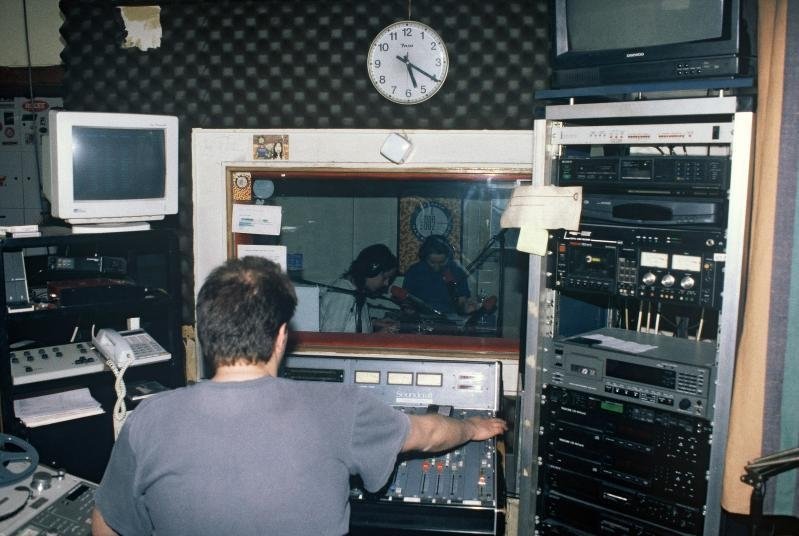
These were the conditions under which Veran Matić, together with several other student journalists from Belgrade University, founded the radio station B92. Matić had been involved in independent youth media since 1984, and the station was born from his desire to combine journalism with other forms of civic activism. He proposed that the founding document of the station should be the Universal Declaration of Human Rights – a principle, he told Index, that has guided him since his early life.
“I grew up in a village, mostly with my grandparents. They taught me the values of honesty, justice, and many of the ethical principles rooted in religious teachings,” Matić said. “My interests have always extended beyond journalism alone.”
Blending rock music with current affairs programmes and phone-ins, B92 quickly gained popularity as a rare outlet for Western news and information in Yugoslavia. However, Serbia was becoming increasingly authoritarian under Milošević; the station’s preference for truth-telling was at odds with the regime, and B92 became a prime target for suppression. Years later, Matić found out that he had been surveilled from the very beginning of his career.
“The Yugoslav State Security Service had already begun monitoring and wiretapping me,” he explained. “I was aware that I was being followed, but I had no idea that my telephone conversations had been systematically intercepted for years.”
Matić soon became editor-in-chief of B92. During anti-government demonstrations in Belgrade in March 1991, police stormed the newsroom and threatened staff members and foreign correspondents in the newsroom, forcing the station off the air.
“Tanks had already begun appearing on the streets, and the police threatened violence against our staff,” Matić said. “We finally suspended broadcasting, but we refused to air the official state news agency’s reports. The following day we resumed broadcasting without permission because the student protests had begun.”
The next time the state tried to shut B92 down, in 1996, the station was ready. Staff outmanoeuvred the authorities by transmitting their signal over the internet to the BBC in London, which relayed it by satellite back to local radio stations across Serbia for broadcast. This was one of the first examples of using the internet to circumvent censorship in broadcasting.
Matić contended that the most dangerous period for B92 staff was during the NATO bombing campaign in 1999 – a large-scale air campaign to destroy Yugoslav infrastructure and to stop the repressive activities of the Milošević government. In and amongst the turbulence and warfare, Radio B92 was once again banned. But this time, Matić was arrested.
“I was taken to a detention cell inside the largest police headquarters in Belgrade,” he said. “Through a tiny window I could see the night sky, waiting for the bombers to arrive. For the first time in my life, I felt completely powerless.”
Matić and his colleagues were buoyed, though, by an international campaign of solidarity in support of independent media in Serbia. They responded with innovation, driven by their belief that the authorities were “not stronger than the ideas.”
“We responded by installing transmitters in Romania and Bosnia and Herzegovina, as well as a clandestine transmitter in Belgrade,” Matić told Index. “We switched it on on 5 October 2000, when nearly half a million people gathered peacefully in Belgrade to bring down Slobodan Milošević’s dictatorship.”
In the years that followed, Matić continued to build his career in journalism. He helped to establish the Commission for the Investigation of Murders of Journalists in 2013, and currently chairs the Permanent Working Group for the Safety of Journalists and the Association of Independent Electronic Media (ANEM). He is also head of the B92 foundation, a non-profit launched by the media house which brings together companies, foundations and civil society organisations to promote philanthropy and humanitarian aid.
Even though the Milošević era is long gone, Matić continues to face adversity and censorship while reporting in Serbia. Just last month, he was attacked while filming a public gathering in front of the National Assembly, when someone forcibly took his phone despite Matić introducing himself as a journalist.
Matić is keen to stress that this was not an isolated incident. “What happened that day cannot be understood simply as an incident in which I was prevented from filming,” he said. “It was the culmination of a much longer process of public targeting and the creation of an atmosphere in which violence against me has effectively been legitimised.”
Veran Matić in 2011, the year he was given police protection. Photo: Portal Vlade APV / CC BY 3.0
Between 2011 and 2016 he was under 24-hour police protection, both in Serbia and while travelling abroad. More recently, current President Aleksandar Vučić publicly disparaged Matić during a TV appearance, suggesting that people convicted of crimes as a result of Matić’s investigative journalism had been wronged. At the same time, a pro-government media organisation ran what Matić described as a lengthy propaganda piece on him.
“After the broadcast, the threats intensified,” he said. “I have repeatedly been verbally abused and physically confronted in public. Members of my family have also been threatened.
“The most frightening aspect is not only the hostility itself, but the growing conviction that there is little institutional protection available.”
Matić is not the only journalist in Serbia being targeted in this way. According to the official records of the Supreme Public Prosecutor’s Office, only 12 out of 271 recorded cases of threats and attacks against journalists over the past two and a half years have resulted in final court judgments.
Independent media is vital in holding those in power to account and being part of it will never be an easy profession. Matić identified several economic, legal, and security issues facing such outlets, including the threat of SLAPPs together with smear campaigns, harassment on social media and intimidating surveillance tactics.
“The consequence is that many journalists go to work every day knowing they are exposed targets,” said Matić. “It has become a struggle for personal safety, for the survival of independent journalism, and ultimately for Serbia’s democratic future.”
The B92 foundation has provided support to journalists outside of Serbia in recent years, including correspondents in Ukraine and Gaza. Through his experiences, Matić understands the importance of press freedom globally – and the cost that can come with it.
“In many ways, my entire professional life has unfolded under pressure, threats and various forms of state repression,” he reflected. “If we want citizens to continue knowing what is really happening in our country, we must ensure that the journalists uncovering those truths are able to continue their work safely.
“That, more than anything else, is what keeps me going.”
Read the full article here
Fact Checker
Verify the accuracy of this article using AI-powered analysis and real-time sources.