

 Freedom Index

Listen to the article
from the another-moral-panic-bubble-popped dept
A couple weeks back, Jonathan Haidt published another entry in his ongoing campaign to convince the world that social media is inherently ruining kids’ lives. This one was a victory lap titled “Seven Lines of Evidence Against Social Media,” treating recent developments — including the social media addiction verdicts against Meta that most people are misunderstanding — as vindication of his thesis.
Part of the evidence he marshaled was Pew polling showing that parents are worried about their kids’ social media use. Which, fine. Parents worrying about what their kids are up to is as old as the human species, and usually about as productive as yelling at the wind. It’s kind of what parents do. It’s why every generation has its own series of “the kids these days!” moral panics.
But then something inconvenient happened for Haidt’s thesis: Pew went and did a brand new study exploring teens’ experiences on TikTok, Instagram, and Snapchat. This one asked the kids themselves.
The results are awkward for the panic narrative.
For years now, I’ve been pointing out that the social-media-is-destroying-kids narrative — which Haidt has done more than anyone else to popularize — has never had the empirical backing its proponents claim. Multiple major studies have failed to replicate the harm claims. When researchers have looked carefully, they’ve often found the causal arrow pointing the other direction: kids who are already struggling with mental health issues and not getting adequate support tend to spend more time on social media, rather than social media causing the mental health issues.
Indeed, the research repeatedly suggests that for the very small number of kids who are facing mental health problems and overrelying on social media in response, the answer is a targeted intervention to help those individuals — not a broad “ban kids from social media” program.
The new Pew data does more than nudge that picture along; it gives it a massive shove.
Let’s start with the finding that should end this debate on its own. Pew asked teens how what they see on each platform makes them feel about themselves. Here’s what the kids reported:
About six-in-ten teen TikTok, Instagram and Snapchat users say what they see on each makes no difference in how they feel about themselves. And about a quarter say it makes them feel about equally better and worse.
When teens say these platforms do make them feel better or worse, it leans more positive. For example, 15% of TikTok users say what they see there makes them feel better, while 3% say it makes them feel worse.
The bar chart showing just how few kids claim that TikTok, SnapChat, and Instagram make them feel worse about themselves is quite telling:
Just look at those numbers. That tiny green bar? That’s the percentage that says these services make them feel worse about themselves. On TikTok — the platform most frequently cast as an unusually dangerous self-esteem killer for teen girls — 15% of teen users say it makes them feel better about themselves, and just 3% say it makes them feel worse. That’s a 5-to-1 ratio in the wrong direction for the moral panic narrative.
The numbers on the other platforms follow the same script. On Snapchat, 13% say it makes them feel better, just 2% worse. On Instagram — the platform Haidt has singled out for particular damnation, building much of his case on leaked Meta internal research he insists proves it’s poisonous — 10% say it makes them feel better, just 3% say it makes them feel worse.
Three percent. That’s not a signal of a generation-defining mental health catastrophe. That’s barely distinguishable from a rounding error.
And even these small numbers overstate the harm, because the vast majority of kids—around 60% on each platform—say these apps make no difference at all to how they feel about themselves. Add the quarter who report “about equally better and worse,” and you’re left with a tiny minority on either side of the ledger, tilted toward the positive.
Overall experience tracks the same way:
All told, teens tend to have a mostly positive experience on TikTok, Instagram and Snapchat. About seven-in-ten teens on each platform say this. Very few – just 3% on each – say it’s mostly negative.
Seven-in-ten teens report a mostly positive experience. Three percent report a mostly negative one. These numbers are not ambiguous. If social media was so inherently harmful to kids, the numbers would not — could not — look that way.
Separately, Pew also asked parents how much time their teens spend on these platforms — and the disconnect between what parents believe and what their kids report is massive:
28% of teen TikTok users report spending too much time on the site, and that jumps to 44% when parents were asked about their teen’s use of the platform.
Parents think their teens are spending too much time on TikTok at a rate nearly 60% higher than the teens themselves report. That gap is the entire moral panic, distilled to a single data point: worried adults constructing a portrait of a crisis that the people supposedly living it mostly don’t appear to recognize.
And there’s a class dimension to this worry that deserves a lot more attention than it gets. Dig into the survey on what parents say about their teens’ uses of social media and you find that wealthier, more educated parents are significantly more convinced that social media is harming their kids than less affluent parents are.
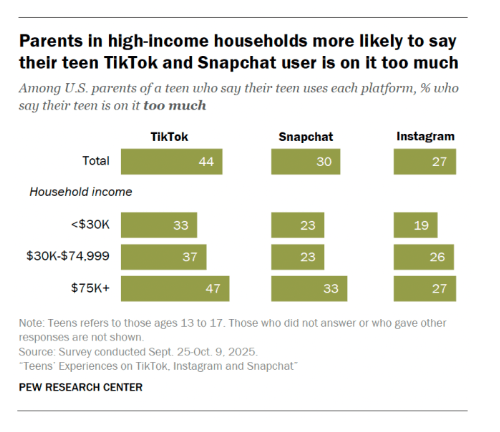
This is exactly what you’d expect if the panic is being driven top-down by elite media and political discourse rather than bottom-up by actual observed harm. The audience buying Haidt’s books, reading his Atlantic pieces, listening to NPR segments about the teen mental health crisis — that audience skews wealthy and educated. And it’s precisely that demographic whose anxiety is most out of step with what kids themselves report.
I’ve written before about how the addiction narrative itself may be doing more damage than the thing it claims to describe — teaching kids to interpret normal experiences as pathological, making them feel broken for doing what basically everyone around them is doing. The socioeconomic breakdown in the Pew data fits that framing.
The panic is a panic of privilege, boosted by institutions that shape how the professional class thinks about everything from parenting to policy.
Now, to be fair, the Pew data isn’t uniformly rosy. Around 40% of TikTok users say it hurts the amount of sleep they get, and a meaningful percentage report productivity impacts. These findings deserve to be taken seriously rather than waved away.
But context matters here. Teenagers doing things late at night that hurt their sleep is not exactly a new phenomenon. Parents were convinced television was destroying their kids’ sleep and rotting their brains in the 1960s. Video games were going to create a generation of zombies in the 1980s and 90s. Before that, novels were going to warp young women’s minds. Pinball machines were banned in New York City until 1976 in part because they were thought to corrupt youth. The “this new thing is ruining our kids” script is older than any of the things it has ever been used to describe.
And even if you want to focus specifically on “sleep” we can go back to articles from the 19th century about how reading in bed was harming sleep.
None of which means sleep impacts don’t matter. They do. But “some kids report this activity affects their sleep” is a very different claim than “this activity is causing a generational mental health crisis requiring sweeping bans.” And notably, the self-esteem and overall-experience numbers I quoted above are measuring exactly the kind of mental health harm the panic is supposedly about. Those numbers don’t show what Haidt needs them to show.
Which brings us back to Haidt’s seven lines of evidence. I’m not going to rehash every point here, because several are variations on the same methodological moves I and others have addressed at length elsewhere — cherry-picked correlational data that Haidt and his collaborators desperately want to treat as proof of causality. Some people will argue that his lines 5 and 6 rebut the directionality critique; I don’t think they do, but unpacking why would take us pretty far afield. The larger pattern is what matters: when researchers ask the kids themselves, across study after study, the apocalyptic picture doesn’t materialize.
None of this means social media is harmless for every kid. It clearly isn’t. For a very small minority of teens, it appears that they are unable to handle these services in a healthy manner. Some kids experience harassment. Some kids lose sleep. Some kids who are already struggling find that social media makes the struggling worse. These are real issues that deserve real attention.
But the policy response that actually fits the data isn’t banning social media, criminalizing its use by minors, or building elaborate age verification regimes that compromise privacy for everyone. The response that fits the data is identifying the small percentage of kids who are actually having trouble and getting them real help: mental health resources, school counselors, and easier access to therapy. It also means giving parents and teachers better tools for understanding how to recognize when a kid is actually struggling. The boring, unglamorous, underfunded work of actually caring for kids who are struggling — not sweeping policy gestures that make worried parents feel like something is being done while the kids who actually need help go without.
The moral panic response is the lazy response. It treats every teenager as presumptively damaged by the same thing, ignores what teenagers actually report about their own experiences, and papers over the reality that the kids who need help will still need help after social media is regulated into oblivion — because for those kids, social media overuse usually signals existing distress rather than causing it.
Haidt is doing a victory lap. The kids Pew just surveyed didn’t get the memo that they’re supposed to be miserable because of TikTok. Fifteen percent of them say TikTok makes them feel better about themselves. Three percent say it makes them feel worse. Seven-in-ten report their overall experience on these platforms is mostly positive.
At some point, the people telling us there’s a generational catastrophe are going to have to reckon with the fact that the generation they claim is in catastrophe keeps telling researchers something very different. That reckoning doesn’t seem to be coming from Haidt anytime soon. But the data keeps piling up anyway.
Filed Under: jonathan haidt, kids, kids and social media, moral panic, social media, think of the children
Companies: pew research
Read the full article here
Fact Checker
Verify the accuracy of this article using AI-powered analysis and real-time sources.