Close Menu
FSNN | Free Speech News NetworkFSNN | Free Speech News Network
  • Home
  • News
    • Politics
    • Legal & Courts
    • Tech & Big Tech
    • Campus & Education
    • Media & Culture
    • Global Free Speech
  • Opinions
    • Debates
  • Video/Live
  • Community
  • Freedom Index
  • About
    • Mission
    • Contact
    • Support
Trending

UK targets Cryptomus, TokenSpot, and payment platforms in new Russia-focused crackdowns

9 minutes ago

HSBC Tests AI-Powered Payments With Blockchain Deposits

17 minutes ago

Bitcoin Rebounds After Rough Week, But Traders Are Pricing In More Downside

21 minutes ago
Facebook X (Twitter) Instagram
Facebook X (Twitter) Discord Telegram
FSNN | Free Speech News NetworkFSNN | Free Speech News Network
Market Data Newsletter
Friday, October 9
  • Home
  • News
    • Politics
    • Legal & Courts
    • Tech & Big Tech
    • Campus & Education
    • Media & Culture
    • Global Free Speech
  • Opinions
    • Debates
  • Video/Live
  • Community
  • Freedom Index
  • About
    • Mission
    • Contact
    • Support
FSNN | Free Speech News NetworkFSNN | Free Speech News Network
Home»News»Media & Culture»The Federal Government Just Posted the Largest Annual Budget Deficit Since COVID
Media & Culture

The Federal Government Just Posted the Largest Annual Budget Deficit Since COVID

News RoomBy News Room56 minutes agoNo Comments4 Mins Read1 Views
Share Facebook Twitter Pinterest Copy Link LinkedIn Tumblr Email VKontakte Telegram
The Federal Government Just Posted the Largest Annual Budget Deficit Since COVID
Share
Facebook Twitter Pinterest Email Copy Link

Listen to the article

0:00
0:00

Key Takeaways

Playback Speed

Select a Voice

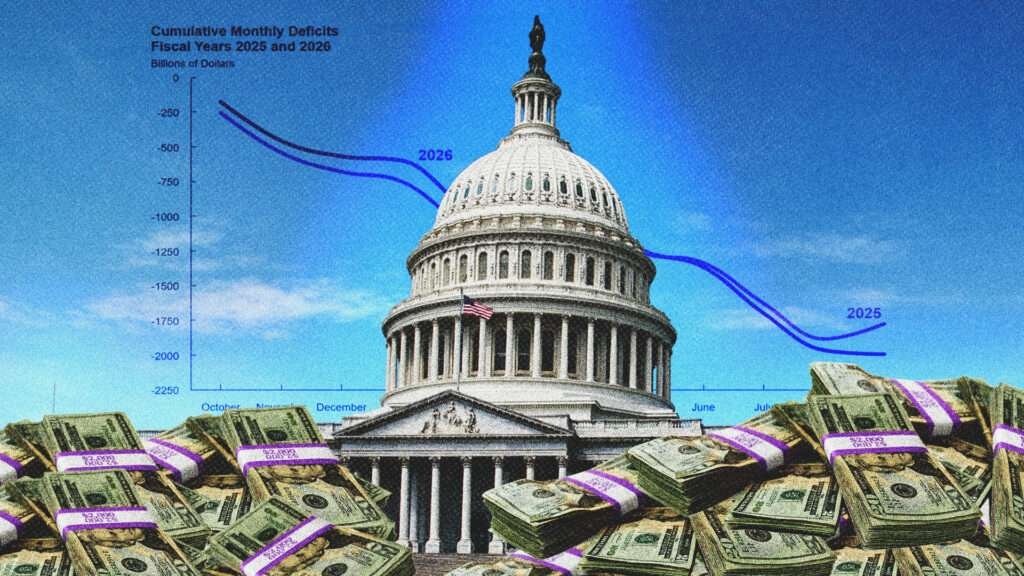
The federal budget deficit totaled nearly $2 trillion for the fiscal year that ended on September 30—the third-largest in American history, trailing only the two deficits recorded during the COVID-19 pandemic.

The fiscal year totals released Thursday by the Congressional Budget Office (CBO) paint another bleak picture about the state of the federal budget. That near-record deficit occurred despite tax revenue increasing by about 3 percent year over year. The federal government collected more than $5.4 trillion in taxes during the past fiscal year.

However, the government spent about $7.4 trillion, a 6 percent increase from the year before. That’s why the deficit widened.

That spending increase was primarily driven by entitlement programs, the military, and interest payments on the national debt. The CBO notes that Social Security spending increased by 5 percent last year due to “increases in average benefits and in the number of beneficiaries.” There was an 8 percent increase in spending on both Medicare and Medicaid, while military spending increased by 5 percent.

“The economy can’t keep pace with the relentless growth of programs such as Social Security and Medicare,” David Ditch, a policy analyst at the Cato Institute, told Reason. “Seniors are receiving far more in benefits than they paid in payroll taxes. America’s leaders should stop pretending otherwise.”

Still, the single biggest factor in rising spending and growing deficits is actually the size of the national debt itself. Interest payments on the debt rose 11 percent in fiscal year 2026 and totaled more than $1.1 trillion.

On the revenue side, the CBO’s data contradicts President Donald Trump’s oft-repeated claim that tariffs are bringing in “trillions” of dollars for the United States.

The CBO reports that the federal government collected $182 billion in customs duties during the fiscal year. That’s actually an 11 percent decline relative to 2025, because the federal government was required to issue refunds for tariffs that were ruled unlawful by the U.S. Supreme Court earlier this year.

The CBO estimates that those refunds reduced tariff collections by about $130 billion—meaning that even if the government had been allowed to keep that money, the revenue totals would be far below Trump’s outlandish claims.

The president is, unfortunately, not alone when it comes to ignoring the federal government’s fiscal trajectory. Neither major political party seems to have a serious plan to address the growing deficit or the underlying factors that are causing the gap between revenue and spending to widen. There has been little talk about the budget deficit during this year’s midterm election season, despite worrying signals from the bond market—yields on both short- and long-term federal debt have climbed steadily this year, a sign that investors are viewing the U.S. government as a riskier investment than in years past.

Maya MacGuineas, president of the Committee for a Responsible Federal Budget (CRFB), a nonprofit that advocates for reducing deficits, said in a statement that policymakers should aim to reduce future budget deficits to about 3 percent of the overall size of the economy—around half of the level hit in 2026.

“Clearly, we can’t keep going like we have,” she added. “Our fiscal path has been running backwards for far too long; it’s time to start working on the path forward.”

Treasury Secretary Scott Bessent has reportedly advised the Trump administration to set that same goal of cutting the budget deficit to 3 percent of the size of the economy by 2028.

However, it also seems likely that Congress will meet in the post-election lame duck session to consider Trump’s plan for a massive increase in military spending. The president has also promised to send $5,000 to every American if Republicans retain control of Congress—an outright political bribe that would cost well over $1 trillion.

If you find yourself in a hole, the first step is to stop digging. However, another year of full Republican control of the federal government has produced a predictably pathetic result: more spending and a larger budget deficit.

Read the full article here

Fact Checker

Verify the accuracy of this article using AI-powered analysis and real-time sources.

Get Your Fact Check Report

Enter your email to receive detailed fact-checking analysis

5 free reports remaining

Continue with Full Access

You've used your 5 free reports. Sign up for unlimited access!

Already have an account? Sign in here

#IndependentMedia #MediaAccountability #NarrativeControl #PoliticalDebate #PublicDiscourse
Share. Facebook Twitter Pinterest LinkedIn Tumblr Email Telegram Copy Link
News Room
  • Website
  • Facebook
  • X (Twitter)
  • Instagram
  • LinkedIn

The FSNN News Room is the voice of our in-house journalists, editors, and researchers. We deliver timely, unbiased reporting at the crossroads of finance, cryptocurrency, and global politics, providing clear, fact-driven analysis free from agendas.

Related Articles

Cryptocurrency & Free Speech Finance

Bitcoin Rebounds After Rough Week, But Traders Are Pricing In More Downside

21 minutes ago
Cryptocurrency & Free Speech Finance

Ethereum L2 Starknet Jumps 20% After Saying It Wants to Become an L1

1 hour ago
Media & Culture

The NIH Plan To Strengthen ‘Replication and Reproducibility’ Will Not Check Anything

2 hours ago
Cryptocurrency & Free Speech Finance

Ledger Probes Potential Theft of $87M in User Funds Tied to Crypto Wallet Reseller

2 hours ago
Media & Culture

Treasury Backs Down on Biden-Era Cryptocurrency Surveillance Proposal

3 hours ago
Media & Culture

Let Charter Schools be as Flexible as Microschools

4 hours ago
Add A Comment
Leave A Reply Cancel Reply

Editors Picks

HSBC Tests AI-Powered Payments With Blockchain Deposits

17 minutes ago

Bitcoin Rebounds After Rough Week, But Traders Are Pricing In More Downside

21 minutes ago

The Federal Government Just Posted the Largest Annual Budget Deficit Since COVID

56 minutes ago

South African journalist faces death threats after anti-migrant activist publishes his number

60 minutes ago
Latest Posts

Lulwa al-Hussainan criticised Kuwait’s Minister of Interior, Fahad Al-Yousef (Main pic: Lana71/WikiCommons; alt pic: taken from Gulf Centre for Human Rights appeal) These are the poignant words of Lulwa al-Hussainan, the Kuwaiti human rights defender known for her outspoken criticism of government policies and her activism on social media. Her criticism of the Minister of Interior, Fahad Al-Yousef, put her in the crosshairs of the authorities, and after facing intimidation and trumped-up charges in connection with her activism, she was forced to flee Kuwait in December 2024. This year she also had her citizenship revoked. Al-Hussainan told Index that she had been inspired to become an activist from an early age. “From a young age I read a great deal, and that reading taught me to stand with anyone who is wronged and to support them,” she said. Her first experience of being targeted for standing up for what she believed in came in June 2021, when she was arrested and detained alongside her husband during a sit-in at Al-Erada Square. Speaking on social media after the event, al-Hussainan said: “They insulted and verbally abused me, and out of spite, they even insulted my deceased and wronged grandfather, the late Musafir Abdulkarim Mahshoum.” Musafir Abdulkarim was a 38-year-old actor born and raised in Kuwait, of Iraqi descent. He was accused of treason by the Kuwaiti authorities when Iraq invaded Kuwait and was executed in 1991. The family strongly deny he was a spy and says it was a fabricated charge. Lulwa al-Hussainan’s profile on social media – where she has built a substantial following – describes herself as a “Granddaughter of a martyr who loved the homeland”, although she made clear that her biggest call to action is through moral obligation rather than family ties. “What inspires me to stand with the oppressed is that it is the right thing to do,” she said. “In my country we used to have a measure of freedom of opinion. Now many people are in prison unjustly because of a word or a view, and they have been beaten, humiliated, and tortured.” Despite her arrest in 2021, al-Hussainan continued to speak out. Her criticism of government policies increased with a vocal campaign against Kuwait’s campaign to revoke citizenships. Authorities in the state have used citizenship as a political weapon against dissidents and critics for years, with an estimated 70,000 Kuwaitis having had their citizenship revoked since the launch of an unprecedented government campaign in March 2024. The repressive tactic has drawn criticism from the international community, condemned as a thinly-veiled attempt to silence opposition with a disproportionate impact on women and minorities. “What inspires me to stand with the oppressed is that it is the right thing to do” Although she wasn’t the only one to voice concerns around the campaign, al-Hussainan’s criticisms of the policy attracted online publicity and support, and subsequently the attention of the authorities. It was this that led to her clash with Interior Minister Al-Yousef.  “I spoke about the revocation of citizenship and defended people who were wronged,” al-Hussainan explained. “They obtained citizenship in accordance with the law, they are not forgers.” “Because of what I said and the position I took, I was summoned by State Security, and the Minister of Interior assaulted me.” According to al-Hussainan, she was reprimanded by Al-Yousef for her posts on X and for impinging on the authority of the Emir and was subjected to beatings and solitary confinement in a freezing cell during this meeting. By the time she was released, her health had severely deteriorated. She subsequently fled the country to seek refuge in the UK.  After leaving Kuwait in December 2024, al-Hussainan was sentenced twice: in March 2025 she was sentenced to three years in prison for “insulting the Emir,” a sentence overturned three months later. In January 2026, she received a second sentence from the Kuwaiti Criminal Court, this time for five years in prison on the same charge. The verdict was widely seen to be a political decision meant to undermine her criticisms of the state rather than a legitimate case.  Posting on social media in the aftermath, al-Hussainan said: “What is happening is the height of a catastrophe. Fahad Al-Yousef is using the war as a pretext to justify his injustice and tyranny, and he is wielding his power as a sword against the people.” In a terrible irony, the very policy al-Hussainan was targeted for opposing was used against her as she was stripped of her citizenship in 2026, along with several other Kuwaiti activists and dissidents residing abroad. While still living in exile, her brother Abdullah Nasser Al-Hussainan – himself a content creator who makes and posts comedic videos on YouTube – was arrested and charged in what Lulwa believes was retribution for her activism and an attempt to intimidate her into silence.  Posting CCTV footage of the arrest on X, she stated: “This video proves my brother was kidnapped right in front of the house. Fahad Al-Youssef is escalating his animosity and taking revenge on me by kidnapping my brother. Unfortunately, in Kuwait, people get kidnapped from their homes.” I was summoned by State Security, and the Minister of Interior assaulted me Al-Hussainan told Index that she misses Kuwait, but she is resigned to her fate for as long as she continues to fight for what she believes in. “I still miss my country, my family, and my friends,” she said. “But I have no choice but to remain in exile. If I return, my fate in Kuwait will be prison.” Despite her current predicament and the charges brought against her and her family by the state, she remains outspoken on social media and continues to demand a review of the mass citizenship revocations and to peacefully protest against the oppressive Kuwaiti regime. In this way, al-Hussainan is the perfect example of how not to be silent. READ MORE

1 hour ago

Thailand’s SEC approves spot Bitcoin and Ether ETFs for Stock Exchange of Thailand

1 hour ago

Blockchain.com Applied for CFTC Licenses for Prediction Markets, Derivatives: Report

1 hour ago

Subscribe to News

Get the latest news and updates directly to your inbox.

At FSNN – Free Speech News Network, we deliver unfiltered reporting and in-depth analysis on the stories that matter most. From breaking headlines to global perspectives, our mission is to keep you informed, empowered, and connected.

FSNN.net is owned and operated by GlobalBoost Media
, an independent media organization dedicated to advancing transparency, free expression, and factual journalism across the digital landscape.

Facebook X (Twitter) Discord Telegram
Latest News

UK targets Cryptomus, TokenSpot, and payment platforms in new Russia-focused crackdowns

9 minutes ago

HSBC Tests AI-Powered Payments With Blockchain Deposits

17 minutes ago

Bitcoin Rebounds After Rough Week, But Traders Are Pricing In More Downside

21 minutes ago

Subscribe to Updates

Get the latest news and updates directly to your inbox.

© 2026 GlobalBoost Media. All Rights Reserved.
  • Privacy Policy
  • Terms of Service
  • Our Authors
  • Contact

Type above and press Enter to search. Press Esc to cancel.

🍪

Cookies

We and our selected partners wish to use cookies to collect information about you for functional purposes and statistical marketing. You may not give us your consent for certain purposes by selecting an option and you can withdraw your consent at any time via the cookie icon.

Cookie Preferences

Manage Cookies

Cookies are small text that can be used by websites to make the user experience more efficient. The law states that we may store cookies on your device if they are strictly necessary for the operation of this site. For all other types of cookies, we need your permission. This site uses various types of cookies. Some cookies are placed by third party services that appear on our pages.

Your permission applies to the following domains:

  • https://fsnn.net
Necessary
Necessary cookies help make a website usable by enabling basic functions like page navigation and access to secure areas of the website. The website cannot function properly without these cookies.
Statistic
Statistic cookies help website owners to understand how visitors interact with websites by collecting and reporting information anonymously.
Preferences
Preference cookies enable a website to remember information that changes the way the website behaves or looks, like your preferred language or the region that you are in.
Marketing
Marketing cookies are used to track visitors across websites. The intention is to display ads that are relevant and engaging for the individual user and thereby more valuable for publishers and third party advertisers.