

 Freedom Index
Listen to the article
The city commission of Emporia, Kansas, has endured countless hours of public criticism. What it could not endure was a few seconds of clapping.
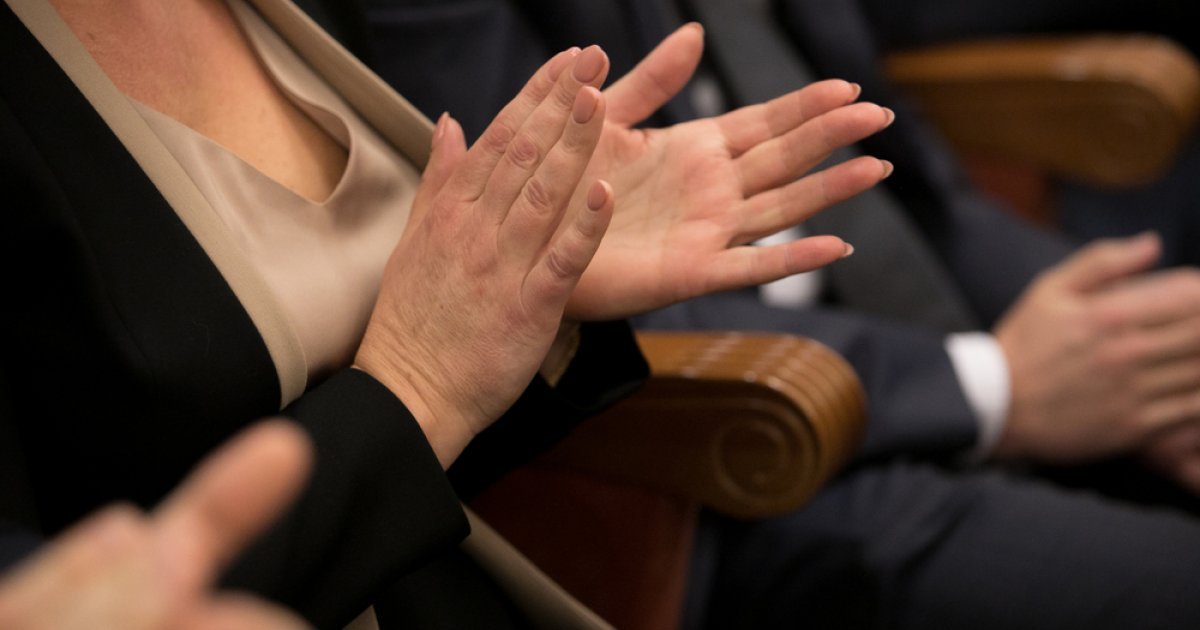
At its July 22 meeting, citizens contested a proposed data center, briefly applauding between public comments as one speaker left the microphone and another approached. Commissioners sometimes ignored the applause and other times warned the audience to stop. But their warnings soon expanded to cover even more muted reactions like finger-snapping and a woman in the back of the room silently waving her hands.
When high school physics teacher Lux Claridge clapped five times for a speaker, a commissioner told officers to remove the next person who clapped. But instead of waiting for another round of applause, officers immediately ordered Claridge to leave. After refusing, Claridge was physically removed, arrested, and booked on charges of disorderly conduct and interference with law enforcement.
In other words, a citizen was thrown to the ground, arrested, and removed from a public meeting for endorsing criticism of local government in a non-disruptive manner.
Soapbox 2026: Tickets on Sale Now
Soapbox is FIRE’s bold new conference, taking place in Philadelphia to celebrate America’s 250th anniversary with high-impact keynotes, timely panels, and unforgettable entertainment.
Read More
Emporia’s written public-comment rules don’t ban applause. They authorize removal when someone “fails to comply with public comment procedure, speaks out of turn, or is otherwise disruptive,” and continues after a warning. To be sure, government bodies can adopt clear, viewpoint-neutral rules against conduct that actually disrupts a meeting — preventing speakers from being heard, hijacking the floor when not recognized to speak, or otherwise preventing the government from conducting its business.
But that’s not what happened in the Emporia Municipal Courtroom. None of the clapping, including Claridge’s, materially disrupted the meeting. Each burst of applause lasted only a few seconds during the interval between public comments. No speaker was interrupted or delayed. The meeting continued moving forward. The only disruption came from the arrest of Claridge and the meeting recess that followed.
The incident illustrates a recurring problem with vague decorum policies for public meetings. They give officials room to recast expression they dislike as “disruption,” and tend to be enforced most aggressively when criticism stings. It’s hard to believe the commission would have reacted the same way to brief applause for comments praising city officials. But even if so, the fact remains that none of the clapping was “otherwise disruptive.” And Claridge’s refusal to leave cannot retroactively supply the missing disruption to justify removal in the first place.
Officials can require order — the First Amendment does not force them to let meetings become ungovernable — but they can’t demand monastic silence and perfect stillness from everyone in the room.
Emporia’s own policy says public comment is intended to “provide citizens with an opportunity to provide input to the governing body on matters of city business.” Brief, nondisruptive audience reactions do exactly that. A few seconds of applause signal support for a speaker and the intensity of public sentiment. Applause can also give residents who don’t make a formal comment themselves a way to convey their opinions.
Local government meetings are where people confront decisions about their neighborhoods, schools, taxes, utilities, and homes. Officials can require order — the First Amendment does not force them to let meetings become ungovernable — but they can’t demand monastic silence and perfect stillness from everyone in the room, then treat any audible or visible reaction as disorder.
If no speaker is drowned out, no one loses their speaking time, and the meeting keeps moving, where is the disruption? When brief applause becomes grounds for removal and arrest, it’s worth asking whether officials are preserving order, or simply punishing dissent.
Read the full article here
Fact Checker
Verify the accuracy of this article using AI-powered analysis and real-time sources.