

 Freedom Index
Listen to the article
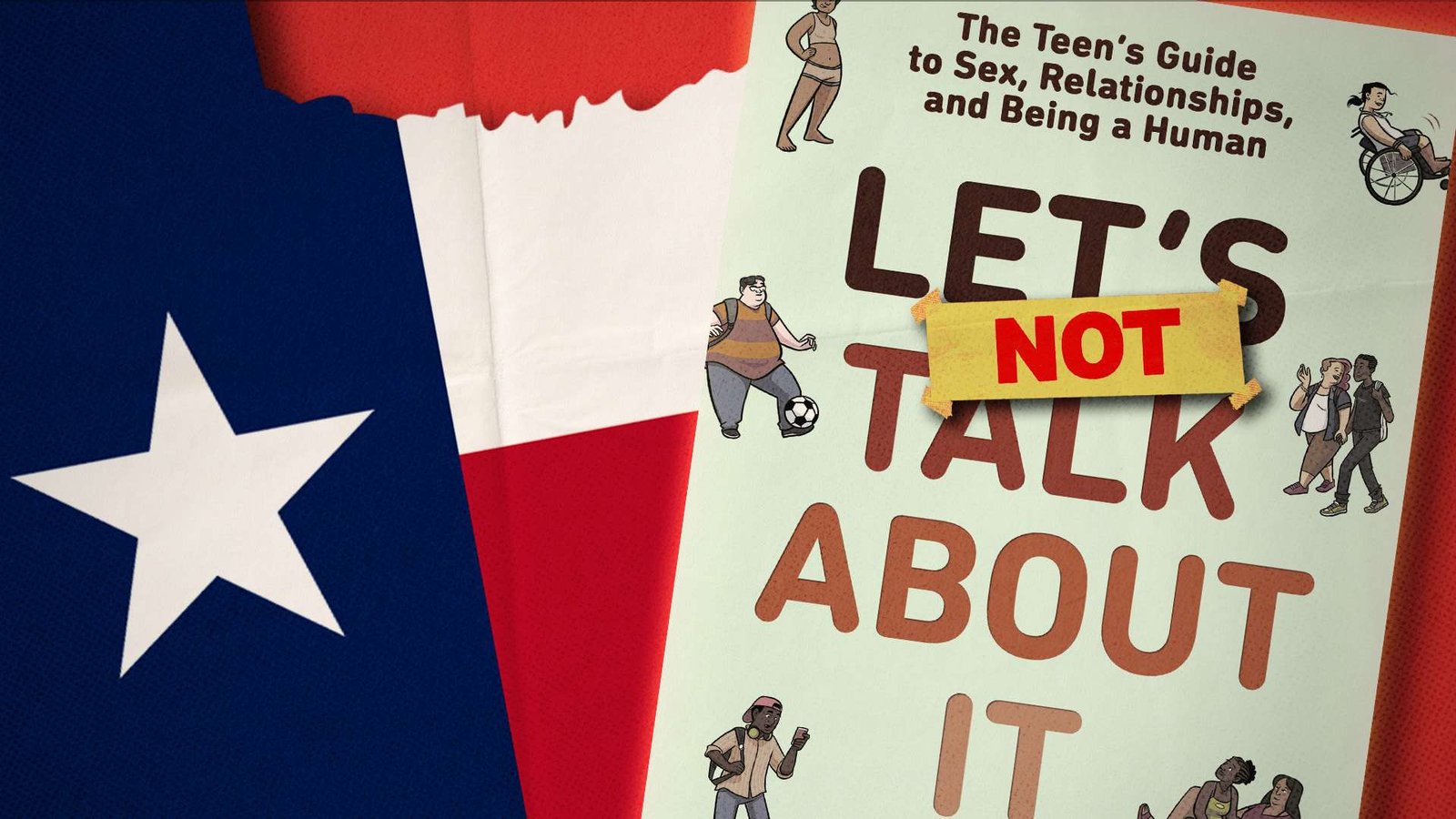
“We’re coming for the books,” said Texas Lt. Gov. Dan Patrick, apparently aiming to sound as much like an arch cartoon supervillain as possible. Last week, Patrick held a press conference alongside conservative activist Bonnie Wallace to take issue with what he called “dirty, filthy, and vulgar books”—and Wallace called “demonic content”—in school libraries.
Also in today’s newsletter: Meta settles for $16.68 billion, Dolly Parton’s Playboy interview, anti-phone phone marketing, getting answers on government hacking, and more.
‘Demonic’ Sex Education Content?
The content in question in Texas is…a sex education book aimed at high-school audiences. Let’s Talk About It: The Teen’s Guide to Sex, Relationships, and Being a Human was the main offender highlighted by Patrick and Wallace. And from their hype, one would think the 2021 book—by married couple Erika Moen and Matthew Nolan—featured explicit pornography, perhaps alongside a guide to gangbangs and instructions on making your own Satan-shaped sex toys.
But from what I can tell, it’s a pretty normal and age-appropriate sex education book. The book’s publisher says it’s intended for audiences ages 14 and up. It covers, in conversational comic-book form, topics like consent, setting sexual boundaries, how to deal with rejection, contraception, and preventing sexually transmitted diseases. It includes messages like “It’s okay to avoid sexy activities if they don’t interest you” or “to never have sex if you know it’s not for you.”
You are reading Sex & Tech, from Elizabeth Nolan Brown. Get more of Elizabeth’s sex, tech, bodily autonomy, law, and online culture coverage.
There are a few pages featuring explicit (cartoon) images of nude bodies, but these are not erotic images. Some come in a section of a chapter on body image that discusses insecurity and the importance of not comparing yourself to others. Others come in a biology lesson about hormones, genitals, and sex characteristics.
There are also mentions of things like polyamory, sex toys, masturbation, porn, and sexting. But these aren’t included in a gratuitous or overly graphic way. They’re presented in an educational manner, albeit on topics that clearly some people in Texas think teens—and perhaps adult women—shouldn’t know about.
“These are books that are so disgusting, so filthy, so dirty, so vulgar, so pornographic that for the ladies here, I wouldn’t even open it and show you,” Patrick said. “I didn’t show the female senators last session….We passed [Senate Bill 13], but I did it without.”
It’s rare that men in power make explicit how much they view women—including female colleagues—like children, but here we are!
Sex censorship has always been rooted in patriarchal “protection” of children and women (whom they consider children). Imagine telling a room full of colleagues — fellow legislators! reporters! — that they must be protected from anodyne discussions of sex in a book meant for kids 14 and up.
— Mike Stabile (@mikestabile.bsky.social) 2026-08-19T23:32:16.663Z
The bill Patrick mentioned, passed last year, gives parents more power to challenge the presence of particular books in school libraries and gives school boards final say over what’s allowed on library shelves.
Patrick “also said that state legislators would file a bill next session that requires the Texas Education Agency to lower a school’s accountability grade if it has any copies of a challenged book on its shelves,” KXAN reports.
“We’re not banning books,” Patrick stressed at the press conference. “You can buy any book you want to buy, and many you can find in public libraries.”
Fair enough—though I’m not entirely convinced folks like Patrick wouldn’t try to ban certain books if the First Amendment allowed it. But authorities needn’t literally ban books like Let’s Talk About It in order to warrant criticism.
In this case, we’ve got the state’s lieutenant governor pressuring schools across the state to remove particular books from their libraries and touting legislation to tie school rankings to how well schools comply.
That’s quite different from individual school librarians, administrators, or boards deciding not to stock those books on their own school’s shelves. It’s not an outright ban, sure, but it is a heavy-handed approach. And it seems certain to render a wide range of books out of reach for many students, who may not have money of their own to buy them or face various barriers to checking them out from public libraries (including that public libraries, especially in conservative areas, could be bullied into removing these books too).
It also leaves little room for schools and school districts to make their decisions about what is appropriate. Patrick actually complains that some school districts have resisted pressure to remove particular books from school libraries.
I get why books like Let’s Talk About It might make some people uncomfortable. (Heck, I probably blushed reading a few sections.) But if we don’t want teenagers to learn about sexuality largely from online porn, then books like this—which talk about a wide range of relationship and sexuality topics in a frank way—could be important.
It seems clear that for Texas authorities, the issue isn’t this book being literally obscene or particularly pornographic but that it’s talking to teens about things like sex and masturbation at all. It’s also hard not to suspect that some of the issue, too, is its inclusion of same-sex couples and statements like “gender is so much bigger than male and female.”
At the press conference, Patrick’s office gave attendees copies of Let’s Talk About It with five pages flagged. According to KXAN, these included:
- A disclaimer that says to consult a medical professional for health information.
- Two pages referencing sex toys (one says they exist; the other warns that inserting things without a flared base into an anus can result in a hospital visit).
- Two pages discussing pornography (noting it may be illegal to view depending on a person’s age or region, and that it can be unrealistic or unethical).
Patrick went on to bash a book about animal reproduction (Do Animals Fall In Love?) for “measur[ing] the penis size of over 80 animals.”
Patrick’s list of “filthy,” “dirty,” and “vulgar” books contains almost 2,200 books that he wants banned from public school shelves. “The list heavily focuses on LGBTQ+ titles, gender-identity topics, sex education, body-awareness, romance titles,” notes KHOU.
It includes all sorts of respected literature—from contemporary young-adult books like The Perks of Being a Wallflower and The Fault In Our Stars to classics like The Glass Menagerie by Tennessee Williams, Flowers for Algernon by Daniel Keyes, The Bluest Eye by Toni Morrison, The Picture of Dorian Gray by Oscar Wilde, and I Know Why the Caged Bird Sings by Maya Angelou. Other titles on the list include such as Ab(solutely) Normal: Short Stories That Smash Mental Health Stereotypes, Anne Frank’s Diary: The Graphic Adaptation, Better Than We Found It: Conversations to Help Save the World, Launching Our Black Children for Success, We Need To Talk About Vaginas, and LGBTQ Human Rights Movement.
In the News
Meta settles for $16.68 billion. Whoa—as I was writing this newsletter this morning, news broke that Meta has settled with the states accusing it in court of deliberately designing platforms like Facebook and Instagram to make children addicted. From Reuters:
The settlement resolves claims brought by 29 U.S. states, and will end a federal trial that had been one of the highest-profile tests yet of allegations that social media companies harmed young users.
Meta will impose daily usage limits and restrict nighttime usage by children who use Facebook and Instagram, and enhance measures to prevent children from accessing age-restricted content.
The Menlo Park, California-based company denied wrongdoing in agreeing to settle.
I can understand why they did this, but…ugh. It seems destined to only empower state authorities, who will say this proves that they were right, and to encourage more lawsuits that try to circumvent the First Amendment and Section 230 by claiming their problems with social media platforms are about “product design,” not speech.
Government hackers: Some senators want answers on how often federal law enforcement hacks Americans’ phones. From Politico:
Sen. RON WYDEN (D-Ore.) and Rep. GREG CASAR (D-Texas) sent a letter to GAO today asking that it study how federal law enforcement agencies are using spyware technologies to access the mobile devices of Americans, particularly by agencies including the departments of Homeland Security and Justice.
GAO spokesperson Sarah Kaczmarek said Friday that the agency “has received the congressional requests. GAO has a process it goes through to determine whether we do work and when, which we are working through right now.”
From their letter:
While federal law enforcement agencies have used hacking and spyware as an investigative tool for more than 25 years, there exists little public information regarding its scope, frequency, or operational safeguards. Unlike traditional surveillance authorities, such as wiretaps or pen registers, the government does not publish annual reports for hacking operations. Furthermore, while the Department of Justice (DOJ) and Department of Homeland Security (DHS) have established public policies governing their use of surveillance technologies like cell-site simulators (“Stingrays”), no comparable public policies exist that govern federal hacking. Moreover, DOJ and the Federal Bureau of Investigation (FBI) have repeatedly ignored congressional requests for greater transparency across multiple administrations.
On Substack
Could smartphones become obsolete? Kate Lindsay of the embedded newsletter notices a rise in “anti-phone phone marketing,” in which companies like Google and Apple are pushing “for people to spread their screen time out across multiple devices”:
I went back to watch Apple’s WWDC event from June, and while they didn’t explicitly use anti-phone language, they’re taking the same general approach, referring to their suite of products as a “common foundation of technologies.” In other words: No phone? No problem. Wear our smartwatch and put on our smartglasses, and watch us blend seamlessly into the very fabric of your day-to-day life. It’s exactly what Embedded predicted would happen a year ago after the introduction of Liquid Glass: Scrolling is over.
The death of the social feed and the introduction of this design suggests we are indeed on that precipice of an entirely new way of interacting with technology: We don’t want an everything app on one piece of everything tech. We want our tech everywhere, to follow us as we move throughout the world, all feeding into a personalized digital ecosystem—our virtual realities.
Through this lens, I can see my phone becoming a relic—a clunky thing that our kids will only ever have ironically, or, like early digital cameras now, a nostalgic escape from whatever tech we’ll be using then.
Will that happen? I’d love to know what Sex & Tech readers think.
Read This Thread
Pushback against blaming ChatGPT for suicide:
Really frustrating coverage of a woman who died by suicide, attributing to much of it to ChatGPT. There’s a lot missing here, and some obvious things they didn’t point out.
For one, talking to a therapist about suicidal thoughts can mean you end up being sent to a mental… pic.twitter.com/EPPeClqmHN
— Shoshana Weissmann, Sloth Committee Chair 🦥 (@senatorshoshana) August 25, 2026
More Sex & Tech News
- “And I mean, who else but Dolly Parton should be on the cover of Playboy? If you wanted an outrageous person to be an outrageous magazine cover, who else? I just hope people will take it in the spirit in which I did it—you know, something cute and off-the-wall for me.” Read the full 1978 Dolly Parton (RIP) interview with Playboy here.
• Partying against moral panic:
Wow okay this really blew up! Was originally supposed to be a house party at my 900 sq ft. Shaw rowhome but obviously need a bigger space now. Anyone interested in sponsoring or own a venue in DC? https://t.co/VIv4xjqxcU
— Jonas Du (@JonasYDu) August 25, 2026
• I talked to Andrew Langer of Washington Signal’s Lunch Hour podcast about tech regulation—and how it always starts with sex:
Can laws designed to protect people online ultimately threaten privacy and free speech?
On this episode of the Lunch Hour Podcast, host @Andrew_Langer sits down with @ENBrown , Senior Editor at @reason, to discuss the growing debate over government regulation of online speech,… pic.twitter.com/qvtIkjbjCR
— Lunch Hour Podcast (@TheLunchHourPod) August 24, 2026
• Maxine Doogan explains the dangers of California’s Assembly Bill 2001, which “is being marketed as a narrow procedural update” but could be used against sex workers and others to “seize assets without the burden of criminal-level due process.”
• Isabelle Fox on sex-work decriminalization: “More government involvement does not automatically mean better conditions. What matters is whether providers, women, have real autonomy.”
Vegas-related. Sex work should be decriminalized, not legalized. pic.twitter.com/sLqYIxulDg
— Vital Vegas (@VitalVegas) August 24, 2026
• A growing number of experts are warning against blanket blocks on teens using social media, notes Mike Masnick. “This matters, because for the last year or so it’s felt almost inevitable that social media bans would become the global default—despite the science not supporting them, and despite nobody having any real evidence about what the bans themselves would do to kids.”
• Now you know:
You learn something new every day!
— Steve Carlson (@lcosgrove.bsky.social) 2026-08-20T20:45:09.606Z
Read the full article here
Fact Checker
Verify the accuracy of this article using AI-powered analysis and real-time sources.