

 Freedom Index
Listen to the article
Sony’s ability to generate anger lately is pretty impressive. After the company announced that there would be no more physical media versions of games made starting in 2027, to the resounding anger of many people, Sony also demonstrated yet again that it’s capable of ripping away the digital “purchases” people had made once its own licensing arrangements expire. While some folks out there understand that in the cases of some digital goods you’re not actually buying a thing, but a temporary license, many others either don’t know that or simply don’t like it, spurring on further anger against Sony across the internet. And that’s leaving aside entirely the subject of game and cultural preservation in all of this.
Sony is bad enough at this that they can manage to piss me off even when I probably agree with them when it comes to a particular lawsuit. Let’s get through the part where I’m on their side first.
There is a lawsuit going on in California, brought against Sony by a group of PlayStation gamers, that is arguing that the platform doesn’t comply with a relatively new California law for digital purchases that has strict rules around disclosing that the nature of the purchase is a license. The suit argues for non-compliance because the PlayStation Store uses the phrases “buy” and “purchase”, which is forbidden by the law.
Unfortunately for the plaintiffs, that’s not the full story. Here’s the relevant section of the law:
(b) (1) It shall be unlawful for a seller of a digital good to advertise or offer for sale a digital good to a purchaser with the terms “buy,” “purchase,” or any other term which a reasonable person would understand to confer an unrestricted ownership interest in the digital good, or alongside an option for a time-limited rental, unless either of the following occur:
(A) The seller receives at the time of each transaction an affirmative acknowledgment from the purchaser indicating all of the following:
(i) That the purchaser is receiving a license to access the digital good.
(ii) A complete list of restrictions and conditions of the license.
(iii) That access to the digital good may be unilaterally revoked by the seller if they no longer hold a right to the digital good, if applicable.
(B) The seller provides to the consumer before executing each transaction a clear and conspicuous statement that does both of the following:
(i) States in plain language that “buying” or “purchasing” the digital good is a license.
(ii) Includes a hyperlink, QR code, or similar method to access the terms and conditions that provide full details on the license.
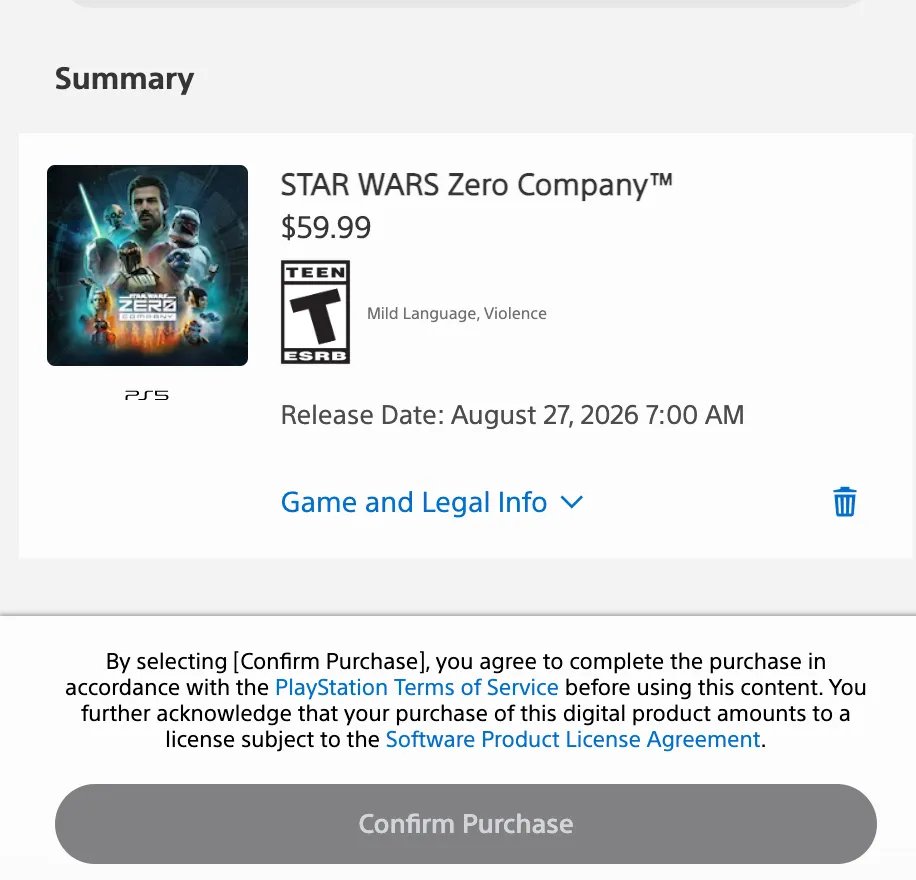
And here’s what it looks like if you were to make a purchase for a license for a digital game on the PlayStation Store:
So let’s go back to the law. Yes, the page uses the term “purchase”. It also asks for acknowledgement via the “Confirm Purchase” button that the customer understands they’re buying a license (and it’s in plain language), links to the SPLA and TOS which outline the restrictions and conditions of the license, and details the revokable nature of that license. Sony is arguing it’s compliant and I’m compelled to agree.
And if Sony left it at that, I wouldn’t be writing this post right now. But then the company just had to further and say something really stupid.
Now, as reported by Game File, Sony recently filed its response to the lawsuit, claiming that customers are not only told “your purchase of this digital product amounts to a licence”, but that “reasonable consumers” already understand this anyway without having to be told.
Sony’s argument is that because digital copies of games are not a finite resource, and that because multiple people can buy a digital copy of the same game, that means nobody actually ‘owns’ it – if they did, nobody else would be able to have it.
“As plaintiffs admit, Section 1 of the SPLA likewise explains that ‘the Software is licensed to you, not sold’, Sony’s filing reads. “This makes sense. In the digital age, it is not plausible to allege that reasonable consumers believed they were obtaining ‘ownership’ of a digital game.
“Were that the case, then Plaintiff Edward Heycock would not have been able to obtain the game Resident Evil Requiem on February 25, 2026 for $69.99 from the PlayStation Store after Plaintiff Jason Mendoza had obtained Resident Evil Requiem on February 14, 2026, because Mr Mendoza, not Sony, would have owned it then.”
And on this, Sony can fuck all the way off. This is completely wrong on a variety of levels.
Let’s start with the fact that the internet is chockablock with discussions trying to unconfuse many people when it comes to what they bought in a digital purchase. There are Reddit posts asking this question. There are tech blogs that have put out specific articles answering the question of ownership of certain digital goods. Or, if the wider internet doesn’t suffice for you, the FTC has articles on its own website that try to help address ownership rights for the public for digital goods. Here’s a snippet that will help drive home the second reason Sony’s statement is so dumb.
When you buy a physical item, you’ve got it. It’s yours. But when you click the “buy” button on a digital product, it really depends. You may have access to it only while you have an active account with the platform or website that sold it, or only for as long as that platform or website stays in business. Another factor is Digital Rights Management (DRM) software, which is attached to many digital items and is the thing that makes it impossible, for example, for you to play a video game on a different console brand.
Another reason why you might not have full control of your digital product is that what you really got when you clicked “buy” is often merely a license to access the content. This fact is often explained only in fine print in the terms of service — terms that the seller can usually change at will. And if the seller itself has licensing issues with the content you bought, then your own license to use the digital item can become worthless. All things beyond your control.
So all of these entities putting out all of this information to try to educate the public about what the hell they bought with a digital purchase are only speaking to the unreasonable? That’s, dare I say, an unreasonable thing to say.
And in that FTC post, did you happen to notice just how many qualifiers are stuffed into those two paragraphs? It depends. May. Many. Might. Often. So why all of those qualifiers?
Because some digital purchases can and do confer ownership to the buyer. Not everyone is out here selling a license. Some digital goods are sold as permanent ownership.
So, no matter how this particular lawsuit shakes out, Sony needs to either understand their own customers’ sentiments and knowledge far better than they do, or they need to stop saying things that they know are false. I can attest that the general public does not have a firm understanding of their ownership rights and what they’re actually buying with digital purchases. Pretending otherwise is nonsense.
Read the full article here
Fact Checker
Verify the accuracy of this article using AI-powered analysis and real-time sources.