

 Freedom Index

Listen to the article
What is Bitcoin mining?
Bitcoin mining is the process that keeps the BTC network secure and operational.
Bitcoin (BTC) miners collect pending transactions, bundle them into blocks and repeatedly perform hashing attempts (trial and error) until they produce a hash that meets the network’s difficulty target.
The first miner to find a valid solution broadcasts their block. Once the rest of the network verifies it, that miner earns a reward.
If another miner solves the block before you, your result becomes invalid, known as a “stale block,” and you must start over with a new set of transactions for the next block.
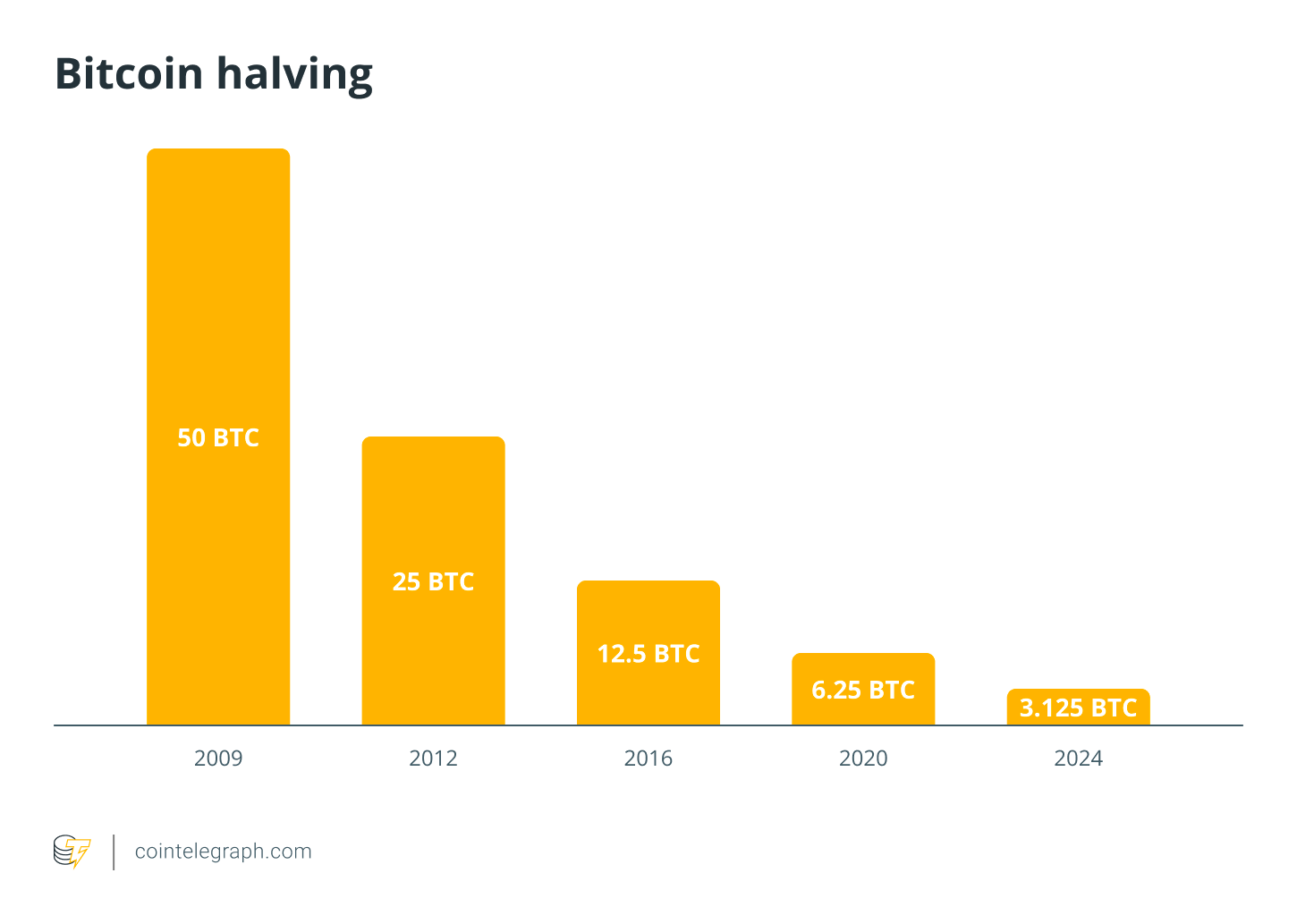
As of 2025, the block reward is 3.125 BTC, following the April 2024 halving. Miners also earn transaction fees, which fluctuate based on network congestion.
Competition is fierce, and the barrier to entry is high. Nearly all miners now use specialized Application-Specific Integrated Circuit (ASIC) machines, and most join mining pools to stabilize their income by sharing rewards with other participants.
Did you know? It’s a common misconception that Bitcoin miners “solve complex cryptographic puzzles.” In reality, there’s no puzzle to crack. Miners simply make trillions of guesses every second until one produces a hash below the network’s difficulty target.
How a block is actually found
Here’s a step-by-step look at how a block is mined on the Bitcoin network:
-
A miner builds a candidate block from pending transactions in the mempool.
-
They add a special “coinbase transaction” (not related to the Coinbase exchange), which both mints new BTC and claims transaction fees.
-
The miner repeatedly hashes the block’s header (through SHA-256) while adjusting the nonce (a number only used once).
-
The goal is to find a hash value lower than the network’s current difficulty target.
Once a valid block is found, the miner broadcasts it to the network. Other nodes independently verify its proof-of-work and transactions before adding it to their local copy of the blockchain.
If two miners find valid blocks at nearly the same time, the blockchain can briefly split into two versions. The network resolves this when one branch accumulates more proof-of-work (PoW) and becomes the main chain, while the other is discarded as a “stale” block.
This system ensures Bitcoin’s consensus always follows the chain with the greatest accumulated work, keeping forks short-lived and the ledger resilient.
Mining rewards after the 2024 halving
When Bitcoin’s fourth halving took place in April 2024, the block reward fell from 6.25 BTC to 3.125 BTC.
That’s the fixed reward every miner competes for. With around 144 blocks mined each day, the network issues roughly 450 new BTC daily, not including transaction fees.
The fee wildcard
Transaction fees are what make miner earnings unpredictable.
Around the April 2024 halving, Bitcoin saw a surge in activity triggered by the launch of Runes, a new token protocol that flooded the mempool with transactions. For a short period, transaction fees actually exceeded the 3.125 BTC block reward. Some blocks paid miners tens of BTC in fees alone, a rare windfall compared to the usual baseline.
These spikes, however, were short-lived. By mid-2025, median fees had returned to normal levels as demand cooled.
That pattern is familiar: Whenever the mempool overflows, whether from new protocols, hype cycles or major onchain events, users outbid each other for space in Bitcoin’s limited 1 MB-4 MB block window. Once the backlog clears, bidding wars end and fee revenue returns to baseline.
Hashrate and difficulty
Mining power is measured in hashrate, the total computing power dedicated to securing the Bitcoin network.
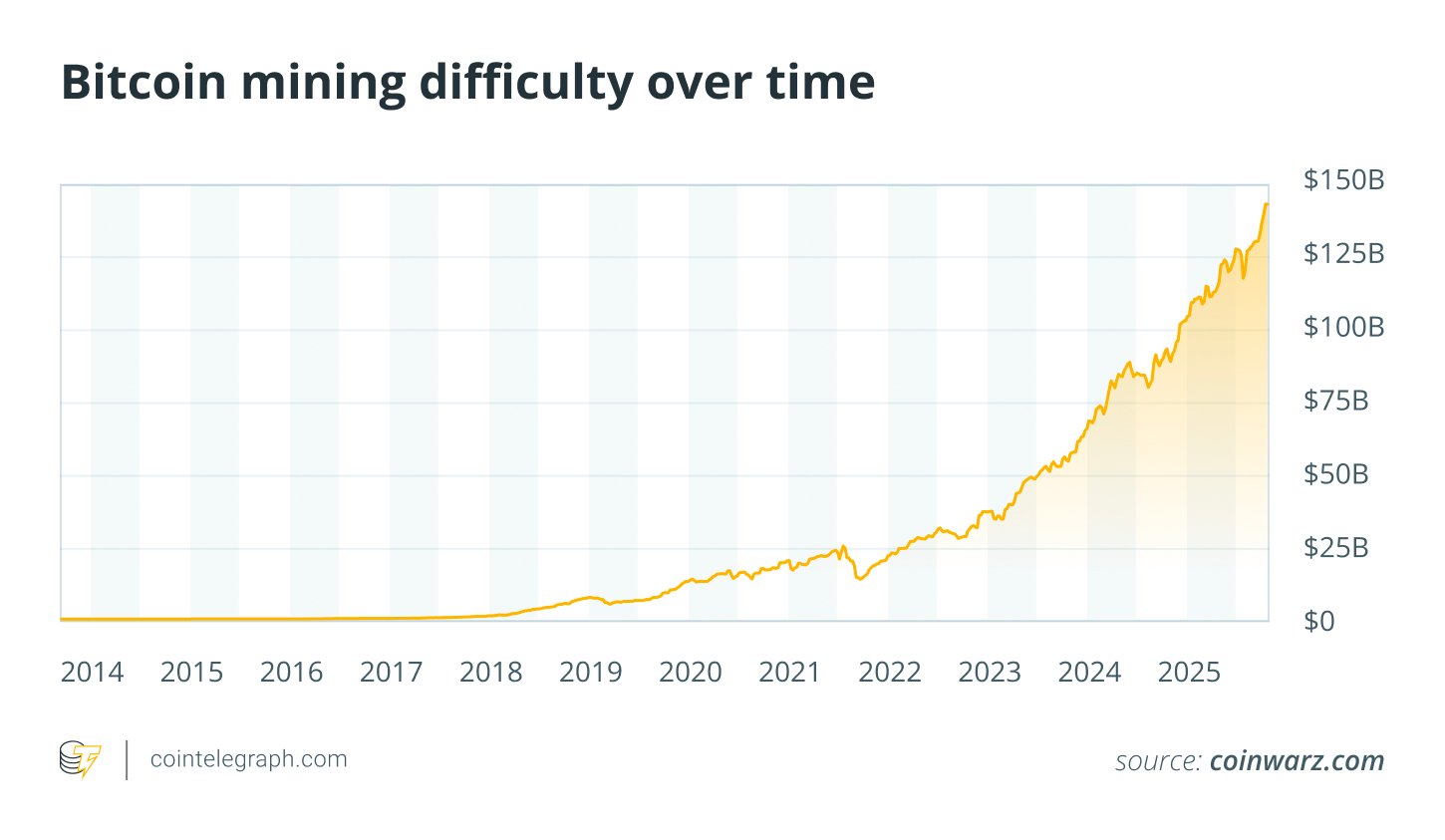
Bitcoin keeps block times close to 10 minutes by adjusting mining difficulty every 2,016 blocks, or roughly every two weeks.
Here’s how the cycle works:
-
When the hashrate increases, blocks are mined faster than intended, leading to the next adjustment to raise difficulty.
-
If the hashrate falls, blocks take longer to produce, and the network lowers difficulty to compensate.
For miners, higher difficulty means earning fewer BTC for the same amount of work. That’s why each difficulty retarget feels like an “earnings report”; it resets revenue expectations for the next two weeks.
In 2025, both the hashrate and difficulty are at record highs. New, more efficient ASIC fleets keep coming online, pushing difficulty upward and forcing older rigs out of the market.
Operators with high power costs are usually the first to shut down unless they can stay afloat by finding cheaper energy or benefiting from sudden spikes in price and fees.
Bitcoin mining is still a constant race: Only the most efficient setups survive when margins tighten.
Did you know? Bitcoin’s 10-minute block time was designed as a compromise: short enough for reasonably quick confirmations yet long enough to minimize the risk of simultaneous block discoveries and chain splits.
Hardware and setups in 2025
Bitcoin mining is all about squeezing maximum efficiency from every watt of power. By 2025, the industry had evolved far beyond hobby rigs.
The hardware miners use
At the core of nearly every modern mining farm are ASICs, machines built exclusively for Bitcoin. Their efficiency is measured in joules per terahash (J/TH), indicating how much energy is required to produce one unit of hashing power.
-
Air-cooled units: These remain the workhorses of the industry — models like Bitmain’s S21 (17.5 J/TH) and MicroBT’s M60S (18.5 J/TH) dominate large farms. High-end versions such as the Bitmain S21 XP push efficiency further to around 13.5 J/TH.
-
Hydro and immersion rigs: These represent the cutting edge, with models like the S21 XP Hyd rated near 12 J/TH. They deliver top-tier performance but demand specialized liquid-cooling systems, adding cost and operational complexity.
Cooling approaches
Cooling has become a defining factor in large-scale mining:
-
Air: The cheapest and easiest to deploy, but noisy and less power-dense.
-
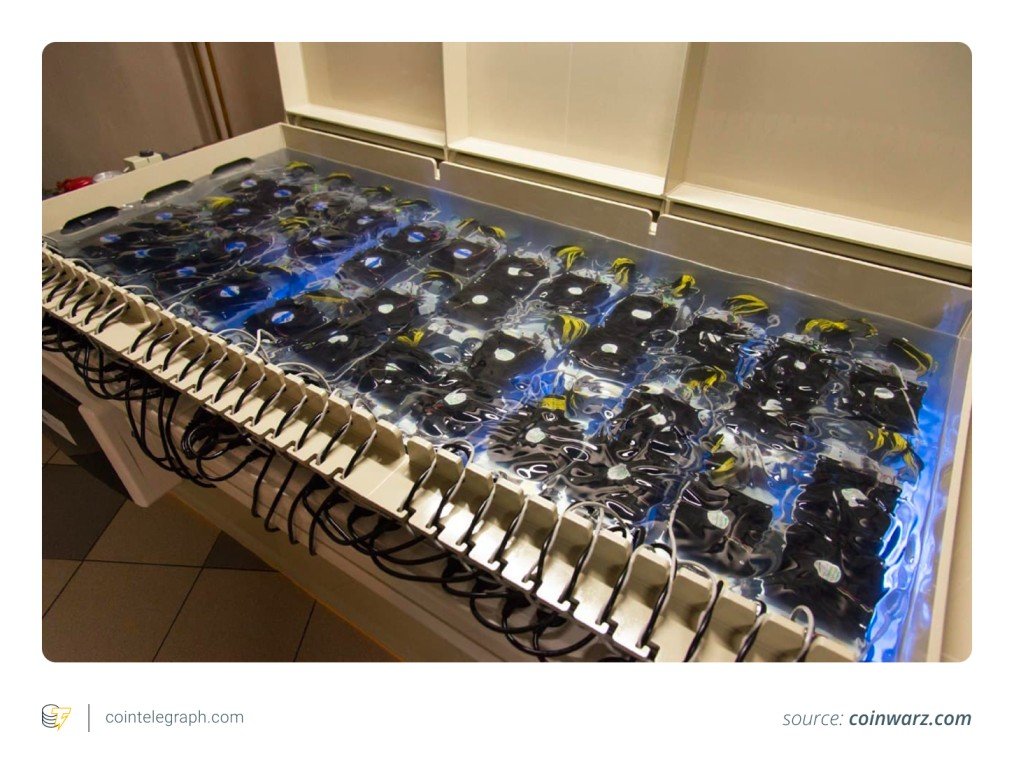
Immersion: Submerges rigs in dielectric fluid, boosting uptime and overclocking potential; farms like Riot’s Rockdale dedicate entire halls to this setup.
-
Hydro: Closed-loop water systems built into the machines, offering top efficiency but requiring major infrastructure investment.
Fleet strategy
Mining economics can swing week to week, so operators adapt their fleets using both hardware choices and firmware tuning:
-
Low-power (underclocking): Reduces output but boosts efficiency, ideal when Bitcoin’s hashprice (revenue per unit of compute) is weak.
-
Overclocking: Trades efficiency for higher throughput, used when BTC’s price or transaction fees surge.
The golden rule in 2025 is that efficiency matters more than raw power, unless you have access to ultra-cheap, reliable electricity that justifies higher consumption.
Pools, payouts and hashprice
Nearly all miners today point their machines to pools, which bundle hashrate from thousands of participants.
Pools stabilize earnings: Instead of waiting to personally “win” a block, miners receive steady payouts based on their contributed share.
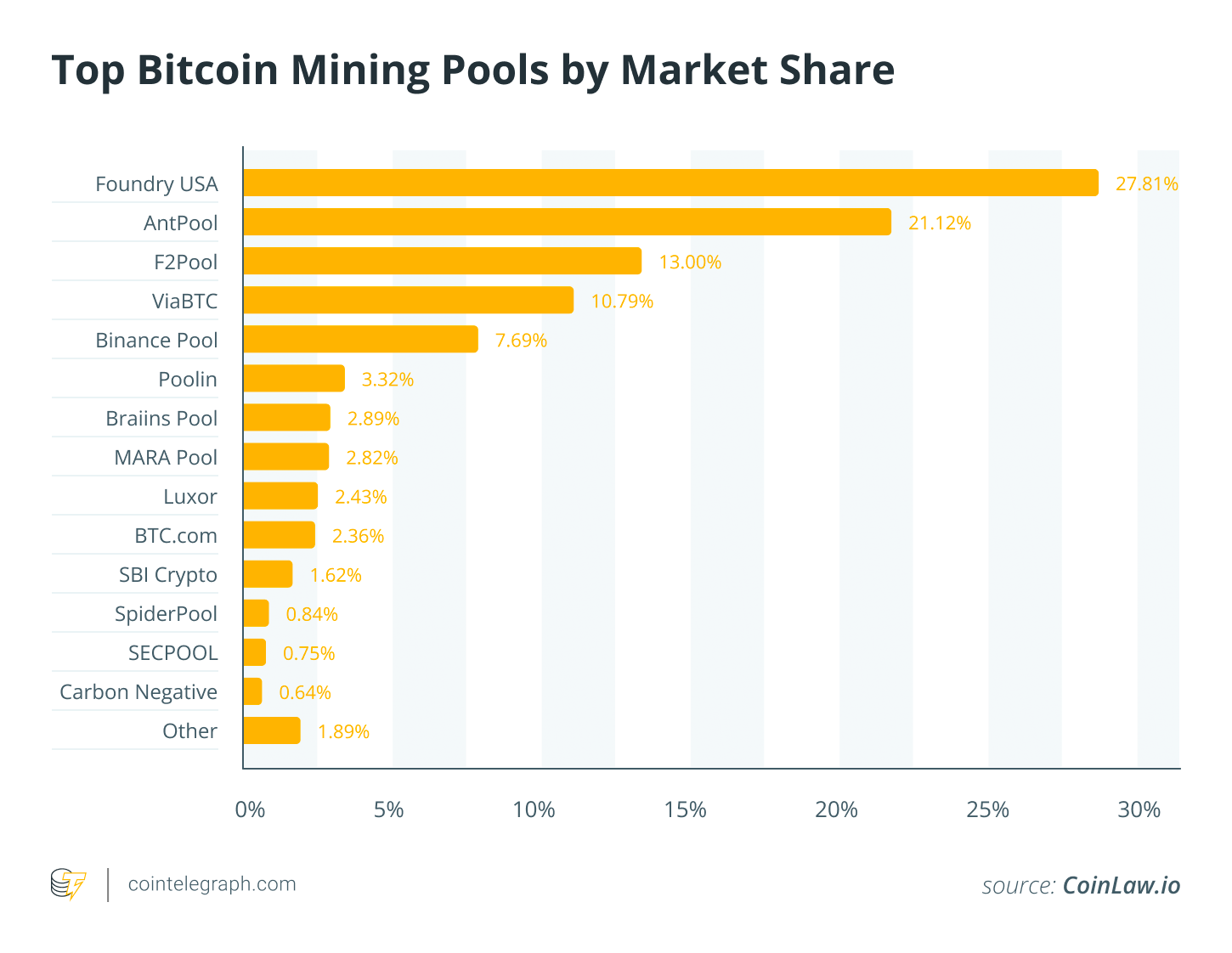
A handful of major pools, such as Foundry USA, AntPool, F2Pool and ViaBTC, dominate the network. Their activity is easy to track on live dashboards that show which pool mined the latest block.
How pools pay
-
Pay-per-share (PPS) and full pay-per-share (FPPS): Offer predictable payouts for every share submitted, with FPPS including a transaction fee estimate.Pay-per-last-N-shares (PPLNS): Riskier since rewards only come when the pool finds blocks — higher variance, but sometimes better returns.
The choice depends on whether you prefer steady cash flow (PPS/FPPS) or can tolerate volatility for potential upside (PPLNS).
Hashprice: The miner’s key metric
Miner income is typically measured as hashprice, the USD earned per petahash of hashrate per day. Hashprice rises with Bitcoin’s price and transaction fees but declines as network difficulty increases.
As of October 2025, the spot hashprice hovered around $51 per petahash per second per day. Break-even levels vary widely based on machine efficiency and electricity cost, which is why miners with cheap or flexible power deals tend to survive downturns.
Did you know? Bitcoin miners hedge much like energy companies. By using tools such as hashrate forwards and fixed-payout contracts, they can lock in future revenue instead of riding the volatility of hashprice.
Energy and geography
Energy costs, local grid policies and geography determine what miners stay profitable and which ones get squeezed out.
How much energy does Bitcoin use?
It depends on who’s measuring.
In May 2025, Digiconomist estimated Bitcoin’s annualized electricity consumption at roughly 190 terawatt-hours: comparable to the yearly power use of a mid-sized country such as Poland or Thailand.
Some estimates, including data from the Cambridge Bitcoin Electricity Consumption Index, put Bitcoin’s share of global electricity use at roughly 0.8%.
In the United States, government data suggests crypto mining accounts for between 0.6% and 2.3% of national power demand.
Miners as flexible power users
It’s also important to note that miners are flexible loads on the grid.
In Texas, for example, the Electric Reliability Council of Texas market pays miners to power down during peak demand.
Riot Platforms disclosed that in August 2023, these demand-response credits were worth the equivalent of 1,136 BTC. Of course, interruptible power deals can flip the economics of mining.
Where the machines are
After China banned crypto mining in 2021, a large portion of displaced capacity migrated to regions with abundant energy resources.
Texas became a focal point, while Canadian provinces with hydroelectric capacity and natural gas also attracted significant deployments.
By 2025, public mining companies had been operating an estimated 7.4 gigawatts of capacity across the US and Canada.
The deciding factors are straightforward: cheap and stable power, favorable regulatory terms and grid programs that pay miners to act as a flexible load by curtailing during peak demand.
Read the full article here
Fact Checker
Verify the accuracy of this article using AI-powered analysis and real-time sources.