

 Freedom Index
Listen to the article
Twenty-four states and the District of Columbia have legalized recreational marijuana so far, representing a major shift in drug policy. But the legalization movement has slowed, and in several states, activists are mounting campaigns to make recreational THC products illegal once again, including in Maine and Arizona. In November, Massachusetts voters will decide on whether to repeal the legalization measure approved in 2016. Ohio recently narrowed the cannabis legalization law passed in 2023.
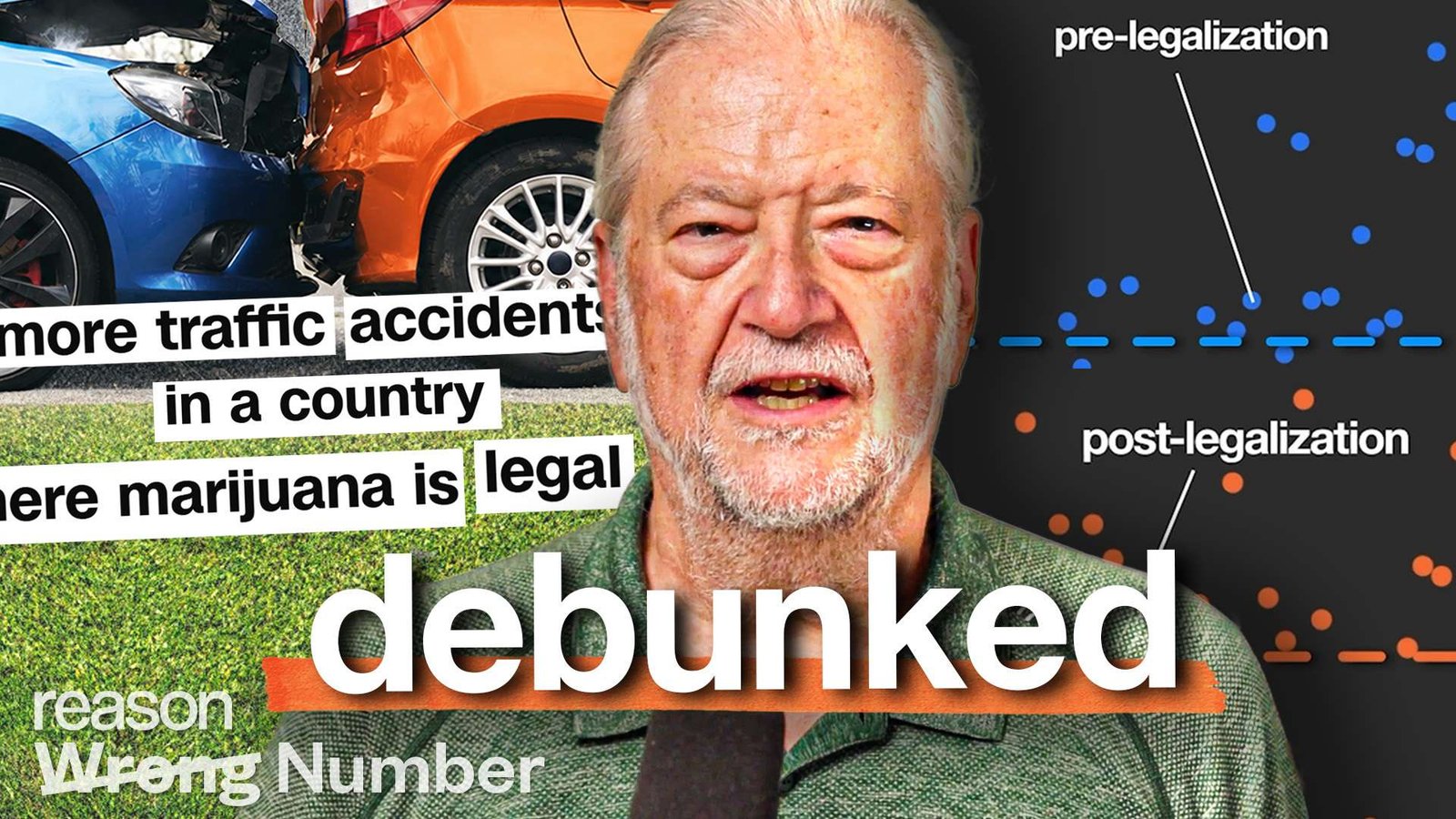
One of the main concerns cited by anti-weed activists is that legalization has led to a spike in traffic accidents because more people are driving while high. But the body of research they point to has actually failed to show that marijuana legalization has increased traffic accidents or deaths.
Driving While High?
Last October, The Wall Street Journal published an editorial titled “More Marijuana Users Are Crash Dummies.”
“How much social and public-health damage will Americans suffer before doing a U-turn on marijuana promotion?” the editorial begins. “A new study finds that more than 40% of drivers who died in car accidents in one U.S. county over the last six years had elevated levels of the drug in their blood.”
The “new study” they cited is available only as an abstract and a short press release describing a conference presentation of an unpublished report, with no supporting details. After the Journal editorial appeared, we made several attempts to speak with the lead author, Wright State University professor of surgery Akpofure P. Ekeh, to obtain a copy of the draft study and answer some basic questions. We were unable to reach him. A public information officer at the American College of Surgeons, where Ekeh is a member, told us via email that the study “is a research-in-progress, meaning there is not yet a complete study that I am able to provide.”
The press release and abstract alone are enough to undermine the study’s conclusions. The claim that 40 percent of deceased drivers had elevated levels of marijuana in their blood isn’t trustworthy because THC testing is only ordered in some cases, presumably the ones when driver impairment is suspected. So the study is likely based on a biased sample. Drivers were likely tested because they were suspected of intoxication.
Also, testing the blood of autopsied drivers doesn’t mean they were high while driving. THC in the blood generally indicates that someone has used marijuana in the previous few days. Postmortem THC tests are particularly unreliable.
The press release also had no mention of a control, so we have no idea if the drivers’ THC-positive rate is higher or lower than for the general population. Scientific studies require a control. It also looked at one county in Ohio, covering data before and after marijuana was legalized there in 2023, and there was no significant change in the ratio of drivers with THC in their blood.
So the study, if it ever does appear, will have nothing to say on the impact of marijuana legalization on driving while high, and it won’t present evidence that this practice is on the rise. That didn’t stop The Wall Street Journal in its coverage of this yet-to-materialize study from claiming in its subhead that “high-on-pot drivers are contributing to more highway accident deaths.”
Did Marijuana Legalization Cause a Spike in Highway Deaths?
Another study from the Insurance Institute for Highway Safety did claim to show a difference between pre- and post-legalization of marijuana use by drivers by examining changes in accident rates in five Western states. It found that legalization was associated with a 2.3 percent increase in fatal crash rates.
Here’s how the authors presented the data.
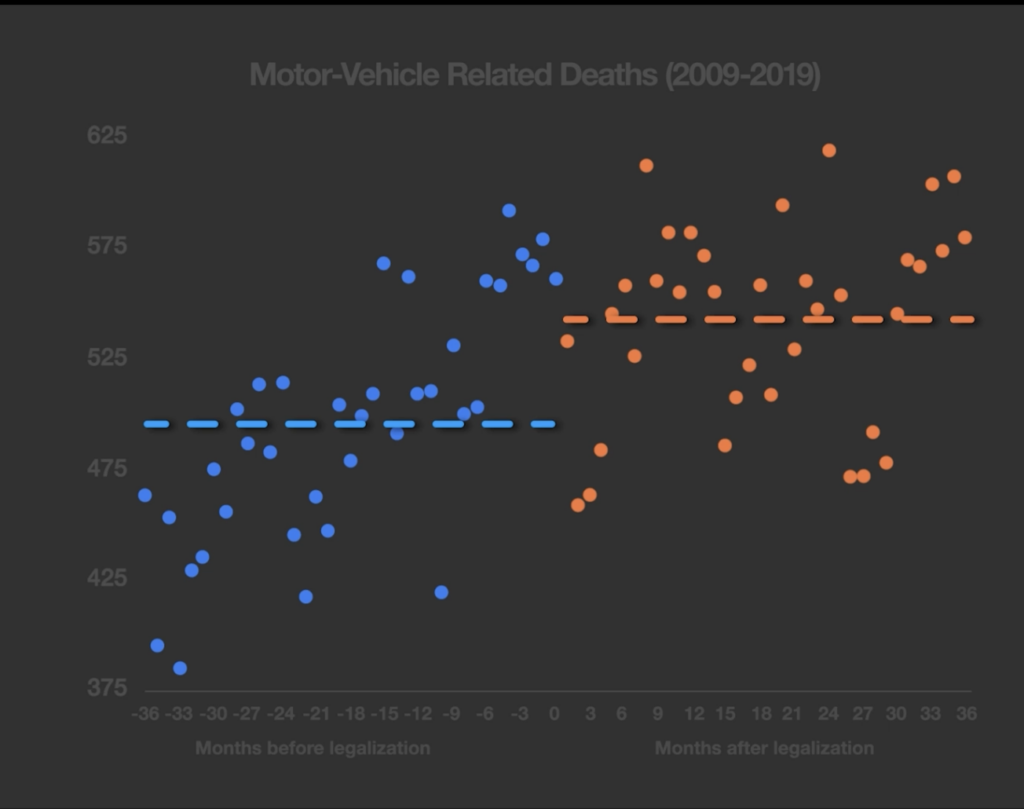
The blue dots represent seasonally adjusted monthly motor-vehicle fatalities before legalization, the orange dots represent those after legalization, and the dashed lines show the averages before and after legalization.
The three-year average traffic death rate in legalization states was 9.5 percent higher after legalization than before. The pattern was the same in the control states that did not legalize, but they had only a 6.5 percent increase. After some complex adjustments, the authors attributed a 2.3 percent increase to legalization. It looks like a big jump. But that’s because the chart presented the data in a misleading way.
I recharted the data and, unlike the authors, I made it into a time series, accounting for changes in the rate of traffic deaths during the study period. This way, you can see the trends, which undercut the authors’ thesis.
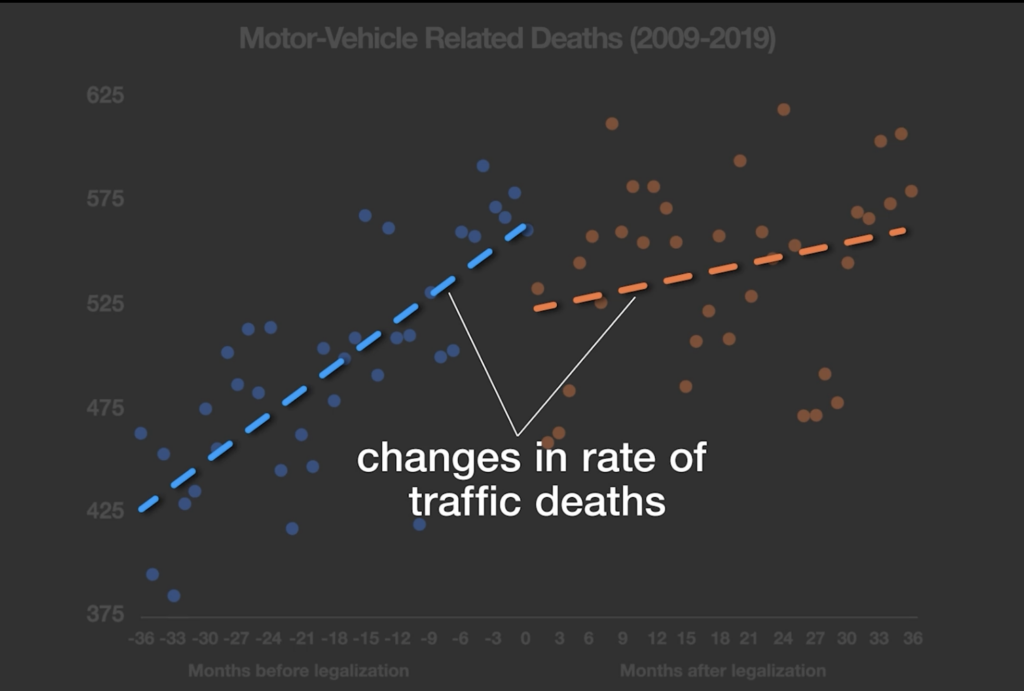
See how the blue line is rising much faster than the orange line. That shows the rate of increase in traffic deaths slowed considerably after legalization.
Does that mean that marijuana legalization meant fewer highway deaths? No, because correlation isn’t causation, and we don’t know what caused the decline. But the study’s authors’ reverse claim is clearly contradicted by the data.
In an email exchange, Charles M. Farmer, the lead author of the study, defended his methodology, arguing that it included a time variable. The problem is that his time variable was held constant pre- and post-legalization, so it doesn’t capture the change in slope and intercept that occurred at legalization.
Flooding Emergency Rooms?
The most explosive finding about the dangers of legal weed comes from a study by a team of Canadian researchers, who looked at emergency room records in Ontario before and after legalization took effect in October 2018. As CNN summarized it, the study found that “documented marijuana-related traffic accidents that required treatment in an emergency room rose 475% between 2010 and 2021.”
Why is the 475 percent claim misleading? For starters, the news coverage didn’t mention that we’re talking about a very small number of people. During the period when marijuana was legalized and commercialized, 120,569 people showed up in Ontario emergency rooms due to traffic accidents. Just 125 people, or 0.1 percent of the total, “had documented cannabis involvement,” according to the clinical judgment of the onsite medical team. Moreover, for every cannabis involvement patient, there were 18 with alcohol impairment. Of the people with cannabis involvement, 42 percent also had alcohol involvement. Cannabis alone does not seem to be the major intoxicant choice to impair driving.
The tally of 125 people over 20 months works out to about six people per month. Before legalization, there were two people per month showing up at emergency rooms with “cannabis involvement.” That’s a 200 percent increase, not a 475 percent increase. Why did the authors claim a 475 percent increase?
Marijuana legalization overlapped with the COVID-19 lockdowns. During the pandemic, people were driving much less, leading to a decline in total car accidents.
The authors wanted to adjust for this unusual situation, so they assumed that if people had been driving normally, there would have been many more marijuana-related accidents. That assumption, along with a few other adjustments, led them to raise the 200 percent increase to 475 percent.
This adjustment isn’t valid. You can’t compare COVID lockdown data with pre-COVID data because life was so abnormal. School closures in Ontario meant people were driving their kids to school less often, and many were working from home or were unemployed. Since most people who drive while high are less likely to do so while heading to work or taking their kids to school, you would expect an increase in the proportion of drivers on the road with marijuana in their system during the lockdowns, even if the absolute number stayed the same.
Another problem is that the 125 people counted by the researchers weren’t necessarily high while driving. Just because they were classified as cannabis users in the E.R. doesn’t mean they were under the influence at the time of the accident, or that marijuana caused them to crash their cars.
Some of those 125 people were passengers rather than drivers, which makes the inference that marijuana contributed to the crashes even more dubious. If someone who didn’t use marijuana was giving a ride to a friend because he was too stoned to drive, and they still got into an accident, the passenger would have been counted as a patient with “documented cannabis involvement.” That tells us nothing about whether marijuana legalization led to more traffic accidents.
Another problem with the dataset is that many of the people were counted because they admitted to the doctor at the E.R. that they were marijuana users. Patients would have been more willing to admit to their drug habit after legalization than before, which further biased the data.
In the end, the 475 percent figure is based on a small absolute number, an invalid adjustment that boosted the percentage increase, and a tainted dataset. We emailed University of Ottawa professor of medicine Daniel Myran, the lead author of the study, to explain our concerns about his data and methodology. A spokesperson replied on his behalf: “This study was published in JAMA Network Open, a peer-reviewed journal, and underwent independent evaluation of its methodology and findings before publication.”
No researcher has demonstrated a convincing association, let alone a causal link, between marijuana legalization and a significant increase in traffic accidents in any state. There is a long list of things that legalization might affect: traffic fatalities, teenage pregnancy, suicides, violent crime, property crime, bankruptcies, high school graduation rates, etc. These indicators go up and down for reasons that are typically not well understood. If you choose one social indicator to study, there’s close to a 50 percent chance that it got worse after legalization, creating opportunities to use statistical techniques to make it look as if there were a causal relationship.
Since states started legalizing marijuana, there has been no detectable social harm. Predictions that legal weed would have catastrophic consequences have turned out to be hyperbolic.
Draconian drug laws were passed due to claims that the alternative was massive social and individual harm. Harry Anslinger, director of the Federal Bureau of Narcotics from 1930 to 1962, wrote, “How many murders, suicides, robberies, criminal assaults, holdups, burglaries, and deeds of maniacal insanity [marijuana] causes each year…can be only conjectured.” Apocalyptic predictions were necessary to justify the enormous violence, cost, law enforcement corruption, and infringement of rights the drug war required.
Legalization disproved the claims. They’re being replaced by claims that legalization increases traffic accidents by 2.3 percent. Even if there were solid evidence for that claim, it’s laughably inadequate to support a drug war.
The real story is that we legalized marijuana in many states, and the sky did not fall.
To keep up with our video series Wrong Number featuring Aaron Brown, and to receive bonus content and more, click here to enter your email address. By joining our list, you’ll also have a chance to win a copy of Brown’s new book, Wrong Number: How To Extract Truth From a Blizzard of Quantitative Disinformation.
Read the full article here
Fact Checker
Verify the accuracy of this article using AI-powered analysis and real-time sources.