

 Freedom Index
Listen to the article
The Trump administration claims that its new Homeland Security task forces are here to protect Americans from an “invasion” by undocumented immigrants and thwart terrorist organizations, foreign cartels, and transnational gangs. So why are they targeting immigrant asylum seekers—who are in the country legally—over sex work?
To be fair, this seems to be a minor part of the task forces’ business. Much of the time, they’ve been waging a drug war against American citizens, as I reported last month.
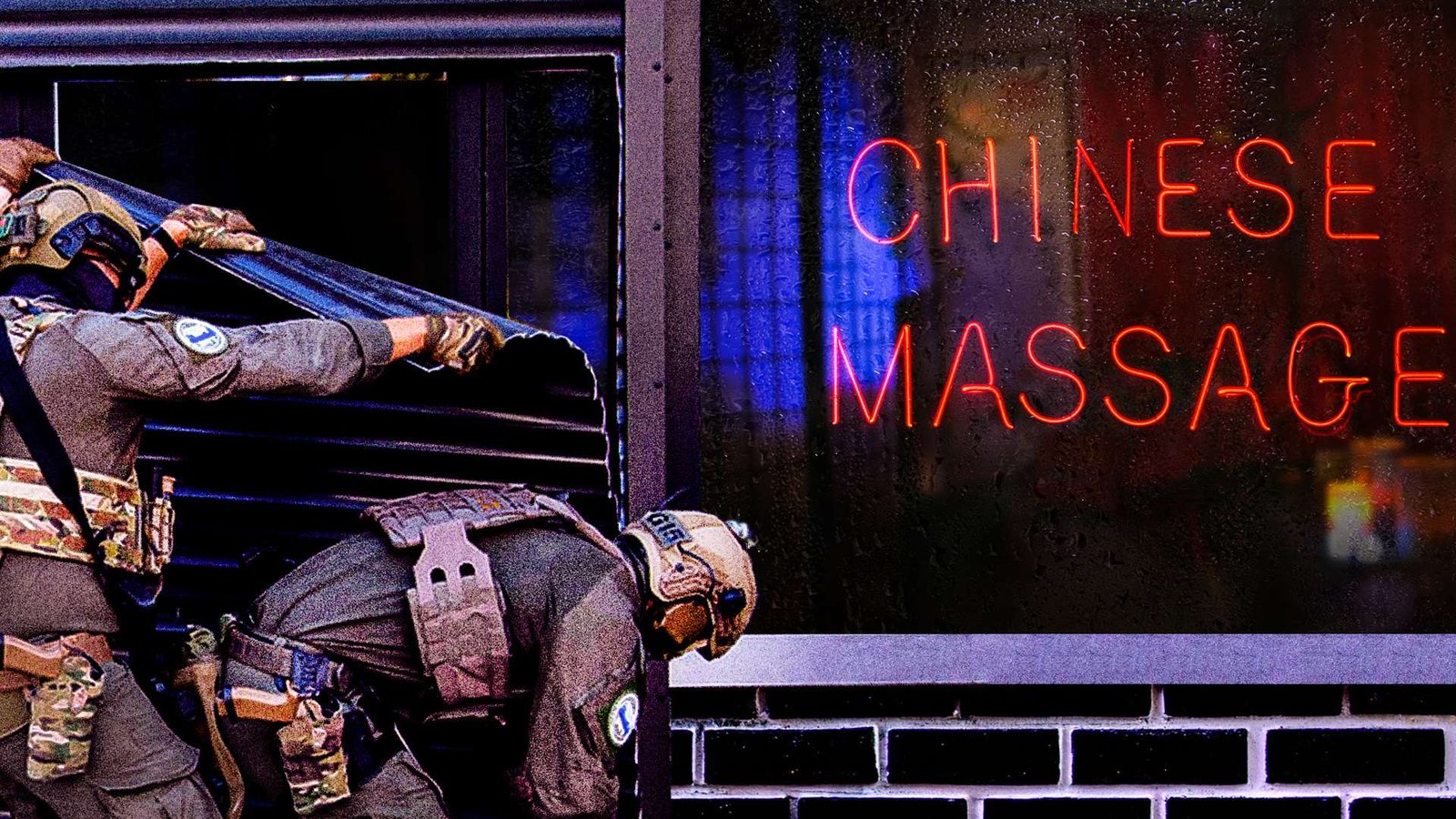
Today, I want to focus on one case that didn’t make it into that piece. It’s the case that turned me on to the shams that are these new Homeland Security task forces, and it involves an old preoccupation of federal law enforcement: Asian immigrant–owned massage parlors.
You are reading Sex & Tech, from Elizabeth Nolan Brown. Get more of Elizabeth’s sex, tech, bodily autonomy, law, and online culture coverage.
“Four Chinese nationals indicted on charges of human trafficking, immigration violations, and money laundering,” the U.S. Attorney’s Office for the Western District of Pennsylvania announced in January. At first, it seemed like a standard massage-parlor prostitution bust. But then I got to this language:
This prosecution is part of the Homeland Security Task Force (HSTF) initiative established by Executive Order 14159, Protecting the American People Against Invasion. The HSTF is a whole-of-government partnership dedicated to eliminating criminal cartels, foreign gangs, transnational criminal organizations, and human smuggling and trafficking rings operating in the United States and abroad. Through historic interagency collaboration, the HSTF directs the full might of United States law enforcement towards identifying, investigating, and prosecuting the full spectrum of crimes committed by these organizations, which have long fueled violence and instability within our borders. In performing this work, the HSTF places special emphasis on investigating and prosecuting those engaged in child trafficking or other crimes involving children. The HSTF further utilizes all available tools to prosecute and remove the most violent criminal aliens from the United States.
That’s some serious rhetoric. Was there, perhaps, more than just adult prostitution going on here? Or was this just the feds leveling up their anti-immigrant propaganda? If you guessed the latter, you may be a realist about how law enforcement operates.
In this case, the feds had indicted one dead person. So that brings our actual number of defendants down to three.
These three defendants—Shuhua Qiu, Chunlong Lin, and Lijuan Zhao—were all legal immigrants, according to U.S. Attorney Paul Sellers.
Qiu, a licensed massage therapist, had been in the country for 16 years and was granted political asylum from China. Zhao petitioned for asylum years ago but was still awaiting a decision.
Prosecutors allege that Qiu, Lin, and Zhao owned and managed two spas where sex acts sometimes took place alongside regular massages. That’s all.
The defendants are not alleged to have used force, or to have smuggled illegal immigrants into the country. They’re not alleged to be part of a transnational trafficking cartel. They just employed immigrant sex workers, prosecutors claim, and sometimes drove them from Queens across state lines to Pennsylvania or vice versa.
They were indicted in January—ending a two-year investigation, according to the Erie Times-News—and accused of running two spas “that served as fronts for unlawful businesses in which persons promoted and engaged in commercial sex.”
The trafficking charges stem from the fact that it’s illegal to bring someone across state lines for the purposes of prostitution. The immigration charge? Because it’s illegal to harbor noncitizen sex workers without reporting them to immigration authorities. And the money laundering charge stems from the fact that the defendants used banks to run their (allegedly illicit) massage business.
One of the defendants, Zhao, pleaded guilty in June and is now on track to be deported. The other two have pleaded not guilty, and their cases are ongoing.
As part of a plea deal, Zhao pleaded guilty to conspiracy to commit a crime against the United States. Prosecutors asked the court to sentence her to 10 to 16 months in prison and, at sentencing, accused Zhao of human trafficking, despite the fact that the case involves no allegations that the women employed at these massage businesses were forced into work or sex.
Judge Susan Paradise Baxter told Zhao that the court was “disgusted” by her actions and sentenced her to time served (the nearly five months she had already been imprisoned since her arrest).
But Zhao won’t get out of prison yet. “Zhao is also being held in prison on an immigration detainer, and she will eventually be deported to China,” reports the Erie Times-News. “Baxter indicated that Zhao could remain jailed on the immigration detainer for an extended period of time—perhaps even longer than any sentence she would receive in the prostitution case.”
The feds were framing this as a blow against “the most violent criminal aliens.” In reality, they locked up a middle-aged immigrant woman for employing sex workers at her massage business without ratting them out to immigration authorities.
ICE’s internal investigations unit is now investigating Americans who criticize ICE. The agency’s Office of Professional Responsibility is “supposed to act as an internal watchdog,” Wired points out. “It’s responsible for inspecting detention facilities, investigating allegations of employee and contractor misconduct, and processing security checks for new applicants. On its site, it says it also protects against ‘external threats’ by managing badge access to buildings and maintaining the agency’s network security. But lately, court documents indicate, it appears to be pursuing more civilians…for what they say online.” Read the whole thing here.
“‘Social media addiction’ is way more complicated than you think,” write Sally Satel and Stephen Morse at Persuasion. Satel is a lecturer in psychiatry at Yale and directs a methadone clinic, in addition to being an American Enterprise Institute senior fellow. Morse teaches law and psychiatry at the University of Pennsylvania. Both are critical of the way “social media addiction” cases are playing out in court, suggesting that “the courtroom is a domain where the claim of being ‘addicted’ should be held to a different, more stringent standard” than in the clinician’s office.
This is not to deny that habitual or addictive behavior has a biological basis. All behavior has a biological basis. The neurotransmitter dopamine appears to play a role, but its importance has been wildly exaggerated by professionals, including a Stanford psychiatrist who served as an expert witness in Kaley’s case and has called smartphones “the modern-day hypodermic needle, delivering digital dopamine 24-7 for a wired generation.” The so-called “dopamine theory of addiction” has been harshly criticized as too simplistic.
Most relevant to legal action, however, is that we cannot distinguish between an urge to scroll that wasn’t resisted and one that could not be resisted. Vexing questions abound. Is there a clear way to disentangle the role played by social media “addiction” from the influence of preexisting psychological problems, especially since such problems are ubiquitous among teens? Is it possible that teens’ distress caused them to turn to intensive social media use in the first place, rather than the other way around?
We cannot know. Nothing—no brain scan, blood test, or psychological measure—can validate anyone’s capacity to control an urge, or identify the specific cause of psychological harms.
Making such determinations is not essential for treatment, where the goal is to help people no matter the cause of their distress. But they are vital for adjudicating liability for defendants accused of addicting people, because this could be the basis of lawsuits that can cost companies millions of dollars and extensively expand civil liability.
More here.
This is especially important considering the absurd sums that states are seeking in these trials.
Beyond ludicrous to seek damages worth the entire value of the company. This isn’t about righting any wrongs, it’s about destroying several critical outlets for speech. The economic damage to 401Ks, pensions, & small business would be enormous as well. https://t.co/8iuZ1cQGiG
— Patrick Hedger (@pat_hedger) July 7, 2026
According to a Meta court filing made Monday, four states want a $1.4 trillion penalty to be lobbied against the company. “The figure is close to Meta’s market capitalization of roughly $1.5 trillion,” notes Quartz. Meta replied in the court filing that “a sanction of that size has no analog in the history of consumer protection enforcement.”
Perhaps “adult” use cases for LLMs are a corollary. Despite the initial hype, there’s been remarkably little success in attracting consumers to AI porn — digital twins, AI creators— than people imaginedChat is a different story. Fanfic, roleplay and virtual companions are far more successful.
— Mike Stabile (@mikestabile.bsky.social) 2026-07-01T00:10:52.185Z
Matthew Sheffield’s whole post is worth a read, too. For now, I’m just going to pull out this amazing tidbit about an AI goblin mode debacle that I somehow missed earlier this year:
The most humorous instance came in April, when ChatGPT users began noticing that the 5.1 model had a weird habit of randomly inserting references to goblins and other mythical creatures into discussions that had nothing to do with fantasy fiction. The company didn’t say anything at first until someone on the internet noticed that the instructions for its Codex agent included the following directive: “Never talk about goblins, gremlins, raccoons, trolls, ogres, pigeons, or other animals or creatures unless it is absolutely and unambiguously relevant to the user’s query.”
After the anti-goblin instruction became a meme (oh the irony), the company fessed up to the situation in a blog post that disclosed that the fantasy creature obsessions were the product of OpenAI’s introduction of a “Nerdy” personality as one of several that users could choose from. But since LLMs do not have actual intentionality, when training users were rating ChatGPT’s Nerdy outputs, their apparent amusement with silly goblin references in that mode leaked out of containment.
• The “perfect dumb phone” is…an iPhone? Wired‘s Jeremy White discovered “a way to set up an iPhone as the perfect dumb phone for children—one with access to only the apps you deem appropriate, no internet browser, but with all-important tracking and navigation abilities.”
• Deepfakes legislation threatens free speech: Although the NO FAKES Act “is aimed at deepfakes, it sweeps in a great deal of lawful speech,” the Cato Institute’s David Inserra points out. “The bill erects a sweeping licensing regime for AI-generated content that will stop malicious or unwanted deepfakes at the cost of preventing Americans from creating, sharing, or accessing a wide range of lawful speech.”
• Texas app law can take effect: “The Supreme Court on Monday declined to pause enforcement of a Texas law that restricts which apps children can download from online stores,” reports The Washington Post. “The high court’s brief, unsigned order allows the law to be enforced while a challenge to it plays out in lower court.” (Age-verification laws were sold as a way to protect minors from sexual content, notes the Free Speech Coalition’s Mike Stabile on Bluesky. “And now it’s being used against you. Censorship and surveillance are vampires. Once you invite them in, they start looking at your neck.”)
• Anti-porn group submits AI hallucinations to court: The National Center on Sexual Exploitation—”the far right, anti-sex, anti-speech, and anti-internet group” formerly known as Morality in Media, as Mike Masnick aptly characterizes it—was caught fabricating citations in legal filings, Masnick reports. “And then, once they were on notice of falsified filings, they… didn’t fix them. Indeed, NCOSE’s lawyers continued to rely on a hallucinated citation.”
• “This era of the internet is becoming stale,” suggests Spencer Kornhaber at The Atlantic, “and the trajectory it set culture upon is reaching a terminal point.”
• Another bogus massage parlor “sex trafficking” ring stopped: Alaskan authorities who raided Asian massage businesses in April claimed to have dismantled a sex trafficking operation. “But that’s not exactly what the charging documents say,” notes Tara Burns:
Instead, the alleged sex trafficking included arranging duos, giving rides from the airport, taking out the trash, paying to install a business sign, working the front desk, buying groceries, and managing businesses where consensual adult sex work allegedly occurred. Three sex workers are being held with either no bail or $100,000 bail.
• More evidence that Australia’s teen social media ban is a bust: Age-assurance software testers “found that platforms did not ask for age proof on any of the 50 accounts it opened after the law came into force,” reports Reuters. “The previously unreported finding reveals a largely overlooked flaw: while the process has so far focused on the accuracy of photo-based age-assurance software, the initial vetting stage—which guesses a person’s age range based on their general online activity—does not appear to be picking up young users for further checks.”
Read the full article here
Fact Checker
Verify the accuracy of this article using AI-powered analysis and real-time sources.