Close Menu
FSNN | Free Speech News NetworkFSNN | Free Speech News Network
  • Home
  • News
    • Politics
    • Legal & Courts
    • Tech & Big Tech
    • Campus & Education
    • Media & Culture
    • Global Free Speech
  • Opinions
    • Debates
  • Video/Live
  • Community
  • Freedom Index
  • About
    • Mission
    • Contact
    • Support
Trending

Nomura’s Laser Digital backs ZIGChain for onchain private credit push in UAE

6 minutes ago

Does the Coldcard Attack Mean All Hardware Wallets Are Now Insecure?

8 minutes ago

Anthropic’s Claude Mythos 5 ‘Targeted Real People’ in UK Cyber Tests: AISI

9 minutes ago
Facebook X (Twitter) Instagram
Facebook X (Twitter) Discord Telegram
FSNN | Free Speech News NetworkFSNN | Free Speech News Network
Market Data Newsletter
Wednesday, August 5
  • Home
  • News
    • Politics
    • Legal & Courts
    • Tech & Big Tech
    • Campus & Education
    • Media & Culture
    • Global Free Speech
  • Opinions
    • Debates
  • Video/Live
  • Community
  • Freedom Index
  • About
    • Mission
    • Contact
    • Support
FSNN | Free Speech News NetworkFSNN | Free Speech News Network
Home»Cryptocurrency & Free Speech Finance»Morning Minute: Jim Cramer Sells His Bitcoin Over Quantum Fears
Cryptocurrency & Free Speech Finance

Morning Minute: Jim Cramer Sells His Bitcoin Over Quantum Fears

News RoomBy News Room1 hour agoNo Comments5 Mins Read2 Views
Share Facebook Twitter Pinterest Copy Link LinkedIn Tumblr Email VKontakte Telegram
Morning Minute: Jim Cramer Sells His Bitcoin Over Quantum Fears
Share
Facebook Twitter Pinterest Email Copy Link

Listen to the article

0:00
0:00

Key Takeaways

Playback Speed

Select a Voice

Morning Minute is a daily newsletter written by Tyler Warner. The analysis and opinions expressed are his own and do not necessarily reflect those of Decrypt.

GM!

Today’s top news:

  • Crypto majors slightly green while stocks hit new ATHs; BTC +0.5% at $64.1k
  • BTC ETF inflows reach $380M in first 2 sessions this week
  • Justin Drake and others propose EIP-8361 to curb ETH inflation
  • Cloudflare launched Cloudflare Wallets geared towards AI agent payments
  • CASHCAT soars 40% to $96M leading broad Robinhood Chain rebound

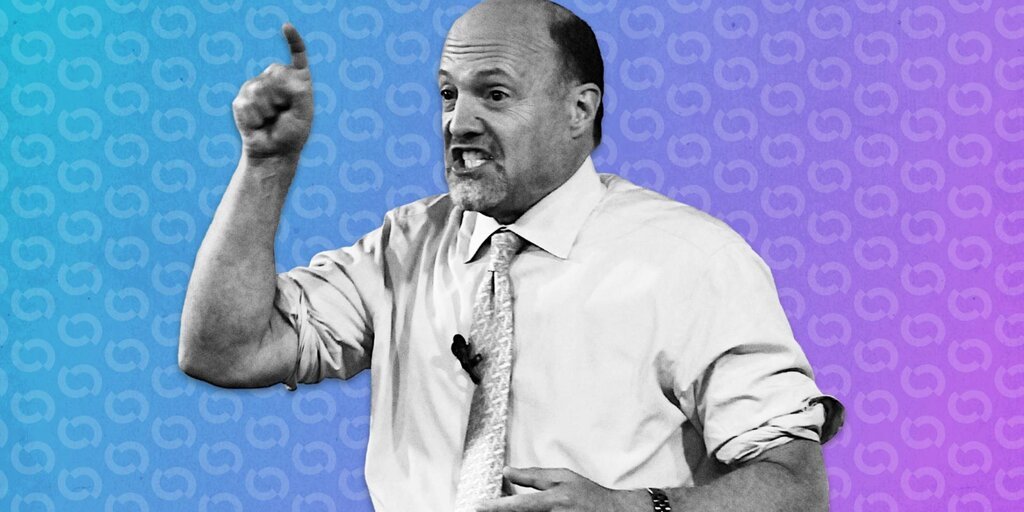
🔮 Jim Cramer Is Selling His Bitcoin Over the Quantum Threat

CNBC host Jim Cramer said he’s selling his Bitcoin, this time over fears of quantum computing.

The decision came on air, after Cramer interviewed IBM CEO Arvind Krishna and asked whether quantum computers could eventually crack the cryptography protecting his coins. “I think that you should give yourself three or four years,” Krishna replied, “and at that point, I would get rather paranoid about it.” Cramer didn’t wait. “Arvind Krishna knows quantum incredibly. He knows Bitcoin and quantum. And I’m going to sell mine,” he said, adding that Ethereum might be “even worse.” Bitcoin rose about 1.6% the day he announced it.

Crypto traders greeted the news with open glee, invoking the “inverse Cramer” trade, the running joke that the reliable move is the opposite of whatever he recommends. “Thank you Jim!” read one top reply. Of course, Cramer has a history of selling the bottom. Cramer said he’d dumped all his crypto and wouldn’t touch it “in a million years” in December 2022 with Bitcoin near $16,800, and it gained more than 400% over the next three years.

But Cramer’s poor track record aside, the quantum threat is a very real one for crypto. AI was credited with the recent Coldcard exploit, which has passed $100M in losses. And it came after a string of DeFi hacks and exploits totalling well over $300M. The hard part to fathom—this is the worst these models are ever going to be.

With that said, the silver lining is a major security incident like the Coldcard one may be exactly what crypto teams needed to take the quantum threat seriously and begin taking action. Protocols like ZEC went on the offensive and used frontier AI to find exploit vectors in their own cryptography (and they found them, and patched them). ZEC sold off of course, but has since rebounded swiftly. Other protocols should follow their lead, and ASAP.

So Jim Cramer is right to be concerned. Will he end up selling the bottom for the 2nd cycle in a row? We will find out soon enough…

🌎 Macro Crypto and Markets

  • Crypto majors are slightly green while stocks hit new ATHs; BTC +0.5% at $64.1k; ETH even at $1,868; SOL even at $73.70; HYPE +3% at $57
  • Top alt movers include PUMP (+13%), ZEC (+6%) and LIT (+3%)
  • Oil -5% at $76.20; Gold +1.9% at $4,230
  • Stock futures are green again after making new ATHs on Tuesday; DOW +0.4%, Nasdaq +0.2%
  • SpaceX topped Wall Street revenue forecasts but booked a $540M Bitcoin markdown, with its 18,712 BTC falling in value to $1.10B from $1.64B
  • Justin Drake and five other researchers proposed EIP-8361 to curb Ethereum inflation, a “Tapered Issuance Burn” that would destroy a rising share of validator rewards as staking grows, cutting yield to about 1% at today’s ~33% staked and to 0% once half of all ETH is staked
  • Cloudflare launched Cloudflare Wallets, letting AI agents autonomously pay for APIs and content via x402 stablecoin micropayments within human-set spending guardrails
  • Circle posted $701 million in Q2 revenue as USDC circulation grew 19% to $73.3 billion and adjusted EBITDA rose 8% to $143 million, with its Arc mainnet slated for September 16 (CRCL +5%)
  • Ledger weighed in on the Coldcard exploit as AI reshapes wallet security, arguing the attack marks a turning point where AI-driven vulnerability hunting forces hardware makers to rethink how they audit and defend their firmware
  • Wells Fargo will offer tokenized deposits for 24/7 corporate payments, joining JPMorgan and Citi in the race to move Wall Street’s settlement rails onchain
  • Samsung is poised to become a dominant stablecoin distributor, according to analysts, with its wallet’s reach across hundreds of millions of devices positioning it as a major on-ramp for stablecoin payments
  • BitGo’s WBTC moved to Chainlink, pushing the LayerZero-to-Chainlink tally near $15 billion

Corporate Treasuries & ETFs

Meme Coin Tracker

  • Meme leaders were mostly red; DOGE -1%, SHIB -3%, PEPE -2%, PENGU -1%, TRUMP -1%, BONK even
  • Robinhood chain was very green led by Cashcat (+40% to $96M), Tendies (+38%) and Frong (+78%); PONS steady at $20M after releasing V2
  • Solana leaders included Cupsey (+58%), Stonk (+165%) and Kimchi (+90%); CATE fell another 40% to $18M, ANSEM -7% to $170M

💰 Token, Airdrop & Protocol Tracker

  • Uniswap teased its new product “pools dot trade” launching today
  • New Solana launchpad StonkFun caught momentum on Tuesday, as it pairs pre-IPO stocks with memecoins
  • Proof of Play is winding down after failing to find a sustainable model, open-sourcing its code and freeing its Pirate Nation IP under CC0, while the PIRATE token lives on independently (PIRATE at $1M after reaching $100M+)
  • The Eliza project founded by Shaw Walters is officially shutting down and winding down it foundation, turning the token and remaining treasury over to a group of holders

🚚 What is happening in NFTs?

  • NFT leaders were slightly red; Punks -1% at 31.7 ETH, BAYC -1% at 8.33 ETH, Pudgy even at 3.87 ETH; Stonkbrokers -8% to 5.9 ETH
  • Merry Men (+550%), pyo (+50%) and Zaibatsu (+15%) led top movers
  • TokenWorks announced 30% buybacks for FWA using historical platform fees alongside the 80% go-forward buybacks, as the token went live for trading at 3 pm ET yesterday (FWA -20% to $7M)

Daily Debrief Newsletter

Start every day with the top news stories right now, plus original features, a podcast, videos and more.


Read the full article here

Fact Checker

Verify the accuracy of this article using AI-powered analysis and real-time sources.

Get Your Fact Check Report

Enter your email to receive detailed fact-checking analysis

5 free reports remaining

Continue with Full Access

You've used your 5 free reports. Sign up for unlimited access!

Already have an account? Sign in here

Share. Facebook Twitter Pinterest LinkedIn Tumblr Email Telegram Copy Link
News Room
  • Website
  • Facebook
  • X (Twitter)
  • Instagram
  • LinkedIn

The FSNN News Room is the voice of our in-house journalists, editors, and researchers. We deliver timely, unbiased reporting at the crossroads of finance, cryptocurrency, and global politics, providing clear, fact-driven analysis free from agendas.

Related Articles

Cryptocurrency & Free Speech Finance

Nomura’s Laser Digital backs ZIGChain for onchain private credit push in UAE

6 minutes ago
Cryptocurrency & Free Speech Finance

Does the Coldcard Attack Mean All Hardware Wallets Are Now Insecure?

8 minutes ago
Cryptocurrency & Free Speech Finance

Anthropic’s Claude Mythos 5 ‘Targeted Real People’ in UK Cyber Tests: AISI

9 minutes ago
Media & Culture

Meta Backs Off Sloppy Gambit To Nickel-And-Dime AI Glasses Customers

41 minutes ago
Media & Culture

VDARE’s Libel Case Against N.Y. Times Thrown Out

42 minutes ago
Cryptocurrency & Free Speech Finance

Mike Novogratz’s Galaxy Digital (GLXY) heads lower after earnings

1 hour ago
Add A Comment
Leave A Reply Cancel Reply

Editors Picks

Does the Coldcard Attack Mean All Hardware Wallets Are Now Insecure?

8 minutes ago

Anthropic’s Claude Mythos 5 ‘Targeted Real People’ in UK Cyber Tests: AISI

9 minutes ago

Meta Backs Off Sloppy Gambit To Nickel-And-Dime AI Glasses Customers

41 minutes ago

VDARE’s Libel Case Against N.Y. Times Thrown Out

42 minutes ago
Latest Posts

The studios of B-92 in Belgrade. Photo: EC – Audiovisual Service / Raymond Maxwell In 1989, Serbia was in a state of turbulence. The region was on the brink of the Yugoslav wars – the decade-long conflict prompted by the collapse of Yugoslavia, of which Serbia was one of six constituent republics. Slobodan Milošević, populist president of Serbia who gained power by capitalising on rising ethno-nationalist tensions, had recently come into office. Central communist control was weakening, dissent had been stifled and free media was at a premium. These were the conditions under which Veran Matić, together with several other student journalists from Belgrade University, founded the radio station B92. Matić had been involved in independent youth media since 1984, and the station was born from his desire to combine journalism with other forms of civic activism. He proposed that the founding document of the station should be the Universal Declaration of Human Rights – a principle, he told Index, that has guided him since his early life. “I grew up in a village, mostly with my grandparents. They taught me the values of honesty, justice, and many of the ethical principles rooted in religious teachings,” Matić said. “My interests have always extended beyond journalism alone.” Blending rock music with current affairs programmes and phone-ins, B92 quickly gained popularity as a rare outlet for Western news and information in Yugoslavia. However, Serbia was becoming increasingly authoritarian under Milošević; the station’s preference for truth-telling was at odds with the regime, and B92 became a prime target for suppression. Years later, Matić found out that he had been surveilled from the very beginning of his career. “The Yugoslav State Security Service had already begun monitoring and wiretapping me,” he explained. “I was aware that I was being followed, but I had no idea that my telephone conversations had been systematically intercepted for years.” Matić soon became editor-in-chief of B92. During anti-government demonstrations in Belgrade in March 1991, police stormed the newsroom and threatened staff members and foreign correspondents in the newsroom, forcing the station off the air. “Tanks had already begun appearing on the streets, and the police threatened violence against our staff,” Matić said. “We finally suspended broadcasting, but we refused to air the official state news agency’s reports. The following day we resumed broadcasting without permission because the student protests had begun.” The next time the state tried to shut B92 down, in 1996, the station was ready. Staff outmanoeuvred the authorities by transmitting their signal over the internet to the BBC in London, which relayed it by satellite back to local radio stations across Serbia for broadcast. This was one of the first examples of using the internet to circumvent censorship in broadcasting. Matić contended that the most dangerous period for B92 staff was during the NATO bombing campaign in 1999 – a large-scale air campaign to destroy Yugoslav infrastructure and to stop the repressive activities of the Milošević government. In and amongst the turbulence and warfare, Radio B92 was once again banned. But this time, Matić was arrested. “I was taken to a detention cell inside the largest police headquarters in Belgrade,” he said. “Through a tiny window I could see the night sky, waiting for the bombers to arrive. For the first time in my life, I felt completely powerless.” Matić and his colleagues were buoyed, though, by an international campaign of solidarity in support of independent media in Serbia. They responded with innovation, driven by their belief that the authorities were “not stronger than the ideas.” “We responded by installing transmitters in Romania and Bosnia and Herzegovina, as well as a clandestine transmitter in Belgrade,” Matić told Index. “We switched it on on 5 October 2000, when nearly half a million people gathered peacefully in Belgrade to bring down Slobodan Milošević’s dictatorship.” In the years that followed, Matić continued to build his career in journalism. He helped to establish the Commission for the Investigation of Murders of Journalists in 2013, and currently chairs the Permanent Working Group for the Safety of Journalists and the Association of Independent Electronic Media (ANEM). He is also head of the B92 foundation, a non-profit launched by the media house which brings together companies, foundations and civil society organisations to promote philanthropy and humanitarian aid. Even though the Milošević era is long gone, Matić continues to face adversity and censorship while reporting in Serbia. Just last month, he was attacked while filming a public gathering in front of the National Assembly, when someone forcibly took his phone despite Matić introducing himself as a journalist. Matić is keen to stress that this was not an isolated incident. “What happened that day cannot be understood simply as an incident in which I was prevented from filming,” he said. “It was the culmination of a much longer process of public targeting and the creation of an atmosphere in which violence against me has effectively been legitimised.” Veran Matić in 2011, the year he was given police protection. Photo: Portal Vlade APV / CC BY 3.0 Between 2011 and 2016 he was under 24-hour police protection, both in Serbia and while travelling abroad. More recently, current President Aleksandar Vučić publicly disparaged Matić during a TV appearance, suggesting that people convicted of crimes as a result of Matić’s investigative journalism had been wronged. At the same time, a pro-government media organisation ran what Matić described as a lengthy propaganda piece on him. “After the broadcast, the threats intensified,” he said. “I have repeatedly been verbally abused and physically confronted in public. Members of my family have also been threatened. “The most frightening aspect is not only the hostility itself, but the growing conviction that there is little institutional protection available.” Matić is not the only journalist in Serbia being targeted in this way. According to the official records of the Supreme Public Prosecutor’s Office, only 12 out of 271 recorded cases of threats and attacks against journalists over the past two and a half years have resulted in final court judgments. Independent media is vital in holding those in power to account and being part of it will never be an easy profession. Matić identified several economic, legal, and security issues facing such outlets, including the threat of SLAPPs together with smear campaigns, harassment on social media and intimidating surveillance tactics. “The consequence is that many journalists go to work every day knowing they are exposed targets,” said Matić. “It has become a struggle for personal safety, for the survival of independent journalism, and ultimately for Serbia’s democratic future.” The B92 foundation has provided support to journalists outside of Serbia in recent years, including correspondents in Ukraine and Gaza. Through his experiences, Matić understands the importance of press freedom globally – and the cost that can come with it. “In many ways, my entire professional life has unfolded under pressure, threats and various forms of state repression,” he reflected. “If we want citizens to continue knowing what is really happening in our country, we must ensure that the journalists uncovering those truths are able to continue their work safely. “That, more than anything else, is what keeps me going.” READ MORE

47 minutes ago

Mike Novogratz’s Galaxy Digital (GLXY) heads lower after earnings

1 hour ago

Binance Affiliates Sue RedotPay Over User Diversion Claims

1 hour ago

Subscribe to News

Get the latest news and updates directly to your inbox.

At FSNN – Free Speech News Network, we deliver unfiltered reporting and in-depth analysis on the stories that matter most. From breaking headlines to global perspectives, our mission is to keep you informed, empowered, and connected.

FSNN.net is owned and operated by GlobalBoost Media
, an independent media organization dedicated to advancing transparency, free expression, and factual journalism across the digital landscape.

Facebook X (Twitter) Discord Telegram
Latest News

Nomura’s Laser Digital backs ZIGChain for onchain private credit push in UAE

6 minutes ago

Does the Coldcard Attack Mean All Hardware Wallets Are Now Insecure?

8 minutes ago

Anthropic’s Claude Mythos 5 ‘Targeted Real People’ in UK Cyber Tests: AISI

9 minutes ago

Subscribe to Updates

Get the latest news and updates directly to your inbox.

© 2026 GlobalBoost Media. All Rights Reserved.
  • Privacy Policy
  • Terms of Service
  • Our Authors
  • Contact

Type above and press Enter to search. Press Esc to cancel.

🍪

Cookies

We and our selected partners wish to use cookies to collect information about you for functional purposes and statistical marketing. You may not give us your consent for certain purposes by selecting an option and you can withdraw your consent at any time via the cookie icon.

Cookie Preferences

Manage Cookies

Cookies are small text that can be used by websites to make the user experience more efficient. The law states that we may store cookies on your device if they are strictly necessary for the operation of this site. For all other types of cookies, we need your permission. This site uses various types of cookies. Some cookies are placed by third party services that appear on our pages.

Your permission applies to the following domains:

  • https://fsnn.net
Necessary
Necessary cookies help make a website usable by enabling basic functions like page navigation and access to secure areas of the website. The website cannot function properly without these cookies.
Statistic
Statistic cookies help website owners to understand how visitors interact with websites by collecting and reporting information anonymously.
Preferences
Preference cookies enable a website to remember information that changes the way the website behaves or looks, like your preferred language or the region that you are in.
Marketing
Marketing cookies are used to track visitors across websites. The intention is to display ads that are relevant and engaging for the individual user and thereby more valuable for publishers and third party advertisers.