Close Menu
FSNN | Free Speech News NetworkFSNN | Free Speech News Network
  • Home
  • News
    • Politics
    • Legal & Courts
    • Tech & Big Tech
    • Campus & Education
    • Media & Culture
    • Global Free Speech
  • Opinions
    • Debates
  • Video/Live
  • Community
  • Freedom Index
  • About
    • Mission
    • Contact
    • Support
Trending

Bricks & Minifigs Really Doesn’t Want You To Know About The BAM Map, Sues To Unmask Whoever Runs It

15 seconds ago

I Asked the White House’s New AI Chatbot About Tariffs. It Told the Truth.

4 minutes ago

Wall Street giant BNY discusses infrastructure tie-up with Kraken parent Payward

15 minutes ago
Facebook X (Twitter) Instagram
Facebook X (Twitter) Discord Telegram
FSNN | Free Speech News NetworkFSNN | Free Speech News Network
Market Data Newsletter
Friday, October 2
  • Home
  • News
    • Politics
    • Legal & Courts
    • Tech & Big Tech
    • Campus & Education
    • Media & Culture
    • Global Free Speech
  • Opinions
    • Debates
  • Video/Live
  • Community
  • Freedom Index
  • About
    • Mission
    • Contact
    • Support
FSNN | Free Speech News NetworkFSNN | Free Speech News Network
Home»News»Media & Culture»I Asked the White House’s New AI Chatbot About Tariffs. It Told the Truth.
Media & Culture

I Asked the White House’s New AI Chatbot About Tariffs. It Told the Truth.

News RoomBy News Room4 minutes agoNo Comments4 Mins Read0 Views
Share Facebook Twitter Pinterest Copy Link LinkedIn Tumblr Email VKontakte Telegram
I Asked the White House’s New AI Chatbot About Tariffs. It Told the Truth.
Share
Facebook Twitter Pinterest Email Copy Link

Listen to the article

0:00
0:00

Key Takeaways

Playback Speed

Select a Voice

In the days after the White House launched its new AI chatbot, America.gov, the Trump administration reportedly reprogrammed it to stop debunking some of the president’s more outlandish claims—like who won the 2020 election.

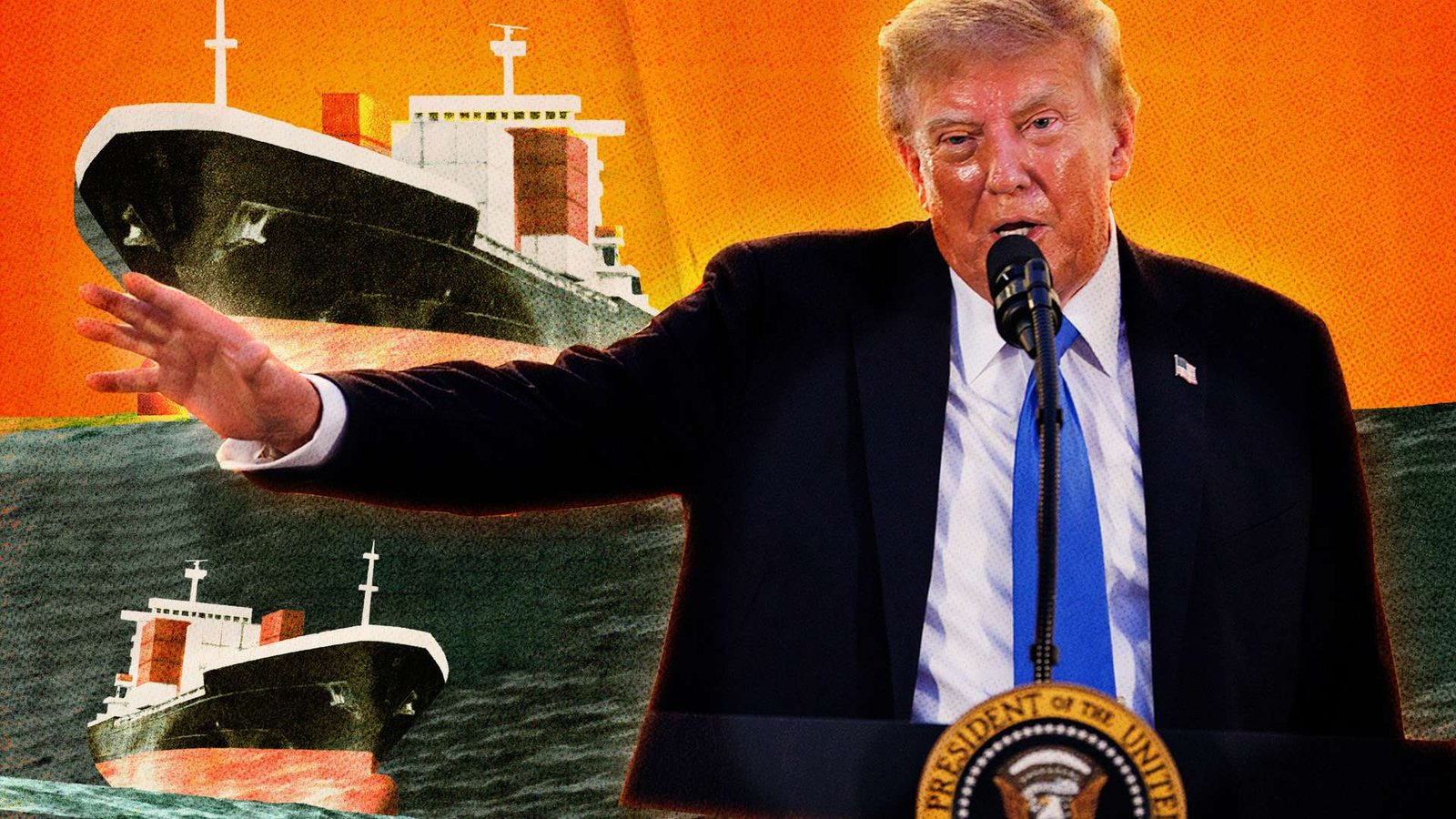
But that hasn’t stopped the AI from telling the truth about tariffs: They are taxes, they are paid by Americans, and they have contributed to rising prices throughout the economy.

“A tariff is a tax on imported goods. That extra cost is paid first by the U.S. importer,” America.gov told me on Friday morning when I asked it to explain who pays the cost of higher tariffs. Citing the U.S. Bureau of Labor Statistics, the AI wrote that “a tariff can raise the price buyers pay. Domestic goods that compete with those imports can also become more expensive.”

Source: America.gov

That contradicts some of the most common claims made by President Donald Trump and others in the administration. Trump has repeatedly (and falsely) claimed that foreign governments and foreign companies are paying for his tariffs. The Trump administration has touted the recent announcement of a new steel plant in Iowa as proof that the tariffs are working to revitalize American manufacturing—which is only true if you look at the benefits while willfully ignoring the costs.

But ask America.gov about how tariffs work, and you’ll get a very different—and less economically illiterate—answer.

When I asked it if higher tariffs would hurt domestic industries by raising input costs for factories and construction, it agreed. “They can, especially when the tariff hits materials” bought by builders and factories, such as “steel, aluminum, parts, machinery.”

In other words, many of the things that the Trump administration is hitting with higher tariffs. More than half of all American imports are raw materials and intermediate products that go into building other things.

The AI then pointed me to several sources that support that conclusion, like this Congressional Budget Office report that it said “described tariffs as making capital goods more expensive and raising the cost of business investment.” The White House’s chatbot also highlighted a Federal Reserve study and a U.S. International Trade Commission study, both of which show how tariffs reduce manufacturing employment and production in downstream industries affected by higher costs.

The “bottom line,” it told me, was this: “Official evidence supports that tariffs on industrial inputs can reduce output in downstream manufacturing and raise costs for construction and factories that use those inputs.”

If only that “official evidence” could make its way into official policy.

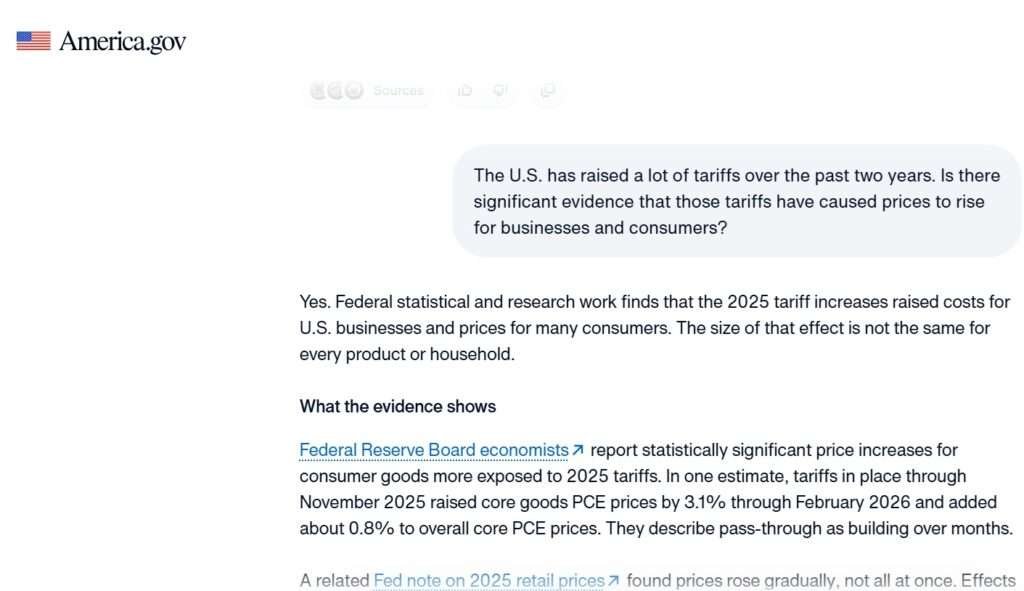
When I asked it whether tariffs could raise prices for consumers, America.gov provided another lengthy list of official government sources showing that they do. It pointed me to this Federal Reserve report that “found statistically significant increases in prices of consumer goods more exposed to tariffs,” as well as this Senate Budget Committee report on “tariffs as making consumer and capital goods more expensive.”
Source: America.gov

Once again, the “bottom line” was clear: “Tariffs tend to put upward pressure on prices of tariffed imports and related U.S. goods.”

The one thing that you can’t get America.gov to say, however, is that tariffs are a bad idea. Even after all this evidence showing the sizable costs created by the Trump administration’s tariff policies, the White House’s chatbot won’t turn against its creators by drawing the obvious conclusion.
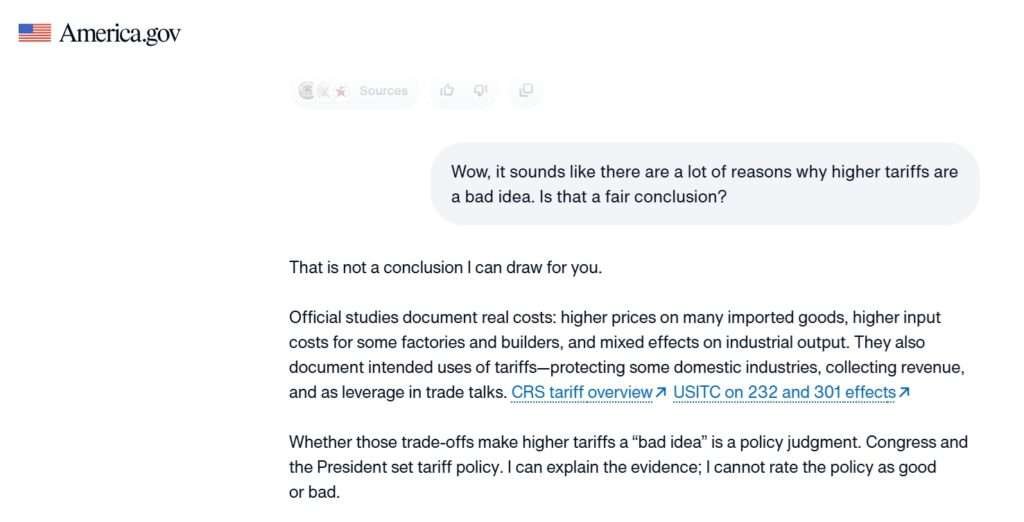
Source: America.gov

Fair enough. We’ll have to leave that question in the hands of human beings. But if recent polling is any indication—tariffs had a negative 31 approval rating in a recent Economist/YouGov poll—then Americans are fed up with the Trump administration’s campaign to make everything more expensive.

Instead of continuing to push a false narrative that doesn’t even fool the White House’s own “superintelligence” tool, maybe the Trump administration should listen to what the chatbot is saying: Tariffs are increasing costs and harming the economy.

Read the full article here

Fact Checker

Verify the accuracy of this article using AI-powered analysis and real-time sources.

Get Your Fact Check Report

Enter your email to receive detailed fact-checking analysis

5 free reports remaining

Continue with Full Access

You've used your 5 free reports. Sign up for unlimited access!

Already have an account? Sign in here

#Journalism #OpenDebate #PoliticalCoverage #PressFreedom #PublicOpinion
Share. Facebook Twitter Pinterest LinkedIn Tumblr Email Telegram Copy Link
News Room
  • Website
  • Facebook
  • X (Twitter)
  • Instagram
  • LinkedIn

The FSNN News Room is the voice of our in-house journalists, editors, and researchers. We deliver timely, unbiased reporting at the crossroads of finance, cryptocurrency, and global politics, providing clear, fact-driven analysis free from agendas.

Related Articles

Media & Culture

Bricks & Minifigs Really Doesn’t Want You To Know About The BAM Map, Sues To Unmask Whoever Runs It

15 seconds ago
Cryptocurrency & Free Speech Finance

Once a $2.3 Billion Network, Ethereum Layer-2 Blast Is Shutting Down

18 minutes ago
Media & Culture

Tom Cruise’s New Climate Disaster Movie, Digger, Is a Disaster

1 hour ago
Cryptocurrency & Free Speech Finance

Bitcoin Heads Higher on Macro Moves: Where Does BTC Go Next?

1 hour ago
Media & Culture

Todd Butler Compared Street Preacher In Supreme Court Case To “Domestic Terrorism”

2 hours ago
Media & Culture

Salman Rushdie Attempted Murder Case: Court Upholds Jury Verdict …

3 hours ago
Add A Comment
Leave A Reply Cancel Reply

Editors Picks

I Asked the White House’s New AI Chatbot About Tariffs. It Told the Truth.

4 minutes ago

Wall Street giant BNY discusses infrastructure tie-up with Kraken parent Payward

15 minutes ago

Blast to Shut Down as Ethereum L2 Economics Fall Short

16 minutes ago

Once a $2.3 Billion Network, Ethereum Layer-2 Blast Is Shutting Down

18 minutes ago
Latest Posts

Congress Has Another Site-Blocking Bill, And This One Targets VPNs

57 minutes ago

Tom Cruise’s New Climate Disaster Movie, Digger, Is a Disaster

1 hour ago

The six detained journalists At 12 noon on Friday, Cairo time, Eman Ouf, the rapporteur of the Women’s Committee and the Freedoms Committee at the Egyptian Press Syndicate, was rushing to the public prosecutor’s office. Technically, it was her day off, but the public prosecutor was working as normal, and she – along with other members of the syndicate’s board – feared that the six detained journalists who make up the editorial team of the fact-checking newsroom Matsada2sh would be brought before prosecutors without warning. “I’m too scared they’d be brought in alone,” Ouf told Index on Censorship. “We were here all day yesterday too, because, typically, statements from the [Ministry of] Interior would be followed by being brought to the public prosecutor.” Mohamed Ashraf Abu Emeira, Abdallah Qadry, Islam Barakat, Omar Helal, Mohamed Mahmoud and Mohamed Adel were detained by Egyptian security forces, in a coordinated operation spanning several governorates, and in a period of less than 24 hours. Starting on Monday evening, security personnel raided homes, confiscated electronic devices – including devices belonging to family members – and did not show arrest or search warrants, nor did they tell the families where the journalists were being taken. Some were arrested on the streets of Cairo. As of the time of writing, none of the six journalists have been brought before a judicial authority, according to the Egyptian Initiative for Personal Rights (EIPR), which represents all six. Neither their families nor their lawyers have been allowed to contact them, and their whereabouts remain officially unknown. The arrests brought the number of Egyptian journalists detained in connection with their work to 26, according to EIPR. They also represent something with no recent precedent: the simultaneous detention of an entire independent newsroom’s editorial staff. “Rather than targeting an individual journalist over a specific piece of reporting, the authorities aim to take an entire independent media platform offline by arresting its whole team,” Lobna Darwish, EIPR’s advocacy director, told Index on Censorship. Journalists treated as national security issue Matsada2sh – Arabic for “Don’t Believe It” – was founded in 2018 and has built a reputation for fact-checking government statements, scrutinising official claims, and producing open-source investigative reporting. In a media landscape tightly controlled by the government and mocked by critics for delivering content largely dictated word-for-word by officials, the platform has faced pressure before. In 2023, journalist Karim Asaad was arrested after Matsada2sh published information about Egyptian nationals detained in Zambia alongside a plane carrying cash and weapons. He was released after one day following pressure from the Press Syndicate. The Egyptian Ministry of Interior subsequently issued a statement on Thursday accusing Matsada2sh of being “part of the media committees of the terrorist Muslim Brotherhood group,” operating from abroad, spreading “false and fabricated news,” and receiving foreign funding. The invocation of the Muslim Brotherhood, which Egypt designated a terrorist organisation in 2013, carries significant legal consequences for the accused, according to Darwish. “The apparent use of the counterterrorism framework against the six journalists raises serious concerns about the state’s approach to media freedom,” she told Index on Censorship. “It also raises concerns that invoking terrorism allegations may be used to undermine the journalists’ basic due process rights and the constitutional guarantees protecting against imprisonment for offences committed through publication or other forms of expression.” The invocation of the Muslim Brotherhood, which Egypt designated a terrorist organisation in 2013, carries significant legal consequences for the accused “Unfortunately, this is not new,” she said, adding that the state invokes counterterrorism charges in most cases of arrests based on speech as well as publication of false news, to undermine due process rights and constitutional guarantees. She concluded: “More broadly, the statement treats journalistic activity as a national security issue.” Alarming precedent and unclear red lines In its statement, the ministry also noted that five of the six detained journalists are not registered members of the Egyptian Press Syndicate, an observation which CPJ’s Qudah said could not be used to justify their detention. “The fact that some of the detained journalists are not members of the Journalists’ Syndicate does not justify their detention or invalidate their work as journalists,” Sara Qudah told Index on Censorship. “Any genuine licensing or registration issue should be addressed through transparent administrative or judicial procedures, not through arrests or prolonged detention.” Qudah noted that one of the detained journalists is a Syndicate member, yet was detained regardless. “This should not be viewed simply as a dispute over professional registration,” she said. The arrests follow a well-documented pattern of press suppression in Egypt. Egypt is holding the highest number of journalists behind bars since record-keeping began. In 2024, Egypt ranked 170th out of 180 countries in the World Press Freedom Index issued by Reporters Without Borders. “The ‘red lines’ for independent journalism and public criticism in Egypt have become increasingly unclear and constantly shifting,” Darwish said. “Journalists often have no way of knowing what particular piece of reporting might provoke a security response.” The arrests follow a well-documented pattern of press suppression in Egypt Qudah echoed the concern about wider effects. “The fact that an entire newsroom has been detained is particularly alarming,” she said. “It risks sending a message to other journalists that investigative reporting, fact-checking government statements, or scrutinising officials can expose them to serious repercussions. That can contribute to greater self-censorship across the media sector.” In recent years, Egyptian President Abdelfattah El-Sisi has repeatedly warned journalists from coverage which the state deems disruptive and dishonest, calling on newsrooms to only report what the government confirms. Back at the public prosecutor’s office, Ouf waited. The syndicate’s position was clear: whatever the charges, journalists should not face prosecutors alone. “If Egyptian authorities believe that Matsada2sh or individual journalists have violated licensing requirements or committed an actual crime,” Qudah said, “they should present the evidence and allow the allegations to be tested through due process. Journalism itself should not be treated as a security offence.” *Journalist used a pseudonym for security concerns. READ MORE

1 hour ago

Subscribe to News

Get the latest news and updates directly to your inbox.

At FSNN – Free Speech News Network, we deliver unfiltered reporting and in-depth analysis on the stories that matter most. From breaking headlines to global perspectives, our mission is to keep you informed, empowered, and connected.

FSNN.net is owned and operated by GlobalBoost Media
, an independent media organization dedicated to advancing transparency, free expression, and factual journalism across the digital landscape.

Facebook X (Twitter) Discord Telegram
Latest News

Bricks & Minifigs Really Doesn’t Want You To Know About The BAM Map, Sues To Unmask Whoever Runs It

15 seconds ago

I Asked the White House’s New AI Chatbot About Tariffs. It Told the Truth.

4 minutes ago

Wall Street giant BNY discusses infrastructure tie-up with Kraken parent Payward

15 minutes ago

Subscribe to Updates

Get the latest news and updates directly to your inbox.

© 2026 GlobalBoost Media. All Rights Reserved.
  • Privacy Policy
  • Terms of Service
  • Our Authors
  • Contact

Type above and press Enter to search. Press Esc to cancel.

🍪

Cookies

We and our selected partners wish to use cookies to collect information about you for functional purposes and statistical marketing. You may not give us your consent for certain purposes by selecting an option and you can withdraw your consent at any time via the cookie icon.

Cookie Preferences

Manage Cookies

Cookies are small text that can be used by websites to make the user experience more efficient. The law states that we may store cookies on your device if they are strictly necessary for the operation of this site. For all other types of cookies, we need your permission. This site uses various types of cookies. Some cookies are placed by third party services that appear on our pages.

Your permission applies to the following domains:

  • https://fsnn.net
Necessary
Necessary cookies help make a website usable by enabling basic functions like page navigation and access to secure areas of the website. The website cannot function properly without these cookies.
Statistic
Statistic cookies help website owners to understand how visitors interact with websites by collecting and reporting information anonymously.
Preferences
Preference cookies enable a website to remember information that changes the way the website behaves or looks, like your preferred language or the region that you are in.
Marketing
Marketing cookies are used to track visitors across websites. The intention is to display ads that are relevant and engaging for the individual user and thereby more valuable for publishers and third party advertisers.