

 Freedom Index
Listen to the article
Good men can make terrible kings … but bad men cannot make good kings.
~Brandon Sanderson, The Well of Ascension
The Middle East makes fools of everybody. US president George W. Bush’s decision to invade Iraq in 2003 seemed like a good idea to a lot of us at the time; a supermajority in Congress—including many Democrats—voted to authorise it. Demolishing Saddam Hussein’s totalitarian regime went smoothly as far as wars go, but Iraq didn’t actually possess the weapons of mass destruction we’d been told to fear, and a rogue’s gallery of Ba’ath Party insurgents, radical Sunni Islamists, and Iranian-backed militias unleashed a civil war that took two years to control before Iraq stabilised to become the precariously democratic country it is today.
President Obama’s far-more restrained air-power campaign over Libya in 2011 also seemed reasonable at the time. Europe took the lead in that instance, thereby mollifying critics around the world who’d denounced Bush as a unilateral cowboy. The tyrannical Moammar Qaddafi was gearing up to massacre vast numbers of people, but protecting the rebels and engineering his downfall led to a power vacuum, a failed state, and rampant warlordism. The same US administration’s 2015 Joint Comprehensive Plan of Action (better known as the Iran nuclear deal) managed to slow Iran’s pursuit of a nuclear-weapons capability. But sanctions were lifted as part of the package, and Iran used that money to pour guns, missiles, and military advisors into Syria, Lebanon, and Gaza, feeding a slew of destructive wars.
Hardly anyone—besides a diminishing number of liberal interventionists and neoconservative foreign-policy hawks—gave Obama a hard time for staying out of Syria during the uprising against Bashar al-Assad. After Iraq and Afghanistan, almost nobody wanted to go in there, not even just to crater the runways used by Assad’s air force. Not liberals, not progressives, and not those now calling themselves America First. But then the uprising metastasised into a civil war that lasted seven times as long as Iraq’s, killing between 200,000 and 300,000 people. The Russians stepped in as the regional power, and Syria haemorrhaged so many refugees into the West that it triggered the xenophobic backlash fuelling Brexit in the United Kingdom, the election of Donald Trump in the United States, and a smorgasbord of nativist parties—some of which have pedigrees that trace back to the Nazis—across Europe from Poland to France.
Foreign policy in the Middle East is what podcasters Jennifer Welch and Angie Sullivan call a lazy susan of shit sandwiches: all the available options are terrible. If you’re the decision-maker faced with a Middle East crisis, you are condemned to make terrible decisions no matter what you decide, whether it’s a big war, a small war, diplomacy, or nothing at all. So let’s start by offering at least some grace to everyone burdened with this thankless and frankly traumatising job.
Deciding what to do—if anything—about Iran’s nuclear program is the mother of all terrible jobs. Do nothing, and Iran will obtain apocalyptic weaponry. On Quds Day in 2017, the regime installed a digital clock in Tehran’s Palestine Square that began counting down the number of days until “the annihilation of Israel.” The countdown’s conclusion was timed to coincide with the 25-year expiration date of Obama’s nuclear deal, at which point the Islamic Republic would be free to finish what Hitler started. No people on earth would sit patiently awaiting the moment when genocidal fascists decide to erase them from the map. The Jews, in particular, are in no mood to be phlegmatic after what happened the last time somebody tried this kind of thing.
Israel already has nuclear weapons, so a nuclear conflagration between Israel and Iran threatens the genocide of two ancient peoples in the Middle East, not just one, plus however many Palestinians, Lebanese, Iraqis, Kurds, Azerbaijanis, and Gulf Arabs might be blown to pieces in the blast radius and irradiated by nuclear fallout. And if you don’t care about human life, well, there’s always the collapse of the global energy market and the economy to worry about. It ought to go without saying that the most destructive war in the history of our species would be the worst possible outcome.
The US could have decided to stick with the nuclear deal, buy time, and hope that the Iranian regime imploded or was overthrown before the agreement expired. But the ayatollahs are nothing like reformist Soviet premier Mikhail Gorbachev in the waning days of the Cold War. They negotiate in bad faith and use the money from sanctions relief to unleash a vast swath of murder, arson, and mayhem even without nuclear weapons. An Iraq-style air-and-ground invasion, on the other hand, would almost certainly topple the Islamic Republic, although that would involve a bloody ground war followed by a long, perilous, and ruinously expensive aftermath. South Carolina Senator Lindsey Graham might be happy to sign up for this, but hardly anyone else would.
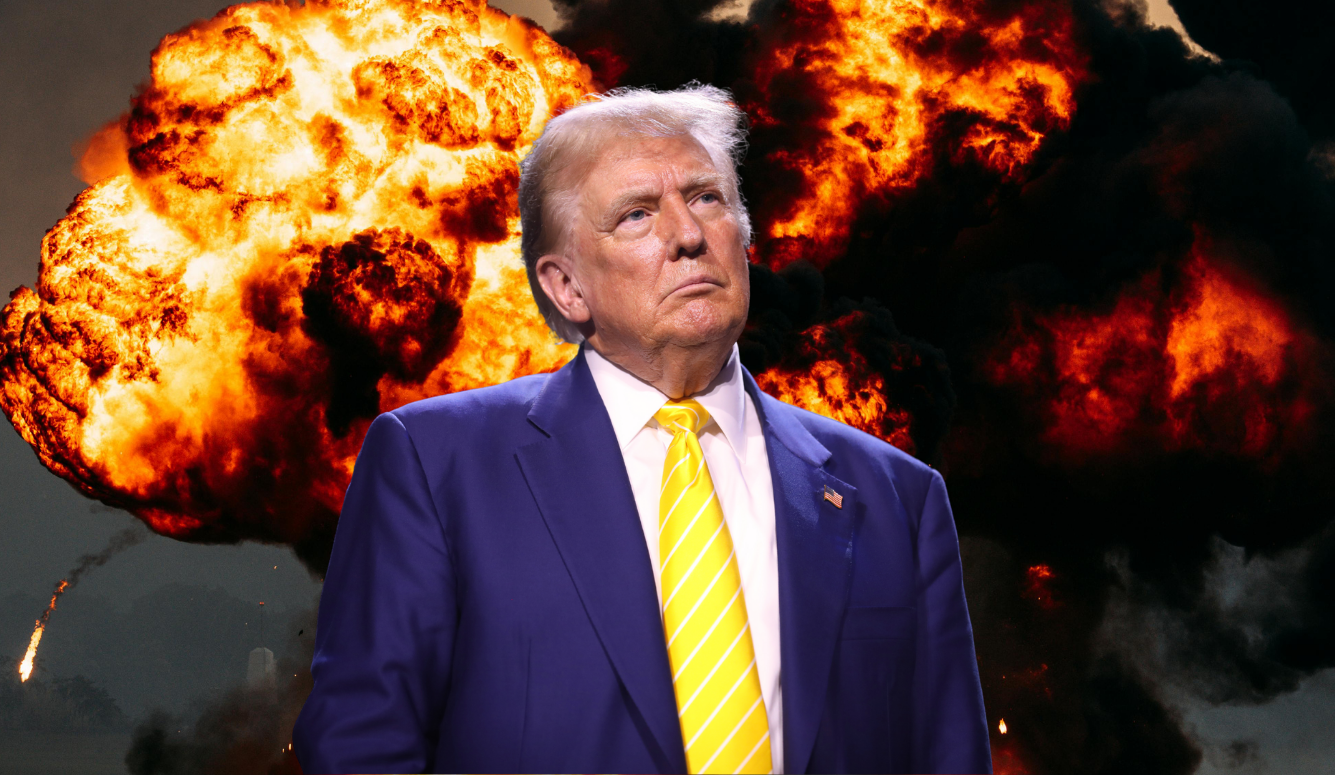
So, having torn up the Iran deal in his first term, Donald Trump opted for regime-change-by-limited-air-war in his second, hoping to get the best possible result for the lowest possible cost. He went to war with the Israelis, and with much quieter support from America’s Arab allies in the Persian Gulf, who had been menaced and attacked by Iran for decades. We can hardly blame them for finally hitting back at a regime weakened by the destruction of its allies in Syria, Gaza, and Lebanon. The blowback was inevitable, like gravity pulling a tennis ball back down to earth. Shoot at me, and I will shoot back. Hold my head underwater, and I will gouge out your eyes.
Trump was not as daunted by the prospect of a war with Iran as his predecessors, but that’s mostly because he had no idea what he was getting into and didn’t bother to find out. He seemed to believe that only cowardice and fecklessness had prevented his predecessors from solving a problem that could be rapidly resolved with some guts and a massive application of force. Operation Epic Fury would be another Venezuela cakewalk. Warnings that the Iranians might close the Strait of Hormuz and produce a global energy shock were waved away. The US and the Israelis would decapitate the regime, and whoever emerged from the rubble would come crawling before Trump begging for mercy. At which point, Trump could install some hapless stooge whom he could boss around, the US could freewheel through its target list, confiscate Iran’s stocks of highly enriched uranium (HEU), and then everyone could go home with as many barrels of Iranian oil as they could carry.
But Trump’s war is not going to plan. The US and the Israelis did decapitate the regime, but Iran did not immediately sue for peace, and they did close the Strait of Hormuz. The Islamic Republic now exercises a stranglehold over a vital trade chokepoint, a state of affairs feared for nearly a half century but which never actually materialised until now.
Read the full article here
Fact Checker
Verify the accuracy of this article using AI-powered analysis and real-time sources.