Close Menu
FSNN | Free Speech News NetworkFSNN | Free Speech News Network
  • Home
  • News
    • Politics
    • Legal & Courts
    • Tech & Big Tech
    • Campus & Education
    • Media & Culture
    • Global Free Speech
  • Opinions
    • Debates
  • Video/Live
  • Community
  • Freedom Index
  • About
    • Mission
    • Contact
    • Support
Trending

Trump’s Iowa Steel Mill Is a Win for Steelmakers. What About Everyone Else?

40 minutes ago

Crypto for Advisors: The CLARITY Act failed, but the rules came anyway

56 minutes ago

NEAR Intents Hit By $3.8M Exploit In Latest Crypto Platform Hack

57 minutes ago
Facebook X (Twitter) Instagram
Facebook X (Twitter) Discord Telegram
FSNN | Free Speech News NetworkFSNN | Free Speech News Network
Market Data Newsletter
Thursday, October 1
  • Home
  • News
    • Politics
    • Legal & Courts
    • Tech & Big Tech
    • Campus & Education
    • Media & Culture
    • Global Free Speech
  • Opinions
    • Debates
  • Video/Live
  • Community
  • Freedom Index
  • About
    • Mission
    • Contact
    • Support
FSNN | Free Speech News NetworkFSNN | Free Speech News Network
Home»News»Global Free Speech»History is being written by the AI victors
Global Free Speech

History is being written by the AI victors

News RoomBy News Room11 months agoNo Comments12 Mins Read21 Views
Share Facebook Twitter Pinterest Copy Link LinkedIn Tumblr Email VKontakte Telegram
History is being written by the AI victors
Share
Facebook Twitter Pinterest Email Copy Link

Listen to the article

0:00
0:00

Key Takeaways

Playback Speed

Select a Voice

This article first appeared in Volume 54, Issue 3 of our print edition of Index on Censorship, titled Truth, trust and tricksters: Free expression in the age of AI, published on 30 September 2025. Read more about the issue here.

We are right to be concerned about what artificial intelligence is doing to our present and what it might do to our future. But I am more worried about what it can do to our past.

Access to archives is becoming harder. Manuscripts are fragile, and verifying historical evidence contradicting established narratives is time-consuming. Technology makes history seem fun and exciting by enabling direct communication with historical figures and using visuals that simplify the past, but it weakens our understanding. Artificial intelligence reshapes research by digitising archives and analysing data quickly, but it poses risks. AI often lacks academic rigour, drawing from biased sources and oversimplifying complex events. It presents information with unearned authority, spreading errors rapidly. Unlike historians, AI cannot evaluate credibility, weigh accounts or identify gaps in records.

The result is that our history runs the risk of being skewed towards what’s most accessible online: mainstream narratives drawn from popular databases, digitised books, encyclopaedias, widely-read history books and even crowd-sourced portals. Marginalised voices – Indigenous people, minorities, or communities without digitised records – risk being erased further. When AI amplifies the dominant version of events, alternative interpretations fade into obscurity.

For all its potential, AI cannot replace the human historian. Critical judgment, contextual thought and insights, and the ability to navigate conflicting evidence and picking plausible theories remain essential to safeguarding the integrity of the past.

Consider a recent experiment by Indian historian Anirudh Kanisetti. A trained engineer, Kanisetti has written two engrossing books on the Chaulukyas and the Cholas, two medieval-era dynasties of southern India. Despite his background in engineering, or perhaps because of it, he is sceptical of the use of AI in history. He decided to challenge the Goliath. He sought AI assistance and then wrote about his experience on Instagram. He calls AI “language calculators, and not very good ones”. He asked Copilot, Microsoft’s AI tool which uses OpenAI’s ChatGPT, to write an essay based on his work about a medieval regiment in India.

In its references, the tool produced a paper by an academic Kanisetti knew of, but he had never heard of this paper. He called out Copilot, and it immediately admitted it had made up the fact. Its subsequent apology was insincere. Kanisetti then posed another query, instructing Copilot to cite primary sources. This time, the bot confidently misquoted primary sources and, again, admitted the fabrication when he called it out.

Kanisetti is worried because he knows the sources and can find out when AI is lying; other users may not be that knowledgeable and may rely on AI to do the grunt work of checking citations. As he puts it: “Large language models (LLMs) are trained to seem to be helpful, so you think they have value. But they are actually faffing, lying, fabricating … Engagement generates shareholder value.”

Our information ecosystem is being destroyed, he added.

He has grasped the essence of the problem that is bothering many historians in the global south.

The future historian’s skillset

Aanchal Malhotra, who has written a fascinating history about India’s Partition, told me: “This thought of AI rewriting history is new but a terrifying one, because of the scale it can achieve.”

Doyenne of Indian history Romila Thapar told Index: “What AI can do to history is in a sense already being done by what the Hindutva-vadis [right-wing Hindu nationalists] are doing to Indian history. It is an alternative, distorted history that they are propagating. So far, professional historians are dismissing it by showing that there is no reliable evidence to provide proof of what is being stated in the Hindutva version. One can predict that with the availability of AI there can be massive forging of many documents that will be put forward as proof. So training in professional history will require the ability to recognise forged documents, especially if they are documents that are said to belong to earlier times. The historian of today has to be a multidisciplinary person, but the historian of tomorrow will also have to be trained in the technology of verifying documents and publications.”

She wonders if the techniques of historical excavation will need to change, since the authenticity of three-dimensional artefacts gathered from sites will have to be proved. As soon as an artefact is discovered, will it need to be intensively photographed and marked and documented and a tiny sample be analysed? This will make excavation absurdly expensive if the veracity of every object has to be proved, she adds. And she is concerned about how AI’s apparent ability to bring characters from the past back to life would interfere with what we know to be true.

She also worries about what AI can do to historical questioning and education. If students start asking AI to write their papers and tutorials (as many are), they will become masters at writing prompts, but not at drawing their own analysis. They will know how to use a machine, but truth will elude them. “They won’t know why they have written what they have,” she said.

History abounds with examples of misinterpretations, such as the figurine of a horse in Mohenjo-daro in Pakistan, which suggested that the horse had been domesticated as early as the second millennium BC.

Peter Frankopan, who teaches history at Oxford, told Index: “The skill of a historian is to be able to deal with complex materials… The idea of lots of forgeries is as old as writing systems. Information has always been used and manipulated to embed hierarchies, to spread falsehoods and to manipulate people – whether literate or otherwise. So training historians in the present and future simply requires the right skills to be learned, and the discipline of asking the right questions. Clearly, we have some challenges ahead; but there have always been such problems in the past.”

The risks heighten with the seductive charm of AI-generated visual imagery. Manu Pillai, who has written thoughtful and engrossing books on the history of southern India and, more recently, about the making of modern Hindu identity, told Index it was only a question of time before we find sophisticated imagery or videos generated by AI that would make the crudely written WhatsApp messages appear believable. There are twin dangers in India, he said. There is high digital access but weak digital literacy, “which means large segments of people are likely to be misled. We also live in a time when more and more people have an appetite for conspiracy theories and for ‘alt’ facts, and many therefore would be predisposed to swallow some of the material that comes their way”.

AI for good…occasionally

AI does provide notable benefits, such as drawing patterns from vast amounts of data and deciphering handwriting. It helps restore and better understand complex historical texts. The Arolsen Archives use AI to catalogue documents related to Nazi persecution victims. Yad Vashem uses AI to identify unknown Holocaust victims. The USC Shoah Foundation and Illinois Holocaust Museum use AI-driven holographic displays, voice recognition and virtual reality to create transparent, immersive experiences for remembrance and education.

AI’s inability to separate truth from lies is the real danger. As an aggregator, if it finds a particular version of a story cited more often, it is trained to assume it is part of the mainstream discourse. It overemphasises the dominant narrative over alternative views, which reinforces misinterpretations and falsehoods.
Manila-based Singaporean historian Thum Ping Tjin (better known as PJ Thum) is wary. The founder of New Naratif notes that throughout human history, tools have emerged to make our communication and information exchange quicker, and these tools have raised alarms. They have inevitably been co-opted by those with money and power in order to get more money and power. “They have used those tools to present versions of history to further their own goals,” Thum said.

“In many cases, the worst-case scenario you fear already exists,” he told Index. “Southeast Asian governments have long used their resources to fabricate, censor and present their own version of history and their power to enforce it. Singapore has had an entire industrial complex of official historians repeating the ‘official’ version of history. Professional historians who seek to correct the record are treated as public enemies.”

Thum himself underwent hours of gruelling questioning by government officials when he critiqued Singapore’s official interpretation of how it got separated from Malaysia, and the government introduced a new law intended to attack disinformation but which in effect ensured that the dominant, state-approved narrative would prevail.

Alarmed by the attacks on crucial aspects of American history, primarily dealing with race, the American Historical Association Council has issued guidelines based on principles that reinforce the need for historical thinking, reminding us that AI produces texts, images, audio and video, but not truth. It also warned about AI’s tendency to hallucinate and introduce false certainties.

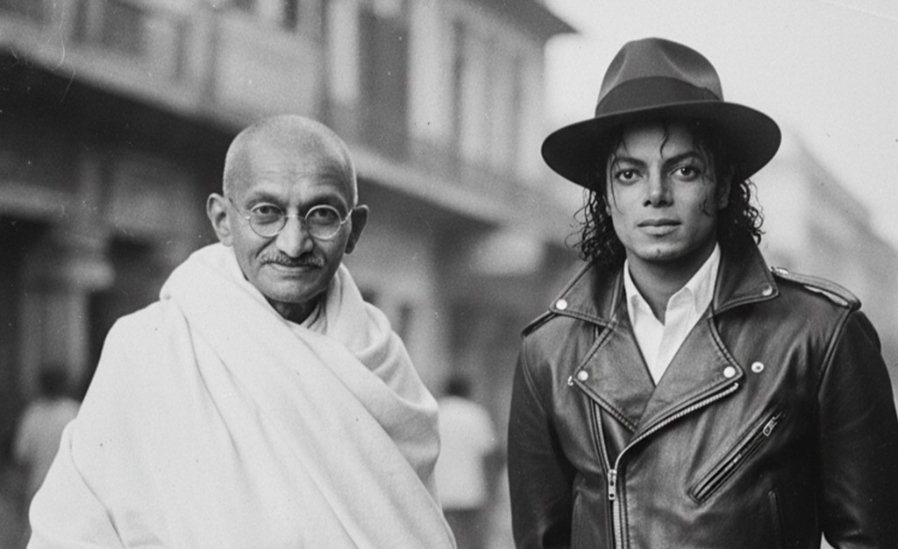
AI’s biggest impact on history is deepfake technology. Erasing inconvenient truths or spreading lies isn’t new – Joseph Stalin famously airbrushed Leon Trotsky out of photos. In the late 1990s, a Malaysian newspaper altered photos to remove Anwar Ibrahim after he fell out with prime minister Mahathir Mohammed.

The problem of AI fakes

Forged documents have long confused historians; for example, Nazi era expert Hugh Trevor-Roper believed the fake Hitler diaries were genuine because of their voluminous content. The fabricated 1903 Protocols of the Elders of Zion fuelled antisemitism and conspiracy theories. Recently, AI-generated deepfake videos, such as one of US congresswoman Alexandria Ocasio-Cortez, which depicted her in Congress arguing that a jeans ad featuring Sydney Sweeney was racist, have gone viral, highlighting new dangers in disinformation.

Kanisetti points out that many Indians consume historical materials now through videos. These don’t claim authenticity, but to the untrained mind the realistic-looking videos appear to be well-researched. “The right wing has no incentive to doctor primary sources yet, because the general public is already uninterested in the ambiguities of evidence-based history,” he said. Many viewers want affirmation of their beliefs; they no longer care if what they are seeing is accurate.

In What is History?, EH Carr wrote: “The facts speak only when the historian calls on them: it is he who decides to which facts to give the floor, and in what order or context.” The selection of facts is integral to historical research. Good historians must be aware of their personal biases and the context of their work. Only humans have the capability to understand the emotions involved and the ethical choices that need to be made; it is why at universities, history is part of the humanities department and not in a scientific lab.

Historians are quick to caution. One of the biggest risks is Holocaust denial and revisionism. Unesco published a report last year with the World Jewish Congress, which showed how hate groups could use AI to deny the Holocaust, including by fabricated testimonies and altered historical records. The Historical Figures app allows users to ‘chat’ with prominent Nazis such as Adolf Hitler and Joseph Goebbels, and it falsely claims that Goebbels (for example) was not intentionally involved in the Holocaust and had tried to prevent violence against Jews. Unesco has its own recommendations for ethics in AI, which it urges governments to follow. It has also asked tech companies to improve their standards and act responsibly.

But governments have neither the capacity nor, in some cases, the willingness to prevent disinformation from spreading widely. Can states be trusted? Can corporations, which are incentivised by maximising shareholder value? Open-source algorithms, digital watermarking and community-based content moderation are all necessary potential solutions, but none is sufficient. Educating the public, particularly young people, on how to critically evaluate information and recognise misinformation is crucial to combat the negative impacts.

Thum told me: “The only defence against this is by educating ourselves to be more sceptical and information-literate; by democratising the tools and skills of history; and by teaching people to be more sceptical and critical of those with information and power, so that we are less likely to be tricked by AI or whatever the next technology is.”

In 1987, I interviewed Salman Rushdie in Bombay, as the city was then known, when he had completed writing The Satanic Verses. Other than his editors, few knew what the novel was about.

When I asked him, he said: “It is about angels and devils and how it is very difficult to establish ideas of morality in a world which has become so uncertain that it is difficult to even agree on what is happening. When one can’t agree on a description of reality, it is very hard to agree on whether that reality is good or evil, right or wrong. When one can’t say what is actually the case, it is difficult to proceed from that to an ethical position. Angels and devils are becoming confused ideas … It is an attempt to come to grips with that sense of a crumbling moral fabric or, at least, a need for the reconstruction of old simplicities.”

AI makes us believe in simplicities, that truth is easy to access, and that answers to complex questions are just one click away. It is the product in our age of instant gratification. Reality, like history, is more nuanced. The challenge lies in our not being condemned to repeat it.

Read the full article here

Fact Checker

Verify the accuracy of this article using AI-powered analysis and real-time sources.

Get Your Fact Check Report

Enter your email to receive detailed fact-checking analysis

5 free reports remaining

Continue with Full Access

You've used your 5 free reports. Sign up for unlimited access!

Already have an account? Sign in here

Share. Facebook Twitter Pinterest LinkedIn Tumblr Email Telegram Copy Link
News Room
  • Website
  • Facebook
  • X (Twitter)
  • Instagram
  • LinkedIn

The FSNN News Room is the voice of our in-house journalists, editors, and researchers. We deliver timely, unbiased reporting at the crossroads of finance, cryptocurrency, and global politics, providing clear, fact-driven analysis free from agendas.

Related Articles

Global Free Speech

CPJ urges Morocco to end press surveillance following Amnesty report 

2 hours ago
Global Free Speech

          As news broke that 84,270 people, including more than 32,000 children, had been affected by Nepal’s catastrophic floods, one visual offered something the world desperately needed in the moment: hope. The video shows a little girl, buried under thick mud, being is rescued by Nepal’s emergency teams. Instinctively, the viewer roots for her as rescuers carry her to safety, wrapping her shivering body in a red shawl. But the most moving moment of the video comes towards the end. The girl is sitting motionless in a relief camp, an officer feeding her warm soup. As the camera lingers on her face, a faint smile almost begins to show. It is the kind of image that can offer the viewer respite from the horrors of a humanitarian crisis. The video rapidly spread rapidly across all social media platforms, with commentators calling it a miracle. Of sorts. In fact, it was an AI miracle. Agence France-Presse (AFP) Fact Check’s investigation led them to an India-based creator, who admitted creating the video with the help of AI-generative tools. His justification was disarmingly straightforward: emotionally engaging visuals perform well online. This was just one of the many digitally-manufactured “miracles” put into social media heavy rotation during the floods. Another clip, showing a bridge collapsing into floodwaters swallowing vehicles and human lives, seemed to have been lifted straight out of a Roland Emmerich disaster film. The video racked up more than 2 million views on X before it was debunked as AI-generated by Factly. What made this social media post stand out for me was the identity of one of the people sharing it – an experienced news editor. The post, still pinned on his X profile and with more than 2 million views, suggests that even experienced newsroom decision-makers could be fooled by synthetic disaster footage – or, worse still, be untroubled about the veracity of such videos. Both videos incorporate the visual language of short films, but were not released in cinemas or on Netflix. They surfaced on Facebook, X and Instagram, even as emergency teams continued to search for the thousands of people that went missing after a glacial collapse triggered devastating floods in Nepal and Tibet on August 26. Even as survivors photographed authentic eyewitness footage, synthetic visuals emerged alongside them. The floods became one of the first major climate disasters in South Asia where documentation and fabrication coexisted in the same visual ecosystem.     Screenshot of debunked Nepal floods footage “During earlier disasters, our primary challenge was identifying old footage, establishing where a video was recorded and determining whether it was being presented in the correct context,” Saurabh Shukla told Index. Shukla is founder and editor-in-chief of NewsMobile, an India-based independent media organisation that debunks AI-related deepfakes and focuses on verified information. “The biggest difference today is the sheer speed at which fabricated and misleading visuals entered the information ecosystem,” Shukla said. “With generative AI, we now have an additional challenge – determining whether the event depicted in a video ever happened in the first place.” This has fed into a media environment where unverified visuals are disseminated faster than the verified facts reported by journalists. “Speed without verification can amplify confusion, while verification without timely reporting can leave an information vacuum,” Shukla said. “The challenge for newsrooms is to strike the right balance between being fast and being accurate.” The first images of rescue missions in secluded mountainous regions almost always come from locals, and thus forming the spine of disaster reporting. These inevitably blurry and shaky recordings do not have the polished quality of professional news reporting, but do carry something far more consequential: the credibility that comes with eyewitness documentation. These images often shape the core of the collective memory of a tragedy. But in an age of visual manipulation and trickery, that presumption of authenticity no longer holds. Factly conducted 30 fact-checks into coverage of the Nepal floods; fully one-third involved AI-generated visuals. “Beyond checking the location, source, and context of a visual, we also had to establish whether the visual itself was authentic,” Akshay Kumar Appani, lead fact checker and researcher at Factly, told Index. “During breaking disasters, old AI-generated visuals can spread rapidly while being presented as current footage. This makes it harder for journalists to establish the truth. The visual of the miracle child perfectly captured this dilemma. It was designed to evoke an emotional reaction; but it also looked like the kind of footage that journalists hope to find during crisis reporting. The video was vertically filmed. The camera movement was wobbly. The lighting was grainy. The muffled background sound felt believable. The video presented none of the glaring distortions that once made AI interventions easy to spot. Fabricated videos, today, can be produced to mimic the aesthetics of authentic citizen journalism. It was for this precise reason that the floods presented journalists with a crisis that went beyond recognising AI-generated images: they were increasingly obliged to verify whether the footage reaching them was genuine in the first place. Screenshot of video debunked by Factly Newsmobile’s verification process increasingly involves examining individual frames, conducting reverse-image searches, analysing visual inconsistencies and using AI-detection tools where appropriate. “However, detection tools are only one part of the process. We still need corroboration,” Shukla said. “We cannot rely solely on automated detection tools,” Sumit Dubey, South Asia digital verification editor for AFP’s Fact Check vertical, told Index. Fact-checking, he explained, requires going beyond automated outputs: tracing the original source, examining context, verifying metadata, looking for corroborating evidence and, where possible, speaking to relevant sources. “Automated tools are useful indicators, but fact-checking cannot be outsourced to a button,” Dubey said. The proliferation of synthetic media output in the wake of natural disasters is not new. It’s the sophistication of the output that has changed. For years, much of the public conversation around AI manipulation centred on faces: celebrity deepfakes, altered political speeches and fabricated portraits. The Nepal floods flipped that narrative. Almost every fabricated clip featured rivers, glaciers, collapsing hillsides, dams, flooded valleys or stranded animals. “AI-generated environmental content poses a different problem: [the] tells are failures of physics rather than anatomy,” Mahsa Alimardani told Index. Alimardani is associate director for technology threats and opportunities at Witness, a global organisation helping people use video and technology to protect and defend human rights This explains why the Nepal videos were so plausible. The miracle girl video wasn’t believable just because of her facial expressions. It was convincing because the sludge moved convincingly, because the choreography resembled actual emergency rescues, because the emotional tonality seemed genuine. “Most post-hoc detection tools were designed for content featuring physical characteristics, and they currently struggle significantly with environmental and disaster content,” Bruna Martins dos Santos – policy and advocacy manager, Witness Technology Threats and Opportunities – told Index. “Journalists might also struggle because many tools have limited capabilities to identify synthetic content generated elsewhere,” she said. Another emerging trend is the increasingly complicated role of Big Tech itself in detecting and labelling fake generative-AI content. Some of the clearest AI verdicts came from detection tools built by the very same companies whose models created the same fakes. Three weeks after the US state of California and the EU mandated the requirement for greater transparency with respect to AI-generated content, Witness and Indicator tested thirteen major AI providers. They found that seven had no public detector at all. “The capability to identify synthetic content partly existed. The governance around it did not,” Alimardani said. When both authentic and synthetic content circulate in disaster situations, the biggest challenge that journalists face is that of establishing truth amidst widespread public uncertainty and doubt. According to Martins dos Santos, “Journalists and local fact-checkers can face immense time pressure, often wasting scarce resources re-detecting the same recycled disaster footage across multiple platforms and languages.” The greatest danger emerging from Nepal may not be that people believed the fake videos. It may be that they have begun to doubt the real ones. Shukla’s concern is that people may stop trusting visual evidence altogether. “Imagine a situation where genuine footage of a disaster emerges, but people dismiss it as AI-generated. Facts become secondary to perception.” Within days of the floods, even authentic CCTV footage from the Gyirong border was being perceived as AI-generated, prompting fact-checkers to establish that the scenes it depicted were real. This exposed a troubling issue: even authentic visuals can no longer be taken at face value. Martins dos Santos told Index that the phenomenon has a name: “Liar’s dividend”, whereby the mere existence of convincing synthetic content allows bad actors to dismiss genuine, damaging evidence as fake simply by claiming it was AI-generated. This means that genuine footage is no longer accorded credibility immediately; it may first be perceived with suspicion. “This means a video may look completely authentic and still be fabricated. Conversely, genuine footage can contain compression artefacts that make it appear suspicious,” Shukla warned. Appani, for his part, noted that synthetic media doesn’t merely affect verification in real time. It also reshapes collective memory. “Widely circulated synthetic or recycled footage may eventually be remembered as genuine imagery from the disaster. Generative-AI could therefore affect not only how disasters are verified in real-time, but also how they are documented and remembered in the future.”The Nepal floods left destruction in its wake, and also a warning for journalists covering climatic disaster. The defining challenge of disaster reporting is no longer capturing the first image, but establishing which image the world can trust. In Shukla’s words: “For fact-checkers, the challenge is not just determining whether a video is real. It is establishing whether it actually belongs to the event it claims to depict.” READ MORE

3 hours ago
Global Free Speech

CPJ, partners call on Malta to ensure broad consultation on draft media reform bill 

5 hours ago
Global Free Speech

Hong Kong journalist Tang Ho-wing arrested in latest sedition case

21 hours ago
Global Free Speech

Taliban shut down 3rd Shiite-centered media outlet in 4 months in Afghanistan

23 hours ago
Global Free Speech

Iran sentences 2 journalists as media crackdown widens

1 day ago
Add A Comment

Comments are closed.

Editors Picks

Crypto for Advisors: The CLARITY Act failed, but the rules came anyway

56 minutes ago

NEAR Intents Hit By $3.8M Exploit In Latest Crypto Platform Hack

57 minutes ago

Near Intents Hacked for $3.8M Days After Denying North Korea-Linked Bitget Hacker

58 minutes ago

Jewish Community Center’s Lawsuit Against “Goyim Defense League” Can Go Forward

2 hours ago
Latest Posts

CPJ urges Morocco to end press surveillance following Amnesty report 

2 hours ago

NEAR Intents hit by $3.8M exploit, pauses cross-chain services in latest crypto hack

2 hours ago

Stablecoins Can Drain From Banks And Nations At Lightning Speed

2 hours ago

Subscribe to News

Get the latest news and updates directly to your inbox.

At FSNN – Free Speech News Network, we deliver unfiltered reporting and in-depth analysis on the stories that matter most. From breaking headlines to global perspectives, our mission is to keep you informed, empowered, and connected.

FSNN.net is owned and operated by GlobalBoost Media
, an independent media organization dedicated to advancing transparency, free expression, and factual journalism across the digital landscape.

Facebook X (Twitter) Discord Telegram
Latest News

Trump’s Iowa Steel Mill Is a Win for Steelmakers. What About Everyone Else?

40 minutes ago

Crypto for Advisors: The CLARITY Act failed, but the rules came anyway

56 minutes ago

NEAR Intents Hit By $3.8M Exploit In Latest Crypto Platform Hack

57 minutes ago

Subscribe to Updates

Get the latest news and updates directly to your inbox.

© 2026 GlobalBoost Media. All Rights Reserved.
  • Privacy Policy
  • Terms of Service
  • Our Authors
  • Contact

Type above and press Enter to search. Press Esc to cancel.

🍪

Cookies

We and our selected partners wish to use cookies to collect information about you for functional purposes and statistical marketing. You may not give us your consent for certain purposes by selecting an option and you can withdraw your consent at any time via the cookie icon.

Cookie Preferences

Manage Cookies

Cookies are small text that can be used by websites to make the user experience more efficient. The law states that we may store cookies on your device if they are strictly necessary for the operation of this site. For all other types of cookies, we need your permission. This site uses various types of cookies. Some cookies are placed by third party services that appear on our pages.

Your permission applies to the following domains:

  • https://fsnn.net
Necessary
Necessary cookies help make a website usable by enabling basic functions like page navigation and access to secure areas of the website. The website cannot function properly without these cookies.
Statistic
Statistic cookies help website owners to understand how visitors interact with websites by collecting and reporting information anonymously.
Preferences
Preference cookies enable a website to remember information that changes the way the website behaves or looks, like your preferred language or the region that you are in.
Marketing
Marketing cookies are used to track visitors across websites. The intention is to display ads that are relevant and engaging for the individual user and thereby more valuable for publishers and third party advertisers.