

 Freedom Index
Listen to the article
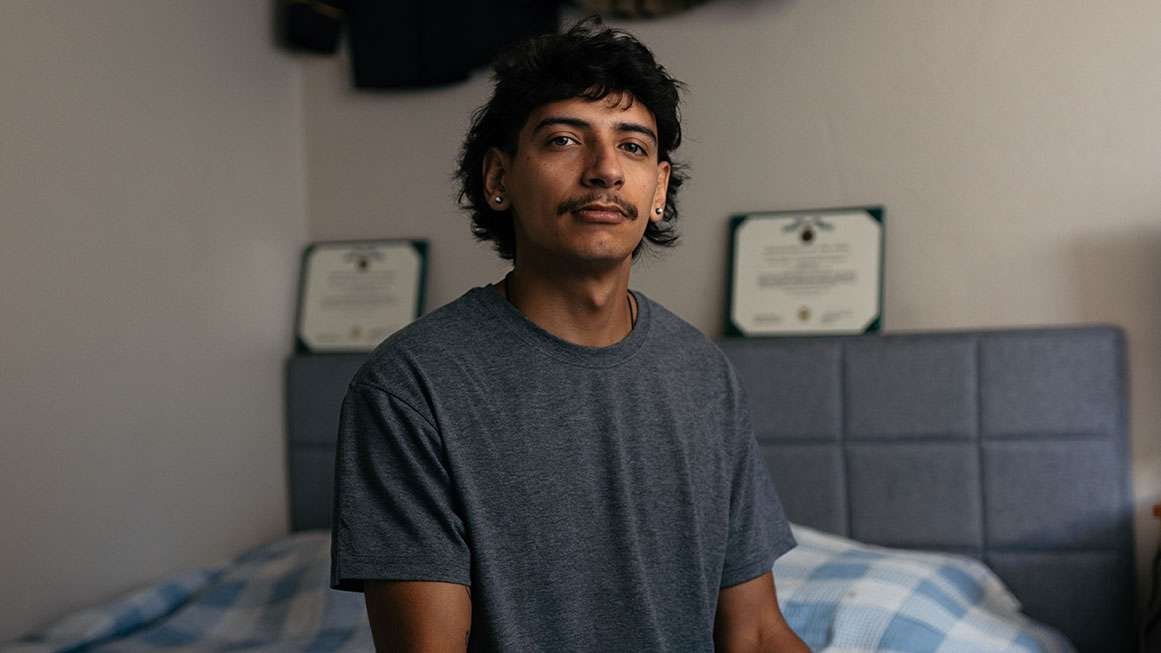
George Retes woke up on July 10, 2025, hoping the day would change his life for the better. Retes, an Army veteran, worked as a security contractor for a legal cannabis farm in Ventura County, California. After seven months on the graveyard shift, working from midnight to 8 a.m., Retes was eager to move to a daytime schedule and spend more waking hours with his family.
“I do everything for my kids,” says the 25-year-old father. “That’s what it’s all for.” When he finally got the new schedule, he saw it as a perfect opportunity.
Things seemed normal that Thursday as he drove along the back roads to work his first day shift. But as Retes pulled up to the entrance to his workplace, he saw pandemonium: cars everywhere blocking the road, cars without drivers, drivers zigzagging around other cars. Along with other federal agencies, Immigration and Customs Enforcement (ICE) was out in force, and so were people protesting.
President Donald Trump had started to roll out his mass deportation campaign in early 2025. By June, workplace raids were happening across Southern California as agents tried to reach a goal of 3,000 arrests a day, inciting widespread panic and disorder. After protests erupted in Los Angeles, Trump sent in roughly 4,000 National Guard members to quell the turmoil.
But without a call from work warning him not to come in, Retes pressed on. “I still got to go to work like normal,” he says. “I need to get paid. I still need to keep a roof over my kids’ heads.”
Such stories have played out thousands of times during the second Trump administration. People leave their homes for work, school, or an appointment. The routine trip turns into chaos when they stumble into an immigration raid.
Making his way through parked cars and protesters, Retes eventually reached a line of agents blocking him in the middle of the road. Still hoping to make it in on time, he pulled up and asked to pass. “I was a good distance away, and I put my car in park,” he says. “I got out, stood by my car.”
The agents started yelling, Retes says. “Get the fuck out of here!” “Leave!” “Get back in your car!” “Pull over to the side!” “You’re not going to work.” “Work is closed.” Retes asked for a badge number that he could give to his boss when he didn’t show up on time. But that made the agents madder.
Roughly three out of four ICE detainees have no criminal record, according to a November 2025 Cato Institute report, and are otherwise law-abiding undocumented immigrants—but some of the people arrested are, like Retes, U.S. citizens.
“Literally the first words out of my mouth was that I was a U.S. citizen, that I’m just trying to get work…and they just didn’t care,” Retes says. “They were immediately hostile from the get-go.”
Rather than escalate any further, Retes got back into his car to follow the agents’ directions and leave. But the agents unexpectedly moved forward, surrounded the car, and started banging on its windows and pulling on its door handles, telling him to get out. Another agent yelled at him to reverse, and another told him to pull over to the side of the road. “They’re all yelling contradictory things when all I was already trying to do was leave like they were asking me to do,” says Retes. “Like, what am I supposed to do?”
Retes reversed into the right lane to get out of the way. As he pulled back, agents threw tear gas into the protesters behind him, engulfing his car. He was trapped.
“You go through it in basic training, so I’ve been through tear gas before,” Retes says. “But it was just so different because I wasn’t in the environment….I’m a civilian now.” For a moment, the agents left Retes alone. Unable to see from the tear gas and not wanting to hit any of the people behind him, he felt the only logical thing to do was to stay put, hold out, and hope for the best.
But then agents approached again, banging on the car windows and pulling on door handles. Retes, coughing and trying to catch his breath, pleaded with the officers that he was trying to leave. Then glass went flying everywhere. An agent immediately reached through Retes’ shattered window to pepper-spray him in the face. A split second later, Retes was dragged out of his car.
Unsure what the armed officers would do next, Retes didn’t resist. “At that point,” he recalls, “I’m just a ragdoll.” Regardless, one agent felt the need to kneel on Retes’ back, and another on his neck. “I was just pleading with them, telling them I couldn’t breathe,” he says. “They didn’t care.”
Retes isn’t sure how long he was held down before someone zip-tied his hands. Agents picked him up and walked him to the farm where he works. Officers began asking who would be responsible for Retes. “The entire time they were walking me back, they were passing me off to other agents, asking, ‘Who’s going to take responsibility for what happened to him?'” he says.
Confused as to what had just happened and why, Retes waited for an opportunity to prove he was a citizen. “I mean, I didn’t do anything wrong,” he says. “I just figured they were going to finish doing whatever they were doing and they were going to let me go.” Retes sat zip-tied in the dirt for four hours. “The entire time I was sitting there, they only asked for my ID once,” he says. He told them it was in his car—the one with the disabled veterans license plate. “I don’t know if they ever went to go check my ID.”
The Department of Homeland Security (DHS) had been adamant that its immigration raids were focused on the “worst of the worst criminal illegal aliens.” So it was reasonable for Retes, who was perhaps racially profiled by officers, to think he’d be free to leave after proving his citizenship.
But a new practice was emerging. By October 2025, ProPublica had identified at least 170 Americans who’d been detained, sometimes violently, and held by immigration agents. (The full number is unknown, since the federal government doesn’t collect data on how many U.S. citizens are detained during immigration enforcement.) One citizen, arrested twice by immigration agents in Alabama, says that officers called his REAL ID fake. A woman in Los Angeles was tackled to the ground when her mother dropped her off for work near an immigration sting.
Eventually, agents put Retes into an unmarked car and drove him to a Navy base. There, authorities took his fingerprints, his picture, and a mouth swab for DNA. “They ended up reading me my rights and just told me that they were just investigating everything that happened…and why I was there,” says Retes. “They never said I was being charged with anything. They never said that I was getting arrested.”
Retes says he complied with every order. He figured that once the officials got all the proof they needed that he was a citizen, they would let him go. Instead, they drove him to the Metropolitan Detention Center in downtown Los Angeles.
“When they took me to the prison…it was just like one thing after another, and I was just so confused,” Retes says. “There was no explanation.” He was processed and strip-searched like any other inmate. When he asked if he could call his family or a lawyer, Retes says, he was simply ignored. So were his requests for a shower to wash away the still-burning tear gas and pepper spray.
“That entire Thursday night, my body’s on fire,” Retes recalls. “My hands, my face…literally a heat I cannot describe. Just imagine being on fire and just not being able to do anything.”
The following morning, after a medical evaluation that included some mental health questions, Retes was placed in a suicide watch cell: a yellow concrete room with a thin mattress top, a tiny rectangular window, and constant light. “A guard sits there 24/7, writing down what I’m doing every 10 minutes, and I’m in there naked in a hospital dress,” he says. Despite his many requests, he was never allowed to make a phone call.
“That Sunday morning, close to afternoon…an officer walked up to the cell and said I was off suicide watch and I was going to be released. And he just walked away,” says Retes. Hours later, another officer finally opened the door to his cell. As he changed back into his clothes and signed for his possessions, officers told him he was finally free to go after spending over three full days in custody.
“So I asked them, like, ‘So I was locked up in here, and I missed my daughter’s birthday for no reason?'” he recalls. What followed, Retes says, was “the loudest silence ever.”
Retes didn’t get an explanation for his arrest until he described his harrowing experience in a September op-ed for the San Francisco Chronicle. DHS responded with a post on X claiming that Retes had been arrested for assaulting law enforcement.
“It was the only explanation I got from that entire thing…a tweet…and it was a lie,” says Retes. “I was just in shock.” Footage of the incident was widely available, yet the agency was still trying to avoid any accountability.
“I knew everything that had happened wasn’t right,” he says. “I knew from the moment I was in there if I ever got out…I need accountability. I need an explanation.”
This wasn’t the only time the agency had resorted to lies after its aggressive immigration enforcement tactics were scrutinized. Over the course of Trump’s second term, DHS has grown increasingly comfortable with claiming falsely that people arrested, injured, or killed by immigration officers had been “violent” or even “terrorists.”
Those lies became infamous after the fatal shootings of Renée Good and Alex Pretti in January 2026, when DHS officials asserted wrongly that both had intended to commit acts of domestic terrorism. But DHS had been regularly lying to the American public for months before then.
In Chicago, for example, after an immigration officer shot an American woman five times, DHS claimed that agents had been “boxed in” by domestic terrorists and had shot defensively after their vehicle was “rammed” by the woman. But the woman lived, and federal charges against her were dropped when the evidence contradicted the shooting agent’s story.
At the time of this publication, DHS has not recanted its lies about Retes.
Unfortunately, holding government agents accountable is a steep uphill battle. Suing federal officers for violating constitutional rights is notoriously difficult. Although the U.S. Supreme Court’s decision in Bivens v. Six Unknown Named Agents of the Federal Bureau of Narcotics (1971) recognized that Americans may sue federal officials for damages arising from Fourth Amendment violations, that case has been practically overruled in recent years. This lack of redressability is why some members of Congress are attempting to codify the Court’s Bivens ruling into federal law. By amending a federal statute known as Section 1983 to include federal officers, legislators would clear a pathway for citizens to bring law enforcement to court for misconduct.
When Retes learned from his lawyers at the Institute for Justice, a nonprofit law firm, just how difficult it would be to hold the officer involved in his case accountable, he was shocked. “If someone violates your rights, you should be able to get accountability and justice for what happened to you,” says Retes. But after understanding the legal barriers ahead, Retes said it was like flipping a switch. “This is much bigger than just me,” he says. “There’s all these people that this is happening to.”
Rather than “mope and cry about it,” Retes and his attorneys have filed suit under the Federal Tort Claims Act against the federal agencies involved in his three-day-long detention, arguing that they violated his Fourth and Fifth Amendment rights. They are also using a California law to sue the unknown officers involved in his case for interfering with Retes’ enjoyment of his constitutional rights. While waiting to see if the courts will take his claims seriously, Retes has flown to D.C. multiple times to speak with members of Congress about amending Section 1983. He testified before a bicameral public forum last December, and he attended the State of the Union address in February to represent those who have been victimized by unconstitutional actions taken by federal agents.
“I understand that my case resonates with a lot of people,” Retes says. He doesn’t just want a solution for himself; he wants “a pathway for everyone else” to get justice. “It shouldn’t matter that you’re a veteran or the color of your skin or if I’m an immigrant,” he says. “We all deserve to be treated fairly and with human dignity.”
This article originally appeared in print under the headline “Why This U.S. Citizen Was Arrested and Jailed During an ICE Raid.”
Read the full article here
Fact Checker
Verify the accuracy of this article using AI-powered analysis and real-time sources.