Close Menu
FSNN | Free Speech News NetworkFSNN | Free Speech News Network
  • Home
  • News
    • Politics
    • Legal & Courts
    • Tech & Big Tech
    • Campus & Education
    • Media & Culture
    • Global Free Speech
  • Opinions
    • Debates
  • Video/Live
  • Community
  • Freedom Index
  • About
    • Mission
    • Contact
    • Support
Trending

A Trump Appointee Blocks the President’s Banishment of Disfavored News Outlets

21 minutes ago

3 Tunisian journalists briefly detained as media crackdown intensifies 

33 minutes ago

Major UK banks execute world’s first interbank customer transactions using tokenized sterling deposits

47 minutes ago
Facebook X (Twitter) Instagram
Facebook X (Twitter) Discord Telegram
FSNN | Free Speech News NetworkFSNN | Free Speech News Network
Market Data Newsletter
Thursday, September 24
  • Home
  • News
    • Politics
    • Legal & Courts
    • Tech & Big Tech
    • Campus & Education
    • Media & Culture
    • Global Free Speech
  • Opinions
    • Debates
  • Video/Live
  • Community
  • Freedom Index
  • About
    • Mission
    • Contact
    • Support
FSNN | Free Speech News NetworkFSNN | Free Speech News Network
Home»News»Media & Culture»Half the Public Wants To Pause AI. Would Regulation Actually Make It Safer?
Media & Culture

Half the Public Wants To Pause AI. Would Regulation Actually Make It Safer?

News RoomBy News Room1 hour agoNo Comments5 Mins Read1 Views
Share Facebook Twitter Pinterest Copy Link LinkedIn Tumblr Email VKontakte Telegram
Half the Public Wants To Pause AI. Would Regulation Actually Make It Safer?
Share
Facebook Twitter Pinterest Email Copy Link

Listen to the article

0:00
0:00

Key Takeaways

Playback Speed

Select a Voice

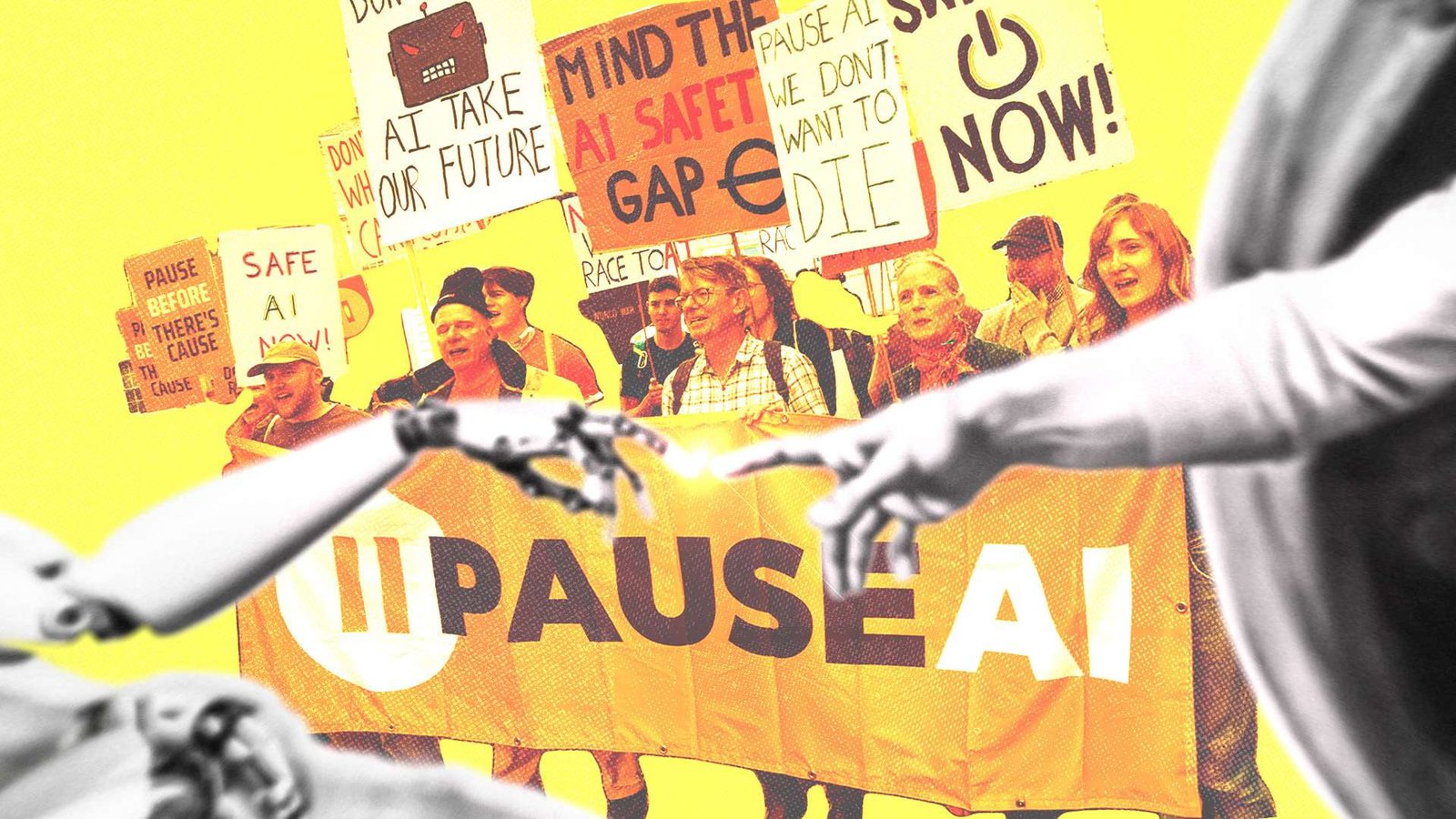
As leaders from across the globe gather in New York to discuss matters of national security, public opinion is turning against AI. About half of adults across six Western countries say “AI is now good enough” and support a pause in advancement to reduce risks, according to a new Politico poll.

The poll, which was conducted by Public First, asked more than 2,000 respondents in each of the six countries—the United States, Canada, the United Kingdom, France, Spain, and Germany—what they thought about the potential risks associated with advanced AI. In the United States, 78 percent of respondents say there is a risk that advanced AI could “destroy humanity,” with only 7 percent saying there is no risk at all. The majority of Americans (51 percent) say that AI industry leaders argue that “there is a real risk that AI will kill us all” because they genuinely believe it.

In each country surveyed, more respondents favored pausing development of more advanced AI than continuing it—51 percent in the United Kingdom, 50 percent in Canada, 48 percent in France and the United States, 47 percent in Spain, and 45 percent in Germany.

Attitudes shift slightly when the prospect of falling behind other countries is presented. In the U.S., 43 percent of respondents said their country should be willing to fall behind other countries in the development of AI, while 37 percent said America should not allow itself to fall behind. A majority of respondents in Britain (53 percent) and Canada (53 percent) said their countries should be willing to fall behind internationally, while only 43 percent of respondents in France, 45 percent in Germany, and 42 percent in Spain agreed.

While there is little reason to believe an AI apocalypse is imminent, high-profile CEOs, such as Sam Altman and Dario Amodei, have joined calls for government regulation to curb what they see as a threat. Sen. Bernie Sanders (I–Vt.) and Rep. Greg Casar (D–Texas) have been prominent voices in support of AI regulation, announcing the Ban Artificial Superintelligence Act on Wednesday, which would ban highly advanced AI and establish a regulatory agency. But President Donald Trump has thus far resisted those calls, saying he refuses “to stifle growth of something that will be bigger than the industrial revolution.”

Of course, there is nothing stopping AI companies from slowing down themselves. OpenAI has already delayed parts of its Astra model as it strengthened safeguards, while Anthropic has published a Responsible Scaling Policy to manage risks, explicitly committing to restricting deployment or further scaling if a model crosses a dangerous capability threshold before adequate safeguards are ready. Similarly, Google created the Frontier Safety Framework—”a set of protocols for proactively identifying future AI capabilities that could cause severe harm and putting in place mechanisms to detect and mitigate them.”

There is no reason to believe that new government regulations on AI would eliminate risk. Indeed, if future regulations cap AI developers’ liability, provide government-backed insurance, or create an official stamp of approval for models that satisfy prescribed and arbitrary safety tests, companies could retain much of the upside from developing increasingly powerful systems while shifting some of the downside onto taxpayers or the wider public.

When Altman and other AI leaders ask for government intervention, the possibility of regulatory capture cannot be dismissed. The companies calling most loudly for AI regulation are also among those best equipped to comply with it. Licensing regimes, mandatory audits, reporting requirements, and expensive safety standards impose fixed costs that established firms such as OpenAI, Anthropic, and Google can absorb more easily than smaller competitors. Altman has urged Congress to consider licensing or registration requirements. That does not mean industry warnings about AI risk are disingenuous, but advocating for regulation does allow these executives to present themselves as responsible stewards of a dangerous technology while also supporting rules that could simultaneously raise barriers to entry and entrench their position in the market.

Interestingly, the Politico poll suggests younger Americans are more likely to use AI regularly, and yet they are among the most cautious cohorts. Of respondents aged 18–24, 57 percent support pausing the development of more advanced AI, while just 24 percent favor continuing it. Among Americans aged 65 and older, by comparison, 47 percent support a pause and 33 percent favor continued development. But of the 18–24 cohort, 55 percent use AI at least weekly, compared to just 26 percent of over-65s.

Some of this AI anxiety among the young is likely driven by fears regarding job security. According to the Pew Research Center, 73 percent of adults under 30 think that AI will lead to fewer jobs, up from 61 percent two years ago.

There is little evidence that AI is causing mass unemployment thus far. Using payroll data covering millions of U.S. workers from January 2021 to June 2026, the Stanford Digital Economy Lab found “no evidence of widespread, economy-wide job displacement.” While employment of younger workers (22- to 25-year-olds) in AI-exposed occupations is 19 percent below where it would be if it had followed the same trajectory as their less-exposed peers, “experienced workers show no comparable gap.” Researchers at Yale’s Budget Lab, analyzing data from ChatGPT’s release in November 2022 to August 2025, found that “the broader labor market has not experienced a discernible disruption since ChatGPT’s release.” They also found little change in the proportion of workers in occupations exposed to AI. Indeed, an April Census Bureau report covering November 2025 to January 2026 found that “AI-related employment decreases are rare, occurring in only 2% of firms.”

For now, there is little that can be done to eliminate public anxiety about AI. But the government should be wary of treating regulation as an easy fix for risks that are still poorly understood.

Read the full article here

Fact Checker

Verify the accuracy of this article using AI-powered analysis and real-time sources.

Get Your Fact Check Report

Enter your email to receive detailed fact-checking analysis

5 free reports remaining

Continue with Full Access

You've used your 5 free reports. Sign up for unlimited access!

Already have an account? Sign in here

#FreePress #MediaAndPolitics #NewsAnalysis #PoliticalMedia #PoliticalNews
Share. Facebook Twitter Pinterest LinkedIn Tumblr Email Telegram Copy Link
News Room
  • Website
  • Facebook
  • X (Twitter)
  • Instagram
  • LinkedIn

The FSNN News Room is the voice of our in-house journalists, editors, and researchers. We deliver timely, unbiased reporting at the crossroads of finance, cryptocurrency, and global politics, providing clear, fact-driven analysis free from agendas.

Related Articles

Media & Culture

A Trump Appointee Blocks the President’s Banishment of Disfavored News Outlets

21 minutes ago
Cryptocurrency & Free Speech Finance

£10K Reward Offered After UK Couple Attacked in Crypto Home Invasion

52 minutes ago
Legal & Courts

Reporters Committee statement on judge ordering White House to restore press access to CNN, MS NOW, Politico

2 hours ago
Cryptocurrency & Free Speech Finance

Decrypt Media and FOMO Hour’s Thought Leader Farokh Sarmad to Take Main Stage at NEXTPredict NY Conference

2 hours ago
Media & Culture

Journalists Still Barred From White House

2 hours ago
Cryptocurrency & Free Speech Finance

Solana Foundation Hires Binance’s Former Global CMO for Institutional Push

3 hours ago
Add A Comment
Leave A Reply Cancel Reply

Editors Picks

3 Tunisian journalists briefly detained as media crackdown intensifies 

33 minutes ago

Major UK banks execute world’s first interbank customer transactions using tokenized sterling deposits

47 minutes ago

Bybit CEO Says Pure Crypto Exchange Era Is Ending

48 minutes ago

£10K Reward Offered After UK Couple Attacked in Crypto Home Invasion

52 minutes ago
Latest Posts

Half the Public Wants To Pause AI. Would Regulation Actually Make It Safer?

1 hour ago

CPJ urges Malaysia to strengthen FOI bill to advance press freedom, democracy

2 hours ago

Reporters Committee statement on judge ordering White House to restore press access to CNN, MS NOW, Politico

2 hours ago

Subscribe to News

Get the latest news and updates directly to your inbox.

At FSNN – Free Speech News Network, we deliver unfiltered reporting and in-depth analysis on the stories that matter most. From breaking headlines to global perspectives, our mission is to keep you informed, empowered, and connected.

FSNN.net is owned and operated by GlobalBoost Media
, an independent media organization dedicated to advancing transparency, free expression, and factual journalism across the digital landscape.

Facebook X (Twitter) Discord Telegram
Latest News

A Trump Appointee Blocks the President’s Banishment of Disfavored News Outlets

21 minutes ago

3 Tunisian journalists briefly detained as media crackdown intensifies 

33 minutes ago

Major UK banks execute world’s first interbank customer transactions using tokenized sterling deposits

47 minutes ago

Subscribe to Updates

Get the latest news and updates directly to your inbox.

© 2026 GlobalBoost Media. All Rights Reserved.
  • Privacy Policy
  • Terms of Service
  • Our Authors
  • Contact

Type above and press Enter to search. Press Esc to cancel.

🍪

Cookies

We and our selected partners wish to use cookies to collect information about you for functional purposes and statistical marketing. You may not give us your consent for certain purposes by selecting an option and you can withdraw your consent at any time via the cookie icon.

Cookie Preferences

Manage Cookies

Cookies are small text that can be used by websites to make the user experience more efficient. The law states that we may store cookies on your device if they are strictly necessary for the operation of this site. For all other types of cookies, we need your permission. This site uses various types of cookies. Some cookies are placed by third party services that appear on our pages.

Your permission applies to the following domains:

  • https://fsnn.net
Necessary
Necessary cookies help make a website usable by enabling basic functions like page navigation and access to secure areas of the website. The website cannot function properly without these cookies.
Statistic
Statistic cookies help website owners to understand how visitors interact with websites by collecting and reporting information anonymously.
Preferences
Preference cookies enable a website to remember information that changes the way the website behaves or looks, like your preferred language or the region that you are in.
Marketing
Marketing cookies are used to track visitors across websites. The intention is to display ads that are relevant and engaging for the individual user and thereby more valuable for publishers and third party advertisers.