

Close Menu
FSNN | Free Speech News NetworkFSNN | Free Speech News Network
  • Home
  • News
    • Politics
    • Legal & Courts
    • Tech & Big Tech
    • Campus & Education
    • Media & Culture
    • Global Free Speech
  • Opinions
    • Debates
  • Video/Live
  • Community
  • Freedom Index
  • About
    • Mission
    • Contact
    • Support
Trending

Bibi Tearing Up the Deal

24 minutes ago

Ethiopian journalist Salsawit Baynesagn detained without charge

31 minutes ago

GoMining challenges Jack Dorsey’s Square with a pure BTC payment rail

43 minutes ago
Facebook X (Twitter) Instagram
Facebook X (Twitter) Discord Telegram
FSNN | Free Speech News NetworkFSNN | Free Speech News Network
Market Data Newsletter
Friday, June 19
  • Home
  • News
    • Politics
    • Legal & Courts
    • Tech & Big Tech
    • Campus & Education
    • Media & Culture
    • Global Free Speech
  • Opinions
    • Debates
  • Video/Live
  • Community
  • Freedom Index
  • About
    • Mission
    • Contact
    • Support
FSNN | Free Speech News NetworkFSNN | Free Speech News Network
Home»News»Media & Culture»FTC Admits Age Verification Violates Children’s Privacy Law, Decides To Just Ignore That
Media & Culture

FTC Admits Age Verification Violates Children’s Privacy Law, Decides To Just Ignore That

News RoomBy News Room4 months agoNo Comments7 Mins Read708 Views
Share Facebook Twitter Pinterest Copy Link LinkedIn Tumblr Email VKontakte Telegram
Share
Facebook Twitter Pinterest Email Copy Link

Listen to the article

0:00
0:00

Key Takeaways

Playback Speed

Select a Voice

from the the-law-breaking-admin dept

We’ve been pointing out the fundamental contradiction at the heart of mandatory age verification laws for years now. To verify someone’s age online, you have to collect personal data from them. If that someone turns out to be a child, congratulations: you’ve just collected personal data from a child without parental consent. Which is a direct violation of the Children’s Online Privacy Protection Act (COPPA)—the very law that’s supposed to be protecting kids.

So what happens when the agency charged with enforcing COPPA finally notices this obvious problem? If you guessed “they admit the conflict and then just promise not to enforce the law,” you’d be exactly right.

The FTC put out a policy statement last week that is remarkable in what it tacitly concedes:

The Federal Trade Commission issued a policy statement today announcing that the Commission will not bring an enforcement action under the Children’s Online Privacy Protection Rule (COPPA Rule) against certain website and online service operators that collect, use, and disclose personal information for the sole purpose of determining a user’s age via age verification technologies.

The FTC appears to be explicitly acknowledging that age verification technologies involve collecting personal information from users—including children—in a way that would otherwise trigger COPPA liability. If the technology didn’t create a COPPA problem, there would be no need for a policy statement promising non-enforcement. You don’t issue a formal announcement saying “we won’t sue you for this” unless “this” is something you could, in fact, sue people for.

The statement itself tries to dress this up by noting that age verification tech “may require the collection of personal information from children, prompting questions about whether such activities could violate the COPPA Rule.” But “prompting questions” is doing an awful lot of work in that sentence. The answer to those questions is pretty obviously “yes, collecting personal information from children without parental consent violates the rule that says you can’t collect personal information from children without parental consent.” The FTC just doesn’t want to say that part out loud, because then the follow-up question becomes: “so why are you encouraging companies to do it?”

Instead, they’ve decided to create an enforcement carve-out. Do the thing that violates the law, but pinky-promise you’ll only use the data to check the kid’s age, delete it afterward, and keep it secure. Then we won’t come after you. This is the FTC solving a legal contradiction not by asking Congress to fix the underlying law or admitting the technology is fundamentally flawed, but by deciding to selectively not enforce the law it’s supposed to be enforcing.

The honest approach would have been to tell Congress that age verification, as currently conceived, cannot be squared with existing privacy law—and that if lawmakers want it anyway, they need to resolve that conflict themselves rather than asking the FTC to pretend it doesn’t exist.

No such luck.

And boy, do they seem proud of themselves. Here’s Christopher Mufarrige, Director of the FTC’s Bureau of Consumer Protection:

“Age verification technologies are some of the most child-protective technologies to emerge in decades…. Our statement incentivizes operators to use these innovative tools, empowering parents to protect their children online.”

“The most child-protective technologies to emerge in decades.”

Excuse me, what?

This is the kind of statement that sounds authoritative right up until you spend thirty seconds thinking about it. Anyone with any knowledge of security and privacy knows that age verification is anything but “child protective.” It involves a huge invasion of privacy, for extremely faulty technology, that has all sorts of downstream effects that put kids at risk.

Oh, and the FTC seems proud that the vote for this was unanimous—though it’s worth noting that Donald Trump fired the two Democratic members of the FTC and has made no apparent efforts to replace them, despite Congress designating that the FTC is supposed to have five full members, with two from the opposing party. A unanimous vote among the remaining two Republicans is a strange thing to brag about.

The FTC even posted about this on X, and the response was… well, let me just show you:
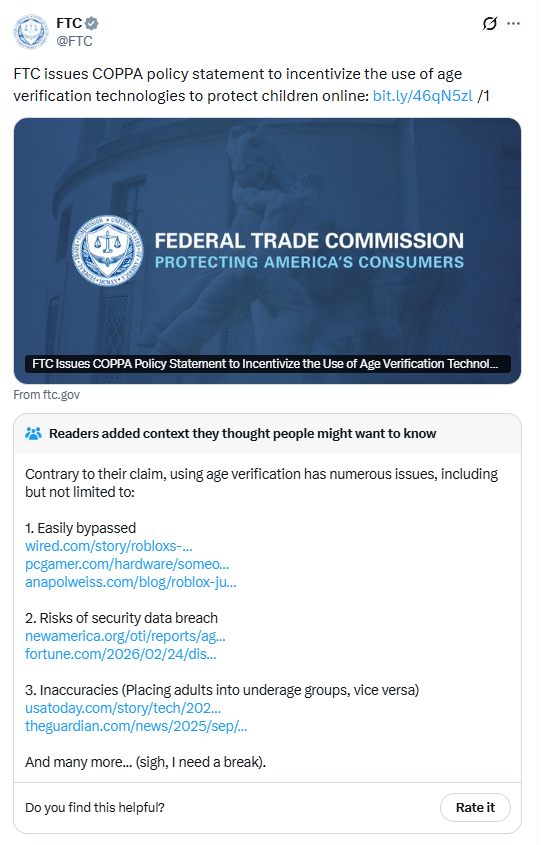
If you can’t see that, the main part to pay attention to is not the tweet from the FTC itself, but the Community Note that (under the way Community Notes works, notes need widespread consensus among users to be appended to the public tweet):

Readers added context they thought people might want to know

Contrary to their claim, using age verification has numerous issues, including but not limited to:

1. Easily bypassed

2. Risks of security data breach

3. Inaccuracies (Placing adults into underage groups, vice versa)

And many more… (sigh, I need a break).

Yeah, we all need a break.

That Community Note does a better job explaining the state of age verification technology than the FTC’s entire Bureau of Consumer Protection. It methodically lists out the problems: kids easily bypass these systems, the collected data creates massive security breach risks, and the technology produces wildly inaccurate results that lock adults out while letting kids through (and vice versa). When the consensus-driven crowdsourced fact-check on your own announcement is more informative than the announcement itself, maybe it’s time to reconsider the announcement.

But let’s say, for the sake of argument, that the technology worked perfectly. Would mandatory age verification still be a good idea?

That still wouldn’t solve the issues with this technology and the harm it does to kids. Even UNICEF (UNICEF!) has been warning that age restriction approaches can actively harm the children they’re supposed to protect. After Australia’s social media ban for under-16s went into effect, UNICEF put out a statement that could not have been more clear about the risks:

“While UNICEF welcomes the growing commitment to children’s online safety, social media bans come with their own risks, and they may even backfire,” the agency said in a statement.

For many children, particularly those who are isolated or marginalised, social media is a lifeline for learning, connection, play and self-expression, UNICEF explained.

Moreover, many will still access social media – for example, through workarounds, shared devices, or use of less regulated platforms – which will only make it harder to protect them.

So the actual child welfare experts are saying that age verification can backfire, push kids into less safe spaces, and should never be treated as a substitute for real safety measures. Meanwhile, the FTC is calling the same technology “the most child-protective” thing to come along in a generation and is waiving its own enforcement authority to encourage more of it.

What we have here is a federal agency that has identified a direct conflict between the law it enforces and the policy outcome it wants. Rather than grappling with what that conflict means—maybe age verification as currently conceived just doesn’t work within the existing legal framework, and for good reason—the FTC has chosen to simply look the other way. The message to companies is clear: go ahead and collect data from kids to figure out if they’re kids. We know that violates COPPA. We don’t care. We like age verification more than we like enforcing our own rules.

That’s a hell of a policy position for the agency that’s supposed to be the last line of defense for children’s privacy online.

Filed Under: age verification, coppa, ftc, think of the children

Read the full article here

Fact Checker

Verify the accuracy of this article using AI-powered analysis and real-time sources.

Get Your Fact Check Report

Enter your email to receive detailed fact-checking analysis

5 free reports remaining

Continue with Full Access

You've used your 5 free reports. Sign up for unlimited access!

Already have an account? Sign in here

#ContentCreators #OpenInternet #PlatformEconomy #TechIndustry #TechNews #Web3
Share. Facebook Twitter Pinterest LinkedIn Tumblr Email Telegram Copy Link
News Room
  • Website
  • Facebook
  • X (Twitter)
  • Instagram
  • LinkedIn

The FSNN News Room is the voice of our in-house journalists, editors, and researchers. We deliver timely, unbiased reporting at the crossroads of finance, cryptocurrency, and global politics, providing clear, fact-driven analysis free from agendas.

Related Articles

Media & Culture

Bibi Tearing Up the Deal

24 minutes ago
Media & Culture

Celebrating American Freedom Means Celebrating Juneteenth

1 hour ago
Cryptocurrency & Free Speech Finance

Texas Brothers Plead Guilty to $8M Armed Crypto Kidnapping

2 hours ago
AI & Censorship

EFF Joins 60+ Groups Urging the UK to Halt Face Estimation at the Border

2 hours ago
Media & Culture

Did California’s Gubernatorial Race Reveal the Limits of ‘Abundance’ Politics on the Left?

2 hours ago
AI & Censorship

The UK’s New Under-16 Social Media Ban Will Cause More Harm Than It Prevents

3 hours ago
Add A Comment

Comments are closed.

Editors Picks

Ethiopian journalist Salsawit Baynesagn detained without charge

31 minutes ago

GoMining challenges Jack Dorsey’s Square with a pure BTC payment rail

43 minutes ago

Former Ethereum Foundation Contributor Warns of ‘Slow-Burning’ Funding Crisis

44 minutes ago

Celebrating American Freedom Means Celebrating Juneteenth

1 hour ago
Latest Posts

A tiny proportion of sexual violence cases in Tigray have led to prosecution This article is written in two voices: First, Birhan Gebrekirstos Mezgbo, a researcher and advocate who lived through the Tigray war, then Veronica Blecker, director of the upcoming documentary on sexual violence in Tigray, Not Ours to Carry. Birhan: The moment everything shut down, it felt like the world had disappeared around us. No phone. No internet. No transportation. No banking. No way to know who was alive and who was not. My mother and sister were only around 120 kilometres away from me, but suddenly they felt unreachable, like they were in another universe. I couldn’t call them, I couldn’t travel to see them, and I had no way to know if they were safe. That silence was one of the hardest things I have ever lived through. Honestly, I don’t think the word “blackout” is enough to describe it. What made it worse was knowing that this darkness was not just about communication being cut. The darkness itself became dangerous. Everywhere you turned there was fear. Soldiers, killers, rapists, all operating inside this silence from which nobody could call for help or even tell the world what was happening. The blackout became part of the violence. At the time, I was meeting with survivors of conflict-related sexual and gender-based violence. I still remember walking for almost three hours to reach one survivor after being told where she was staying. When I arrived, she was gone. I walked that same route again and again, trying to find her. I never did. Veronica: The blackout was not simply the absence of communication. It was a weapon. The violence happened inside a closed circle, surrounded by guns and with no way in or out – not only from Tigray, but even within Tigray itself. Phone lines were cut, the internet was shut down, journalists were expelled, roads were blocked. The darkness was deliberate. It ensured that violence could happen unseen and unheard. Birhan: For survivors of conflict-related sexual violence, this darkness was devastating. Accessing medical care, reporting abuse, or seeking support became almost impossible. Ayder Hospital in Mekelle was one of the few facilities still functioning, sustained largely by the commitment of volunteer doctors and nurses. But reaching it could take weeks or even months. Along the way, survivors often faced even more violence. I still think about Abeba. She was raped three different times while trying to reach help in Mekelle. I often wonder whether her life would have been different if support had been available closer to where she lived. Instead, the journey to seek care exposed her to further harm. Eventually, she lost her life. For me, her story captures what the blackout did to so many survivors. The violence did not end with the assault. The darkness allowed it to continue. Veronica: Between 2020 and 2022, an estimated 600,000 people were killed in Tigray. The Commission of Inquiry on the Situation in the Tigray Region documented more than 280,000 cases of conflict-related sexual violence. A mere 25 military convictions have followed. Even if survivors could bring themselves to speak, to tell the world what was happening and what had happened to them, they are trapped inside a system of fear. In a system where armed men control every road and every community, speaking out can feel like a death sentence. I arrived after the blackout had already done its work. The violence had happened in the dark. There was physical evidence – detention sites, signs of torture, a landscape scarred by war. But there was little footage of the violence as it happened. The blackout had made sure of this. Every editorial decision – how to film testimony, how to protect identities, how to structure the narrative – was made in the knowledge that the official position was that there was nothing to document. These were the decisions that shaped Not Ours to Carry. The film captures what denial looks like in practice. One of the protagonists stands before the African Commission on Human Rights and reads survivor testimony into the official record. Later on, in the same session, the Ethiopian delegation responds on camera, rejecting in its totality what they call “baseless allegations”. The protagonist’s verdict: “Every time I go to these institutions, I feel like a clown in somebody’s circus. Going there and speaking is doing nothing but adding to their show.” Both governments were offered the right to reply. Ethiopia rejected the allegations in their totality. Eritrea did not respond. The denial is not historical. It is ongoing. What we documented is not only a record of violence. It is a record of censorship: the systematic suppression of evidence, testimony, and truth by governments that knew exactly what silence would allow. Survivors of conflict-related sexual violence carry two wounds. The first is what has been done to them. The second is being told that it didn’t happen – being told this by perpetrators, by institutions, by communities that impose shame rather than offer compassion and justice. The blackout prevented documentation. Then the world chose not to look. The silence did not end when the internet came back on. Birhan: I keep speaking because the difference between me and many of the women whose stories I carry is often nothing more than luck. I witnessed their pain and suffering, and I cannot simply move on with my life and ignore it. This is not only my voice; it carries the voices of hundreds of thousands of women and girls. From four-year-old children to grandmothers in their eighties. There can be no real accountability, and no meaningful future, if those voices continue to be ignored. That silence is not only theirs to break. It is ours too. Not Ours to Carry is premiering on 6 July at the Sevil International Women’s Documentary Film Festival, Azerbaijan’s only independent documentary film festival dedicated to women’s issues and gender equality If readers want to support survivors directly, donations go to One Stop Centres in Tigray here: https://www.notourstocarry.com/donate READ MORE

2 hours ago

Franklin Templeton proposes new funds that turn dividends into BTC: Crypto Daily

2 hours ago

Bitcoin’s ‘Deep Value’ Discount Faces Hawkish Fed Test: Bitwise

2 hours ago

Subscribe to News

Get the latest news and updates directly to your inbox.

At FSNN – Free Speech News Network, we deliver unfiltered reporting and in-depth analysis on the stories that matter most. From breaking headlines to global perspectives, our mission is to keep you informed, empowered, and connected.

FSNN.net is owned and operated by GlobalBoost Media
, an independent media organization dedicated to advancing transparency, free expression, and factual journalism across the digital landscape.

Facebook X (Twitter) Discord Telegram
Latest News

Bibi Tearing Up the Deal

24 minutes ago

Ethiopian journalist Salsawit Baynesagn detained without charge

31 minutes ago

GoMining challenges Jack Dorsey’s Square with a pure BTC payment rail

43 minutes ago

Subscribe to Updates

Get the latest news and updates directly to your inbox.

© 2026 GlobalBoost Media. All Rights Reserved.
  • Privacy Policy
  • Terms of Service
  • Our Authors
  • Contact

Type above and press Enter to search. Press Esc to cancel.

🍪

Cookies

We and our selected partners wish to use cookies to collect information about you for functional purposes and statistical marketing. You may not give us your consent for certain purposes by selecting an option and you can withdraw your consent at any time via the cookie icon.

Cookie Preferences

Manage Cookies

Cookies are small text that can be used by websites to make the user experience more efficient. The law states that we may store cookies on your device if they are strictly necessary for the operation of this site. For all other types of cookies, we need your permission. This site uses various types of cookies. Some cookies are placed by third party services that appear on our pages.

Your permission applies to the following domains:

  • https://fsnn.net
Necessary
Necessary cookies help make a website usable by enabling basic functions like page navigation and access to secure areas of the website. The website cannot function properly without these cookies.
Statistic
Statistic cookies help website owners to understand how visitors interact with websites by collecting and reporting information anonymously.
Preferences
Preference cookies enable a website to remember information that changes the way the website behaves or looks, like your preferred language or the region that you are in.
Marketing
Marketing cookies are used to track visitors across websites. The intention is to display ads that are relevant and engaging for the individual user and thereby more valuable for publishers and third party advertisers.