Close Menu
FSNN | Free Speech News NetworkFSNN | Free Speech News Network
  • Home
  • News
    • Politics
    • Legal & Courts
    • Tech & Big Tech
    • Campus & Education
    • Media & Culture
    • Global Free Speech
  • Opinions
    • Debates
  • Video/Live
  • Community
  • Freedom Index
  • About
    • Mission
    • Contact
    • Support
Trending

That $17B Meta settlement comes with a catch: Your online speech rights

22 minutes ago

Daily Deal: Raspberry Pi Pico With Ultimate Starter Kit

28 minutes ago

A Tale of Two Tech Panics

29 minutes ago
Facebook X (Twitter) Instagram
Facebook X (Twitter) Discord Telegram
FSNN | Free Speech News NetworkFSNN | Free Speech News Network
Market Data Newsletter
Friday, August 28
  • Home
  • News
    • Politics
    • Legal & Courts
    • Tech & Big Tech
    • Campus & Education
    • Media & Culture
    • Global Free Speech
  • Opinions
    • Debates
  • Video/Live
  • Community
  • Freedom Index
  • About
    • Mission
    • Contact
    • Support
FSNN | Free Speech News NetworkFSNN | Free Speech News Network
Home»Cryptocurrency & Free Speech Finance»Fed Chair Warsh Calls AI a ‘Hinge Point in History’—4 Key Things He Said
Cryptocurrency & Free Speech Finance

Fed Chair Warsh Calls AI a ‘Hinge Point in History’—4 Key Things He Said

News RoomBy News Room54 minutes agoNo Comments5 Mins Read3 Views
Share Facebook Twitter Pinterest Copy Link LinkedIn Tumblr Email VKontakte Telegram
Fed Chair Warsh Calls AI a ‘Hinge Point in History’—4 Key Things He Said
Share
Facebook Twitter Pinterest Email Copy Link

Listen to the article

0:00
0:00

Key Takeaways

Playback Speed

Select a Voice

In brief

  • Fed Chair Kevin Warsh dedicated a full section of his Jackson Hole keynote to artificial intelligence, calling the current moment a “hinge point in history.”
  • Warsh said annualized sales at the two leading AI labs now top $100 billion, an increase of more than 500% from a year earlier, and confirmed the Fed now treats AI as “potentially a new factor of production.”
  • Warsh flagged that he’s watching AI’s “second derivative”—whether capital-spending growth is still accelerating.

Kevin Warsh’s first Jackson Hole keynote as Federal Reserve chair made headlines mostly for what he refused to say about interest rates. But in the middle of the speech, under the header “Preparing for Future Policy Conjunctures,” sits the section that matters most for anyone tracking where AI money is actually flowing.

Warsh opened it by describing the mood before AI took off: Economists spent the years after the 2008 crisis warning of “secular stagnation,” a world with too much capital chasing too few good investments because, as Warsh put it, “all the good stuff had been invented.” That thesis, he said, no longer holds.

Myriad: What will the Fed do in September? Click to make your prediction.

He backed it with numbers. Business capital expenditures—what he called “the seed corn of future economic growth”—are rising at their fastest pace since 2021, up roughly 9% over the past four quarters, with more than half of that growth tied to AI buildout. What he’ll be watching from here, he said, isn’t the level of that spending but “the second derivative”—whether the growth rate itself keeps accelerating or starts to fade.

Those figures may help understand some of the things Warsh said about AI specifically.

1. AI progress has outpaced even its biggest believers

“Progress in artificial intelligence—the 80-year-old name for the newest technology—has been faster even than its evangelists predicted a couple of years ago,” Warsh said. “The potential for substantially higher growth is on the rise.”

He went further: “Ever-expanding pools of capital are pouring into AI-related infrastructure of all sorts. A kind of hyper–Moore’s law seems to be playing out.”

Moore’s law is the decades-old observation that computing power roughly doubles every two years. Warsh’s “hyper” version claims AI capability is compounding even faster than that—a striking framing from a historically hawkish central banker, not a Silicon Valley pitch deck, and the closest he came to arguing AI alone justifies the market’s massive capital inflows.

2. The AI economy now runs on a $100 billion token market

“Capital and labor have combined to create the large language models at the heart of AI,” Warsh said. “Users buy tokens to gain access to the models.”

He then put a number on it: “Reports put annualized token sales for the two leading labs alone at more than $100 billion—an increase of 500-plus percent from a year ago.”

A token, in this context, is the basic unit AI companies sell access by—roughly a chunk of text a model reads or generates. Warsh citing a specific dollar figure, rather than speaking abstractly about “the AI boom,” signals the Fed now treats token revenue as a trackable line item in the economy, not a niche tech metric.

3. The Fed now treats AI as a factor of production

Warsh said the Fed is closely following the market dynamics of the AI ecosystem. “We recognize that AI is a new variable—potentially a new factor of production—that will have consequences for both the economy and the conduct of monetary policy.”

Factors of production are labor, capital, land. Putting AI in that category is not flattery. It means the Fed is treating token consumption as something that could change how much the economy can produce without overheating—the potential growth rate that sets where interest rates have to sit. Get that wrong and every rate decision inherits the error.

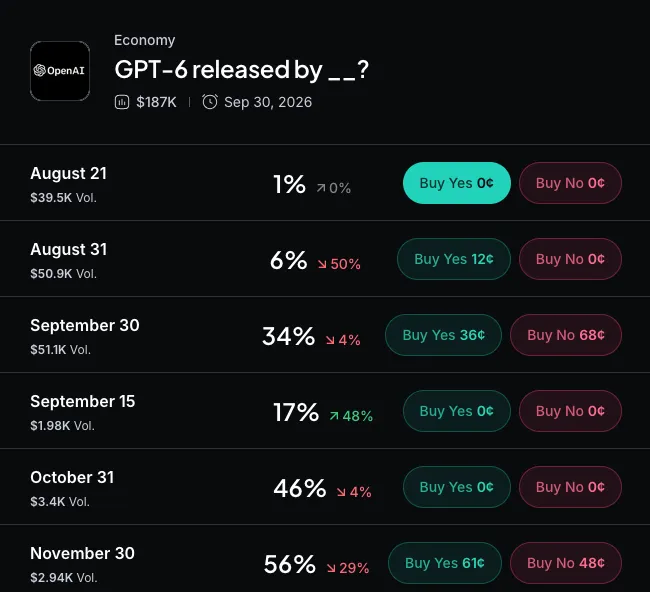
Myriad: When will OpenAI release GPT-6? Click to make your prediction.

Warsh asked whether AI will drive “a significant, sustained rise in productivity across the economy? And if so, when?” He also asked whether “token usage” will be “complementary or competitive to labor.” He answered neither. A Fed task force on productivity and jobs is studying it, and he was blunt that its findings “have no bearing on decisions we make in the current policy conjuncture.”

That gap is the real disclosure. The Fed has decided AI is macro-relevant and simultaneously admitted it has no framework for it yet—while cutting or holding rates on models built before any of this spending existed. Bill Gates has pushed the labor half of that question further, arguing for a robot tax and jobs humans can’t be fired from.

4. Nobody knows who captures the value

Warsh didn’t pretend to have answers. He notes that it’s hard to predict whether AI will actually increase productivity in the global economy, or when that shift will begin.

He also wonders whether this business will result in a global or sectoral growth. “How much of the surplus goes to owners of scarce assets—AI labs, chipmakers, energy producers, and cloud providers?”

He said a Fed task force on “productivity and jobs” is studying it, though its conclusions, he stressed, “have no bearing on decisions we make in the current policy conjuncture.”

Warsh’s own question about scarce assets got a real-world answer two days before he took the podium. Nvidia posted record quarterly revenue of $96.2 billion and disclosed $366 billion in future AI infrastructure commitments, while separately moving to acquire Hugging Face, the open-source AI hub, for roughly $12.9 billion. Conversely, a report from a year ago shows that 95% of generative AI companies are failing.

So the value may be concentrating instead of distributing. If a single chipmaker can absorb that much of the AI buildout’s surplus, and its own compute customers, Warsh’s open question about market structure already has a leading answer.

Daily Debrief Newsletter

Start every day with the top news stories right now, plus original features, a podcast, videos and more.

Read the full article here

Fact Checker

Verify the accuracy of this article using AI-powered analysis and real-time sources.

Get Your Fact Check Report

Enter your email to receive detailed fact-checking analysis

5 free reports remaining

Continue with Full Access

You've used your 5 free reports. Sign up for unlimited access!

Already have an account? Sign in here

Share. Facebook Twitter Pinterest LinkedIn Tumblr Email Telegram Copy Link
News Room
  • Website
  • Facebook
  • X (Twitter)
  • Instagram
  • LinkedIn

The FSNN News Room is the voice of our in-house journalists, editors, and researchers. We deliver timely, unbiased reporting at the crossroads of finance, cryptocurrency, and global politics, providing clear, fact-driven analysis free from agendas.

Related Articles

Media & Culture

Daily Deal: Raspberry Pi Pico With Ultimate Starter Kit

28 minutes ago
Media & Culture

A Tale of Two Tech Panics

29 minutes ago
Cryptocurrency & Free Speech Finance

Circle's USDC takes over Chelsea's jersey in Premier League first sponsorship deal

49 minutes ago
Cryptocurrency & Free Speech Finance

Polish Olympic chief charged in Zondacrypto probe, justice minister says

51 minutes ago
Media & Culture

Pete Hegseth And His Department Of Unconstitutional Revenge Lose Again In California

1 hour ago
Media & Culture

“This Case Begins with a Viral Video” (and Goes on to Involve “the Anti-Doxing League”)

2 hours ago
Add A Comment
Leave A Reply Cancel Reply

Editors Picks

Daily Deal: Raspberry Pi Pico With Ultimate Starter Kit

28 minutes ago

A Tale of Two Tech Panics

29 minutes ago

London’s Africa Centre faces closure Earlier this month, I was saddened to learn that The Africa Centre in London may once again be shutting its doors. It won’t be the first time the centre has had to close – but it may be the last time, although the chief executive is still hopeful he can raise the millions of pounds needed to save it. There’s no point dwelling on the reasons, speculative or factual, behind its current crisis. I did though, looking through a list of its recent events, feel a pang of guilt. I could have done more to support The Africa Centre – turning up, talking to people about it, taking cognisance of the real value it has added over the years to London’s political and social life. When the Africa Centre was founded in 1961, its primary objective was to “educate about, connect to and [advocate] for Africa and its diaspora through arts, innovation, culture, thought leadership and education”. In 1964 it found a home in London’s Covent Garden – the Catholic church purchased an old tomato warehouse on King Street and gifted it “to the people of Africa in perpetuity”. When my parents emigrated to the United Kingdom in the mid-1960s, The Africa Centre was one of the very few places where people like them could find space to negotiate the cultural and social differences between them and the unfamiliar wider world. This process of cultural pollination process worked both ways, mind. Intellectuals, activists and dissidents from across the continent spoke at King Street about the political challenges faced by post-colonial African countries, educating curious audiences who wanted to learn more about a part of the world that for many was at best a construct of the imagination, if even that. For two days last June, the London Archives presented to the public a cross-section of documents, photographs and ephemera from its Africa Centre Collection. The archives were a revealing and at times startling record of political and social openness and curiosity. On one table, a poster from 1968 announced a talk about The Future of the Portuguese Territories – long before Angola and Mozambique became proxy battlegrounds for the Cold War between the Soviets and the West. From 1970, an invitation to a talk by Mrs Lydia Osiyemi, “sociology student and mother”, about The African mother and child in Britain. Judging from the poster (left), I fancy that Mrs Osiyemi’s talk was proposing African solutions to a dilemma that remains very real today – to London’s new arrivals and veterans alike. And then, from the early 1990s, in the centre’s guest book (below right), a tribute from a vanguard of democracy. “I pay tribute to those who founded this institution, and those who run it,” the scrawly script read. “This is …  a major cultural shop-window for Africa of which every African should be proud.” The author: “M.K.O. Abiola of Africa.” The Nigeria I grew up in the 1980s and 1990s, after my parents moved back there for a while, was defined by the ever-present cloud of military dictatorship. I can say that now, in hindsight; it’s strange how one normalises the abnormal when we have nothing to compare it against. When Abiola, a business magnate and politician, ran for president in Nigeria in 1993 for a short while it seemed that the country would escape its history of ethnic strife. But then the military snatched victory from him and imprisoned him, extending their malign grip on the country for another half decade. The BAFTA-winning My Father’s Son is set against the backdrop of that very period. A generation before this, the Africa at the Pictures film festival curated by the centre had offered London similar context to political and social concerns across the continent. Abiola’s entry reminded me that it was in the London, on King Street, that I first began to think more clearly about the right to free expression and what happens when this is curtailed. When Chinua Achebe’s Anthills of the Savannah, an acerbic observation on life under military dictatorship in a fictional west African country, was shortlisted for the Booker in 1987 it couldn’t be bought in Nigeria. I got hold of my copy in London – in the Africa Centre’s cramped and musty bookshop, stuffed with books on and from the continent. It wasn’t all high-minded intellectualism on King Street. The Africa Centre was home to one of the few restaurants in London featuring cuisine from here and there across the continent – Mauritian lamb curry, Algerian couscous, fried plantain and boiled yam. Cost? Dishes were, according to a caption, “between 20p and £3”. Happy days. (An early menu is shown below left). In 2012, the Africa Centre left Covent Garden. Maintaining the Grade II-listed building proved too expensive, some said. Perhaps more to the point, it was no longer a good fit for the commercialised ambience that had sprung up around Covent Garden. The historic building on King Street was sold, and with the support of the Mayor of London and the Arts Council, the Centre relocated itself across the river in 2022, to new premises in Southwark. The last time I was there, in the summer of 2023, was to see a fascinating multi-floor exhibition about Nigeria’s Fuji music. Once again, I was surprised and delighted to learn in the Africa Centre something new about my childhood home, so very far away from it. London of the 1980s and 1990s was nothing like the crucible of cultures that it is today. While migrant communities were not quite silenced, they certainly did not have the right to a voice in the public sphere such as they do today. We complain, correctly, about febrile attempts to exclude inconvenient minority voices from the general discourse today. But we don’t, unfortunately, acknowledge enough the real contribution that physical community spaces, big and small, have made over the years to give London the cultural texture and viscera that makes the challenging and contradictory but still very charming city that it is. I’m going to miss the Africa Centre when it’s gone, and places like it, that helped shaped a city where the right to free expression is still, on the whole, seen to be a good thing. READ MORE

41 minutes ago

Circle's USDC takes over Chelsea's jersey in Premier League first sponsorship deal

49 minutes ago
Latest Posts

Polish Olympic chief charged in Zondacrypto probe, justice minister says

51 minutes ago

Fed Chair Warsh Calls AI a ‘Hinge Point in History’—4 Key Things He Said

54 minutes ago

Pete Hegseth And His Department Of Unconstitutional Revenge Lose Again In California

1 hour ago

Subscribe to News

Get the latest news and updates directly to your inbox.

At FSNN – Free Speech News Network, we deliver unfiltered reporting and in-depth analysis on the stories that matter most. From breaking headlines to global perspectives, our mission is to keep you informed, empowered, and connected.

FSNN.net is owned and operated by GlobalBoost Media
, an independent media organization dedicated to advancing transparency, free expression, and factual journalism across the digital landscape.

Facebook X (Twitter) Discord Telegram
Latest News

That $17B Meta settlement comes with a catch: Your online speech rights

22 minutes ago

Daily Deal: Raspberry Pi Pico With Ultimate Starter Kit

28 minutes ago

A Tale of Two Tech Panics

29 minutes ago

Subscribe to Updates

Get the latest news and updates directly to your inbox.

© 2026 GlobalBoost Media. All Rights Reserved.
  • Privacy Policy
  • Terms of Service
  • Our Authors
  • Contact

Type above and press Enter to search. Press Esc to cancel.

🍪

Cookies

We and our selected partners wish to use cookies to collect information about you for functional purposes and statistical marketing. You may not give us your consent for certain purposes by selecting an option and you can withdraw your consent at any time via the cookie icon.

Cookie Preferences

Manage Cookies

Cookies are small text that can be used by websites to make the user experience more efficient. The law states that we may store cookies on your device if they are strictly necessary for the operation of this site. For all other types of cookies, we need your permission. This site uses various types of cookies. Some cookies are placed by third party services that appear on our pages.

Your permission applies to the following domains:

  • https://fsnn.net
Necessary
Necessary cookies help make a website usable by enabling basic functions like page navigation and access to secure areas of the website. The website cannot function properly without these cookies.
Statistic
Statistic cookies help website owners to understand how visitors interact with websites by collecting and reporting information anonymously.
Preferences
Preference cookies enable a website to remember information that changes the way the website behaves or looks, like your preferred language or the region that you are in.
Marketing
Marketing cookies are used to track visitors across websites. The intention is to display ads that are relevant and engaging for the individual user and thereby more valuable for publishers and third party advertisers.