Close Menu
FSNN | Free Speech News NetworkFSNN | Free Speech News Network
  • Home
  • News
    • Politics
    • Legal & Courts
    • Tech & Big Tech
    • Campus & Education
    • Media & Culture
    • Global Free Speech
  • Opinions
    • Debates
  • Video/Live
  • Community
  • Freedom Index
  • About
    • Mission
    • Contact
    • Support
Trending

Michigan Lawmakers Want To Ban Chinese-Tagged Vehicles From Even Visiting The State. You Know, For Privacy.

19 minutes ago

Elon Musk Becomes the World’s First Trillionaire. Is That Such a Bad Thing?

24 minutes ago

Bitcoin hit bottom at $59,000 marking end to the crypto winter, says Standard Chartered analyst

36 minutes ago
Facebook X (Twitter) Instagram
Facebook X (Twitter) Discord Telegram
FSNN | Free Speech News NetworkFSNN | Free Speech News Network
Market Data Newsletter
Friday, June 12
  • Home
  • News
    • Politics
    • Legal & Courts
    • Tech & Big Tech
    • Campus & Education
    • Media & Culture
    • Global Free Speech
  • Opinions
    • Debates
  • Video/Live
  • Community
  • Freedom Index
  • About
    • Mission
    • Contact
    • Support
FSNN | Free Speech News NetworkFSNN | Free Speech News Network
Home»News»Global Free Speech»Ethiopia expels French journalist Augustine Passilly after reporting trip to Tigray
Global Free Speech

Ethiopia expels French journalist Augustine Passilly after reporting trip to Tigray

News RoomBy News Room2 hours agoNo Comments2 Mins Read1,252 Views
Share Facebook Twitter Pinterest Copy Link LinkedIn Tumblr Email VKontakte Telegram
Ethiopia expels French journalist Augustine Passilly after reporting trip to Tigray
Share
Facebook Twitter Pinterest Email Copy Link

Listen to the article

0:00
0:00

Key Takeaways

Playback Speed

Select a Voice

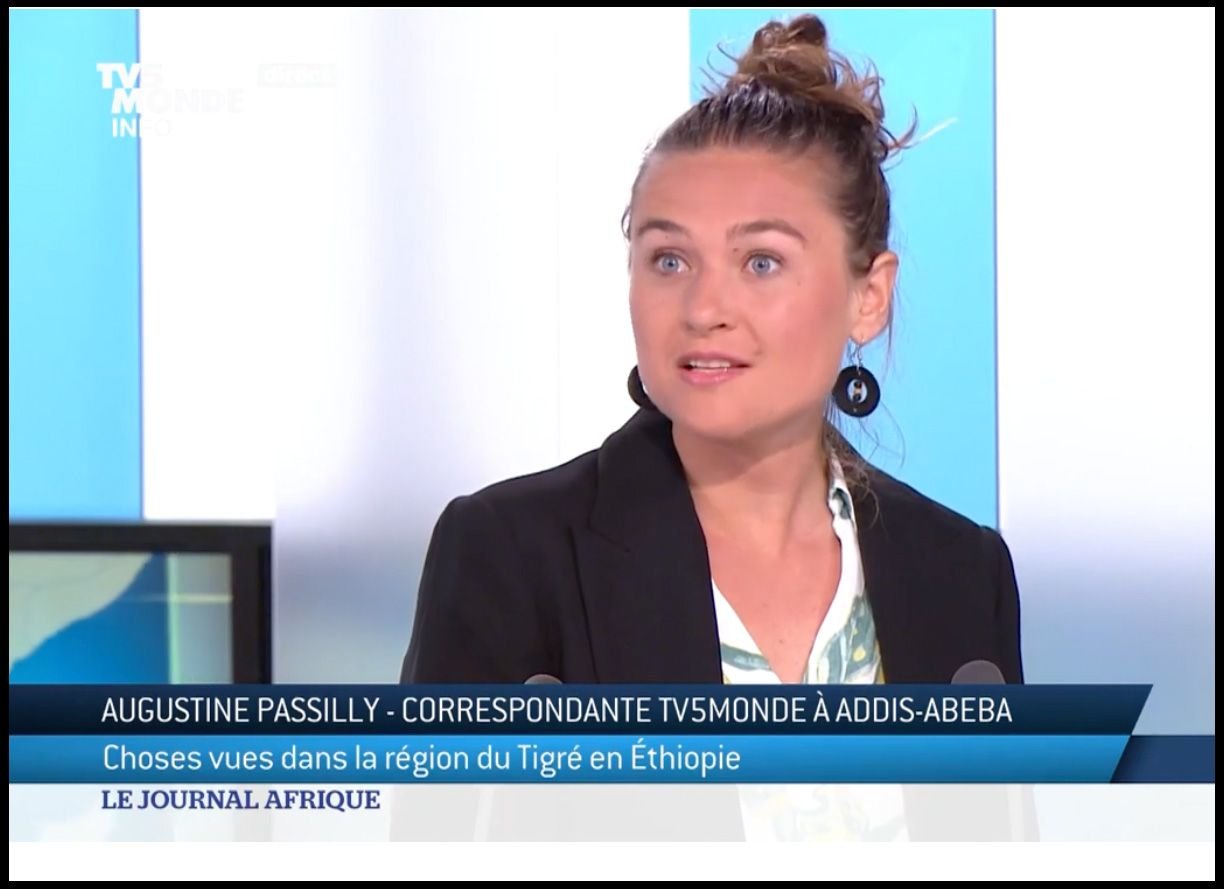
New York, June 12, 2026—The Committee to Protect Journalists calls on Ethiopian authorities to reverse the expulsion of French journalist Augustine Passilly following her reporting trip to the northern state of Tigray, where residents spoke out about their fears of a return to war.

“Ethiopia’s expulsion of Augustine Passilly is a blatant act of retaliation against a journalist for reporting on developments in Tigray, an issue of significant political and security importance that authorities would rather not see scrutinized or discussed publicly,” said CPJ Africa Director Angela Quintal. “Authorities should immediately restore Passilly’s press accreditation and residency permit, allow her to return to Ethiopia and continue her reporting, and stop using regulatory powers to punish independent journalism.”

Passilly, La Croix newspaper’s Ethiopia correspondent since September 2023, told CPJ that she was forced to leave after traveling to the Tigrayan city of Shire on June 3 to report on tensions linked to the 2020–2022 civil war.

Journalists have been shot at and detained in Tigray amid a power struggle among  factions of the Tigray Peoples’ Liberation Front (TPLF), which controls the state, both as a political party and a military force. The TPLF is at odds with the federal government, which banned it as a political party and did not allow Tigray residents to vote in national elections on June 1.

After her return to the capital Addis Ababa on June 6, Passilly was summoned by the regulatory Ethiopian Media Authority and questioned her about the trip, she said. Officials said Passilly’s media accreditation, which was valid until September, would be temporarily suspended due to security concerns, she told CPJ.

Passilly’s story, published on June 8, said Shire’s residents were being subjected to forced recruitment and ordered to finance military camps.

That same day, the media authority informed Passilly that her accreditation had been revoked and told her to leave Ethiopia, she said. She was issued an exit visa and left for France shortly afterwards.

Passilly’s expulsion follows recent Ethiopian restrictions on foreign and independent media, including actions against Reuters, Deutsche Welle, Addis Standard, and Wazema Radio.

The Ethiopian Media Authority did not immediately respond to CPJ’s emailed request for comment.

Read the full article here

Fact Checker

Verify the accuracy of this article using AI-powered analysis and real-time sources.

Get Your Fact Check Report

Enter your email to receive detailed fact-checking analysis

5 free reports remaining

Continue with Full Access

You've used your 5 free reports. Sign up for unlimited access!

Already have an account? Sign in here

Share. Facebook Twitter Pinterest LinkedIn Tumblr Email Telegram Copy Link
News Room
  • Website
  • Facebook
  • X (Twitter)
  • Instagram
  • LinkedIn

The FSNN News Room is the voice of our in-house journalists, editors, and researchers. We deliver timely, unbiased reporting at the crossroads of finance, cryptocurrency, and global politics, providing clear, fact-driven analysis free from agendas.

Related Articles

Global Free Speech

President Donald Trump and FIFA President Gianni Infantino at the White House for the World Cup 2025 draw. Photo: White House “We don’t live on the moon, we live on planet Earth. We have to respect that we are not kings of the world, who can rule over governments and police forces.” These were the words of FIFA president Gianni Infantino at a press conference ahead of the World Cup which has started this week. Infantino was responding to criticism of FIFA’s organisation of football’s greatest tournament, which is being held in the USA, Mexico and Canada. Historically, FIFA has sought to present football as neutral territory, distant from ideological and partisan disputes. The World Cup started out as a symbol of global unity, a celebration of diversity, dialogue between cultures, and football’s ability to bring people together in an increasingly polarised world. However, neutrality can also be interpreted as a way of silencing certain debates. Whenever the organisation decides to limit the free expression of athletes, fans, or host cities, accusations arise that it is privileging a specific view of what can or cannot be said within the sporting environment. The World Cup of today is a money-making juggernaut. The 2026 event is likely to see $11.5 billion pour into FIFA’s coffers and questions over the organisation’s propriety are never far away. As the tournament begins, a series of events has highlighted a debate that goes far beyond the pitch: to what extent is freedom of expression being respected at the world’s biggest sporting event and how much influence do the host countries have in who can do or say what? One of the highest profile incidents related to Somali referee Omar Artan. Selected to officiate at the World Cup, Artan would have become the first Somali referee to participate in the tournament. However, he was not allowed entry into the USA by immigration authorities, preventing his participation in the competition. Somalia is one of the many countries on a travel ban list issued by Trump’s government. The referee’s banning provoked an international reaction and was met with indignation in his country of origin, where the referee was treated as a hero upon his return. Addressing crowds in Mogadishu on his return, Artan said, “Somalia belongs to all of us. Whether times are good or difficult, I want to tell our youth not to lose hope in our country.” For many observers, the case symbolised the conflict between the sometimes harsh immigration policies of individual countries and the principles of universality that should guide a global event like the World Cup. While governments have the sovereign right to control their borders, critics argue that preventing the presence of professionals accredited by FIFA itself contradicts the spirit of inclusion that the organisation claims to uphold. The participation of Iran, at war with the USA, is also proving a tricky challenge for FIFA. The Iranian Football Federation reported problems involving fans who had bought tickets for World Cup matches but subsequently had their travel permits revoked or faced obstacles entering the host country. The federation said: “This incident raises serious questions about the influence of non-sporting and political considerations on the organisation of the world’s biggest football event.” In a tournament presented as a global celebration, the possibility that political and diplomatic factors could interfere with fan attendance has reignited concerns about indirect discrimination. The issue is not just about the right to watch a match. Modern football is also a space for cultural expression and collective identity. When certain groups face additional barriers to attend the event, it seems the voices of some fans are considered to be worth listening to more than others. The challenges of running a global event with participation from countries with vastly differing social attitudes is also a prickly problem for FIFA. Seattle is one of the host cities of the competition and six matches will be played at the city’s main stadium. As the tournament coincides with Pride month, one of the matches – between Egypt and Iran – has been designated a Pride match. Seattle’s mayor-elect Kate Wilson wrote on Instagram, “With matches on Juneteenth and Pride, we get to show the world that in Seattle, everyone is welcome…What an incredible honor!” Iran and Egypt are not quite so impressed. Homosexuality is banned in Iran with LGBTQ+ individuals sometimes facing the death penalty. It is not explicitly banned in Egypt but people are frequently detained and prosecuted under morality laws. The Egyptian football federation made an official complaint, saying it “categorically rejects the holding of any activities related to supporting homosexuality”. The Iranians chipped in, saying, “It is an unreasonable and illogical thing [for a match between the two teams] to support a specific group.” The episode laid bare another challenge faced by FIFA in the 21st century: how to reconcile profoundly different cultures, beliefs, and worldviews within the same event? In a globalised environment, what for some represents a legitimate expression of identity may be seen by others as an inappropriate political message. The line separating individual expression and political positioning becomes increasingly difficult to define. Infantino has tried to shrug off the criticism of these items as well as absurdly high ticket prices (despite which more than six million tickets have been sold). At the pre-tournament press conference Infantino called on fans to “chill and relax” in face of the problems faced by some. He also stated that he should be given credit for Iran being allowed to participate at all, given the USA is at war with the country. Infantino’s supporters believe that the leader seeks to prevent external issues from dominating the World Cup narrative, his critics argue that this stance ignores legitimate problems related to rights, inclusion, and transparency. Interestingly, these controversies contrast with the institutional message promoted by FIFA itself. On several occasions, Infantino has highlighted football’s role as a tool for peace and international dialogue. The organisation frequently emphasises that the sport has the unique ability to unite people regardless of nationality, religion, origin, or political stance. However, recent events demonstrate how complex this mission becomes when confronted with migration policies, diplomatic interests, and cultural disputes. Another important aspect of the debate involves the press. Major sporting events usually attract journalists from all over the world, responsible not only for covering the matches, but also for investigating social, economic, and political issues related to the tournament. Press freedom organisations warn that access to information and the possibility of reporting on sensitive topics without restrictions are fundamental elements for ensuring transparency. When certain issues generate discomfort for governments or organisers, the risk of indirect pressure on journalistic coverage arises. The 2026 World Cup demonstrates that discussions about censorship and freedom of expression are no longer limited to the explicit prohibition of speech. Today, they appear in more subtle issues: who is authorised to enter the country, what symbols are allowed in stadiums, what demonstrations are considered acceptable, and what topics can be discussed without generating reprisals. In a world marked by geopolitical tensions, debates about identity, and security concerns, the promise of a football capable of uniting all peoples is put to the test. The 2026 World Cup will be remembered for the goals, the misses and the champions. But it may also be remembered as a milestone in an increasingly relevant discussion: how to balance security, diversity, and freedom of expression in a truly global event. The answer to this question may be as important for the future of football as any result achieved on the field. READ MORE

3 hours ago
Global Free Speech

Pakistani authorities detain journalist Sohrab Barkat again over reporting on Kashmir

10 hours ago
Global Free Speech

An Afghan teacher. Photo: Yunus Tuğ/Unsplash+ I was sitting in the staffroom of the school where I teach. It was a hot afternoon, and the weather made everything feel heavier. The room was small and crowded, with furniture pushed tightly against the walls as if it had been forced into place years ago and never moved again. Beside me stood an old grey metal cupboard where we kept our daily lesson plans. Its doors were stiff and heavy, and sometimes we had to push hard just to open it properly. The room had only one window. Because the building was above the second floor, the window had been built high into the wall according to local customs, so people could not easily look into their neighbours’ homes. From where I sat beside the cupboard, I could glimpse the sky. It was pale blue mixed with grey, but the sunlight spread across it so harshly that it almost looked white. The brightness felt distant, as if it belonged to another world outside the room. Beside me sat Basira, one of my colleagues who had studied architectural engineering at university. Sometimes she looked at that window and spoke about the years she had spent drawing designs and construction plans, believing she was building a future for herself. She once told me that architecture had taught her to think about light, openness and possibility. Now she sat in a room where even the architecture carried silence and limitation. It was a private school, because that was the only place I could find work. In Afghanistan, private schools are usually attended by the children of businessmen, powerful families and those who can afford better educational opportunities. I studied in a public school myself and I have always believed that education does not depend entirely on the type of school someone attends, but on the determination and enthusiasm of the student. But when I went looking for a job, my opportunities were restricted. After the Taliban came to power in Afghanistan, women were stopped from teaching boys over the age of seven, and girls over the age of 11. Many high school teachers lost their jobs, their profession, their source of independence, stability and participation in society. Some of them moved down to teach at primary school. At the same time, women from other professions, like Basira, went into teaching because it was the only job open to them. The result is that a private school in Kabul or Mazar has an infinite supply of highly qualified women teachers and can treat them as badly as they like. We live under threat. As one of my colleagues said to me once: “Bring a knife and kill us instead. How can we live after being fired with no future and no place in society?” A simple example: laptops. I was expected to bring my own – but I did not have one. This article is typed on a phone. I use my phone for my lesson plans and everything else. But even our phones had to stay hidden most of the time because teachers were not supposed to use them openly during school hours. The administration believed phones distracted teachers from teaching and worried they would spend time scrolling through social media instead of focusing on students. Cameras were installed in every classroom and hallway, and teachers were constantly watched by the school administration. At break, 17 teachers shared the staffroom. Now, four were outside supervising students during the break, while the rest of us squeezed together wherever we could find space. Sometimes we sat so close it felt as if we were sitting in each other’s laps. Beside me sat Freshta, who had studied English literature and spent two years studying nursing before her education was interrupted. She had dreamed of becoming a doctor, but now she taught Oxford Science to young children in a private school. I was studying medicine myself, carrying my own unfinished hopes quietly beside me each day. Across the room sat Yalda, who had studied law and imagined a future in the courts, before the Taliban returned. Teaching was never supposed to be her life. Susan was one of the few who truly loved teaching. She studied mathematics and taught the Afghan curriculum, while I taught Oxford mathematics, which was slightly more advanced. But even Susan was easily replaceable. Our headteacher often spoke of our students studying for their future, but all the time his teachers were learning how temporary they were. Sometimes the worry of losing this last remaining job reminded me of The Metamorphosis, where Gregor worries about work even after turning into an insect. When it comes down to it, people care less about who leaves than about who can still be useful. Across the room one of our middle-aged teachers, Ustad Ziba, was struggling. She suffers from heart problems and finds it difficult to breathe while teaching in a mask. One of her hands constantly pulls the mask down and pushes it back up again as she gasps for air. We thought we were lucky to be in a school where, after much discussion, women teachers were not required to wear the full burqa inside. Instead, we wear a hijab, a headscarf that covers a woman’s hair, neck, shoulders and sometimes the chest, so that not even a single strand of hair is visible. It is worn with a long, loose dress that covers the entire body. In addition, all teachers wear a medical face mask, which covers the nose and mouth. On hot days though, even this lighter face covering is restrictive. Before these rules, long dresses were my favourite clothes. But after they became mandatory, my feelings changed. Whenever I wear them now, I feel as if I am tied with ropes. As I walk, I am constantly afraid of slipping because the long skirt sometimes gets stuck under my feet. When I move around the classroom while teaching, I often think, “What if I suddenly fall in front of my students?” Even simple movements no longer feel natural or comfortable. I was eating a biscuit with a glass of green tea when our male headteacher, a man around 37 years old, came in. In school, he wears local Afghan clothes because in formal workplaces it has become compulsory for men as well as women. Today, he was wearing a long tunic (perahan), loose trousers (tunban) and a long outer coat. No face mask for him though. I could see his kind, anxious face. Our headteacher is an educated man and has two daughters. From the time he started at our school he has always spoken to us in a calm and respectful way. Unlike many others, he did not seem happy about the restrictions placed on women. I felt that he understood our struggles, even if he could not openly speak against the rules. He was part of the school administration, but always afraid that Taliban officials might suddenly arrive without warning to inspect the building. It was always a shocking event: dusty white pick-up trucks would roll up,  armed men sitting in the front. The back opened onto a space for carrying groups of fighters. Truckloads of dust and fear. They would enter our school without even asking permission from the administration, park their vehicles outside the gates and step out with guns hanging from their shoulders. They’d walk through the corridors as if they were searching for a fugitive or someone who had committed a terrible crime. Their radios crackled in their hands while teachers and children lowered their eyes and became silent. Even before they spoke, terror spread through the building. That day, the headteacher told us about something he had heard the day before. A woman walking beside her husband in the market had been stopped because her mask was not covering her face properly. As he spoke, I imagined the scene clearly in my mind. In many provinces, women are beaten with whips by the morality police. This time though he said there were also female workers with the Taliban patrol. They surrounded the woman in the crowded market while male officers stood nearby watching. The woman resisted, perhaps only by trying to protect herself or pull her veil closer around her face, and then the female officers were ordered to beat her. Afterward, they grabbed her by the arms and pulled her toward the waiting vehicle to take her away. All the people watched silently, as if a film scene were unfolding in front of them, yet no one dared to speak. Fear held every voice down. I imagined the dirt roads of the market, the carriages and carts parked around the crowded streets, and the salesmen with tired faces standing helplessly behind their vegetables and goods. Dust hung in the hot air while the woman was dragged away, and everyone pretended not to see because in that moment even looking too long could be dangerous. He lowered his gaze and looked down. There was a kind of silent shame on his face, a silence that many men in Afghanistan seem to carry when they witness these restrictions, but cannot openly oppose them.  The weight of it all bore down on the room. We teachers looked at each other. Yalda pressed her mask tighter against her face, as if trying to disappear into it. Freshta looked down, as if she was searching on the floor for the lost sparkles in her eyes. I stopped eating my biscuit. For a few seconds, no one spoke. The silence was so deep that it felt like even breathing had become louder than usual. The headteacher said: “Dear teachers, your dignity is more important than anything to us. We don’t want any of you to be beaten or arrested on the excuse that you are wearing makeup, using nail polish or not properly covering your face and body.” After that, he left the room. But the heaviness of his words, and the heaviness of these rules, stayed in the room. At that moment something inside me tightened. The room felt even smaller. I looked away and stayed silent. I thought about all the years I had spent studying and working for a future I believed in. I had worked so hard to become someone. Yet now, even the smallest choices, how I dressed, whether I covered my face with a mask on a hot afternoon, no longer belonged to me. I realised that I wanted to scream. Not just a sound, something deeper. I wanted to scream that I exist. That I am a human being. That I have thoughts and a heart and a voice. But the scream did not come out. It stayed inside my throat like a stone that I could not swallow or remove. I wiped my tears before anyone could notice. Outside, life continued as normal. Inside us, something had already changed, even if nothing around us did. I can still feel that scream now. I’m putting it here. Rahmati is a 24-year-old and lives in Kabul, Afghanistan. She had been studying at Kabul University for two years, but her education was stopped. She currently works in education and writes under a pen name for her safety. Some personal details have been adjusted to protect her identity and her family. This story is very personal to her. It reflects the emotional reality of living under restrictions and the silence experienced by many Afghan women. Writing has become her only way to express what cannot be safely spoken in daily life. She hopes that, through publication, these experiences will be seen and understood by a wider audience. READ MORE

1 day ago
Global Free Speech

Tunisian journalist Khaoula Boukrim sentenced in absentia to 4 years in prison 

1 day ago
Global Free Speech

Chicken heads sent to Indonesian news outlet after threats over coverage of Papua documentary

1 day ago
Global Free Speech

CPJ calls on EU to support press freedom reform in Hungary 

1 day ago
Add A Comment
Leave A Reply Cancel Reply

Editors Picks

Elon Musk Becomes the World’s First Trillionaire. Is That Such a Bad Thing?

24 minutes ago

Bitcoin hit bottom at $59,000 marking end to the crypto winter, says Standard Chartered analyst

36 minutes ago

Will Bitcoin’s 200-Week Moving Average Ruin the BTC Price Comeback?

36 minutes ago

Americans Fear Job Losses Due to AI But Hope for Cancer, Alzheimer’s Cures: Anthropic Survey

39 minutes ago
Latest Posts

Maryland Court Rules Against Unconstitutional Stop-and-Frisk in Victory for State’s Gun Owners

1 hour ago

Ethiopia expels French journalist Augustine Passilly after reporting trip to Tigray

2 hours ago

SpaceX opens at $162 in blockbuster Nasdaq debut

2 hours ago

Subscribe to News

Get the latest news and updates directly to your inbox.

At FSNN – Free Speech News Network, we deliver unfiltered reporting and in-depth analysis on the stories that matter most. From breaking headlines to global perspectives, our mission is to keep you informed, empowered, and connected.

FSNN.net is owned and operated by GlobalBoost Media
, an independent media organization dedicated to advancing transparency, free expression, and factual journalism across the digital landscape.

Facebook X (Twitter) Discord Telegram
Latest News

Michigan Lawmakers Want To Ban Chinese-Tagged Vehicles From Even Visiting The State. You Know, For Privacy.

19 minutes ago

Elon Musk Becomes the World’s First Trillionaire. Is That Such a Bad Thing?

24 minutes ago

Bitcoin hit bottom at $59,000 marking end to the crypto winter, says Standard Chartered analyst

36 minutes ago

Subscribe to Updates

Get the latest news and updates directly to your inbox.

© 2026 GlobalBoost Media. All Rights Reserved.
  • Privacy Policy
  • Terms of Service
  • Our Authors
  • Contact

Type above and press Enter to search. Press Esc to cancel.

🍪

Cookies

We and our selected partners wish to use cookies to collect information about you for functional purposes and statistical marketing. You may not give us your consent for certain purposes by selecting an option and you can withdraw your consent at any time via the cookie icon.

Cookie Preferences

Manage Cookies

Cookies are small text that can be used by websites to make the user experience more efficient. The law states that we may store cookies on your device if they are strictly necessary for the operation of this site. For all other types of cookies, we need your permission. This site uses various types of cookies. Some cookies are placed by third party services that appear on our pages.

Your permission applies to the following domains:

  • https://fsnn.net
Necessary
Necessary cookies help make a website usable by enabling basic functions like page navigation and access to secure areas of the website. The website cannot function properly without these cookies.
Statistic
Statistic cookies help website owners to understand how visitors interact with websites by collecting and reporting information anonymously.
Preferences
Preference cookies enable a website to remember information that changes the way the website behaves or looks, like your preferred language or the region that you are in.
Marketing
Marketing cookies are used to track visitors across websites. The intention is to display ads that are relevant and engaging for the individual user and thereby more valuable for publishers and third party advertisers.