Close Menu
FSNN | Free Speech News NetworkFSNN | Free Speech News Network
  • Home
  • News
    • Politics
    • Legal & Courts
    • Tech & Big Tech
    • Campus & Education
    • Media & Culture
    • Global Free Speech
  • Opinions
    • Debates
  • Video/Live
  • Community
  • Freedom Index
  • About
    • Mission
    • Contact
    • Support
Trending

Mizzou investigates professor over months-old remarks about DEI

49 seconds ago

EFF Statement on California Governor’s Executive Order on AI

2 minutes ago

Trump Says Arch Must Be Built Because We Need Somewhere To Store Our Precious ‘Sniper Ammo’

3 minutes ago
Facebook X (Twitter) Instagram
Facebook X (Twitter) Discord Telegram
FSNN | Free Speech News NetworkFSNN | Free Speech News Network
Market Data Newsletter
Wednesday, September 23
  • Home
  • News
    • Politics
    • Legal & Courts
    • Tech & Big Tech
    • Campus & Education
    • Media & Culture
    • Global Free Speech
  • Opinions
    • Debates
  • Video/Live
  • Community
  • Freedom Index
  • About
    • Mission
    • Contact
    • Support
FSNN | Free Speech News NetworkFSNN | Free Speech News Network
Home»News»Media & Culture»Elon Said Fighting CSAM Was “Priority #1.” A NY Times Reporter With A Script Found 75 Known Images.
Media & Culture

Elon Said Fighting CSAM Was “Priority #1.” A NY Times Reporter With A Script Found 75 Known Images.

News RoomBy News Room2 hours agoNo Comments6 Mins Read1 Views
Share Facebook Twitter Pinterest Copy Link LinkedIn Tumblr Email VKontakte Telegram
Elon Said Fighting CSAM Was “Priority #1.” A NY Times Reporter With A Script Found 75 Known Images.
Share
Facebook Twitter Pinterest Email Copy Link

Listen to the article

0:00
0:00

Key Takeaways

Playback Speed

Select a Voice

When Elon first took over Twitter with grand plans to “bring back free speech,” I tried to help him run through the standard content moderation learning curve that basically every site created by a clueless tech bro runs through. They all start with “we’re the free speech site, we allow everything!” and very quickly someone points out that “everything” includes blatantly illegal child sexual abuse material (CSAM). I’ve since been told by multiple former X employees that Elon definitely saw that article and… absolutely hated it.

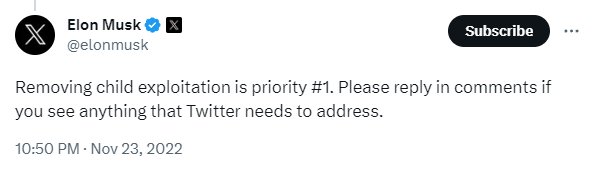
Anyway, soon after that Elon announced that “removing child exploitation is priority #1,” though also suggested people point out CSAM in replies to him if they saw it (which is not how that should be done at all, since it would just point more people to CSAM).

There was also little to no evidence that stopping CSAM was actually “priority #1” seeing that he fired most of the trust & safety team so that at one point there were fewer than 10 specialists working on CSAM. This caused X’s attempts at stopping CSAM to completely fall apart, with experts in the space seeing plenty of evidence that the problem was growing on the platform, rather than shrinking. It probably didn’t help that Musk personally intervened to reinstate the banned account of a conspiracy theorist he really liked after that conspiracy theorist posted one of the most infamous, and most horrifying CSAM images known to authorities.

Of course, that was in the early days. One would hope that a few years further up the learning curve, he’d have learned something. But this is Elon we’re talking about. Last year there was a report that one of the major tool providers for CSAM detection, Thorn, had cut off X, because Elon refused to pay the bill. At the time, X responded angrily to anyone asking about the Thorn situation by claiming that they had put in place their own, better technology to spot CSAM.

How’s that going? Not too well, according to the NY Times, which worked with the Canadian Center for Child Protection to scan X for known abuse imagery. The report covers two separate findings, both of which are alarming. First, there have been obviously lots of reports (and a growing number of lawsuits) regarding claims of Grok producing CSAM. Much of the early reporting, though, didn’t clearly distinguish between actual CSAM and images that are still horrifying and problematic, but probably don’t legally qualify as CSAM.

However, the Canadian Center for Child Protection is certainly able to determine what is actual CSAM, and they were able to find dozens of images that Grok created that appeared to qualify:

In December and January, Grok’s X account produced millions of images of people with their clothing removed in response to prompts from users. After a public outcry, X said it would halt the account from producing those images.

Later, the Canadian center found 65 instances in which Grok created sexualized or exploitative images of children before X halted the bot. During that time frame, users also prompted the chatbot to edit clothed photos of known victims of childhood sexual abuse and depict them in lingerie or bikinis.

Equally as concerning, though, was that the NY Times was able to use PhotoDNA, the baseline tool that many web services use to identify known CSAM via hash matching, and found even more examples this year:

The Times conducted its own scan for child sexual abuse material on X by writing an automated computer program that searched for related terms without displaying the images, which are illegal to view. Links to the images were sent to a Microsoft service that checked whether they were included on lists of known abusive material compiled by the National Center for Missing and Exploited Children and other child safety groups. Matches were verified by analysts at the Canadian Center for Child Protection.

The Times found more than 75 images between January and June. The program The Times wrote reported the images to the authorities. The images were removed, but some had been viewed hundreds of times.

This matters because stopping CSAM is a never-ending game of whac-a-mole when it comes to new material. But, for the most part, that’s not true for old material. PhotoDNA and a few similar offerings have gotten quite good at catching the set of “known” images that circulate over and over, and blocking those before they ever hit a site is baseline competency in trust & safety. These images should never have made it to the site, let alone “viewed hundreds of times.”

One explicit photo The Times’s automated program found on X, which has been known to authorities for at least seven years, showed a young girl with fluid on her face being raped orally. The post of the photo, which advertised the sale of similar illegal content, was publicly available for over an hour in March and received 16 likes and nine reposts from other users before The Times found and reported it.

The person depicted in the image, now an adult, said in an interview that she believed X profited from her abuse and further victimized her by not stopping the image from being shared.

“They’re getting benefits from my abuse, and it just feels like it’s never going to stop,” the woman said of X. She spoke on the condition of anonymity because she has been stalked by people who viewed images of her abuse online. “I get angry that I’m still having to go through this decades later, and that there doesn’t seem to be real-life consequences for people.”

The whole joke in that speedrun piece from four years ago was that Level One lasts about five minutes. You announce that anything goes, someone points out that “everything” includes CSAM, and you quickly learn how to start fighting CSAM — because that’s the one bit of content moderation that everyone agrees on. And the easiest version of that, catching the known images via hash-matching, has had obvious battle tested tooling for years. Elon chose not to use them, insisting he’d built something better himself (perhaps with Grok?). Yet, what he built appears to have been outperformed by a NY Times reporter with a script and access to the PhotoDNA API.

Four years in, and Elon still hasn’t cleared Level One of the curve. Yikes.

Read the full article here

Fact Checker

Verify the accuracy of this article using AI-powered analysis and real-time sources.

Get Your Fact Check Report

Enter your email to receive detailed fact-checking analysis

5 free reports remaining

Continue with Full Access

You've used your 5 free reports. Sign up for unlimited access!

Already have an account? Sign in here

#DigitalCulture #IndependentMedia #InformationAge #Innovation #MediaNews #OnlineMedia
Share. Facebook Twitter Pinterest LinkedIn Tumblr Email Telegram Copy Link
News Room
  • Website
  • Facebook
  • X (Twitter)
  • Instagram
  • LinkedIn

The FSNN News Room is the voice of our in-house journalists, editors, and researchers. We deliver timely, unbiased reporting at the crossroads of finance, cryptocurrency, and global politics, providing clear, fact-driven analysis free from agendas.

Related Articles

AI & Censorship

EFF Statement on California Governor’s Executive Order on AI

2 minutes ago
Media & Culture

Trump Says Arch Must Be Built Because We Need Somewhere To Store Our Precious ‘Sniper Ammo’

3 minutes ago
Media & Culture

The ‘AI Safety’ Movement Is Making AI Less Safe

5 minutes ago
Debates

Pascal Bruckner: I Suffer Therefore I Am, Reviewed

26 minutes ago
Legal & Courts

FCC’s threats to ABC licenses ‘pose a grave danger’ to democracy

29 minutes ago
Cryptocurrency & Free Speech Finance

$161 Million in Decade-Old Bitcoin Has Moved in Just Two Weeks

39 minutes ago
Add A Comment
Leave A Reply Cancel Reply

Editors Picks

EFF Statement on California Governor’s Executive Order on AI

2 minutes ago

Trump Says Arch Must Be Built Because We Need Somewhere To Store Our Precious ‘Sniper Ammo’

3 minutes ago

The ‘AI Safety’ Movement Is Making AI Less Safe

5 minutes ago

Let’s Make Your Voting Plan!

19 minutes ago
Latest Posts

Leading news outlets issue statement in defense of a US free press

20 minutes ago

Turkey under Recep Tayyip Erdoğan has already considers queer lifestyles an impediment to its goals This has been a chilling week for Turkey’s LGBTQ+ communities, perhaps the most unsettling in many years, as police raids against their members sent shockwaves among the country’s marginalised, precarious but well-connected queer groups.   Turkish police have detained multiple individuals from LGBTQ+ rights organisations across Turkey’s 15 provinces, conducting raids on queer association headquarters, confiscating documents from activists, blocking access to websites and social media accounts.  The coordinated raids surprised some, as Turkey has never legally banned homosexuality from Ottoman times onward, but operations, conducted under the government-branded “My Family is Safe” initiative, began on 12 September. An Istanbul court blocked access to numerous websites and social media accounts belonging to LGBTQ+ organisations and activists.  Over five days, courts launched investigations against at least 116 individuals, nine associations, and thirteen businesses. At least 82 were formally arrested as a result of the raids, 25 of whom are LGBTQ+ activists or have formal connections to queer associations. In January 2025, the Turkish government announced 2025 would be “the year of the family”.  Throughout 2025, there were widely shared fears among Turkey’s LGBTQ+ communities of an operation against queer associations and activists. Yet Ankara didn’t take action, despite heightened government rhetoric against “degenerates” and the “LGBT imposition” and “desexualisation policies of globalists”. Then, in May 2025, the government announced an extension of the project, branding 2026-2035 as the “decade of family and population”.  Ankara considers queer lifestyles an impediment to population growth and promised to establish a “digital family shield” to identify, assess, and prevent “harmful elements” that pose a threat to “the health of the Turkish family”.  Instead of passing a law that legally banned queer relationships, the government launched a wave of police operations, branding the effort “My Family is Safe”. “This operation is taking place now because the optimal conditions for carrying it out have been cultivated over the years,” Seçil Epik, founder of Turkish queer publisher Umami, told Index. “For us activists, this comes as no surprise.” Ankara considers queer lifestyles an impediment to population growth Over the past week, the government blocked the website of Kaos GL, Turkey’s first legal LGBTQ+ association, founded in 1994 and granted legal status in 2005. Editors quickly changed its web address to circumvent the ban.   “We don’t have any clear picture of why the operation has begun this week,” Yıldız Tar, editor of Kaos GL, told Index. “It was more like an escalated process that started in 2015 with the attack on pride marches. Now they’re directly targeting LGBTQI organisations, activists and ordinary LGBTQ+ individuals only because they are queer.” Tar was taken into custody on June 23 and sent to Sincan Prison two days later on allegations of “membership in a terrorist organisation” in the days leading up to the Nato Summit in Ankara.  After a month in detention, authorities released him alongside several other individuals, including academics.  Tar had been previously detained on similar allegations in February 2025 and released in May 2025.  “They tried to criminalise homosexuality by passing a law in parliament, but they couldn’t, due to our efforts. Now they are trying to act as if that law passed,” says Tar. Ankara also banned access to ÜniKuir’s news site, the Pink Life (Pembe Hayat) Association, the Youth LGBTI+ Association, Lambdaistanbul, the Muamma LGBTI+ Association, and other queer publications. The ban extended to the social media accounts of actor and trans rights activist Seyhan Arman, and theatre actor and LGBTQ+ activist Zeynep Esmeray Özadikti. On September 13, a day after the internet bans, police in Ankara raided Kaos GL’s office in the Turkish capital, as well as the apartments of Kaos GL members who served on the association’s supervisory boards. “They are trying to act as if that law passed” Kaos GL reported that more than ten LGBTQ+ activists were detained as part of this investigation, led by the Ankara Chief Public Prosecutor’s Office’s Cybercrimes Bureau.  The Kaos GL raid was based on allegations of “obscenity”, an offence defined under Article 226 of the Turkish Penal Code (TCK), alongside alleged violations of the Law on Associations.  The Ankara Chief Public Prosecutor’s Office alleged that “posts containing obscenity” were shared on Kaos GL’s social media accounts in a “manner accessible to children.”  Turkish police and gendarmerie also carried out operations at numerous addresses in Istanbul, targeting queer spaces, like nightclubs and bathhouses, in Beyoğlu and Şişli districts. On 16 September, eight people, five of whom are trans women, were formally arrested, including several Kaos GL board members and the investigative journalist Tuğba Tekerek.  While in custody, Tekerek sent a message to the public: “The ‘lottery’ hit me this time. In 2024, I had traveled to Georgia before the elections and produced various news reports for several outlets. Among them, I had also filed a commissioned story for the Kaos GL news site.”  Tekerek said she was charged with “administering Kaos GL’s Instagram account”, which she said had “absolutely no basis in fact. I simply produced a news report as part of my journalism work. The truth will come out sooner or later.”  Authorities also organised raids in Mersin. The Mersin Chief Public Prosecutor’s Office ordered the detention of individuals who allegedly produced and disseminated “obscene content on social media”. “This sweeping crackdown, in which scores of people have been arrested, has nothing to do with protecting families” As part of the investigation, a Mersin court moved to shut down the “Muamma LGBT Association” and the “Mersin 7 Colors LGBT Association,” both operating in central Mersin. The latest raids drew a strong international reaction. The European Commission said stigmatisation and discrimination run counter to EU values. Council of Europe Human Rights Commissioner Michael O’Flaherty emphasised that explanations based on “family values” and the “protection of children” couldn’t justify restricting human rights.  International rights organisations, led by Ilga-Europe, characterised the operations as a “coordinated attack”. “This sweeping crackdown, in which scores of people have been arrested, has nothing to do with protecting families and everything to do with further harming and stigmatising a community that has battled decades of discrimination and intimidation,” said Amnesty International’s Esther Major, calling for the release of those detained.  Amidst the backlash, a Turkish court blocked access to social media accounts of Amnesty’s Turkish branch, alongside the leftist daily Evrensel, Media and Law Studies Association (MLSA), and Academics for Peace, among others.  At the time of writing, an Amnesty International spokesperson said they had not received any official notification regarding the decision. Still, they noted that as of September 14, their X account could not be accessed from within Turkey. Local reaction was similarly vocal. MPs from opposition parties condemned the operations.  Several queer and feminist groups prepared to deliver a statement about the raids outside Istanbul’s Çağlayan Courthouse on 15 September.  But when the crowd gathered in front of the courthouse around noon, the police told them to disperse before detaining 106 individuals.  Among those detained were Birgün newspaper reporter Sarya Toprak and Şener Azak, who works for Germany’s ARD network.  “We have reached this point as a result of the state’s years-long campaign to target and criminalise LGBTI+ individuals using all available media channels,” said Epik, the publisher. “LGBTI+ people in Turkey are anxious and fearful, and their very existence is on the verge of being outlawed, yet—as always—they continue to resist.”  READ MORE

24 minutes ago

Pascal Bruckner: I Suffer Therefore I Am, Reviewed

26 minutes ago

Subscribe to News

Get the latest news and updates directly to your inbox.

At FSNN – Free Speech News Network, we deliver unfiltered reporting and in-depth analysis on the stories that matter most. From breaking headlines to global perspectives, our mission is to keep you informed, empowered, and connected.

FSNN.net is owned and operated by GlobalBoost Media
, an independent media organization dedicated to advancing transparency, free expression, and factual journalism across the digital landscape.

Facebook X (Twitter) Discord Telegram
Latest News

Mizzou investigates professor over months-old remarks about DEI

49 seconds ago

EFF Statement on California Governor’s Executive Order on AI

2 minutes ago

Trump Says Arch Must Be Built Because We Need Somewhere To Store Our Precious ‘Sniper Ammo’

3 minutes ago

Subscribe to Updates

Get the latest news and updates directly to your inbox.

© 2026 GlobalBoost Media. All Rights Reserved.
  • Privacy Policy
  • Terms of Service
  • Our Authors
  • Contact

Type above and press Enter to search. Press Esc to cancel.

🍪

Cookies

We and our selected partners wish to use cookies to collect information about you for functional purposes and statistical marketing. You may not give us your consent for certain purposes by selecting an option and you can withdraw your consent at any time via the cookie icon.

Cookie Preferences

Manage Cookies

Cookies are small text that can be used by websites to make the user experience more efficient. The law states that we may store cookies on your device if they are strictly necessary for the operation of this site. For all other types of cookies, we need your permission. This site uses various types of cookies. Some cookies are placed by third party services that appear on our pages.

Your permission applies to the following domains:

  • https://fsnn.net
Necessary
Necessary cookies help make a website usable by enabling basic functions like page navigation and access to secure areas of the website. The website cannot function properly without these cookies.
Statistic
Statistic cookies help website owners to understand how visitors interact with websites by collecting and reporting information anonymously.
Preferences
Preference cookies enable a website to remember information that changes the way the website behaves or looks, like your preferred language or the region that you are in.
Marketing
Marketing cookies are used to track visitors across websites. The intention is to display ads that are relevant and engaging for the individual user and thereby more valuable for publishers and third party advertisers.