

 Freedom Index
Listen to the article
In one of Tuesday, May 19th’s most-watched primaries, libertarian-leaning Rep. Thomas Massie (R–Ky.) will go up against an opponent backed by President Donald Trump. The winner of the primary will almost certainly win the general election in Kentucky’s 4th congressional district. As Reason‘s Editor in Chief Katherine Mangu-Ward opined in The New York Times last week, “Congress, and the Republican Party, would be worse off without the friction and clarity Mr. Massie provides.”
I share her estimation, adding only that the country would be worse off, too. Since arriving in Congress in late 2012, Massie has been a reliable advocate for smaller government, lower spending, and abstention from foreign conflicts. More of all that, please.
But as important: What kind of country have we become if unlikely characters like Massie no longer haunt the halls of power? By his own account, he’s equal parts country boy and tech genius, and his “gateway issue into liberty was gun rights” when he showed up at the urbane, liberal Massachusetts Institute of Technology after growing up in the wilds of Kentucky. As he told me a decade ago, “I grew up in a rural area where everybody had guns. And then I went to college and realized people in college wanted to ban these things.” As an engineer, he went from that insight to building a mental system that consistently puts him on the side of a federal government that does less and controls less.
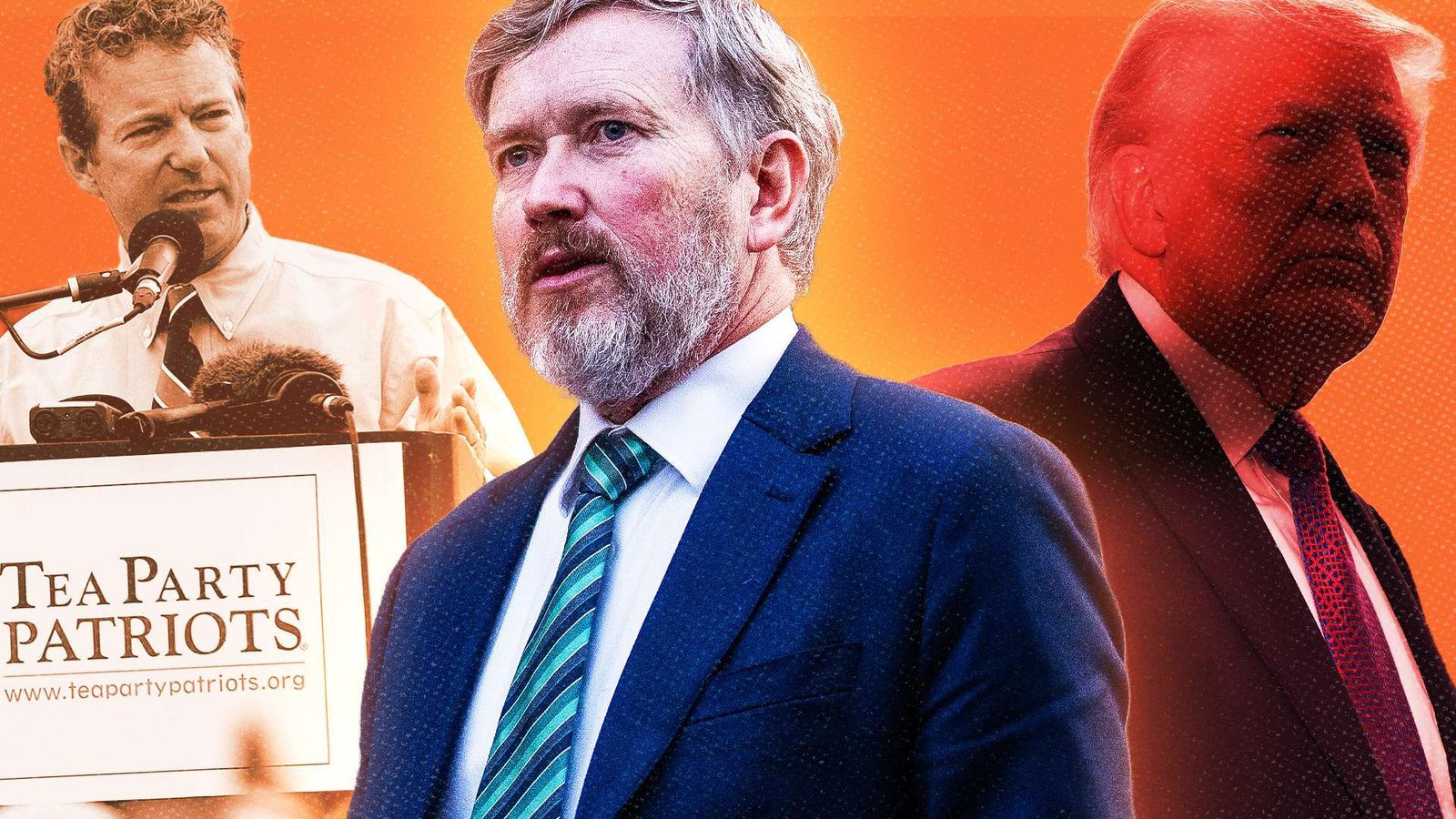
But if Massie loses, it’s not just the end of his career. (He told Mangu-Ward that if GOP primary voters send him packing, he’s going back to his plow and “nobody will ever hear from me again”). It would also effectively be the end of what used to be called the Tea Party, a loose conglomeration of Republican representatives and senators who rode a wave of anti-Barack Obama and anti-George W. Bush sentiment to office in the early 2010s.
Although some said that the tea in Tea Party stood for the “taxed-enough already,” the rallying cry of the early Tea Party movement was “stop the spending.” For a brief, shining moment, the populist right was fully in favor of actually reducing government spending across the board, full stop.
Covering the movement for Reason, including a truly massive demonstration in Washington, D.C., on September 12, 2009, what was striking to me about the Tea Party back then was that it pulled in many types of people from all over the country. As Reason‘s Matt Welch observed:
The general vibe was that they were conservative, and then either Republican, formerly Republican, or independent. Every single one had unkind words to say about George W. Bush’s spending and governing record, though none had protested him. None expressed trust in Republicans, and most preferred a “throw-all-the-bums-out” strategy. All but one did not care about Obama’s birth certificate controversy, and those I asked thought it was foolish to bring guns to political gatherings.
As our early video coverage suggested, this was a movement that was pretty tightly (though not exclusively) focused on spending and debt issues. Recall that under the self-styled compassionate conservatism of George W. Bush, the federal budget grew by about 50 percent over eight years, including huge increases in domestic programs such as prescription drugs for seniors on Medicare and the No Child Left Behind education initiative. Bush was a big-government disaster, and, taking office at the start of a major recession with a large Democratic majority, Obama kicked spending into even higher gear, first in the name of stimulus and then in the name of health care for all.
The 2010 and 2012 elections swept dozens of Tea Party candidates into office, including such high-profile senators as Ted Cruz (R–Texas), Marco Rubio (R–Fla.), Mike Lee (R–Utah), and Rand Paul (R–Ky.), and representatives such as Justin Amash (R–Mich.), Mick Mulvaney (R–S.C.), Mark Meadows (R–N.C.), and Massie himself.
In 2011, Amash and others created the Liberty Caucus, which was very much in keeping with Tea Party principles and explicitly libertarian. By 2015, Tea Party Republicans still had enough swagger to create the Freedom Caucus, a wider-ranging coalition still committed to Tea Party ideals and focusing on procedural rules to ensure even a GOP-led Congress allowed for fair hearings of pending legislation.
At its peak, the Tea Party could claim credit for electing dozens of people to the House and the Senate, and fueling the 2013 government shutdown over the Affordable Care Act (also known as Obamacare). But even as all that was happening, leaders in the movement, including veteran House members such as Reps. Michele Bachmann (R–Minn.) barely kept their seats or lost them like Rep. Eric Cantor (R-Va.), while rookies like Reps. Allen West (R–Fla.) and Joe Walsh (R–Ill.) were sent home.
Often discussed as a “leaderless” and “decentralized” movement, key organizations claiming to speak for Tea Party voters started to include anti-immigrant appeals in their communications and call for defense exemptions to spending cuts. The dramatic failure of Mitt Romney not only to beat an eminently beatable Barack Obama in the 2012 election but also to seriously advance a small-government agenda didn’t energize the GOP to get more principled as much as it opened the door for Donald Trump, who promised all things to all people.
With Trump’s ascendance, whatever energy was left in the Tea Party was pure populist rage and tribal animus rather than anti-government in character. Senators like Mike Lee and Ted Cruz rarely cross Donald Trump, and Marco Rubio continues to fill more and more roles in his second administration. Members of Congress like Mark Meadows and Mick Mulvaney joined the first Trump administration, only to face his wrath and get cashiered, even after pledging fealty to his big-spending ways. Justin Amash left the Republican Party in July 2019, voted to impeach Trump in December 2019, drew rebukes from the Freedom Caucus, and left Congress in 2021 in the face of a very difficult primary. His 2024 bid for the Republican nomination for Senate in Michigan put him at odds with a Trump pick who lost the general election.
The only consistent, libertarian-leaning Tea Party politicians left from the early 2010s are Rand Paul, who seems to be tapping into his small-government bona fides with renewed vigor, and Thomas Massie, who may be on his way back to civilian life. Indeed, even if he wins his primary and reelection, the GOP of which he is part is very different from the one he belonged to when he first arrived in Washington.
And the question remains: What might jumpstart the next broad-based political movement to challenge and reduce the size, scope, and spending of government that is also capable of electing dozens of people to office?
Read the full article here
Fact Checker
Verify the accuracy of this article using AI-powered analysis and real-time sources.